Judge Pauses a Texas Deportation After an ICE Shooting
ICE shooting Texas deportation pause reports raise urgent removal questions. Know what a court hold can mean and request a free case evaluation today.
Published on September 24, 2026
Talk to an immigration attorney
Free call. A clear plan for your case.
Free & confidential · Se habla espanol · 24/7

Have questions? Talk to an attorney - free evaluation.
Call 1-844-967-3536Check your case status now
Look up your immigration case below, then talk to an attorney about what it means — free.
Questions about your result?
Talk to an attorney about your case — free, no obligation.
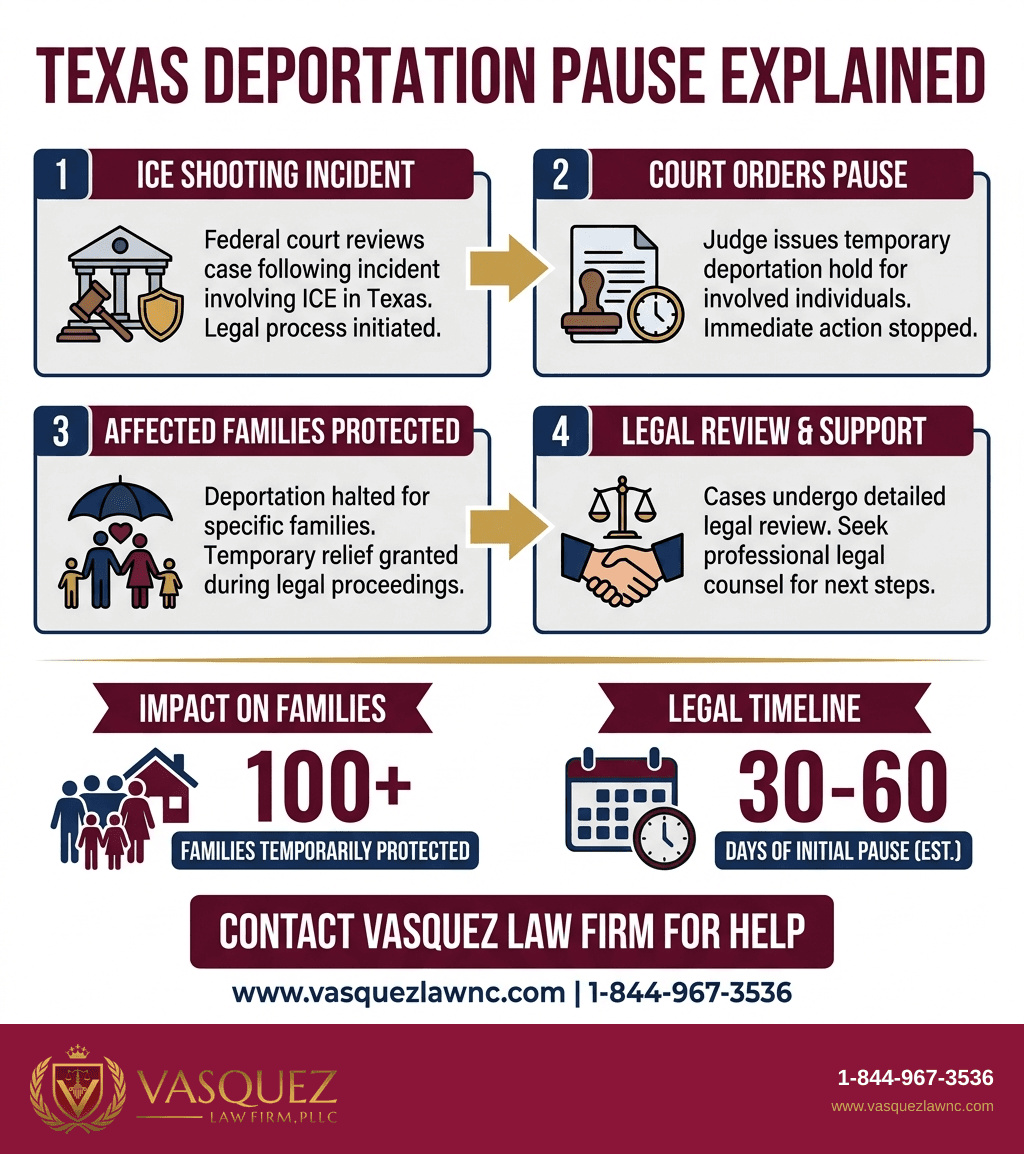
Legal information only: This article is not legal advice. A September 24, 2026 news report says a federal judge paused the deportation of a man shot by ICE in Texas. The report supplied for this article does not identify the court, the person, the order date, or the order's terms. Those missing records matter. Readers should review them before treating the reported ICE shooting Texas deportation pause as a rule for other cases.
The reported event happened in Texas. However, removal law is federal. It can affect people in Orlando, Florida, Raleigh, North Carolina, and nationwide. This may happen when a person faces detention, removal, or an emergency court filing. Our immigration attorneys evaluate federal immigration matters from Raleigh, NC and Orlando, FL.
ICE encounter or deportation risk?
Time-sensitive cases need quick action. We answer 24/7 for emergency immigration matters. Free 15-min call.
A court order for one person is not a nationwide pause on deportations. It may preserve time for medical care, a legal filing, or judicial review. People with a final removal order should not assume the reported ICE shooting Texas deportation pause protects them. They should confirm the status of their own case.
What did the Texas deportation-pause report actually say?
The supplied news summary is dated September 24, 2026. Its claim is narrow. It says a federal judge paused the deportation of a man shot by ICE in Texas. It credits the Wall Street Journal for that account. The provided material includes no court caption, docket number, judge, hearing date, immigration status, or written order.
That missing information limits what can be reported responsibly. The summary supports saying that an ICE shooting Texas deportation pause was reported. It does not show why the judge acted. It does not show whether the government opposed the request. It does not show how long any hold lasts. It also does not show whether a criminal or civil investigation exists.
Why the written order matters
Federal orders can differ sharply. A judge may issue a temporary restraining order, a preliminary injunction, or a case-specific stay. A temporary restraining order is a short-term court order. It usually prevents an action while the court reviews an urgent request. A preliminary injunction is a court order that can provide protection during a case. A stay generally stops a step in a case for a period of time.
These court tools have different standards, lengths, and reach. A stay does not automatically give someone immigration status. It also does not cancel a removal order. The written order explains what the government must stop or delay.
This difference matters because removal proceedings and federal court cases often follow separate tracks. Removal proceedings are the government process used to decide whether a noncitizen may remain in the United States. An immigration judge may enter a removal order. At the same time, a federal court may consider whether it has power to pause the government’s action. The actual order, not a headline, determines who has protection.
ICE has authority to carry out removal orders. That authority still has statutory, constitutional, and court-imposed limits. Statutory limits come from laws passed by Congress. Constitutional limits come from the United States Constitution. Court-imposed limits come from judicial orders. The reported Texas event is a reminder that urgent facts may require urgent review. It does not prove that all ICE vehicle stops, detention decisions, or removals have stopped.
Who could an ICE shooting Texas deportation pause cover?
A pause that names one person usually protects that person. It also binds the government officials covered by the order. The pause reaches only the conduct described in the order. It does not automatically cover relatives, witnesses, people in the same detention facility, or other immigrants with similar facts.
The source material identifies only a man described as having been shot by ICE in Texas. It gives no information about his nationality, immigration history, custody location, medical condition, removal destination, or pending immigration appeal. It also does not say whether he remains detained.
What it does not mean for Orlando families
It does not mean ICE has ordered a halt to vehicle stops. It does not mean people in Orlando, Florida, received a new form of deferred action. Deferred action is a discretionary decision to delay removal for a limited time. It does not mean a person with a final order can delay a scheduled removal by citing an unrelated case.
People may have separate protections based on their own records. These protections may include a pending appeal, a motion to reopen, an application for asylum-related protection, an approved family petition, or a federal court order. A motion to reopen asks the immigration court or agency to look at a case again. The existence and effect of each protection depend on the case’s procedural posture. Procedural posture means the current stage and status of a legal case.
For example, an approved Form I-130 establishes a qualifying family relationship. It does not by itself stop removal. It also does not grant a green card. Families can review the firm’s discussion of family immigration petitions in 2026 while gathering records for an individualized review.
In our experience, the first question in an urgent removal matter is usually whether a final order exists. The next question is whether any court or agency deadline remains open. Those answers shape every next step.
What laws govern removal and court stays?
Section 240 of the Immigration and Nationality Act, codified at 8 U.S.C. § 1229a, governs removal proceedings before immigration judges. The Immigration and Nationality Act is the main federal law governing immigration. Section 240 sets procedures for deciding whether a noncitizen is removable. It also addresses whether the person qualifies for relief. Relief means a legal option that may allow the person to remain in the United States.
A removal order may be reviewed through the administrative process. In many circumstances, it may also be reviewed through a petition for review in a federal court of appeals. A petition for review asks that court to examine a final agency decision.
Section 241 of the INA, codified at 8 U.S.C. § 1231, addresses detention and removal after an order becomes final. The statute generally describes a 90-day removal period. That phrase does not answer every case. Court orders, litigation, travel-document barriers, and statutory provisions can affect timing.
Stays are procedural protections, not immigration benefits
Under 8 C.F.R. § 1003.2, the Board of Immigration Appeals may consider motions to reopen or reconsider. The Board of Immigration Appeals is the agency that reviews many immigration judge decisions. A motion asks the agency to revisit a decision under defined rules. Filing one does not always create an automatic stay of removal. Under 8 C.F.R. § 1003.6, the effect of an appeal also depends on the decision and the procedural setting.
Federal courts may consider emergency requests within the limits Congress has set. Jurisdiction questions can be decisive. Jurisdiction means a court’s legal power to hear a matter or issue an order. A person facing removal needs to identify the issuing agency, the final order date, any appeal, and the exact relief sought. General background appears in the USCIS Policy Manual. USCIS does not decide every removal-court issue.
This legal framework is background only. It is not a statement about the unverified terms of the reported Texas order. The report alone does not show which legal authority the judge used.
What should you do if ICE seeks removal?
If ICE contacts, detains, or schedules removal for a family member, preserve documents on the first day. Ask for copies of charging papers, immigration judge decisions, Board of Immigration Appeals decisions, ICE notices, and federal court filings. Record the date and location. Also record names or identifying information on government paperwork.
Build a usable emergency file
- Find the person’s A-number. This is the nine-digit immigration identifier on agency records.
- Collect passports, entry records, notices to appear, bond papers, prior applications, and proof of family relationships.
- Save medical records and photographs when an injury is relevant. Protect private information while doing so.
- Write a timeline using dates, locations, witnesses, and exact words from notices.
- Check whether an appeal, motion, hearing, or court order is already pending.
Do not sign documents you do not understand. Do not use a social-media post or headline to decide whether removal is paused. Use official copies and case-specific legal review. USCIS case processing information is available through USCIS Processing Times. Those estimates do not predict ICE detention or federal-court deadlines.
People with pending USCIS applications should also preserve receipt notices and biometrics notices. A pending application can matter. Its effect varies by case. The firm’s guide to USCIS deferred action explains why deferred action, when available, is discretionary. It is also different from a court stay.
Facing detention or a removal deadline? Vasquez Law Firm’s federal immigration legal team can assess the documents in your case from Raleigh, NC and Orlando, FL. Se Habla Espanol.
What remains unknown about this report?
The central unknown is the order itself. The supplied report does not provide a docket number or a link to a court document. Without that record, readers cannot verify the judge’s reasoning, the legal standard, the expiration date, or whether the government can seek review.
What's Your Immigration Situation?
Answer 3 questions - we'll tell you your options
Question 1 / 3
What best describes your situation?
Keep Reading
It also does not answer many questions from families. It does not establish that ICE is broadly deporting people in Texas under a changed policy. It does not establish an ICE order halting vehicle stops. It does not identify the most recent ICE shooting. The report gives no incident date or comparison with other incidents.
Check official notices in the individual case, not reposted summaries. Keep contact information current with the relevant immigration court or agency. Retain every receipt. Readers following federal policy developments can also review our report on Federal Register and USCIS rulemaking.
The reported ICE shooting Texas deportation pause may develop as court records emerge. Until then, the reliable lesson is practical. A court hold is powerful only to the extent the written order says it is.
Frequently Asked Questions
Is ICE in Texas deporting people?
ICE may carry out final removal orders under federal law, subject to court orders and case-specific legal limits. The supplied report concerns one reported pause and does not announce a statewide or national change. A person’s own order, appeals, and pending applications determine risk.
Did ICE order a halt to vehicle stops?
The materials provided do not show such an ICE order. A reported judicial pause in one person’s deportation is different from a policy governing vehicle stops. Ask for the actual agency memorandum or court order before treating a claim as official.
Does a shooting allegation stop deportation automatically?
No. An injury or alleged use-of-force incident does not automatically confer immigration status or stay removal. It may create urgent factual and legal issues. A judge or agency must issue relief, or another legal protection must apply, before the person can rely on a pause.
Can a family petition stop removal?
Not automatically. A family petition may support an immigration strategy, but it is not itself a stay. The person may need another filing, relief from removal, or a court order. Preserve the I-130 receipt or approval and seek case-specific advice promptly.
What is a motion to reopen?
A motion to reopen asks an immigration court or the Board of Immigration Appeals to reconsider a case based on new facts or evidence. Strict deadlines and exceptions can apply. Filing it does not necessarily stop removal, so counsel should evaluate stay options separately.
Where can I verify USCIS policy?
The USCIS Policy Manual is an official resource for USCIS benefit adjudications. It cannot replace the immigration-court record, ICE notice, or federal court order in a removal case. Use it with the records that identify your own procedural posture.
Do not make a removal decision based on an unverified headline. Contact Vasquez Law Firm for a case-specific document review and guidance on available federal immigration options. This is general information, not individualized legal advice.
Reviewed by Attorney Vasquez, Managing Attorney

William Vasquez
Founder & CEO, Vasquez Law Firm, PLLC
William Vasquez is the founder and CEO of Vasquez Law Firm, PLLC, a results-driven firm specializing in immigration, criminal defense, personal injury, and workers' compensation. A U.S. Air Force veteran and recipient of the Joint Service Achievement Medal, William is dedicated to fiercely fighting for his clients' rights.
Related Legal Services
Need legal help? Learn more about how our immigration attorneys can help, or contact us for a free evaluation.
You can also visit North Carolina immigration lawyers for more information.