How USCIS Deferred Action Policy Changed in May 2026?
USCIS deferred action policy changed in May 2026 to treat deferred action as an extraordinary use of prosecutorial discretion. This means only exceptional cases qualify for temporary relief from removal. The update affects many immigrants in Raleigh, NC and Orlando, FL, narrowing eligibility and requiring stronger evidence. Learn what the law says, who is impacted, and what steps to take under this new policy.
Published on September 21, 2026
Talk to an immigration attorney
Free call. A clear plan for your case.
Free & confidential · Se habla espanol · 24/7

Have questions? Talk to an attorney - free evaluation.
Call 1-844-967-3536Free Tool
Check Your USCIS Case Status Now
Enter your receipt number - get the official USCIS status in English or Spanish. No registration.
This article provides general legal information, not individualized legal advice. Reading does not create an attorney-client relationship. For advice specific to your situation, contact Vasquez Law Firm.
How USCIS Deferred Action Policy Changed in May 2026?
Facing Deportation?
Time is critical. Our deportation defense attorneys are available 24/7 for emergency cases.
What did USCIS change about deferred action in May 2026?
In May 2026, USCIS updated its policy about deferred action. Deferred action is a temporary pause in removal or other enforcement action. USCIS clarified that it is an extraordinary use of prosecutorial discretion. Prosecutorial discretion means an agency’s power to decide how and when to enforce the law.
USCIS will grant deferred action only in exceptional cases. Officers must carefully review each request. USCIS will not treat deferred action as a routine option.
The new policy appears in the USCIS Policy Manual. This manual is the agency’s central collection of immigration policies. It now replaces older manuals and memoranda.
A memorandum is a written policy instruction. The USCIS Policy Manual replaces the Adjudicator’s Field Manual and previous policy memoranda. It seeks to improve quality and efficiency. It also preserves officer discretion in individual cases.
This change shows a stricter approach to deferred action. USCIS now treats it as a discretionary relief tool for rare situations. The agency also seeks more consistent and clear decisions by its officers.
Deferred action remains temporary relief from removal. However, USCIS no longer views it as a common or routine remedy. Officers must document why a case is extraordinary before they grant deferred action.
This policy change affects many types of applicants. Some may have relied on deferred action as a fallback option. The change also matches USCIS’s mission. That mission includes setting priorities based on agency resources and enforcement priorities.
Who is affected by the new USCIS deferred action policy?
The new USCIS deferred action policy affects people who seek temporary relief from deportation. They seek this relief through prosecutorial discretion. This group includes undocumented immigrants, certain visa holders, and lawful permanent residents facing removal proceedings.
Removal proceedings are government cases that may lead to a person’s deportation. The policy affects applicants nationwide. It includes residents of Raleigh, NC and Orlando, FL.
People have historically used deferred action for compelling humanitarian reasons. Examples include serious health conditions and family hardships. Under the new policy, only people with extraordinary circumstances will qualify.
In Raleigh, NC and Orlando, FL, where our offices are located, many immigrants have sought deferred action. They have used it as a stopgap while pursuing other immigration benefits. A stopgap is a temporary measure used while someone seeks a longer-term solution.
The policy change narrows eligibility. Applicants must provide stronger reasons and better supporting evidence.
USCIS officers must now review each request under stricter criteria. This may reduce the number of approvals. The change affects people without lawful status who cannot adjust status under 8 U.S.C. § 1255. It also affects people with removal orders under 8 U.S.C. § 1227.
Adjustment of status is the process of applying for lawful permanent resident status from inside the United States. A removal order is a government order requiring a person to leave the country.
Community organizations in Raleigh, NC and Orlando, FL report growing concerns. Immigrants worry about the reduced availability of deferred action. The policy may also affect eligibility for employment authorization under 8 CFR § 274a.12.
Employment authorization is legal permission to work in the United States. People who receive deferred action often qualify for work permits. That eligibility may now depend more closely on the facts and strength of each case.
Overall, the policy affects many applicants. It especially affects people without other legal pathways. Those people may have relied on deferred action as discretionary relief.
What does the law actually say about deferred action and prosecutorial discretion?
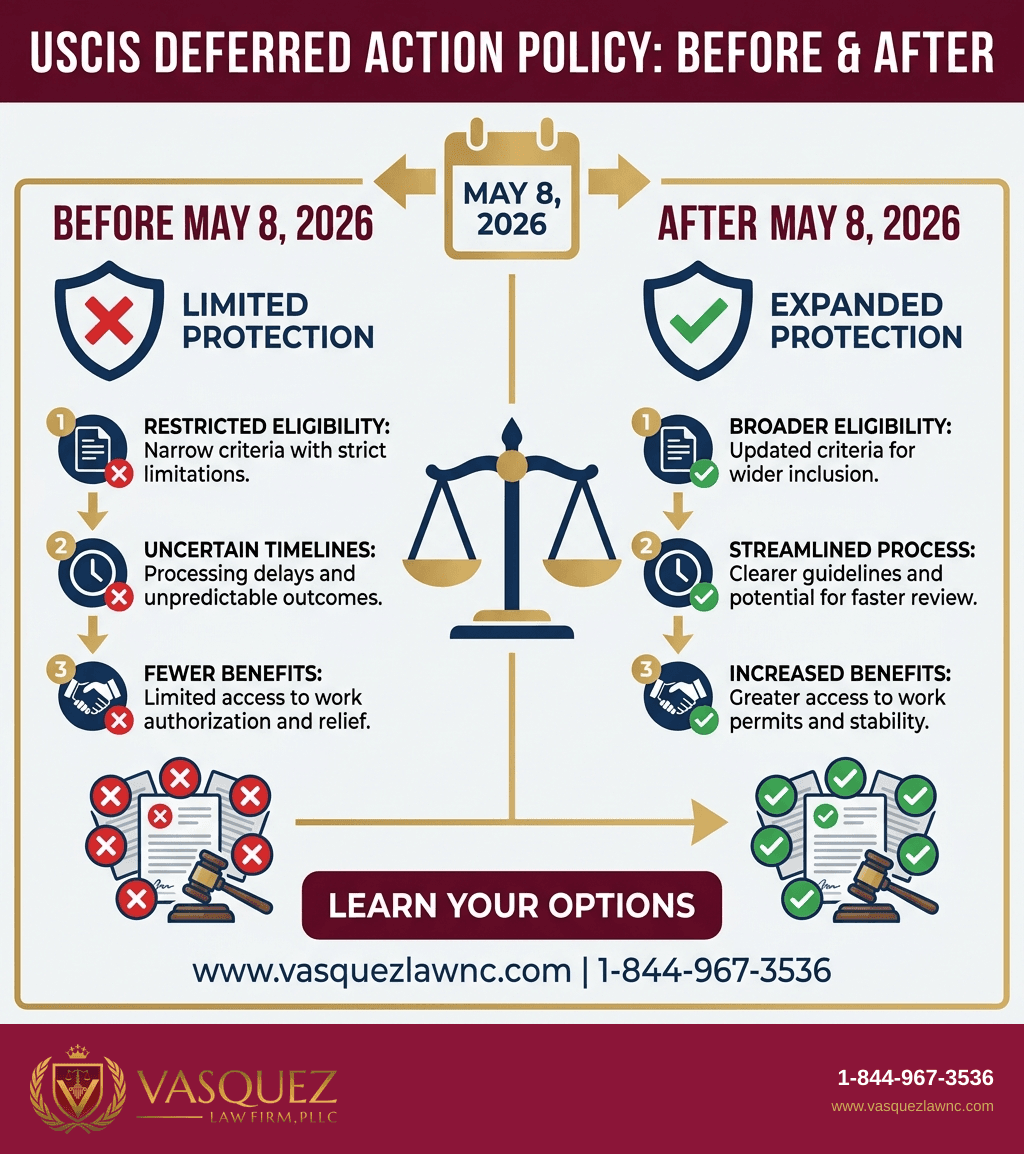
Immigration statutes do not expressly define deferred action. It is a form of prosecutorial discretion. It allows USCIS to temporarily delay removal or another enforcement action.
The May 2026 USCIS Policy Manual calls deferred action an extraordinary measure. The manual reserves it for exceptional cases.
Prosecutorial discretion allows immigration authorities to decide when to enforce the law. It also allows them to set case priorities. Deferred action is one tool among several. Other tools include a stay of removal and parole.
A stay of removal temporarily stops a person’s removal. Parole permits a person to enter or remain in the United States for a specific purpose or period. These tools are different from deferred action.
The Immigration and Nationality Act (INA) provides the statutory framework for adjustment of status under 8 U.S.C. § 1255. However, deferred action itself remains discretionary. It does not give a person lawful status. It only postpones removal.
The USCIS Policy Manual states:
"Deferred action is an extraordinary use of prosecutorial discretion that may be granted in exceptional cases where the individual’s circumstances warrant a temporary reprieve from removal or other enforcement action." (Source: USCIS Policy Manual, https://www.uscis.gov/policy-manual)
This language shows that deferred action is not a right. It is not an entitlement that every eligible person can demand. Instead, it is a rare exception.
USCIS officers may approve or deny deferred action. They must consider the policy, but the policy does not remove their discretion. The Policy Manual also says that deferred action does not create a substantive or procedural right enforceable against the government.
A substantive right is a right to a benefit under the law. A procedural right is a right to a particular government process. The manual says deferred action creates neither type of enforceable right.
The law requires applicants to meet eligibility rules for adjustment of status or other relief. Those rules are needed to obtain permanent status. Deferred action is a stopgap. It is not a path to permanent residence.
What should you do if you want to apply for deferred action under the new policy?
If you are considering deferred action under the May 2026 USCIS policy, understand the new limit. Deferred action is reserved for extraordinary cases. You should prepare evidence showing exceptional circumstances that justify this relief.
At our Raleigh, NC and Orlando, FL offices, we often see applicants misunderstand deferred action. Some treat it as a routine option. The most common mistake is assuming eligibility without clear extraordinary factors. That mistake can lead to denial and lost time.
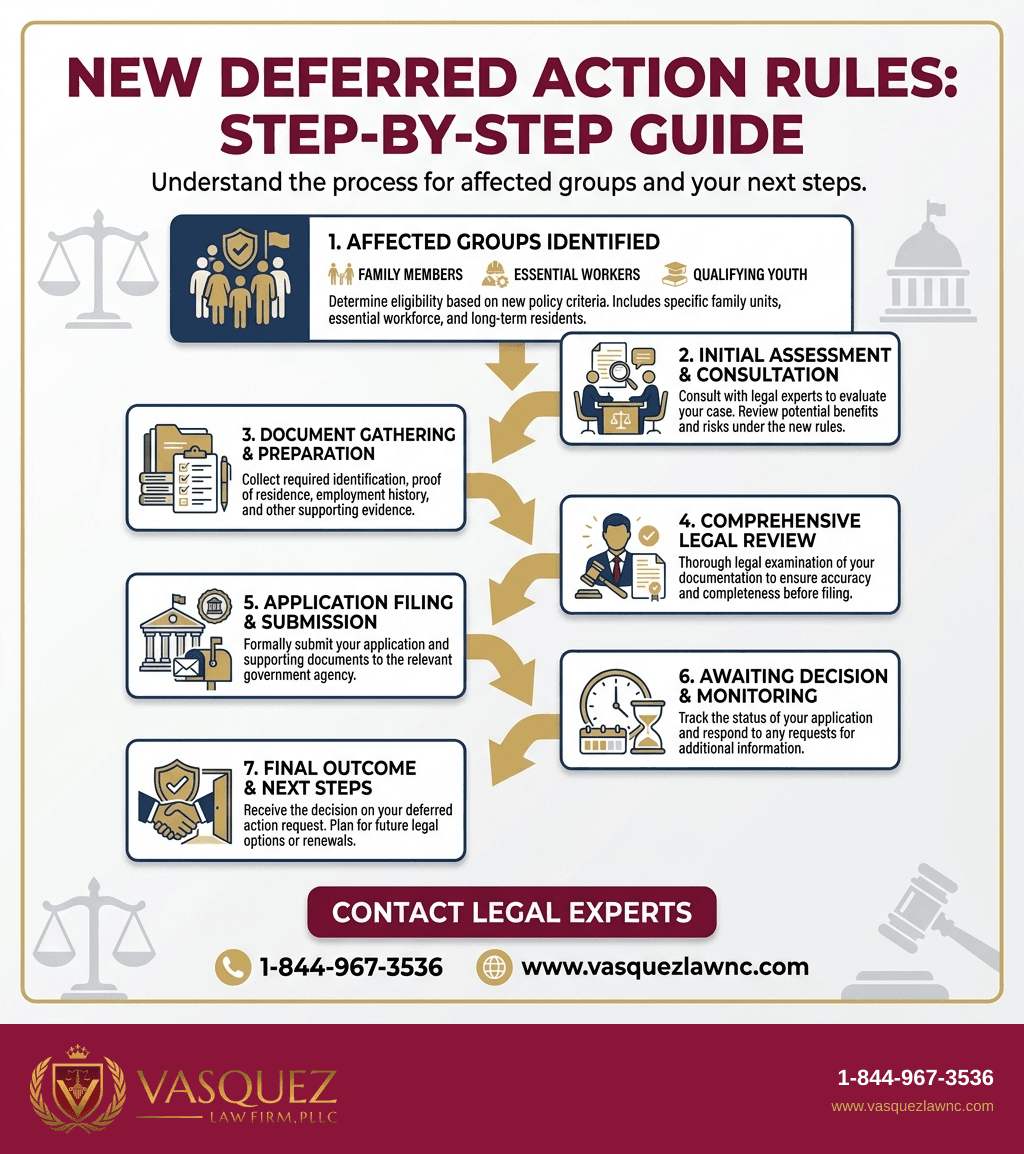
Here are steps to take if you want to pursue deferred action:
- Consult an experienced immigration attorney to evaluate your case and determine if deferred action is appropriate.
- Gather strong evidence of your extraordinary circumstances, such as serious health issues, family hardships, or humanitarian concerns.
- Prepare a detailed written statement explaining why your situation warrants deferred action as an extraordinary use of prosecutorial discretion.
- File any required forms and supporting documentation with USCIS, following instructions in the USCIS Policy Manual and official guidance.
- Consider alternative immigration relief such as adjustment of status under 8 U.S.C. § 1255 or asylum under 8 U.S.C. § 1158, if eligible.
Be aware that deferred action is temporary. It does not provide lawful status. It also does not provide a path to a green card. Under certain conditions, it may allow you to apply for employment authorization.
Document everything carefully. Keep copies of all filings and correspondence with USCIS. Respond promptly to any USCIS request for evidence or an interview.
Working with an immigration attorney can help you avoid common problems. It may also improve your chances under this stricter policy.
What happens next with USCIS deferred action policy after May 2026?
USCIS will continue using the May 2026 deferred action policy. It is the official guidance for officers nationwide. The agency expects officers to apply prosecutorial discretion more consistently. It also expects fewer routine grants of deferred action.
USCIS stated in the Policy Manual:
What's Your Immigration Situation?
Answer 3 questions - we'll tell you your options
Question 1 / 3
What best describes your situation?
Keep Reading
"The Policy Manual is to be followed by all USCIS officers in the performance of their duties but it does not remove their discretion in making adjudicatory decisions." (Source: USCIS Policy Manual, https://www.uscis.gov/policy-manual)
This means officers still have discretion. They must first apply the new standard for extraordinary circumstances before granting deferred action.
Applicants should expect more requests for evidence. USCIS may also request more detailed explanations. Denials may increase when cases lack strong support.
Community groups and legal advocates may watch the policy’s effects. They may seek clarification or changes through public comments or congressional oversight.
Meanwhile, people should review every possible immigration option. They should not rely only on deferred action as a fallback.
| Aspect | Before May 2026 | After May 2026 |
|---|---|---|
| Policy Source | AFM, memoranda, scattered policies | USCIS Policy Manual centralized |
| Deferred Action Use | Sometimes routine or discretionary | Extraordinary use only |
| Eligibility | Broad humanitarian or enforcement priorities | Only exceptional cases with strong justification |
| Officer Discretion | Wide discretion, less formal criteria | Discretion guided by strict extraordinary standards |
| Impact on Work Authorization | Often granted with deferred action | Conditional, depends on case strength |
Frequently Asked Questions about USCIS deferred action policy update
What is deferred action under USCIS?
Deferred action is a temporary postponement of removal or deportation granted at USCIS’s discretion. It does not provide legal status but can protect from removal and allow work authorization in some cases.
Who qualifies for deferred action after the May 2026 update?
Only individuals with extraordinary and compelling circumstances may qualify. Routine or broad humanitarian reasons are no longer sufficient under the new policy.
Does deferred action lead to a green card?
No. Deferred action is temporary relief and does not grant lawful permanent resident status or a path to citizenship. Applicants must seek other legal avenues for permanent residence.
How can I apply for deferred action?
You must submit a request to USCIS with evidence of extraordinary circumstances. Consulting an immigration attorney is crucial to prepare a strong application under the new policy.
Will USCIS grant work authorization with deferred action?
Work authorization may be granted if USCIS approves deferred action and the applicant meets eligibility under 8 CFR § 274a.12. It is not automatic and depends on case specifics.
This article provides general legal information, not individualized legal advice. Reading does not create an attorney-client relationship. For advice specific to your situation, contact Vasquez Law Firm.
Reviewed by William Vasquez, Founder & CEO, Vasquez Law Firm, PLLC.
If you need legal assistance, learn more about our immigration legal services, or call us at 1-844-967-3536 for a free evaluation.
Related Topics

William Vasquez
Founder & CEO, Vasquez Law Firm, PLLC
William Vasquez is the founder and CEO of Vasquez Law Firm, PLLC, a results-driven firm specializing in immigration, criminal defense, personal injury, and workers' compensation. A U.S. Air Force veteran and recipient of the Joint Service Achievement Medal, William is dedicated to fiercely fighting for his clients' rights.
Related Legal Services
Need legal help? Learn more about our immigration legal services, or contact us for a free evaluation.
You can also visit our NC immigration team for more information.