How Families Quickly Find Immigration Detainees
Need to find immigration detainees after an ICE arrest? Use the locator, protect court deadlines, and call for a free evaluation today.
Published on September 23, 2026
Talk to an immigration attorney
Free call. A clear plan for your case.
Free & confidential · Se habla espanol · 24/7

Have questions? Talk to an attorney - free evaluation.
Call 1-844-967-3536Worried how the latest immigration news affects you?
Schedule a confidential case review with an immigration attorney - know exactly where you stand.
USCIS Case Status
Check your USCIS case status
Enter your receipt number and get the official status. Free, no registration.
How Families Quickly Find Immigration Detainees
An ICE arrest can leave a Raleigh family without a location or phone access. It can also start a court deadline. Finding immigration detainees quickly takes more than guessing which jail to call. Families need accurate identity details, the ICE Detainee Locator, and a plan to protect immigration court rights. A federal release order reported outside North Carolina may provide background. It does not automatically release someone held elsewhere.
Need help after an ICE arrest? William J. Vasquez can review the available options. Se Habla Español.
Call now: 1-844-967-3536
Quick Answer
Families can search for immigration detainees through ICE's Online Detainee Locator System. They can use an A-Number and country of birth. They can also use a full name, birth date, and country of birth. An A-Number is an immigration identification number. A locator result does not show whether bond is available. It also does not show whether removal is ordered.
- Save the A-Number and detention location.
- Ask for the next immigration court date.
- Do not trust an ICE inmate list posted on social media.
- Act quickly if the person has a removal order or medical need.
Why immigration detention center details matter
A daughter in Raleigh may hear that ICE took her father after a check-in. She may then find no record in a county jail search. ICE can hold someone at a contract facility. It can also use a county facility or another immigration detention center. Transfers may happen before the family reaches the first location.
Read that again: a missing local jail record does not prove that someone is free. The person may be in ICE custody. The person may have been transferred. The person may not yet appear in a public locator system. The key questions are different. Where is the person? What authority is ICE using? What deadline comes next?
Detention authority often comes from 8 U.S.C. § 1226 while removal proceedings are pending. Removal proceedings are the government process used to decide whether a person may remain in the United States. After a final removal order, 8 U.S.C. § 1231 controls the removal period. A removal order is a formal government order requiring a person to leave. These statutes matter because bond access and court plans may differ. A person may be detained without a criminal conviction. An arrest alone does not prove deportability.
For families seeking immigration detainees, immigration representation for ICE detention concerns can help identify the record, court status, and important documents. Vasquez Law Firm serves immigration clients from Raleigh, NC and Orlando, FL. The firm also serves clients nationwide under federal immigration law.
Status categories change the first question
U.S. citizens should state their citizenship at once. They should protect proof, such as a passport, birth certificate, or certificate of citizenship. ICE cannot lawfully deport a U.S. citizen. Still, proving citizenship may require documents and quick help. Lawful permanent residents may face removal proceedings based on specific charges or immigration grounds. An arrest alone does not create that result.
Dreamers and other DACA recipients should protect their approval notice. They should also protect their employment authorization document and ICE paperwork. DACA means deferred action. Deferred action is a decision to delay removal for a limited period. DACA is not lawful status. It does not remove every detention risk. Review current program information through USCIS DACA guidance before trusting online claims.
ICE Detainee Locator steps after an arrest
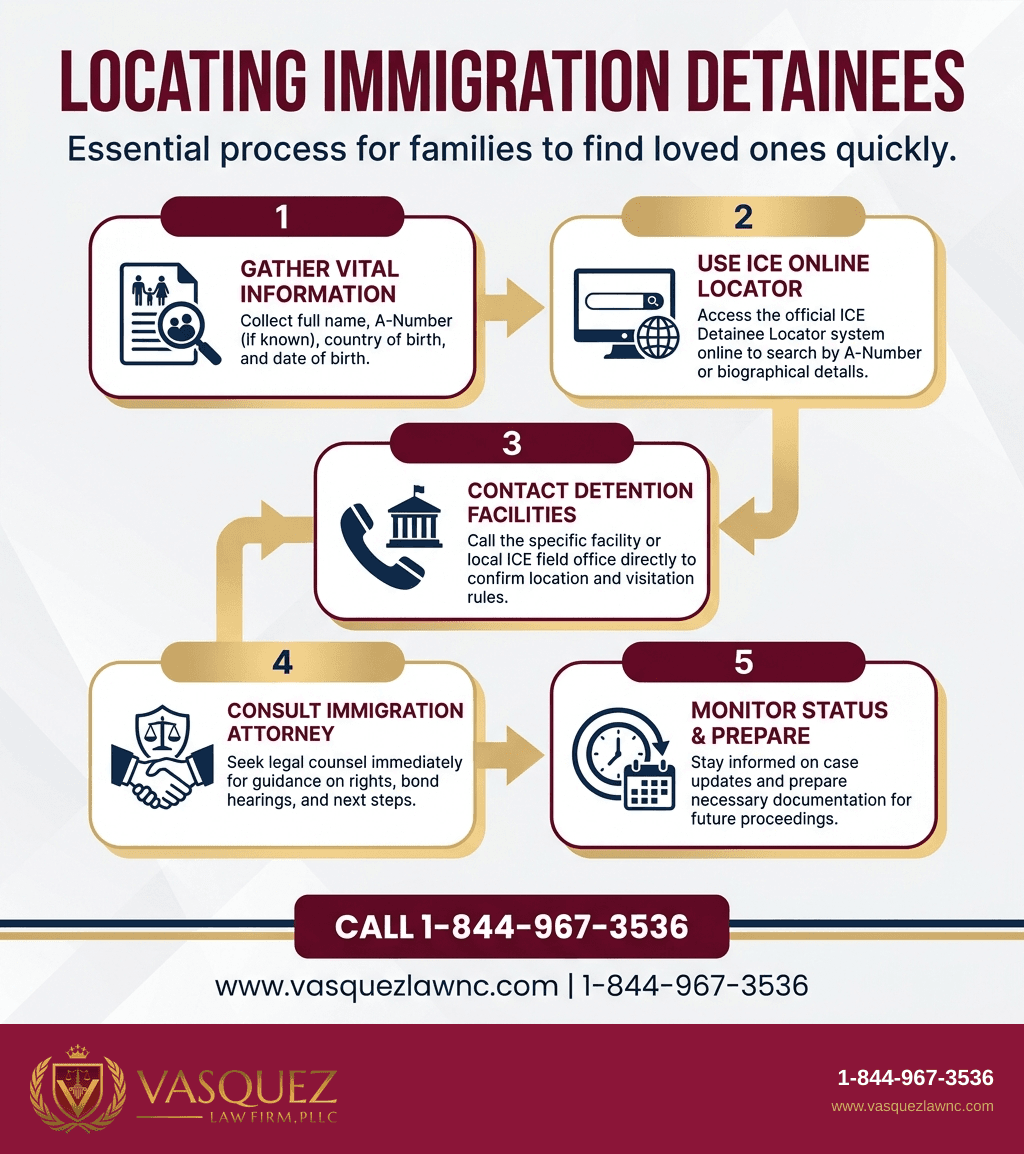
The most useful call begins with four facts. Get the full legal name, date of birth, country of birth, and A-Number if known. The A-Number normally starts with A. It appears on immigration notices, work permits, court documents, and earlier USCIS mail. Do not post it online.
- Search accurately. Use the ICE Detainee Locator with the A-Number and country of birth first. If that fails, search the name. Use the exact spelling and birth date.
- Confirm the facility. Write down the facility name, address, phone number, booking date, and visitation rules. Ask whether a transfer is pending.
- Identify the case posture. Case posture means the current stage of a case. Ask whether an immigration court case exists. Ask whether a Notice to Appear was issued. A Notice to Appear is the document that starts many removal cases. Ask whether ICE claims a prior removal order.
- Preserve documents. Photograph or scan notices, bond papers, passports, DACA documents, criminal dispositions, and family records.
- Get a legal review. The person should learn whether bond, parole, a stay request, or a court filing may be available. Parole is temporary permission to remain outside detention. A stay request asks the government or court to pause removal.
A name search may fail for several reasons. The name may have a different spelling. The person may use a second surname. A recent transfer may not appear yet. Data entry may also be delayed. ICE Detainee mugshots and informal ICE inmate list posts are not reliable substitutes for an official record. Do not pay a stranger who claims private access to detainees.
Court dates are separate from locator results
The locator answers one question: location. It does not replace immigration court records. EOIR controls immigration court proceedings. EOIR means the Executive Office for Immigration Review. A missed hearing can lead to an in absentia removal order under INA § 240(b)(5), codified at 8 U.S.C. § 1229a(b)(5). An in absentia order is a removal order issued when someone misses a required hearing. The family should record every hearing date. Get case-specific guidance before assuming a hearing was cancelled.
If the person may have an underlying family petition, keep the receipt notice and relationship evidence. Our guide to family immigration petitions and evidence explains why a pending petition and detention case are related. They are not the same process.
Detention documents and bond evidence checklist
A bond hearing often involves more than a person’s address. Immigration detainees may need proof of identity, community ties, court reliability, and safety. Start collecting records the same day. Relatives may need time to get certified documents.
- A-Number, Notice to Appear, custody determination, and bond notice.
- Passport, identity documents, and immigration approvals or denials.
- Proof of a stable Raleigh address, lease, utility bill, and sponsor statement.
- Letters from family, faith leaders, employers, or teachers with specific facts.
- Birth certificates for U.S. citizen children and medical or school records when relevant.
- Certified criminal court dispositions, not only arrest reports or screenshots.
- Proof of rehabilitation, treatment, counseling, or compliance where applicable.
- A written timeline of entries, prior immigration filings, and any past removal order.
Read that again: bring certified dispositions, not assumptions about what a charge means. A disposition is the official record showing how a criminal case ended. Immigration consequences often depend on the legal offense and sentence record. The USCIS Policy Manual explains agency policy topics. It does not decide a detention case by itself.
Immigration detainees timeline and realistic expectations
The first 72 hours often shape what a family knows. Day one may include transfer, intake, and limited contact. During days two through seven, ICE may issue charging papers. ICE may also make an initial custody decision or schedule a hearing. Timing differs by facility and court docket.
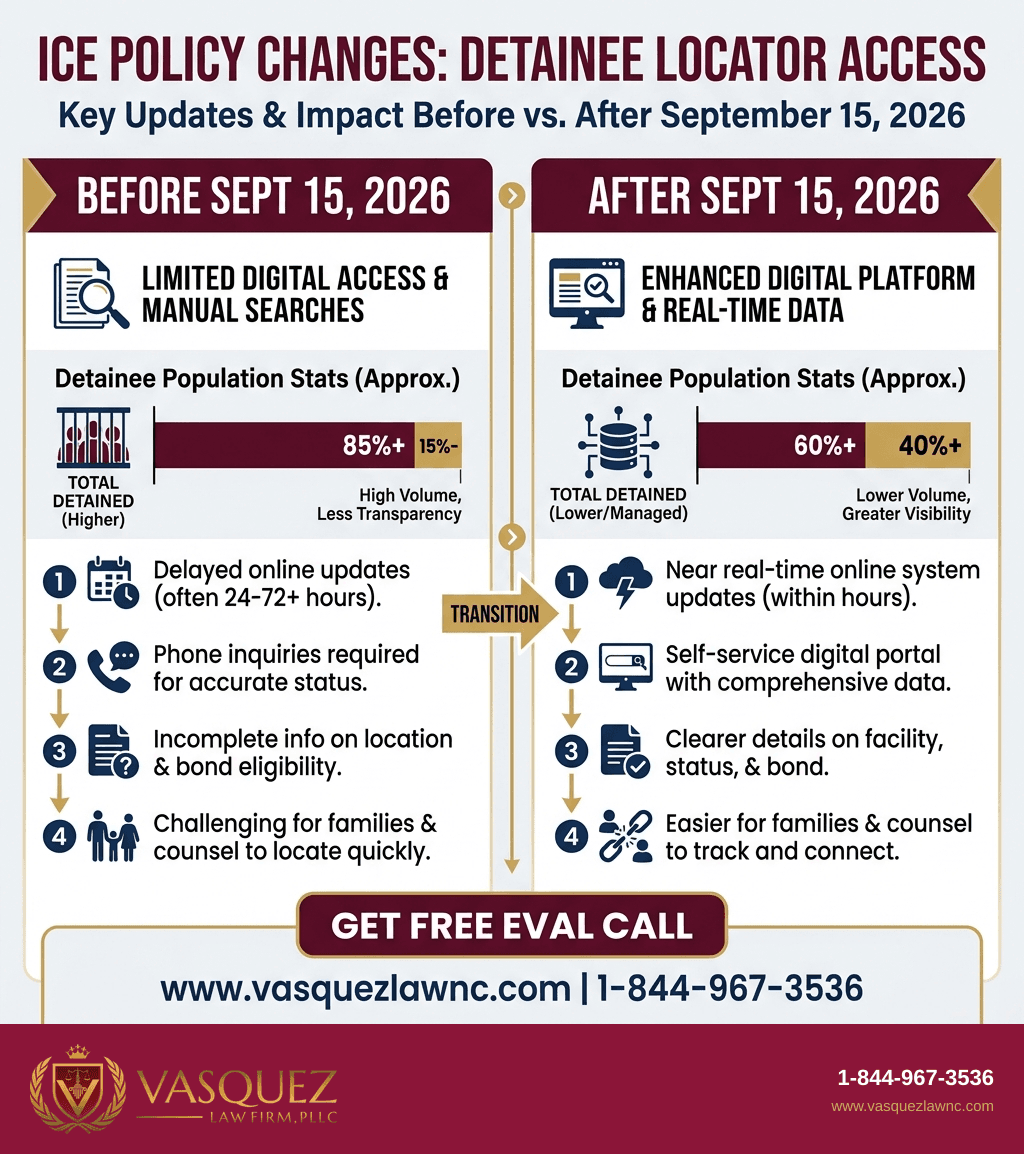
A release order from a federal judge in another state does not become a blanket rule for Raleigh, NC or Orlando, FL. A federal court order applies based on its terms, the parties, and jurisdiction. Jurisdiction means the legal power to decide a matter. The order may signal a legal issue worth watching. The family must still assess the actual detention authority and facts in the relative’s case.
Costs and fees that affect the next step
The government charges no filing fee to search for immigration detainees. Costs may come from a bond payment, document retrieval, medical records, certified court records, travel, or legal review. A bond is not a fee for legal work. It is money paid to secure release while the immigration case continues. Its return depends on following required appearance rules.
USCIS processing estimates apply to specific forms. They do not apply to ICE custody. Check the relevant form number on the official USCIS processing times tool. A pending USCIS application does not automatically stop detention or removal proceedings.
ICE detainee case status mistakes to avoid
One harmful mistake is assuming every detainee can post bond. Some people face arguments for mandatory detention. Others face an issue involving a prior order. Another mistake is signing voluntary departure, stipulated removal, or other papers without understanding the result and available relief. Voluntary departure allows a person to leave under set terms. Stipulated removal is an agreed removal order.
- Mistake: Waiting for ICE to call. Fix: Search, document, and confirm the location.
- Mistake: Sending false documents. Fix: Use truthful records and correct errors promptly.
- Mistake: Missing a court hearing. Fix: Track dates independently and update addresses properly.
- Mistake: Treating social posts as case status. Fix: Verify with the facility and official case records.
- Mistake: Hiding a prior order. Fix: Raise it early so counsel can assess motions or stays.
- Mistake: Assuming DACA ends all risk. Fix: preserve approvals and seek case-specific analysis.
- Mistake: Paying unverified “locator” services. Fix: use official tools and trusted legal help.
The opposing view says detention proves that the government already knows the answer. That reasoning fails because detention and removability are separate legal questions. Removability means the legal basis for requiring someone to leave the United States. The government must still use the legal process. The person may have defenses, relief, citizenship evidence, or a challenge to the allegations.
If you only remember one thing: confirm the location, preserve the paperwork, and do not miss the court date.
Federal detention rules with Raleigh practical notes
Raleigh, NC notes
Immigration law is federal. A Raleigh family must still identify the facility, hearing location, and ICE office connected to the case. Keep a written log of calls, names, dates, and every document received. Vasquez Law Firm can review detention-related immigration concerns from Raleigh, NC.
Orlando, FL notes
For families working from Orlando, FL, the same federal statutes apply. The facility and immigration court logistics may differ. Do not assume that a procedure reported in another state controls an Orlando detention matter.
Nationwide immigration matters
Federal immigration representation can involve clients nationwide. Hearings and custody decisions remain tied to the assigned court and detention setting. federal immigration case support for detained relatives should begin with the actual records, not a headline.
When to call a lawyer now
Call promptly if ICE says the person has a final order. Call if ICE refuses to identify the location. Call if ICE schedules a near-term hearing or presents documents for signature. Urgency also rises when a detainee has a medical condition, a U.S. citizen child, a pending USCIS filing, a criminal history, or a possible citizenship claim.
Soy William Vásquez. Immigration attorney. Fifteen years. I handle cases. No promises. If you need to understand the process, review William J. Vasquez's background and admissions. Bring the paperwork, not rumors.
About Vasquez Law Firm
Vasquez Law Firm provides immigration services with bilingual support staff. The firm helps families facing urgent federal immigration questions. Its approach is direct. First, identify the record. Next, protect deadlines. Then, explain the options in plain language. YO PELEO® POR TI means the firm takes your concern seriously. It does not promise an outcome.
The firm works from Raleigh, NC and Orlando, FL on immigration matters nationwide. Its other practice areas include North Carolina personal injury, workers' compensation, criminal defense, and traffic matters. Se Habla Español.
A detention problem can move before a family has complete information. Ask for a confidential review of the documents you have.
Call 1-844-967-3536 | Se Habla Español
Frequently Asked Questions
What is an immigration detainee?
An immigration detainee is a person held by ICE under federal immigration authority. The person may be awaiting a custody decision, immigration court hearing, removal, or transfer. Detention does not itself prove that the person committed a crime or that removal will occur. The governing authority and case history determine which options may exist.
How do I find someone detained by immigration?
Start with the ICE Online Detainee Locator using the person’s A-Number and country of birth. If the A-Number is unavailable, use the exact name, birth date, and country of birth. If no result appears, confirm spelling, ask whether a transfer occurred, and keep searching through official channels. Do not rely on social-media lists.
Are ICE detainees automatically being deported?
No. ICE detention and deportation are not the same event. Some people may seek bond, contest removability, pursue relief, show citizenship, or seek another lawful process. Others may face a final removal order or limited options. The Notice to Appear, custody paperwork, and immigration history are necessary before anyone can assess the situation accurately.
Can ICE deport a U.S. citizen?
A U.S. citizen cannot lawfully be removed under immigration removal law. A person asserting citizenship should provide available proof promptly, such as a U.S. passport, birth certificate, or certificate of citizenship. Complex citizenship claims can require careful legal analysis, especially where citizenship may derive through a parent. Do not discard old family and immigration records.
Why is a person not appearing in the ICE Detainee Locator?
A search may fail because the person was recently arrested, transferred, released, entered under a different spelling, is under 18, or has data that does not match the search fields. Search with the A-Number where possible. Record each attempt and contact the listed facility or ICE office using verified information, not a paid online locator.
Can family members pay an immigration bond?
In some cases, a qualified person may post an ICE bond if one is set. Eligibility for release and the bond amount depend on the custody determination, alleged immigration grounds, record, and other facts. A bond does not end the immigration case. The person must still attend hearings and comply with the conditions connected to release.
Does a pending DACA renewal stop detention?
A pending DACA renewal is important evidence, but it does not automatically prevent detention or end removal proceedings. Save the receipt notice, prior approval notices, employment authorization document, and all correspondence. USCIS processing times are form-specific and should not be confused with ICE custody timelines. A full review of the record remains important.
What documents should I send to a detained relative?
Send only documents the facility permits and keep copies. Useful records can include identity documents, immigration notices, certified criminal dispositions, proof of family ties, and medical records when relevant. Never create, alter, or send false evidence. Ask about facility rules first, because mail, visitation, and document-delivery procedures differ by location.
Sources and References
- USCIS DACA
- USCIS Processing Times
- USCIS Policy Manual
Psalm 82:3 in the Reina-Valera 1960 says, “Defended al débil y al huérfano; haced justicia al afligido y al menesteroso.” The psalm comes from Israel’s ancient worship tradition and confronts earthly judges who failed the vulnerable. Its original setting demanded justice in public judgment. For a family looking for immigration detainees now, it means facts, records, and dignity matter when power is being exercised.
Forward this to the cousin in Raleigh who cannot locate a parent after an ICE check-in, or the Dreamer who is holding a relative’s A-Number.
This article is general information, not legal advice. Every detention case depends on its specific facts, records, and deadlines.
Start Your Free Evaluation Now
Call 1-844-967-3536. Se Habla Español.
Stay alert. Stay documented. Stay ready. YO PELEO® POR TI.


William Vasquez
Founder & CEO, Vasquez Law Firm, PLLC
William Vasquez is the founder and CEO of Vasquez Law Firm, PLLC, a results-driven firm specializing in immigration, criminal defense, personal injury, and workers' compensation. A U.S. Air Force veteran and recipient of the Joint Service Achievement Medal, William is dedicated to fiercely fighting for his clients' rights.
Related Legal Services
Need legal help? Learn more about how our immigration attorneys can help, or contact us for a free evaluation.
You can also visit North Carolina immigration law firm for more information.