What Are the New USCIS Rulemakings Affecting Immigration Filings in 2026?
The 2026 USCIS Federal Register rulemakings extend approvals for key immigration forms like provisional unlawful presence waivers and waivers of inadmissibility. These changes affect many applicants filing adjustment of status petitions in Raleigh, NC and Orlando, FL. USCIS withdrew proposed rules on biometrics and employment authorization, maintaining current procedures. Learn who is impacted and what to do next.
Published on September 21, 2026
Talk to an immigration attorney
Free call. A clear plan for your case.
Free & confidential · Se habla espanol · 24/7
Have questions? Talk to an attorney - free evaluation.
Call 1-844-967-3536Free Tool
Check Your USCIS Case Status Now
Enter your receipt number - get the official USCIS status in English or Spanish. No registration.
This article provides general legal information, not individualized legal advice. Reading does not create an attorney-client relationship. For advice specific to your situation, contact Vasquez Law Firm.
What recent changes did USCIS announce regarding immigration filings in 2026?
Need legal help?
Immigration in NC and FL. Personal injury and workers compensation across NC. Criminal defense in Johnston, Harnett, Pitt and Cumberland counties, and traffic tickets in 11 NC counties. Tell us your county and we will tell you exactly what we can do.
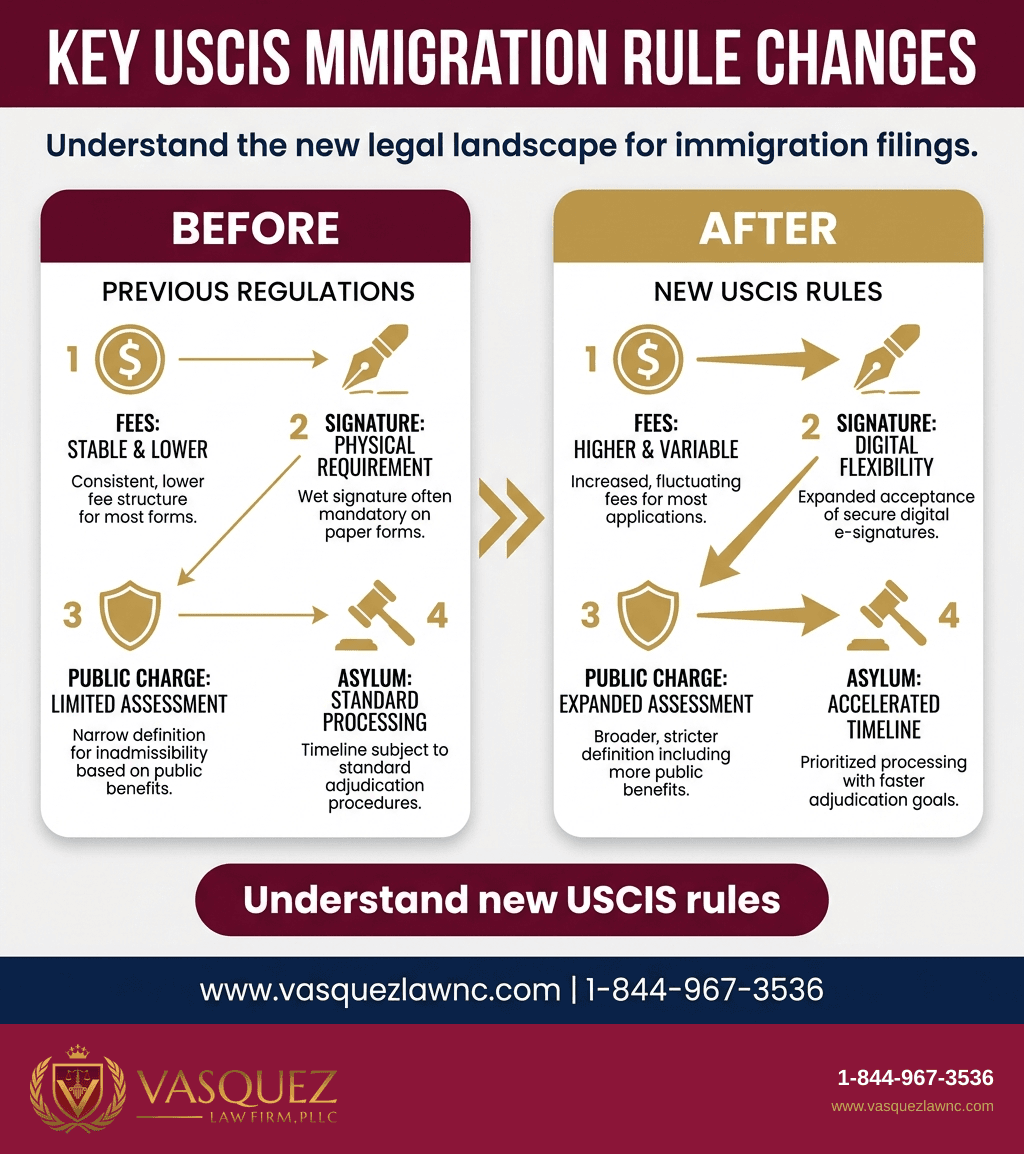
In 2026, USCIS published several rulemakings in the Federal Register. A rulemaking is an agency action that creates, changes, or withdraws a proposed rule. These actions affect immigration filings. They include extensions, without changes, for currently approved information collections. An information collection is a form or request for information that an agency uses. The affected collections include provisional unlawful presence waivers, waivers of grounds of inadmissibility, and petitions for special immigrant status. USCIS also withdrew proposed rules about biometrics collection and employment authorization for certain aliens with final removal orders.
These rulemakings were officially published in September 2026. They reflect USCIS’s ongoing updates to its regulations, forms, and procedures. The agency is following the Paperwork Reduction Act. That law requires agencies to seek public comment and renew approval for information collections. USCIS renewed these approvals without making substantive changes. Substantive changes are changes that affect the main legal requirements. The Federal Register notices identify the affected forms and state how long the extensions last.
USCIS’s 2026 Federal Register activity focuses on making immigration benefit applications clearer and easier to process. It does not introduce new eligibility criteria or major policy changes. This provides continuity for applicants and petitioners in Raleigh, NC and Orlando, FL. Many residents in those areas use these filings to adjust status or obtain work authorization.
For example, USCIS extended approval for the Application for Provisional Unlawful Presence Waiver. It also extended approval for the Application for Waiver of Grounds of Inadmissibility. Neither extension changed the form. These waivers are important for many immigrants who must overcome inadmissibility issues. Inadmissibility means that immigration law may prevent a person from entering the United States or getting an immigration benefit. The waivers may help people who apply for green cards under 8 U.S.C. § 1255 (INA § 245(a)) adjustment of status provisions.
Who is affected by the 2026 USCIS rulemakings on immigration filings?
The 2026 USCIS rulemakings affect many immigrants and petitioners who file applications and petitions with USCIS. They have particular importance in Raleigh, NC and Orlando, FL. The affected people include those seeking adjustment of status, provisional unlawful presence waivers, waivers of inadmissibility, special immigrant petitions, and employment authorization.
Applicants who use forms such as the Application for Provisional Unlawful Presence Waiver and the Petition for Amerasian, Widow(er), or Special Immigrant should see continuity in filing procedures. The extensions did not change those forms. This helps immigrants who face inadmissibility barriers. It also helps people seeking family-based or humanitarian immigration benefits. Family-based benefits rely on a qualifying family relationship. Humanitarian benefits help people who face serious hardship, danger, or other special circumstances.
USCIS also withdrew proposed rules on biometrics collection and employment authorization for certain classes with final removal orders. Biometrics are identifying information, such as fingerprints or photographs. A final removal order is a government order requiring a person to leave the United States. Because USCIS withdrew the proposals, current practices remain unchanged for those groups. This affects people in removal proceedings or under orders of supervision. An order of supervision sets rules that a person must follow while the government monitors the person’s case. Some of these people might have sought changes to employment authorization rules.
In Raleigh, NC and Orlando, FL, immigrant communities often manage complex filings. These rulemakings provide stability and predictability. Thousands of residents file adjustment of status applications or related waivers annually. The extensions help prevent disruptions in processing times and documentation requirements. They do not guarantee approval of any application or petition.
The rulemakings also affect attorneys and accredited representatives who help clients with USCIS filings. An accredited representative is a person authorized to provide certain immigration services through a recognized organization. The rulemakings confirm that the forms and procedures remain consistent through 2026. This lets legal professionals give clients current information. It also helps them avoid confusion caused by changing rules.
What does the law say about USCIS’s authority to issue these rulemakings?
USCIS’s authority to issue rulemakings about immigration filings comes from the Immigration and Nationality Act (INA) and related statutes. Statutes are laws passed by Congress. These laws govern immigration benefits and procedures. Under 8 U.S.C. § 1255 (INA § 245(a)), USCIS administers adjustment of status applications. This includes waivers and related forms.
The Paperwork Reduction Act of 1995 requires federal agencies such as USCIS to obtain Office of Management and Budget (OMB) approval for information collections. The OMB is the federal office that reviews many agency information requests. USCIS follows this requirement by publishing notices in the Federal Register. The notices extend approvals or propose changes. They also invite public comment. Public comment lets people and organizations share views before an agency acts. This process promotes transparency and accountability.
USCIS also works under the Department of Homeland Security’s delegated authority to manage immigration benefits. The Homeland Security Act of 2002 established that authority. Delegated authority means that one government body gives another body power to perform certain duties. USCIS’s rulemakings reflect its duty to improve efficiency while protecting security.
"The Department of Homeland Security (DHS), U.S. Citizenship and Immigration Services (USCIS) will be submitting the following information collection request to the Office of Management and Budget (OMB) for review and clearance in accordance with the Paperwork Reduction Act of 1995. The purpose of this notice is to allow an additional 30 days for public comment." (Source: U.S. Citizenship and Immigration Services, https://www.federalregister.gov/agencies/u-s-citizenship-and-immigration-services)
USCIS’s withdrawal of proposed rules on biometrics and employment authorization also shows its discretion to reconsider regulatory proposals. Discretion means the agency has room to make a lawful choice. USCIS may reconsider a proposal because of public feedback or operating priorities.
Overall, the legal framework supports USCIS’s Federal Register notices. The notices extend form approvals and adjust administrative procedures. They do so without changing substantive immigration law. Substantive immigration law contains the main rights, duties, and eligibility rules that apply to immigration benefits.
What should I do if I need to file immigration forms affected by the 2026 USCIS rulemakings?
If you plan to file forms covered by the 2026 USCIS rulemakings, proceed as usual. This includes provisional unlawful presence waivers and waivers of grounds of inadmissibility. Use the current editions of the forms. USCIS extended the approvals without changes. Therefore, no new forms or instructions are required at this time.
Uno. Verify that you are using the latest USCIS forms. Find them on the official USCIS website or obtain them through your legal representative. Do not rely on outdated versions or copies from third parties.
Dos. Prepare your supporting documents carefully. Follow USCIS guidance. Pay close attention to the eligibility criteria under 8 CFR § 245.1 and related regulations. Regulations are official rules made under authority granted by a statute. Following the requirements can help you avoid delays or denials.
Tres. File your application or petition with the correct USCIS service center or lockbox address. The form instructions identify the correct location. Keep copies of everything you submit. Also keep proof of mailing or electronic filing.
At our Raleigh, NC and Orlando, FL offices, we often see applicants delay filing because they are unsure about rule changes. The 2026 USCIS rulemakings confirm that the current forms and procedures remain valid. Timely filing is therefore important. One common mistake is submitting an incomplete waiver. Another is forgetting required evidence. Either mistake can cause processing delays.
Four. If you have questions or unusual circumstances, consult an experienced immigration attorney. An attorney is a lawyer who may give legal advice. Advice tailored to your case can help you avoid problems. It may also improve your chance of approval, although no attorney can guarantee an outcome.
Five. Stay informed about USCIS updates. Check the Federal Register and the USCIS Policy Manual. The Policy Manual contains USCIS guidance about immigration benefits and procedures. Our firm’s immigration practice page provides ongoing analysis and alerts for Raleigh, NC and Orlando, FL residents.
| Form/Rulemaking | Type | Action Taken | Effective Date |
|---|---|---|---|
| Application for Provisional Unlawful Presence Waiver | Information Collection | Extension Without Change | September 2026 |
| Application for Waiver of Grounds of Inadmissibility | Information Collection | Extension Without Change | September 2026 |
| Petition for Amerasian, Widow(er), or Special Immigrant | Information Collection | Extension Without Change | September 2026 |
| Biometrics Collection Rule | Proposed Rule | Withdrawal | May 2026 |
| Employment Authorization for Certain Aliens with Final Removal Orders | Proposed Rule | Withdrawal | May 2026 |
What happens next with USCIS immigration filing procedures after these 2026 rulemakings?
After these 2026 Federal Register notices, USCIS will continue processing immigration filings. It will use the extended approvals and existing procedures. The agency will review public feedback and operating needs. It will use that information to decide whether it needs more rulemakings or form revisions.
Applicants and petitioners in Raleigh, NC and Orlando, FL should expect stable filing requirements for the covered forms through at least the next approval period. USCIS’s withdrawal of proposed rules on biometrics and employment authorization indicates a pause in changes for those areas. Further review may occur later.
USCIS stated in the Federal Register that:
"The Department of Homeland Security (DHS), U.S. Citizenship and Immigration Services (USCIS) invites the general public and other Federal agencies to comment upon this proposed extension of a currently approved collection of information. In accordance with the Paperwork Reduction Act (PRA) of 1995, the information collection notice is published in the Federal Register to obtain comments." (Source: U.S. Citizenship and Immigration Services, https://www.federalregister.gov/agencies/u-s-citizenship-and-immigration-services)
This continuing public comment process lets interested people and organizations influence future USCIS policies. Immigration attorneys and community organizations should submit feedback. Their comments may help shape procedures that are efficient and fair.
What's Your Immigration Situation?
Answer 3 questions - we'll tell you your options
Question 1 / 3
What best describes your situation?
Keep Reading
Meanwhile, applicants should prepare filings carefully. They should consult legal counsel when they need help with changing requirements. USCIS may issue updated guidance or new rulemakings. Administrative priorities or legislative changes may lead to those actions.
In summary, the 2026 USCIS Federal Register rulemakings maintain current immigration filing processes. They also provide a foundation for continued stability in the administration of immigration benefits.
Frequently Asked Questions about the 2026 USCIS Rulemakings
What forms did USCIS extend approval for in 2026?
USCIS extended approval without change for several key forms, including the Application for Provisional Unlawful Presence Waiver, the Application for Waiver of Grounds of Inadmissibility, and the Petition for Amerasian, Widow(er), or Special Immigrant. These extensions allow continued use of current forms through 2026.
Did USCIS introduce any new immigration filing requirements in 2026?
No. The 2026 rulemakings primarily extend existing form approvals without changes and withdraw certain proposed rules. There are no new substantive filing requirements introduced in these notices.
Who should be most concerned about these USCIS rulemakings?
Applicants filing adjustment of status applications, waivers, or special immigrant petitions in Raleigh, NC and Orlando, FL should be aware of these rulemakings. They ensure continuity in filing procedures and prevent unexpected changes.
What should I do if I already filed under an older form version?
If you filed with an older form version before the extension, USCIS will generally accept it if it was valid at the time. However, always use the latest USCIS forms for new filings to avoid processing issues.
Where can I find official USCIS updates on immigration filings?
Official USCIS updates are published in the Federal Register and on the USCIS website. The Federal Register notices for 2026 are available at https://www.federalregister.gov/agencies/u-s-citizenship-and-immigration-services.
This article provides general legal information, not individualized legal advice. Reading does not create an attorney-client relationship. For advice specific to your situation, contact Vasquez Law Firm.
Reviewed by William Vasquez, Founder & CEO, Vasquez Law Firm, PLLC.
If you need legal assistance, learn more about immigration lawyers in North Carolina, or call us at 1-844-967-3536 for a free evaluation.
Related Topics

William Vasquez
Founder & CEO, Vasquez Law Firm, PLLC
William Vasquez is the founder and CEO of Vasquez Law Firm, PLLC, a results-driven firm specializing in immigration, criminal defense, personal injury, and workers' compensation. A U.S. Air Force veteran and recipient of the Joint Service Achievement Medal, William is dedicated to fiercely fighting for his clients' rights.
Related Legal Services
Need legal help? Learn more about immigration lawyers in North Carolina, or contact us for a free evaluation.
You can also visit immigration legal services throughout NC for more information.