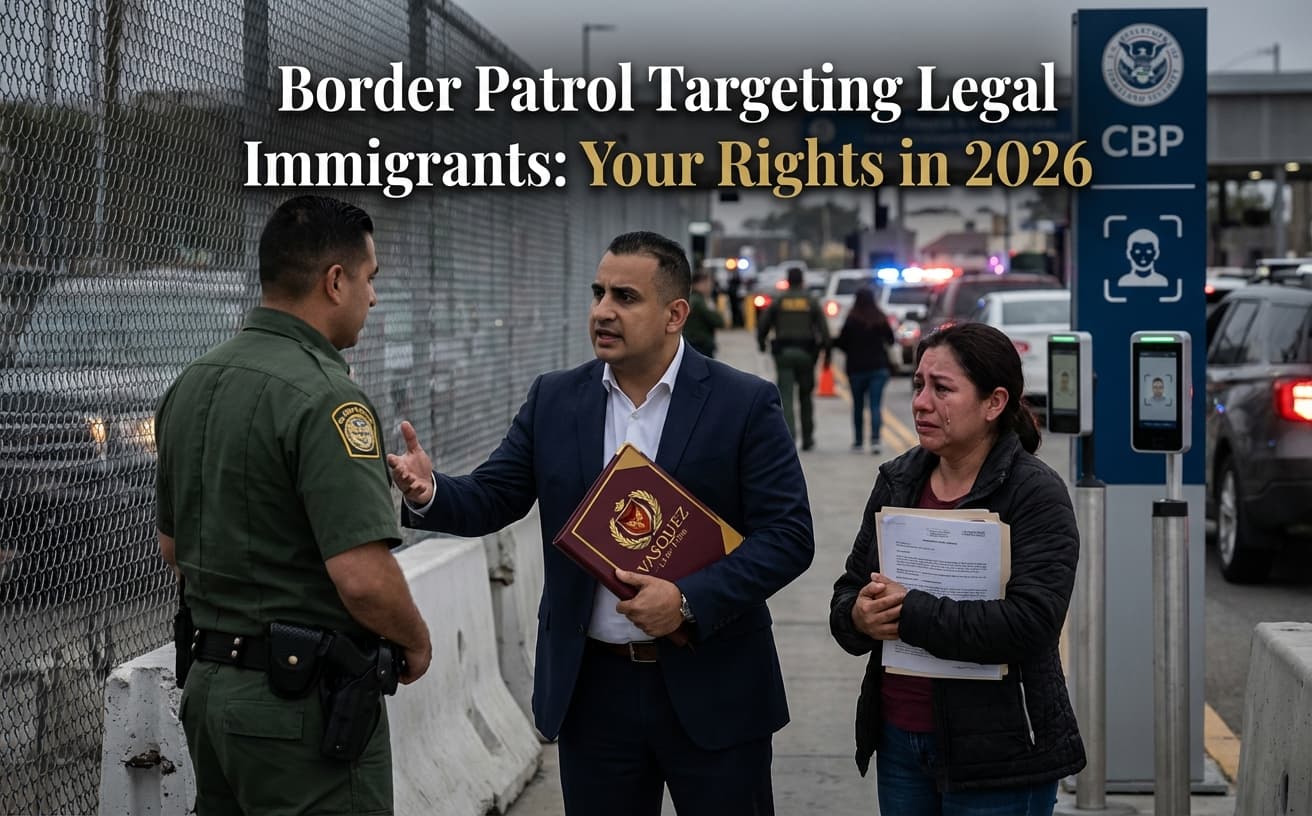
What to Expect From Border Patrol in Arizona and Your Rights in 2026
Understand your rights with Border Patrol in Arizona as of 2026. Learn what to expect during encounters and how Vasquez Law can help. Contact us for a free consultation.
Published on March 5, 2026
Talk to an immigration attorney
Free call. A clear plan for your case.
Free & confidential · Se habla espanol · 24/7

Have questions? Talk to an attorney - free evaluation.
Call 1-844-967-3536Worried how the latest immigration news affects you?
Schedule a confidential case review with an immigration attorney - know exactly where you stand.
What to Expect From Border Patrol in Arizona and Your Rights in 2026
Navigating encounters with Border Patrol Arizona can be a source of significant anxiety and confusion, especially for non-citizens and even U.S. citizens residing near the border. As of 2026, understanding your legal rights and the limits of Border Patrol authority is more crucial than ever. This comprehensive guide provides vital information for individuals in Arizona, from immigration matters to general interactions, ensuring you are prepared and protected. Knowing what steps to take and what questions to ask can significantly impact the outcome of an encounter, safeguarding your freedom and future. We will explore key aspects of Border Patrol operations, your constitutional protections, and how to assert your rights effectively.
Need help with your case? Our experienced attorneys are ready to fight for you. Se Habla Español.
Schedule Your Free Case Evaluation
Or call us now: 1-844-967-3536
Quick Answer
In 2026, Border Patrol Arizona operates within a specific jurisdiction, enforcing immigration laws. While they have broad powers near the border, your constitutional rights remain, including the right to remain silent and to an attorney. Always carry identification, but do not consent to searches or answer questions about your immigration status without legal counsel. Documentation and knowing your rights are key.
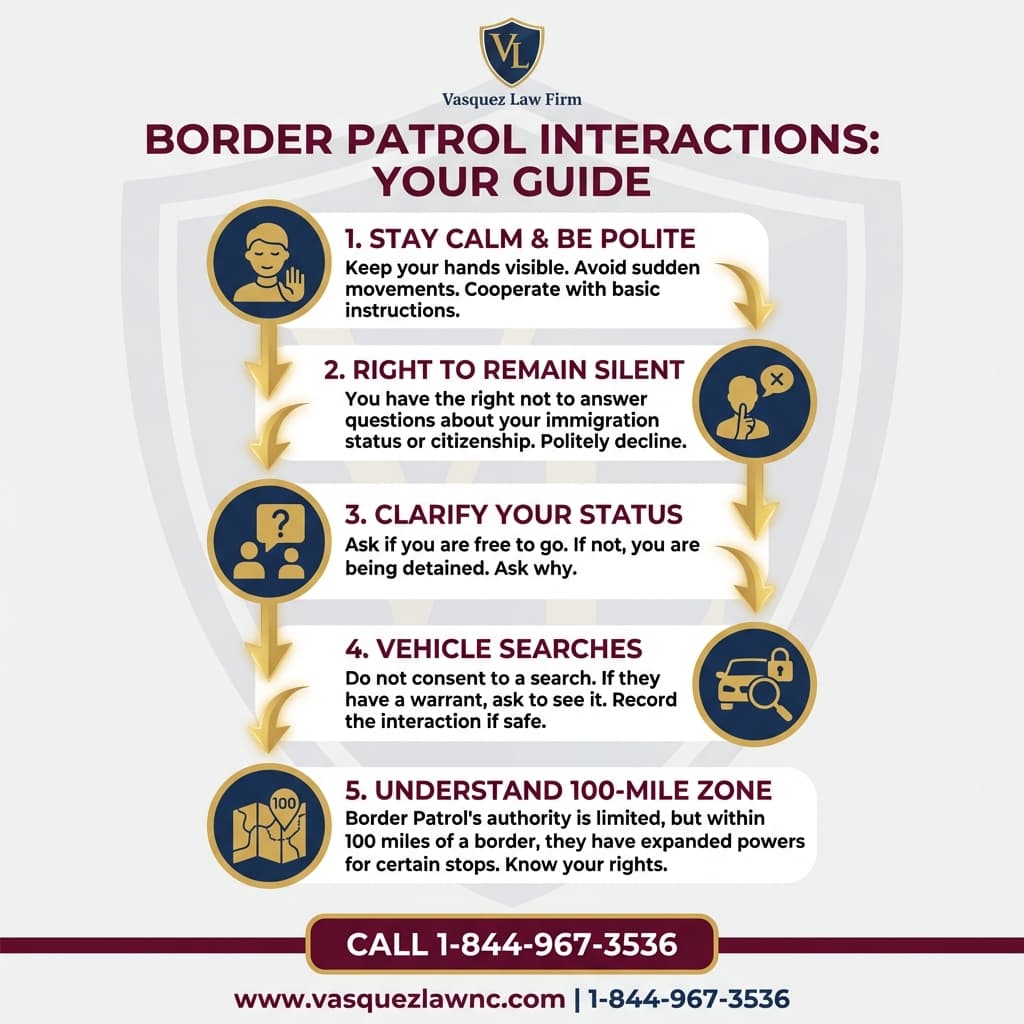
- You have the right to remain silent.
- Do not consent to searches without a warrant.
- Ask if you are free to leave.
- Do not lie or present false documents.
- Contact an attorney immediately if detained.
Understanding Border Patrol Authority in Arizona
The U.S. Customs and Border Protection (CBP), which includes the Border Patrol, maintains significant authority, particularly within 100 air miles of any U.S. external boundary. In Arizona, this 100-mile zone covers a substantial portion of the state, including major cities like Tucson and Phoenix. This broad jurisdictional reach allows Border Patrol agents to conduct operations, including checkpoints and vehicle stops, aimed at intercepting individuals attempting to unlawfully enter the country or transport illicit goods.
However, this authority is not without limits. While agents can question individuals about their citizenship at permanent checkpoints, they generally need reasonable suspicion to stop a vehicle outside of these checkpoints and probable cause to conduct a search without consent or a warrant. Understanding these distinctions is crucial for anyone living or traveling through areas patrolled by Border Patrol Arizona. The scope of their power is defined by federal statutes, such as the Immigration and Nationality Act (INA), and constitutional protections.
Jurisdictional Limits and Checkpoints
Border Patrol's jurisdiction extends beyond the immediate border. The 100-mile zone is a critical concept, granting agents specific powers within this area. Within this zone, agents can operate immigration checkpoints on public roads. At these checkpoints, they can briefly question occupants about their citizenship and immigration status. If agents develop reasonable suspicion of an immigration violation or criminal activity, they may refer individuals to a secondary inspection area for further questioning.
It's important to differentiate between permanent checkpoints and roving patrols. While agents at permanent checkpoints can ask about citizenship without specific suspicion, roving patrols generally require reasonable suspicion to stop a vehicle. This distinction is vital for asserting your rights. The Fourth Amendment protects against unreasonable searches and seizures, and these protections still apply, even within the 100-mile border zone. Knowing the specific Border Patrol Arizona locations and their operational patterns can help you anticipate potential encounters.
Your Constitutional Rights During Encounters with Border Patrol Arizona
Even when interacting with Border Patrol Arizona, you retain fundamental constitutional rights. These rights are enshrined in the U.S. Constitution and apply to everyone within U.S. territory, regardless of immigration status. Key among these are the Fifth Amendment right to remain silent and the Fourth Amendment protection against unreasonable searches and seizures. Exercising these rights respectfully, but firmly, is essential to protecting yourself during an encounter.
You are not required to answer questions about your immigration status or where you were born if you are a U.S. citizen or lawful permanent resident, especially outside of fixed checkpoints. If you are not a U.S. citizen, you generally must answer questions about your immigration status, but you can still refuse to answer other questions. It is always advisable to state that you wish to remain silent and request to speak with an attorney. Remember, anything you say can be used against you in immigration or criminal proceedings.
The Right to Remain Silent and to Counsel
The Fifth Amendment guarantees your right to remain silent. This means you do not have to answer questions from Border Patrol agents, beyond identifying yourself if requested (and only if you are in a vehicle at a checkpoint or have been lawfully stopped). If you are detained, you have the right to request an attorney. It is crucial to invoke this right clearly by stating, "I wish to remain silent and I want to speak with an attorney." Once you invoke this right, agents should cease questioning you.
Do not be intimidated into waiving your rights. Agents may try to continue questioning, but you should politely reiterate your desire for counsel. If you are a U.S. citizen, you are generally not required to carry identification, but it can help avoid prolonged questioning. Non-citizens, however, are required by federal law to carry proof of their immigration registration, such as a Green Card or visa. Failure to do so can lead to detention for identity verification.
What to Do if Stopped by Border Patrol Arizona
An encounter with Border Patrol Arizona can be daunting, but knowing the correct steps can help protect your rights and minimize potential issues. Your actions during a stop can significantly influence the outcome. The primary goal is to remain calm, assert your rights clearly, and avoid any actions that could be misinterpreted or used against you. This includes understanding the difference between a voluntary interaction and a legal detention.
If you are in a vehicle at a fixed checkpoint, be prepared to answer basic questions about your citizenship. If stopped by a roving patrol, agents generally need reasonable suspicion to believe you are involved in an immigration violation or other crime. Always ask if you are free to leave. If the answer is yes, you can calmly drive away. If you are not free to leave, you are being detained, and your rights as a detainee become critical.
Vehicle Stops and Searches
If Border Patrol agents stop your vehicle in Arizona, pull over safely and turn off your engine. Keep your hands visible on the steering wheel. At a checkpoint, you may be asked about your citizenship. If you are a U.S. citizen, you can state, "I am a U.S. citizen." If you are a non-citizen, you must state your citizenship and show valid immigration documents, if requested. Do not answer questions about your travel plans, destination, or where you were born.
Agents generally cannot search your vehicle without your consent, a warrant, or probable cause. If an agent asks to search your vehicle, you should clearly state, "I do not consent to a search." If they proceed with a search without your consent, warrant, or probable cause, do not physically resist, but clearly state that you do not consent. Document everything you can, including agent badge numbers and vehicle descriptions, if it is safe to do so. Remember, your refusal to consent cannot be used as a basis for probable cause for a search. See United States v. Brignoni-Ponce, 422 U.S. 873 (1975) for more on vehicle stops near the border.
Detention and Deportation Defense in Arizona
If you are detained by Border Patrol Arizona, it is crucial to understand that this is not an immediate deportation order, but it is a serious situation requiring prompt legal action. Detention often leads to removal proceedings in immigration court. During this time, you have specific rights, including the right to communicate with an attorney and, in some cases, the right to a bond hearing. Prompt action from an experienced immigration lawyer can make a significant difference in your case.
Upon detention, agents should inform you of your rights, including the right to contact your consulate. Our free consulate directory lists the 24-hour emergency line for each country, which is the number to call from detention. It is vital to exercise your right to an attorney as soon as possible. An attorney can help you understand the charges against you, explore potential defenses to deportation, and represent you in immigration court. They can also assist with bond requests, potentially allowing you to be released from detention while your case proceeds. For more information on your rights during detention, read our article on deportation defense rights.
Seeking Legal Assistance After a Border Patrol Encounter
After any encounter with Border Patrol, especially if you were detained or subjected to a search, contacting an immigration attorney is highly recommended. An attorney can review the details of your encounter, assess whether your rights were violated, and advise you on the best course of action. This is particularly important if you are a non-citizen and there are questions about your immigration status, or if you believe you were unfairly targeted.
For individuals in Raleigh, North Carolina, or anywhere in Florida, Vasquez Law Firm offers experienced legal guidance for immigration matters across the nation. We understand the complexities of federal immigration law and the specific challenges faced by individuals in border regions like Arizona. Our team can help you prepare for future encounters, challenge unlawful detentions, and defend against deportation. Navigating the legal system without an attorney can be overwhelming and can lead to unfavorable outcomes. The stakes are too high to go it alone.
Common Mistakes and How to Avoid Them
Interacting with Border Patrol Arizona can be stressful, and mistakes can have serious consequences for your immigration status or even lead to criminal charges. Avoiding these common pitfalls is key to protecting your rights and ensuring a smoother process. Many individuals, especially those unfamiliar with U.S. law or who do not speak English fluently, may inadvertently jeopardize their position. Being prepared and informed is your best defense.
- Lying or Presenting False Documents: This is a severe offense that can lead to criminal charges, immediate deportation, and future inadmissibility to the U.S. Always be truthful, but remember you can choose to remain silent on certain questions.
- Consenting to Searches: Never consent to a search of your person, vehicle, or belongings without a warrant. Clearly state, "I do not consent to a search." If agents proceed anyway, do not resist, but reiterate your non-consent.
- Failing to Ask if You Are Free to Leave: If you are not at a fixed checkpoint, ask, "Am I free to leave?" If the answer is yes, you can depart. If not, you are detained, and your rights change.
- Not Invoking the Right to Remain Silent: You have the right to remain silent. Do not answer questions about your immigration status, country of origin, or travel plans beyond basic identification at a checkpoint.
- Failing to Request an Attorney: If detained, immediately state, "I want to speak with an attorney." Do not engage in further conversation without legal counsel present.
- Resisting Arrest or Physical Confrontation: Never physically resist an agent, even if you believe the stop is unlawful. This can lead to serious criminal charges and jeopardize your immigration case.
- Signing Documents Without Understanding Them: Do not sign any documents presented by Border Patrol or ICE without fully understanding their content and implications. If you are unsure, refuse to sign and ask to speak with an attorney.
- Not Documenting the Encounter: If safe to do so, try to remember details, write them down immediately afterward, or ask a passenger to observe. Note badge numbers, vehicle IDs, time, and location.
If you only remember one thing: Assert your right to remain silent and request an attorney immediately if you are detained or asked questions beyond your citizenship at a fixed checkpoint.
Immigration Landscape and Border Enforcement in 2026
The immigration landscape in 2026 continues to evolve, with shifting policies and enforcement priorities impacting communities across the nation, especially in states like Arizona. Recent reports, such as those highlighted by CaloNews.com, indicate a heightened focus on immigration enforcement, including strategies that may target individuals for simply not carrying identification. This underscores the need for constant vigilance and up-to-date information regarding your rights and responsibilities.
Federal agencies like CBP and ICE operate under specific guidelines, but these can be subject to change based on new legislation, executive orders, or judicial rulings. Staying informed about these developments is crucial. For example, the Supreme Court's asylum rulings continue to shape how asylum claims are processed at the border and inland. Similarly, policies related to Dreamers and DACA recipients are constantly under review, creating uncertainty for many individuals. Vasquez Law Firm monitors these changes closely to provide the most current and effective legal strategies for our clients.
Nationwide Impact and Legal Trends
While Border Patrol Arizona operations are localized, their impact often reflects broader nationwide immigration trends. Enforcement actions in one sector can influence policies and procedures in others, from ICE enforcement in New Jersey to immigration court proceedings in Reno. The federal nature of immigration law means that a case in Arizona could set precedents or reflect policies applied across the country.
Understanding these interconnected trends is essential for comprehensive immigration defense. For instance, recent discussions around deportation policy for Dreamers or changes to citizenship requirements in 2026 have far-reaching implications. Vasquez Law Firm, with its experience in North Carolina, Florida, and nationwide immigration services, is uniquely positioned to assist clients navigating these complex and often rapidly changing legal waters. We provide strategic defense and proactive planning to protect your interests.
When to Call a Lawyer Now
Knowing when to seek legal counsel is paramount, especially when dealing with federal agencies like Border Patrol Arizona. Certain situations signal an immediate need for an experienced immigration attorney. Delaying legal consultation can severely limit your options and negatively impact your case. If you experience any of the following, contact Vasquez Law Firm without delay:
- You are detained by Border Patrol or ICE.
- You are asked to sign any documents related to your immigration status or deportation.
- You are served with a Notice to Appear (NTA) in immigration court.
- You believe your rights were violated during an encounter.
- You are a non-citizen and have been stopped and questioned about your immigration status.
- You are a U.S. citizen or legal permanent resident, but Border Patrol agents are questioning your status.
- Your family member or friend has been detained.
- You are facing criminal charges that could affect your immigration status.
- You need to understand the implications of a Border Patrol encounter on your visa, Green Card, or citizenship application.
- You are planning to travel through a border zone and want to be fully prepared.
About Vasquez Law Firm
At Vasquez Law Firm, we combine compassion with aggressive representation. Our motto "Yo Peleo" (I Fight) reflects our commitment to standing up for your rights. We understand the fear and uncertainty that immigration issues can bring, and our dedicated team is here to provide clarity and strong advocacy.
- Bilingual Support: Se Habla Español - our team is fully bilingual, ensuring clear communication and understanding.
- Service Areas: We proudly serve clients in North Carolina, Florida, and provide nationwide immigration services.
- Experience: With over 15 years of dedicated legal experience, we have a proven track record of helping clients navigate complex legal matters.
- Results: Our firm has successfully handled thousands of cases across various practice areas, always striving for the best possible outcomes.
Attorney Trust and Experience
Attorney Vasquez holds a Juris Doctor degree and is admitted to practice in both the North Carolina State Bar and Florida Bar. With over 15 years of dedicated legal experience, he has built a reputation for providing personalized attention and achieving favorable outcomes for his clients. His commitment to justice and his deep understanding of immigration law make him a trusted advocate for individuals and families facing challenging situations.
Don't face your legal challenges alone. Our team is here to help you every step of the way.
Call today: 1-844-967-3536 | Se Habla Español
Frequently Asked Questions
Does Arizona have Border Patrol?
Yes, Arizona has a significant Border Patrol presence, particularly in its southern regions. The Tucson Sector is one of the busiest in the nation, responsible for patrolling 262 miles of the U.S.-Mexico international border. Agents operate within a 100-mile zone from the border, conducting surveillance, vehicle stops, and operating immigration checkpoints to enforce federal immigration laws and prevent illegal crossings and smuggling.
Can Border Patrol pull you over for speeding in AZ?
Generally, Border Patrol agents do not have the authority to pull you over solely for a traffic violation like speeding, as that falls under state or local law enforcement jurisdiction. However, if they observe a traffic violation that creates reasonable suspicion of an immigration offense or other federal crime, they might use that as a pretext for a stop. Their primary role is federal immigration and customs enforcement, not routine traffic enforcement.
What is the 100-mile border zone in Arizona?
The 100-mile border zone is a federal designation that allows U.S. Customs and Border Protection (CBP) to operate with expanded authority, including conducting searches and seizures without warrants, within 100 air miles of any U.S. land or coastal border. In Arizona, this zone covers a vast area, impacting many residents and travelers. While powers are expanded, constitutional rights, like the right to remain silent, still apply within this zone.
What should I do if Border Patrol stops me at a checkpoint?
At a fixed checkpoint, be prepared to answer basic questions about your citizenship. If you are a U.S. citizen, state, "I am a U.S. citizen." If you are a non-citizen, show your valid immigration documents. You are not required to answer questions about your destination, travel plans, or other personal matters. Do not consent to any searches of your vehicle or person. If detained, ask for an attorney immediately.
Can Border Patrol search my vehicle without my consent?
Border Patrol agents generally need your consent, a warrant, or probable cause to search your vehicle. If they ask to search, you have the right to refuse by stating, "I do not consent to a search." If they proceed without your consent or a warrant, do not physically resist, but clearly state that you are not consenting to the search. Your refusal to consent cannot be used as a reason for probable cause.
Do I have to carry my papers in Arizona?
U.S. citizens are not generally required to carry identification, although it can expedite encounters. Non-citizens aged 18 and older, however, are required by federal law (8 U.S.C. § 1304(e)) to carry proof of their lawful immigration registration, such as a Green Card, visa, or other valid immigration document. Failure to do so can lead to detention for identity verification, even if you are legally present in the U.S.
What happens if Border Patrol detains me?
If detained by Border Patrol, you have the right to remain silent and the right to speak with an attorney. You should clearly state, "I want to speak with an attorney." Do not sign any documents or answer questions beyond basic identification until you have consulted with legal counsel. Detention often leads to immigration court proceedings, making immediate legal representation critical for your defense and potential release on bond.
How can an immigration lawyer help after a Border Patrol encounter?
An immigration lawyer can assess if your rights were violated, advise you on the legal implications of the encounter, and represent you in immigration court if you are detained or placed in removal proceedings. They can help with bond requests, prepare your defense against deportation, and ensure all legal avenues are explored to protect your immigration status and future in the U.S. Timely legal intervention is crucial.
Are Border Patrol agents the same as local police?
No, Border Patrol agents are federal law enforcement officers whose primary mission is to enforce federal immigration laws and prevent illegal entry into the U.S. While they have broad powers within the border zone, their authority differs from local police, who enforce state and municipal laws. Border Patrol agents cannot typically enforce state traffic laws or respond to local crimes unless they are directly related to their federal duties or in emergency situations.
What is the difference between Border Patrol and ICE?
Both Border Patrol and ICE (Immigration and Customs Enforcement) are components of the Department of Homeland Security (DHS), but they have distinct roles. Border Patrol (part of CBP) primarily operates at and between ports of entry, focusing on securing U.S. borders. ICE, on the other hand, enforces immigration laws within the interior of the U.S., including conducting arrests, detentions, and deportations of undocumented immigrants. They often coordinate but have different operational scopes.
Sources and References
- U.S. Citizenship and Immigration Services (USCIS)
- Executive Office for Immigration Review (EOIR)
- 8 U.S.C. § 1304 - Powers and duties of the Attorney General; central file; information from aliens; reports of status, change of address, or employment; fingerprinting
- United States v. Brignoni-Ponce, 422 U.S. 873 (1975)
Ready to take the next step? Contact Vasquez Law Firm today for a free, confidential consultation. We're committed to fighting for your rights and achieving the best possible outcome for your case.
Start Your Free Case Evaluation Now
Call us: 1-844-967-3536
Se Habla Español - Estamos aquí para ayudarle.

William Vasquez
Founder & CEO, Vasquez Law Firm, PLLC
William Vasquez is the founder and CEO of Vasquez Law Firm, PLLC, a results-driven firm specializing in immigration, criminal defense, personal injury, and workers' compensation. A U.S. Air Force veteran and recipient of the Joint Service Achievement Medal, William is dedicated to fiercely fighting for his clients' rights.
Related Legal Services
Need legal help? Learn more about how our immigration attorneys can help, or contact us for a free evaluation.
You can also visit our North Carolina immigration practice for more information.