Know Your Rights During ICE Enforcement in New Jersey in 2026
Understand ICE enforcement in New Jersey and your legal rights as an immigrant in 2026. Contact Vasquez Law Firm for a free consultation.
Published on March 4, 2026
Talk to an immigration attorney
Free call. A clear plan for your case.
Free & confidential · Se habla espanol · 24/7

Have questions? Talk to an attorney - free evaluation.
Call 1-844-967-3536Worried how the latest immigration news affects you?
Schedule a confidential case review with an immigration attorney - know exactly where you stand.
Know Your Rights During ICE Enforcement in New Jersey in 2026
Navigating immigration laws can be incredibly complex, especially when facing federal agencies like U.S. Immigration and Customs Enforcement (ICE). For immigrants and their families in New Jersey, understanding your rights and the realities of ICE enforcement is crucial. As of 2026, policies and procedures continue to evolve, making it essential to stay informed and know how to protect yourself and your loved ones. This guide provides vital information on what to expect from ICE enforcement in New Jersey and outlines the steps you can take to assert your constitutional rights.
Need help with your case? Our experienced attorneys are ready to fight for you. Se Habla Español.
Schedule Your Free Case Evaluation
Or call us now: 1-844-967-3536
Quick Answer
ICE enforcement in New Jersey, like other states, operates under federal immigration law. While New Jersey has certain sanctuary policies, federal agencies like ICE are not bound by them. Immigrants have constitutional rights, including the right to remain silent and to speak with an attorney, which are crucial during any encounter.
- You have the right to remain silent.
- Do not open your door to ICE without a warrant signed by a judge.
- Request to speak with an attorney immediately.
- Do not sign any documents without legal counsel.
- Always carry proof of your immigration status if you have it.
- Know your local legal aid resources and immigration attorneys.
Understanding ICE Enforcement in New Jersey
ICE, or U.S. Immigration and Customs Enforcement, is a federal law enforcement agency responsible for enforcing immigration laws within the United States. Their activities include investigations, arrests, detention, and deportation of individuals who violate these laws. While New Jersey has adopted certain policies aimed at limiting cooperation between local law enforcement and federal immigration authorities, these policies do not prevent ICE from operating within the state.
It's important to differentiate between local police and federal ICE agents. Local police generally cannot enforce federal immigration laws unless cross-designated. However, ICE agents have the authority to make arrests anywhere in the country, including in New Jersey, if they have probable cause to believe an individual is in violation of immigration law. This can lead to significant stress and uncertainty for immigrant communities across the state, from cities like Newark to smaller towns like Smithfield, North Carolina, where Vasquez Law Firm also serves clients.
In 2026, the landscape of immigration enforcement continues to be dynamic. Knowing your rights, such as those protected by the Fourth and Fifth Amendments of the U.S. Constitution, is paramount. This includes protections against unreasonable searches and seizures, and the right to due process. Understanding these rights can empower you during an encounter with ICE agents and help you avoid common pitfalls that could jeopardize your immigration status. Vasquez Law Firm is dedicated to providing robust immigration defense, ensuring our clients are well-informed and protected.
New Jersey Policies vs. Federal Authority
New Jersey has implemented policies such as the Immigrant Trust Directive, which limits how state and local law enforcement agencies cooperate with federal immigration authorities. This directive aims to build trust between immigrant communities and local police, encouraging immigrants to report crimes without fear of deportation. For example, local police typically cannot stop, search, or arrest someone solely based on their immigration status.
However, it is crucial to understand that these state-level directives do not strip ICE of its federal authority. ICE agents can still conduct operations, including arrests, within New Jersey. They are not bound by the state's trust directive. Therefore, while local police might not ask about your immigration status, ICE agents can and will. This distinction is vital for anyone living in New Jersey who may be concerned about federal immigration enforcement actions.
The complexities arising from the interplay of state and federal laws highlight the importance of legal counsel. An experienced immigration attorney can help you understand these nuances and prepare for potential encounters with ICE. They can also represent you in immigration court proceedings, which are entirely separate from state criminal courts. This dual system requires specialized knowledge that a dedicated immigration law firm provides.
Your Rights During an ICE Encounter
Knowing your rights is your strongest defense during an encounter with ICE. These rights are guaranteed by the U.S. Constitution, regardless of your immigration status. Asserting them calmly and clearly can make a significant difference in the outcome of an encounter. It's not about resisting, but about exercising your legal protections.
- Right to Remain Silent: You are not required to answer questions from ICE agents beyond providing your name. You can state, "I wish to remain silent and I want to speak with an attorney."
- Right to Refuse Search: ICE agents cannot search your property or person without a warrant signed by a judge, or your consent. Do not consent to any searches.
- Do Not Open the Door: If ICE agents come to your home, do not open the door unless they have a warrant signed by a judge. Ask them to slide the warrant under the door or hold it up to a window. A warrant for arrest (Form I-200) is different from a search warrant.
- Right to an Attorney: If you are arrested or detained, you have the right to speak with an attorney. Request one immediately. Do not sign any documents without legal counsel.
- Document Everything: If possible and safe, write down or remember details of the encounter, including agent badge numbers, vehicle descriptions, and what was said.
For more detailed information on your rights, the American Civil Liberties Union (ACLU) provides comprehensive guides available online. Understanding these fundamental rights is the first step in protecting yourself and your family from potential immigration enforcement actions in New Jersey.
What to Do If ICE Shows Up at Your Home or Work
An encounter with ICE can be frightening, whether at your home, workplace, or in public. Your actions during these critical moments can significantly impact your future. Remaining calm and knowing the correct procedures are essential. These steps apply broadly across the country, including in areas like Smithfield, North Carolina, and throughout Florida, where Vasquez Law Firm provides immigration services.
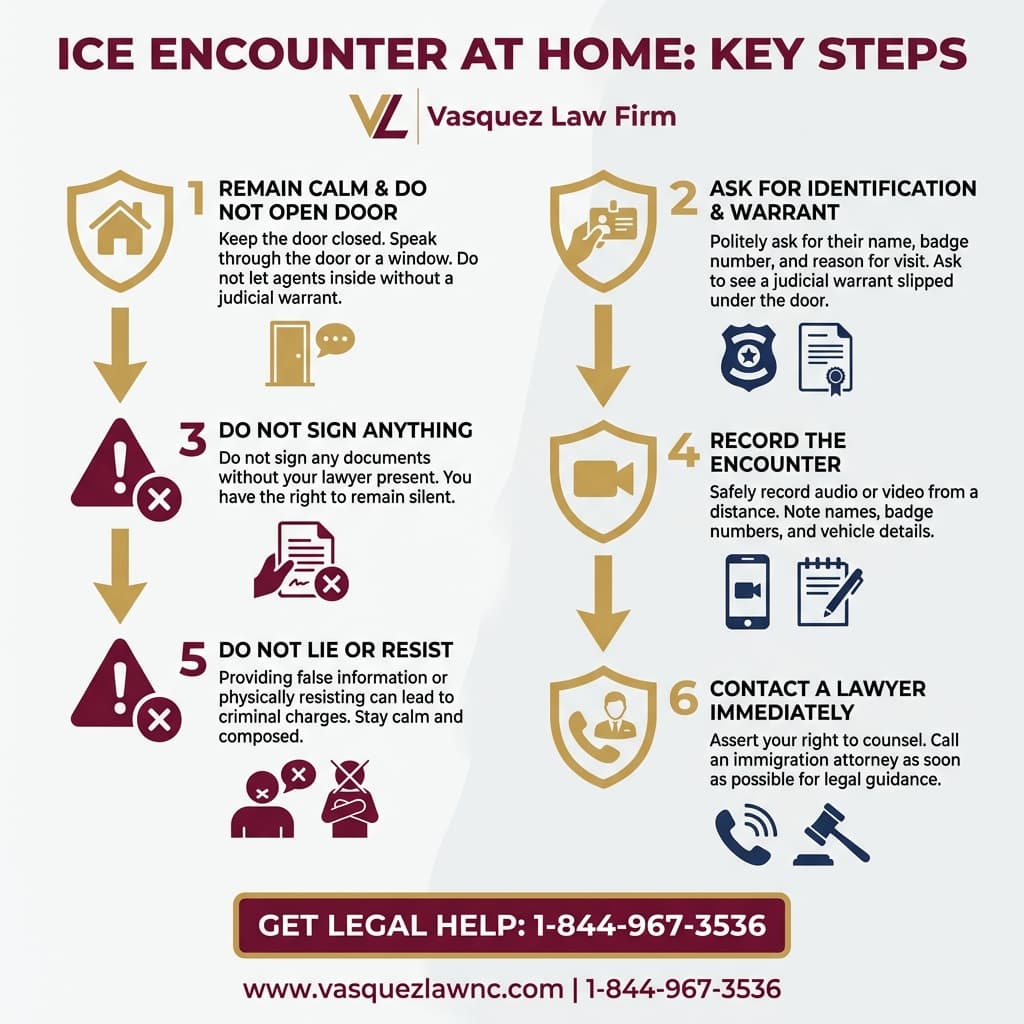
At Your Home
- Do Not Open the Door: Verify if they have a warrant. A warrant must be signed by a judge (not an immigration officer) and specify your address.
- Ask for the Warrant: Request they slide it under the door or show it through a window.
- Confirm the Warrant: Check that it is a judicial warrant (signed by a judge) and that it has the correct address. If it's an administrative warrant (Form I-200 or I-205) signed by an ICE officer, you do not have to open your door.
- Assert Your Rights: If they enter, state clearly, "I do not consent to this search."
- Contact an Attorney: Call an immigration lawyer immediately.
At Your Workplace
- Remain Silent: You are not obligated to answer questions about your immigration status or country of origin.
- Do Not Flee: This can be interpreted as resisting arrest.
- Show ID (If Requested): If you have an employment authorization document or Green Card, you can show it.
- Request an Attorney: State, "I need to speak with my lawyer."
- Document the Encounter: Note badge numbers, names, and what happened.
For any situation involving ICE enforcement in New Jersey, immediate legal counsel is critical. An attorney can assess your situation, advise you on your rights, and represent you in any subsequent proceedings. This proactive approach can help protect your interests and potentially prevent deportation. Vasquez Law Firm is ready to assist you.
Common Mistakes and How to Avoid Them
During a stressful encounter with ICE, it is easy to make mistakes that could harm your case. Being aware of these common errors can help you navigate the situation more effectively and protect your legal rights. Many of these mistakes stem from fear or a lack of understanding of immigration law.
- Opening the Door Without a Judicial Warrant: This is a frequent error. Always verify the warrant is signed by a judge and has the correct address before allowing entry. An administrative warrant does not compel you to open your door.
- Answering Questions About Status: You are not legally required to disclose your immigration status to ICE agents. Remaining silent is your right.
- Signing Documents Without Legal Review: Never sign anything an ICE agent gives you without first having an attorney review it. You could inadvertently waive important rights or agree to voluntary departure.
- Providing False Information: Lying to a federal agent can lead to serious criminal charges and further complicate your immigration case. Always be truthful if you choose to speak, but remember your right to remain silent.
- Failing to Consult an Attorney Immediately: Delaying legal counsel can limit your options and reduce your chances of a favorable outcome. The sooner you speak with a lawyer, the better.
- Not Knowing Your Rights: A lack of awareness about your constitutional rights leaves you vulnerable. Educate yourself and your family on what to do during an ICE encounter.
- Carrying False Documents: Presenting fake identification or documents can lead to criminal charges and severe immigration consequences.
If you only remember one thing: Always remember your right to remain silent and to speak with an attorney before answering any questions or signing any documents presented by ICE agents. This single action can provide a crucial layer of protection.
Don't face your legal challenges alone. Our team is here to help you every step of the way.
Call today: 1-844-967-3536 | Se Habla Español
Immigration Enforcement: Nationwide and Local Context
While this article focuses on ICE enforcement in New Jersey, it's important to understand that immigration law is federal, meaning the core statutes and regulations apply nationwide. However, the practical application and local context can vary significantly. States like New Jersey and North Carolina, where Vasquez Law Firm also operates, may have different policies regarding local law enforcement cooperation with ICE. Florida, another state where we offer immigration services, presents its own unique landscape regarding immigration policies and enforcement.
Federal Framework
The Immigration and Nationality Act (INA), found in Title 8 of the U.S. Code, forms the bedrock of U.S. immigration law. It defines who is considered an alien, how one can enter and remain in the U.S., and the grounds for removal (deportation). Agencies like ICE and U.S. Citizenship and Immigration Services (USCIS) operate under these federal statutes and regulations, such as those found in 8 C.F.R. § 287.1, which details the powers of immigration officers.
This means that the fundamental rights you have during an ICE encounter, such as the right to remain silent and the right to an attorney, are federal constitutional rights that apply across all states. The procedures for arrest, detention, and removal proceedings are also governed by federal law, although specific detention facilities or court schedules may differ by region. Understanding this overarching federal framework is crucial for any immigrant in the U.S.
North Carolina Notes
In North Carolina, the legal environment regarding immigration enforcement can differ from New Jersey's. While NC does not have a statewide sanctuary law, some local jurisdictions have adopted policies that limit cooperation with ICE. However, state law, such as N.C. Gen. Stat. § 162-62, requires sheriffs to cooperate with ICE regarding detainer requests for individuals charged with certain offenses. This means that local jails in North Carolina are generally more likely to honor ICE detainer requests than in some New Jersey jurisdictions.
For individuals in North Carolina, especially in areas like Smithfield and throughout Johnston County, it's vital to be aware of the specific policies of your local sheriff's office and police departments. An arrest, even for minor offenses, could potentially lead to an ICE detainer and subsequent deportation proceedings. Vasquez Law Firm, serving clients throughout North Carolina, is well-versed in these local nuances and can provide essential guidance.
Florida Notes
Florida has taken a different approach to immigration enforcement than New Jersey. In recent years, Florida has passed legislation that generally requires state and local law enforcement agencies to cooperate with federal immigration authorities. For example, Florida Statute § 908.106 mandates that law enforcement agencies use their best efforts to support the enforcement of federal immigration law, including honoring ICE detainer requests.
This means that immigrants in Florida may face a higher risk of being transferred to ICE custody if they are arrested by local law enforcement. The state's stance emphasizes cooperation, making it even more critical for individuals to understand their rights and seek legal counsel immediately if they encounter law enforcement or ICE. Vasquez Law Firm extends its immigration services to Florida, providing critical defense and advocacy in this challenging environment.
When to Call an Immigration Lawyer Now
The complexities of immigration law and the severe consequences of enforcement actions mean that prompt legal intervention is often necessary. Do not wait until it's too late to seek professional help. An experienced immigration lawyer can be your strongest advocate, protecting your rights and fighting for your future. Here are critical triggers indicating you should call an attorney immediately:
- ICE agents have contacted you or a family member.
- You or a loved one has been arrested by ICE or local law enforcement and an ICE detainer has been issued.
- You have received a Notice to Appear (NTA) in immigration court.
- You are facing deportation or removal proceedings.
- You are concerned about your immigration status or that of a family member.
- You need help understanding a specific immigration policy or law, especially concerning ICE enforcement in New Jersey or other states.
- You believe your rights have been violated during an encounter with law enforcement or ICE.
- You are considering applying for immigration benefits but have past legal issues that might affect your eligibility.
- You need assistance with an asylum claim or other humanitarian relief.
- You are a non-citizen charged with a crime, as criminal charges can have severe immigration consequences.
Vasquez Law Firm offers comprehensive immigration legal services, from initial consultations to aggressive courtroom representation. Our team is ready to provide the guidance and advocacy you need. We understand the urgency and sensitivity of these matters.
About Vasquez Law Firm
At Vasquez Law Firm, we combine compassion with aggressive representation. Our motto "Yo Peleo" (I Fight) reflects our commitment to standing up for your rights and advocating tirelessly on your behalf. We understand the profound impact that immigration and other legal issues can have on individuals and families, and we approach every case with the dedication it deserves.
- Bilingual Support: Se Habla Español - our team is fully bilingual, ensuring clear communication and understanding for all our clients.
- Service Areas: We proudly serve clients across North Carolina and Florida, and provide nationwide immigration services, offering expert legal counsel wherever you are.
- Experience: With over 15 years of dedicated experience, we have a proven track record of helping clients navigate complex legal matters and achieving favorable outcomes.
- Results: Our firm has successfully handled thousands of cases across multiple practice areas, including immigration, personal injury, workers' compensation, and criminal defense.
Attorney Trust and Experience
Attorney Vasquez holds a Juris Doctor degree and is admitted to practice in both the North Carolina State Bar and Florida Bar. With over 15 years of dedicated legal experience, he has built a reputation for providing personalized attention and achieving favorable outcomes for his clients. He is committed to upholding justice and empowering individuals through knowledgeable and tenacious legal representation. Our firm's strong foundation is built on trust, integrity, and a deep understanding of the law.
Frequently Asked Questions
Is ICE allowed in New Jersey?
Yes, ICE is a federal agency and is allowed to operate in New Jersey. While the state has policies like the Immigrant Trust Directive that limit cooperation between local law enforcement and ICE, these directives do not prevent ICE from conducting its own enforcement operations, including arrests and detentions, within the state's borders. It's crucial to understand this distinction for your protection.
What should I do if ICE shows up at my work in New Jersey?
If ICE agents appear at your workplace, you have the right to remain silent. Do not answer questions about your immigration status or country of origin. Ask to speak with an attorney immediately and do not sign any documents without legal counsel. Remember, you do not have to flee, but asserting your rights calmly is key. Document the encounter if it is safe to do so.
Can ICE ask for proof of citizenship?
Yes, ICE agents can ask for proof of citizenship or immigration status. However, you have the right to remain silent and do not have to answer their questions directly. If you are a lawful permanent resident or have other valid immigration documents, you should carry them and present them if asked. Always consult an attorney before providing extensive information or signing documents.
Can you call local police on ICE?
You can call local police if you believe ICE agents are violating the law or engaging in misconduct. However, local police generally cannot intervene in a legitimate federal immigration enforcement action. They also might not be able to prevent ICE from making an arrest if the agents are acting within their federal authority. Your best course of action is to contact an experienced immigration attorney immediately.
What does ICE do to immigrants?
ICE primarily enforces federal immigration laws. This includes identifying, arresting, and detaining individuals who are in the U.S. without authorization or who have violated their immigration terms. Their actions can lead to deportation (removal) from the United States. ICE also investigates various transnational crimes, but its public-facing role often involves immigration enforcement and detention.
Where is ICE immigration located right now?
ICE operates numerous field offices, detention facilities, and sub-offices across the United States. While their specific operational locations for enforcement actions can vary daily and are often not publicly disclosed, you can find official ICE office locations on the U.S. Immigration and Customs Enforcement website. For current enforcement activities, it's best to consult local news or an immigration attorney.
Who created ICE immigration?
U.S. Immigration and Customs Enforcement (ICE) was created in 2003, as part of the Department of Homeland Security (DHS). This reorganization followed the September 11, 2001, terrorist attacks, merging various functions of the former Immigration and Naturalization Service (INS) and other agencies to enhance border and national security. It is a key component of federal efforts to enforce immigration and customs laws.
What is the ICE deportation number?
There isn't a single "ICE deportation number" for individuals to call regarding their own deportation. However, if you or a loved one is detained by ICE, you can use the ICE Online Detainee Locator System to find information. For legal inquiries or assistance with a deportation case, contacting an immigration attorney directly is the most effective approach. They can guide you through the complex legal process.
Can ICE enter a business without a warrant?
ICE agents generally need a warrant or consent to enter private, non-public areas of a business. In public areas of a business, they may enter without a warrant. However, if they are seeking to arrest a specific individual, they would typically need an administrative warrant (Form I-200) or, ideally, a judicial warrant to enter private spaces. Always consult an attorney if ICE attempts to enter your business.
What kind of warrants do ICE agents use?
ICE agents use two main types of warrants: administrative warrants (Form I-200, Warrant for Arrest of Alien, or Form I-205, Warrant of Removal/Deportation) and judicial warrants. Administrative warrants are issued by ICE officers themselves and do not grant permission to enter a private residence without consent. Judicial warrants, signed by a federal judge, typically do grant authority to enter private property, which is a critical distinction.
Sources and References
- U.S. Citizenship and Immigration Services (USCIS)
- Executive Office for Immigration Review (EOIR)
- U.S. Code Title 8, Chapter 12: Immigration and Nationality
Need immigration help? Our immigration attorneys can review your case.
Ready to take the next step? Contact Vasquez Law Firm today for a free, confidential consultation. We're committed to fighting for your rights and achieving the best possible outcome for your case.
Start Your Free Case Evaluation Now
Call us: 1-844-967-3536
Se Habla Español - Estamos aquí para ayudarle.


William Vasquez
Founder & CEO, Vasquez Law Firm, PLLC
William Vasquez is the founder and CEO of Vasquez Law Firm, PLLC, a results-driven firm specializing in immigration, criminal defense, personal injury, and workers' compensation. A U.S. Air Force veteran and recipient of the Joint Service Achievement Medal, William is dedicated to fiercely fighting for his clients' rights.
Related Legal Services
Need legal help? Learn more about how our immigration attorneys can help, or contact us for a free evaluation.
You can also visit North Carolina immigration lawyers for more information.