What You Should Know About Reno Immigration Court in 2026
Facing a Reno immigration court case? Understand the process and protect your rights in 2026. Contact Vasquez Law Firm for a free consultation today.
Published on March 4, 2026· Updated August 3, 2026
Talk to an immigration attorney
Free call. A clear plan for your case.
Free & confidential · Se habla espanol · 24/7

Have questions? Talk to an attorney - free evaluation.
Call 1-844-967-3536Check your case status now
Look up your immigration case below, then talk to an attorney about what it means — free.
Questions about your result?
Talk to an attorney about your case — free, no obligation.
What You Should Know About Reno Immigration Court in 2026
Check your own case: look up your immigration court (EOIR) case status free - enter your A-Number to see your next hearing date, judge, court, and case clock. No login.
Navigating the complexities of the Reno immigration court can be a daunting experience for anyone facing deportation or seeking asylum. As of 2026, understanding the specific procedures, potential challenges, and your legal rights is more crucial than ever. This guide provides essential information to help you prepare for your case, whether you're attending a hearing or checking your immigration court date.
Need help with your case? Our experienced attorneys are ready to fight for you. Se Habla Español.
Schedule Your Free Case Evaluation
Or call us now: 1-844-967-3536
Quick Answer
The Reno immigration court, part of the Executive Office for Immigration Review (EOIR), handles deportation and asylum cases. Understanding your hearing schedule, case status, and having legal representation are vital steps. The court's procedures can be complex, and timely preparation with an attorney can significantly impact your outcome.
- Verify your immigration court date and location online.
- Gather all relevant documents and evidence.
- Seek experienced legal counsel for your defense.
- Understand the difference between USCIS and immigration court proceedings.
- Be aware of potential 'ambush' tactics that may rush proceedings.
- Prepare for various outcomes, including appeals.
Understanding the Reno Immigration Court System in 2026
The Reno immigration court operates under the U.S. Department of Justice's Executive Office for Immigration Review (EOIR). It is responsible for adjudicating immigration cases, primarily those involving individuals placed in removal proceedings. This means if you have received a Notice to Appear (NTA), your case will likely be heard before an Immigration Judge in Reno.
Unlike U.S. Citizenship and Immigration Services (USCIS), which processes visa applications and petitions for benefits, the immigration court is a judicial body that determines whether non-citizens can remain in the United States. The proceedings are formal and adversarial, often involving government attorneys (ICE counsel) seeking deportation. The stakes are incredibly high, as the outcome can directly affect your ability to live and work in the U.S.
Recent reports, such as those from the Reno Gazette Journal, have highlighted concerns about 'ambush' tactics in the Reno immigration court, leading to rushed deportations. This underscores the critical need for robust legal representation. An experienced immigration lawyer can help you navigate these challenges, ensure due process, and present the strongest possible defense against removal.
Key Players in Immigration Court
When you attend a hearing at the Reno immigration court, you will encounter several key individuals and entities. The Immigration Judge (IJ) presides over the case, makes decisions on admissibility and deportability, and rules on applications for relief. The Department of Homeland Security (DHS) attorney, often referred to as ICE counsel, represents the government's interests and seeks to remove non-citizens. You, as the respondent, are the individual whose immigration status is being adjudicated. Your attorney, if you have one, will represent your interests and advocate on your behalf, presenting evidence and arguments.
Understanding the roles of these parties is crucial for anyone facing a case in the Reno immigration court. The judge acts as an impartial decision-maker, but they must follow strict legal guidelines and precedents. Having a skilled lawyer by your side ensures that your voice is heard and your rights are protected throughout the complex legal process.
Preparing for Your Reno Immigration Court Date
Receiving a Notice to Appear (NTA) is the first step in removal proceedings. It is essential to take this document seriously and begin preparing immediately. The NTA will specify the charges against you and the date and time of your initial master calendar hearing. Missing this hearing can lead to an order of deportation in absentia, making it much harder to resolve your case.
Checking your immigration court case status regularly through the Executive Office for Immigration Review (EOIR) online system or by phone is highly recommended. Court schedules can change, and staying informed is vital. You should also begin gathering all relevant documents, such as birth certificates, marriage licenses, proof of residence, and any evidence supporting your claim for relief, like asylum or cancellation of removal.
Engaging an immigration attorney early in the process is perhaps the most critical step. An attorney can help you understand the charges, identify potential forms of relief, prepare necessary applications, and represent you effectively in court. They can also advise on strategies to avoid common pitfalls and ensure that all deadlines are met. This proactive approach significantly improves your chances of a favorable outcome in the Reno immigration court.
Documents and Evidence Checklist for Immigration Court
Preparing a comprehensive set of documents is vital for your immigration court case. The specific documents you need will depend on the type of relief you are seeking, but a general checklist includes:
- Notice to Appear (NTA): The document initiating your removal proceedings.
- Identification: Passport, birth certificate, driver's license.
- Proof of Relationship: Marriage certificates, birth certificates of children, family photos.
- Financial Documents: Tax returns, pay stubs, bank statements, proof of financial support.
- Medical Records: If seeking asylum based on medical issues or for humanitarian relief.
- Police Records: For any arrests or convictions (even if dismissed), obtain certified dispositions.
- Affidavits/Letters of Support: Statements from family, friends, or community members testifying to your good character or hardship.
- Country Conditions Reports: If seeking asylum, reports on human rights in your home country.
- Proof of Residence: Utility bills, leases, school records, employment records.
- Any Applications for Relief: I-589 (Asylum), I-485 (Adjustment of Status), I-130 (Petition for Alien Relative), etc., with all supporting documentation.
Having these documents organized and readily available will streamline your case and allow your attorney to build a strong argument on your behalf. Missing documents can cause delays or weaken your claim.
Common Mistakes to Avoid in Reno Immigration Court
Navigating the immigration court system can be complex, and even minor errors can have significant consequences. Avoiding common pitfalls is crucial for a successful outcome in your Reno immigration court case. Here are some key mistakes to steer clear of:
- Missing Court Dates: Failing to appear for a scheduled hearing can lead to an order of removal in absentia, making it extremely difficult to reopen your case. Always confirm your immigration court date and location.
- Not Seeking Legal Counsel: Representing yourself in immigration court is highly risky. Immigration law is intricate, and a lawyer can identify relief options, present evidence effectively, and challenge government arguments.
- Providing Inconsistent Information: Any discrepancies in your statements, applications, or testimony can be used against you by the government attorney. Always be truthful and consistent.
- Failing to Disclose Criminal History: Even minor arrests or convictions, including those expunged, must be disclosed. Failure to do so can lead to accusations of misrepresentation and severe penalties.
- Not Submitting Documents on Time: Immigration courts have strict deadlines for submitting applications and supporting evidence. Missing these deadlines can result in the denial of your application for relief.
- Ignoring Changes in Law: Immigration law is constantly evolving. What was true last year may not be true in 2026. An experienced attorney stays updated on all changes.
- Lack of Preparation for Testimony: Your testimony is a critical part of your case. Being unprepared for questioning by the judge or government attorney can weaken your credibility.
- Not Understanding the Charges: Ensure you fully comprehend the allegations in your Notice to Appear. Your defense strategy hinges on addressing these specific charges.
If you only remember one thing: Always consult with an experienced immigration attorney before attending any hearing at the Reno immigration court. Their expertise is invaluable.
Don't face your legal challenges alone. Our team is here to help you every step of the way.
Call today: 1-844-967-3536 | Se Habla Español
Timeline and What to Expect in Reno Immigration Court
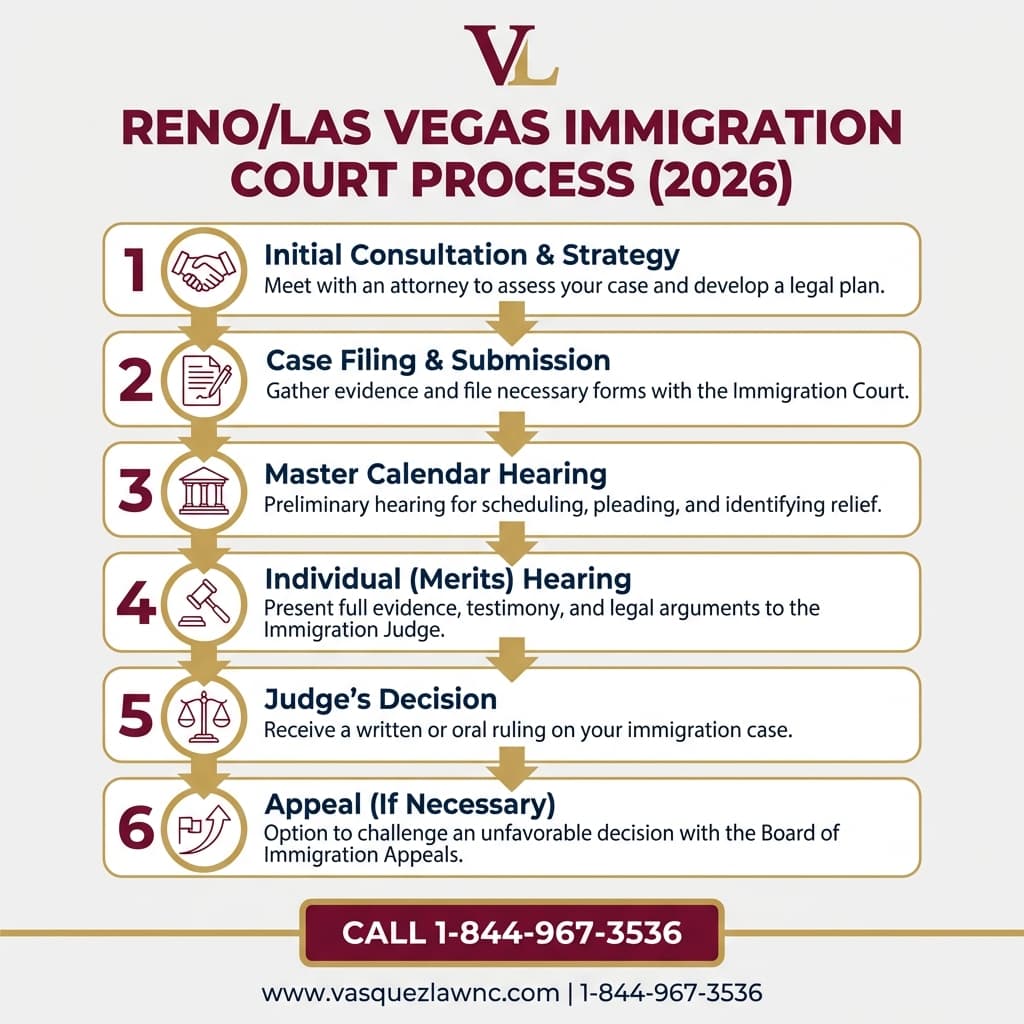
The timeline for an immigration court case can vary significantly, ranging from a few months to several years, depending on the complexity of the case, the court's docket, and the type of relief sought. Generally, the process involves several stages:
- Master Calendar Hearing (MCH): This is your initial appearance before the Immigration Judge. During the MCH, you will acknowledge receipt of the NTA, plead to the allegations, and inform the judge of your intent to seek relief from removal. The judge will set deadlines for filing applications and schedule your individual hearing.
- Filing Applications for Relief: After the MCH, you and your attorney will prepare and submit applications for relief (e.g., asylum, cancellation of removal, adjustment of status) along with all supporting documentation. This stage requires meticulous attention to detail and adherence to strict deadlines.
- Individual Hearing (Merits Hearing): This is the main hearing where you present your case, offer testimony, and introduce evidence. The government attorney will also present their case and cross-examine you and your witnesses. The judge will then make a decision based on the evidence and arguments presented.
- Decision and Appeal: After the individual hearing, the Immigration Judge will issue a decision. If the decision is unfavorable, you may have the option to appeal to the Board of Immigration Appeals (BIA). If the BIA denies your appeal, you may be able to appeal to a federal circuit court.
Throughout this process, continuous communication with your attorney and adherence to court instructions are essential. Unexpected delays or expedited hearings can occur, making it important to have flexible and responsive legal support.
Costs and Fees for Immigration Court Cases
The financial aspect of an immigration court case can be a significant concern for many individuals. The costs involved typically include attorney fees, government filing fees, and other miscellaneous expenses. Understanding these factors can help you plan and manage your case effectively.
- Attorney Fees: These vary widely depending on the complexity of your case, the attorney's experience, and the amount of time required. Some attorneys charge a flat fee for specific services, while others bill hourly. Vasquez Law Firm offers competitive rates and transparent fee structures, often starting with a free initial consultation to discuss your options.
- Government Filing Fees: USCIS and EOIR charge fees for various applications for relief, such as asylum applications (though asylum itself usually has no filing fee), applications for adjustment of status, or motions to reopen. These fees can range from a few hundred to over a thousand dollars. Fee waivers may be available for certain applications if you meet specific poverty guidelines.
- Expert Witness Fees: In some cases, you may need to hire expert witnesses (e.g., country conditions experts, psychologists) to support your claim, especially in asylum cases. Their fees can add significantly to the overall cost.
- Translation and Documentation Costs: If your documents are not in English, you will need certified translations, which incur additional costs. Obtaining certified copies of birth certificates, marriage licenses, or criminal records also involves fees.
It is important to discuss all potential costs with your attorney upfront to avoid surprises. An experienced lawyer can help you understand the financial implications and explore any available options for fee waivers or payment plans.
When to Call an Immigration Lawyer for Your Reno Case
The sooner you engage an immigration attorney for your Reno immigration court case, the better your chances of achieving a favorable outcome. Here are some critical triggers indicating you should call a lawyer immediately:
- You have received a Notice to Appear (NTA) in immigration court.
- You or a family member has been detained by ICE.
- You are seeking asylum or protection from deportation.
- You have a prior deportation order or criminal record.
- You believe you qualify for relief from removal (e.g., DACA, VAWA, U-Visa).
- Your immigration court date is approaching rapidly.
- You do not understand the charges against you or the court process.
- You have been denied an immigration benefit by USCIS.
- You are considering an appeal of an unfavorable immigration court decision.
- You need help checking your immigration court date or case status.
Don't wait until it's too late. Early intervention by a skilled attorney can make a significant difference in protecting your rights and securing your future in the United States. Vasquez Law Firm is ready to provide the aggressive and compassionate representation you deserve.
About Vasquez Law Firm
At Vasquez Law Firm, we combine compassion with aggressive representation. Our motto "Yo Peleo" (I Fight) reflects our commitment to standing up for your rights.
- Bilingual Support: Se Habla Español - our team is fully bilingual
- Service Areas: North Carolina, Florida, and nationwide immigration services
- Experience: Over 15 years helping clients navigate complex legal matters
- Results: Thousands of successful cases across multiple practice areas
Attorney Trust and Experience
Attorney Vasquez holds a Juris Doctor degree and is admitted to practice in both the North Carolina State Bar and Florida Bar. With over 15 years of dedicated legal experience, he has built a reputation for providing personalized attention and achieving favorable outcomes for his clients. He understands the unique challenges faced by immigrants and is committed to fighting for justice. Vasquez Law Firm is passionate about helping individuals and families achieve their American Dream.
Frequently Asked Questions
Can you attend an immigration court hearing?
Yes, immigration court hearings are generally open to the public, except for certain sensitive cases like asylum where privacy is a concern. You can attend to observe proceedings, but you must adhere to court rules regarding conduct and electronic devices. If you are the respondent, your presence is mandatory unless specifically excused by the judge.
How do I find my immigration court case status or date?
You can find your immigration court case status or date through the Executive Office for Immigration Review (EOIR) automated case information system. This system is accessible online or by phone. You will need your A-number (Alien Registration Number) to retrieve your information. Regularly checking your status is crucial due to potential schedule changes.
What's the difference between USCIS and immigration court?
USCIS (U.S. Citizenship and Immigration Services) is an administrative agency that processes immigration benefits like green cards, visas, and citizenship applications. Immigration court, part of the Department of Justice's EOIR, is a judicial system that hears cases of individuals facing deportation or appealing USCIS denials. They have distinct roles and functions.
How long do immigration court cases take in 2026?
The duration of immigration court cases in 2026 varies greatly, from a few months to several years. Factors influencing the timeline include the complexity of the case, the specific immigration court's caseload, the type of relief sought, and whether appeals are filed. An attorney can provide a more personalized estimate.
Can I get deported if I miss my Reno immigration court date?
Yes, missing your scheduled immigration court date at the Reno immigration court can lead to an order of removal (deportation) in absentia. This means the judge can order your deportation without you being present. It is extremely difficult to reverse such an order, making attendance or proper notification critical.
Do I need a lawyer for my immigration court hearing?
While you have the right to represent yourself, having an experienced immigration lawyer is highly recommended. Immigration law is incredibly complex, and a lawyer can explain your rights, identify potential forms of relief, prepare and present your case effectively, and navigate the court's procedures, significantly increasing your chances of success.
What is the Executive Office for Immigration Review (EOIR)?
The Executive Office for Immigration Review (EOIR) is an agency within the U.S. Department of Justice responsible for adjudicating immigration cases. It includes immigration courts nationwide, such as the Reno immigration court, and the Board of Immigration Appeals (BIA). EOIR's primary mission is to fairly administer and interpret U.S. immigration laws.
What is an A-number and why is it important for court?
An A-number, or Alien Registration Number, is a unique nine-digit identification number assigned to non-citizens by the Department of Homeland Security (DHS). It is crucial for all immigration proceedings, including those at the Reno immigration court. You will need your A-number to check your case status, communicate with immigration authorities, and file any applications.
Can I change my immigration court venue to a different state?
It may be possible to change your immigration court venue, a process known as a change of venue, but it requires filing a motion with the immigration court. The judge will consider factors like your current residence, the location of witnesses, and the convenience of the parties involved. An attorney can advise if this is a viable option for your case.
What if I fear returning to my home country?
If you fear returning to your home country due to persecution or torture, you may be eligible to apply for asylum or withholding of removal. These are complex forms of relief that require strong evidence and detailed testimony. It is essential to discuss your fears and potential claims with an experienced immigration attorney immediately to explore your options.
Sources and References
- Executive Office for Immigration Review (EOIR)
- U.S. Citizenship and Immigration Services (USCIS)
- 8 U.S. Code § 1229a - Removal proceedings (Cornell Law)
Ready to take the next step? Contact Vasquez Law Firm today for a free, confidential consultation. We're committed to fighting for your rights and achieving the best possible outcome for your case.
Start Your Free Case Evaluation Now
Call us: 1-844-967-3536
Se Habla Español - Estamos aquí para ayudarle.


William Vasquez
Founder & CEO, Vasquez Law Firm, PLLC
William Vasquez is the founder and CEO of Vasquez Law Firm, PLLC, a results-driven firm specializing in immigration, criminal defense, personal injury, and workers' compensation. A U.S. Air Force veteran and recipient of the Joint Service Achievement Medal, William is dedicated to fiercely fighting for his clients' rights.
Related Legal Services
Need legal help? Learn more about immigration lawyers in North Carolina, or contact us for a free evaluation.
You can also visit statewide immigration legal services for more information.