USCIS Adjustment of Status Explained: How the Process Works in 2026
Learn how USCIS Adjustment of Status works in 2026. Understand steps, timelines, and requirements. Contact Vasquez Law for a free consultation today.
Published on June 2, 2026
Talk to an immigration attorney
Free call. A clear plan for your case.
Free & confidential · Se habla espanol · 24/7
Have questions? Talk to an attorney - free evaluation.
Call 1-844-967-3536Free Tool
Check Your USCIS Case Status Now
Enter your receipt number - get the official USCIS status in English or Spanish. No registration.
USCIS Adjustment of Status Explained: How the Process Works in 2026
Applying for USCIS Adjustment of Status in 2026 involves a detailed federal process allowing eligible immigrants to become lawful permanent residents without leaving the U.S. This guide explains what adjustment of status means, who qualifies, required documents, timelines based on official USCIS processing data, and common challenges. If you are in Raleigh, NC, or Orlando, FL, our immigration attorneys at Vasquez Law Firm can help guide you through navigating this vital immigration step with trusted, bilingual support. Understanding how USCIS handles applications can help prevent costly mistakes and delays.
Adjustment of status is how many applicants obtain their green card without leaving the United States.
Need help with your case? Our experienced attorneys are ready to fight for you. Se Habla Español.
Or call us now: 1-844-967-3536
Quick Answer
The USCIS Adjustment of Status allows eligible immigrants already in the U.S. to apply for a green card without leaving. The key steps include submitting Form I-485, attending biometrics, possibly completing an interview, and receiving a decision. Processing times vary but average 8-14 months. Correct documentation and legal guidance improve chances of success.
- File Form I-485 with USCIS
- Attend biometrics appointment
- Complete possible USCIS interview
- Receive decision on permanent residence
- Seek legal help to avoid mistakes
Understanding USCIS Adjustment of Status
Imagine you married a U.S. citizen and want to live permanently in the United States without returning to your home country. Adjustment of Status (AOS) provides this option by allowing eligible individuals physically present inside the U.S. to apply for lawful permanent residence, commonly called a green card, through the United States Citizenship and Immigration Services (USCIS).
USCIS Adjustment of Status in 2026 operates under federal law, specifically 8 U.S.C. § 1255, which outlines eligibility and procedures. Instead of applying at a U.S. consulate abroad, applicants submit Form I-485, Application to Register Permanent Residence or Adjust Status, directly to USCIS. This ability to remain in the country during the process is critical for many immigrants.
Adjustment of Status applies to various categories, including family-based, employment-based, humanitarian, and special immigrant categories. For example, spouses of U.S. citizens often apply via AOS after a bona fide marriage. Applicants must be admissible, meaning they meet health, criminal, and immigration standards, or qualify for a waiver under special or extraordinary circumstances.
Understanding the significance and eligibility requirements of adjustment of status can put you on the right path toward permanent residency in Raleigh, NC, or Orlando, FL. To ensure compliance with the latest USCIS guidance, consulting a knowledgeable immigration attorney is advised.
Step-by-Step Process for Adjustment of Status
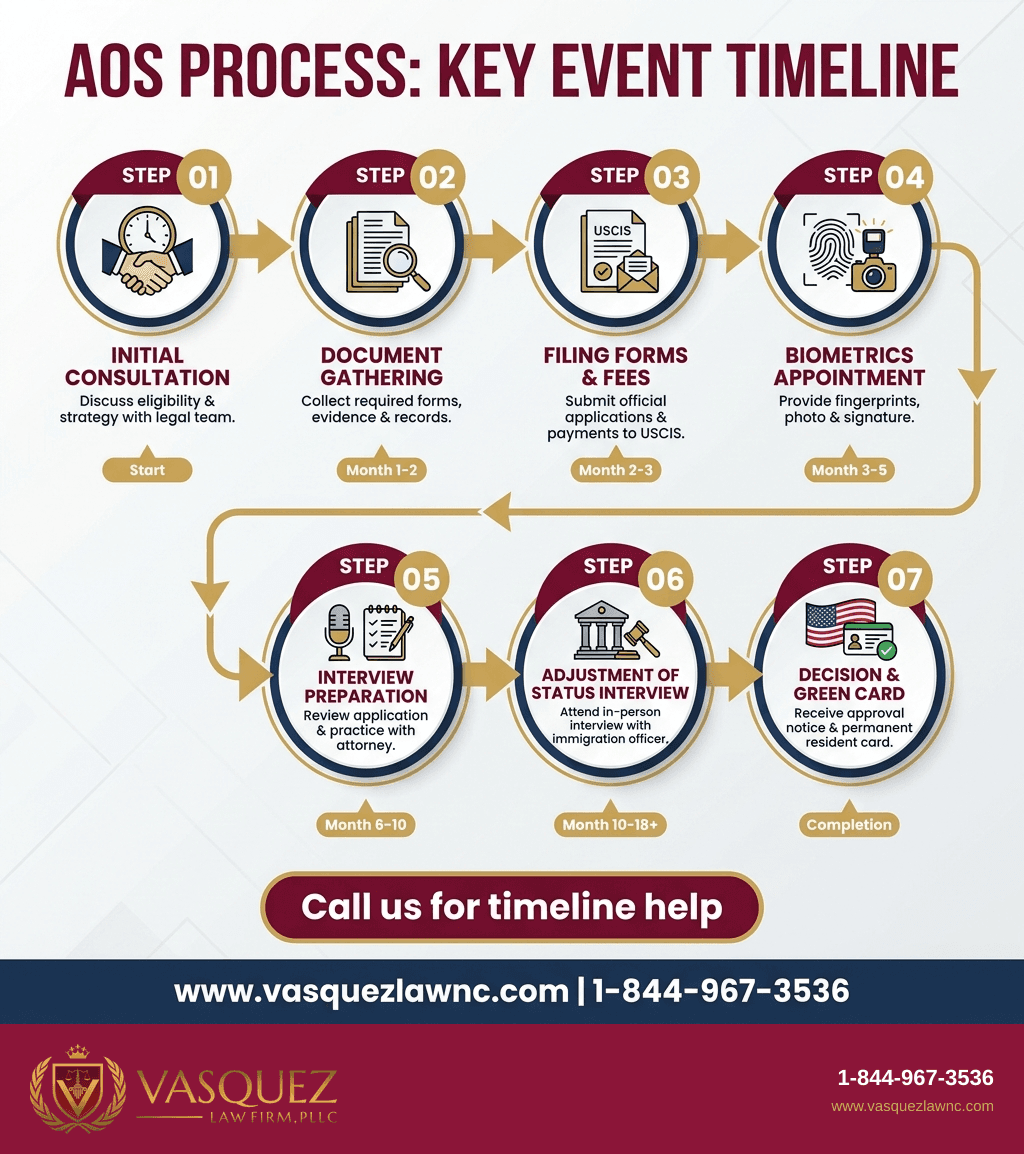
- Determine Eligibility: Confirm you have a qualifying immigrant petition (e.g., Form I-130 for family or I-140 for employment) and meet admissibility requirements.
- File Form I-485: Submit a complete and signed application package including fees and supporting evidence to USCIS. Include forms like I-130, I-864 affidavit of support, and identity documents as required.
- Biometrics Appointment: USCIS schedules fingerprinting and photo appointments to conduct background checks.
- Attend USCIS Interview: Many applicants are required to attend an interview where a USCIS officer verifies the information and evaluates eligibility.
- Receive Decision: USCIS issues a notice of approval or denial. Approval grants lawful permanent residence status with a green card.
For people filing adjustment of status after marriage, this process typically involves concurrent filings of I-130 and I-485. It is important to follow USCIS instructions carefully to avoid delays or denials.
Additional Steps and Considerations
- If you have travel plans while your application is pending, you must apply for advance parole (Form I-131) to leave and re-enter the U.S. legally.
- Work authorization (Form I-765) can be requested while your adjustment is pending, usually taking 3 to 6 months to process.
- Exceptional cases involving extraordinary circumstances may receive expedited processing or discretion from USCIS.
Documents and Evidence Checklist
Submitting a thorough evidence package is crucial. Key documents include:
- Completed and signed Form I-485 plus applicable filing fees.
- Approved immigrant petition (e.g., Form I-130 approval notice).
- Proof of lawful entry to the U.S. (I-94 arrival record or visa).
- Two passport-style photos meeting USCIS specifications.
- Government-issued identification documents such as passport or driver’s license.
- Birth certificate with certified English translation if applicable.
- Medical examination report (Form I-693) from an authorized civil surgeon.
- Affidavit of support (Form I-864) from petitioner to demonstrate financial ability.
- Marriage certificate for family-based applications.
- Police clearance or court records if there is any history requiring disclosure.
Several items on that list, including the birth certificate, marriage certificate and police records, are issued by your home country rather than by USCIS, and your consulate is where you request them. Find yours in our free consulate directory: 137 consular offices across 16 countries, with addresses, phone numbers and appointment portals.
Failing to provide complete or accurate evidence often leads to Requests for Evidence (RFEs) or delays.
Timeline: What to Expect in 2026
The USCIS Adjustment of Status timeline varies by local office and applicant category. Recent USCIS processing times for Form I-485 show averages between 8 and 14 months. Here is a general timeline:
- Weeks 1-4: Receipt Notice from USCIS confirming application intake.
- Weeks 6-8: Biometrics appointment notice and completion.
- Months 2-8: Background and security checks conducted by USCIS.
- Months 5-12: Interview scheduling and completion.
- Months 8-14: USCIS final decision mailed.
Applicants should monitor status online and respond promptly to any USCIS correspondence. Delays can occur if additional evidence or clarifications are needed.
Checking Status
USCIS maintains an online case status tool at their official site. Entering your receipt number provides updated processing information.
Costs and Fees Impacting Adjustment of Status
As of 2026, typical USCIS fees for adjustment of status include:
- Filing fee for Form I-485: $1,140 for applicants aged 14-78.
- Biometrics fee: $85 for applicants required to provide fingerprints.
- Work permit (I-765) and travel permit (I-131) fees may be additional or waived if filed concurrently.
- Medical examination costs paid separately to the civil surgeon.
Legal fees for attorney representation vary based on case complexity but provide value by ensuring correct filing and addressing potential legal issues early.
Common Mistakes and How to Avoid Them
- Incomplete Form Submission: Ensure every page is completed, signed, and dated properly to avoid RFEs.
- Missing Supporting Documents: Submit all required evidence, especially proof of relationship and lawful entry.
- Ignoring Biometrics or Interview Notices: Always attend appointments to prevent application denial.
- Failure to Update USCIS Address: Notify USCIS within 10 days if you move to keep notices from getting lost.
- Unauthorized Travel: Leaving without advance parole can abandon your application.
- Undisclosed Criminal Records: Full disclosure avoids issues later in the process.
- Trying to DIY Complex Cases: Consulting an experienced immigration lawyer helps avoid costly errors.
If you only remember one thing: Complete your application carefully and seek professional help in Raleigh or Orlando for the best chance of success.
Jurisdiction Notes for NC, FL, and Nationwide Cases
North Carolina Notes
Vasquez Law Firm serves clients in Raleigh, NC, providing local insight and representation for USCIS adjustment of status cases. USCIS Charlotte Field Office handles many interviews and cases for NC residents. Local attorneys understand specific regional backlogs and procedural preferences.
Florida Notes
In Orlando, FL, the local USCIS field office oversees interviews and biometrics appointments for Florida residents seeking adjustment. Vasquez Law Firm offers bilingual immigration services at its Orlando office, helping clients from diverse backgrounds navigate adjustment smoothly under the latest USCIS policies.
Nationwide Concepts
Adjustment of status is a federal process uniform across the U.S. Federal laws and USCIS regulations guide eligibility and procedures. However, processing times, office practices, and local USCIS workloads vary. Nationwide eligibility restrictions under INA § 245 and related USCIS regulations apply to all cases.
When to Call a Lawyer for Adjustment of Status Help
- If you receive a Request for Evidence (RFE) or Notice of Intent to Deny (NOID)
- If you have a complex immigration or criminal history
- If you suspect eligibility issues or inadmissibility grounds
- Before submitting your adjustment application
- When you receive a USCIS interview notice and need preparation
- If you are unsure about using advance parole or work authorization
- After denial of your adjustment application
- For assistance with waivers of inadmissibility
About Vasquez Law Firm
At Vasquez Law Firm, we combine compassion with aggressive representation. Our motto "Yo Peleo®" (I Fight) reflects our commitment to standing up for your rights.
- Bilingual Support: Se Habla Español — Spanish-speaking attorneys and staff available
- Service Areas: North Carolina, Florida, and nationwide immigration services
- Experience: Over 30 years helping clients navigate complex legal matters
- Results: Thousands of successful cases across multiple practice areas
Attorney Trust and Experience
William J. Vásquez is admitted to the North Carolina State Bar (2011) and to the U.S. Courts of Appeals for the 4th, 5th, and 11th Circuits. Florida-jurisdiction matters at the firm are handled by Florida Bar attorney Harold Estrada-Rodriguez (FL Bar No. 1041171). The firm has provided dedicated legal representation since 2011, with personalized attention to each client's case.
Don't wait to get the help you deserve. Call us now for immediate assistance.
Se Habla Español
Frequently Asked Questions
What is USCIS Adjustment of Status?
USCIS Adjustment of Status is the federal process that allows eligible foreign nationals physically present in the U.S. to apply for lawful permanent residence without leaving the country, governed by 8 U.S.C. § 1255 and requiring Form I-485 submission and background checks.
Who qualifies for adjustment of status in 2026?
Applicants must have an approved petition, be physically in the U.S., and meet admissibility requirements. Special categories apply to refugees and humanitarian cases. Legal advice helps ensure eligibility.
How long does the adjustment of status process take?
Processing times average 8 to 14 months in 2026, varying by case type and USCIS office workload. Check official USCIS processing times regularly for updates.
What forms are required for USCIS adjustment of status?
Form I-485 is primary, supported by approved immigrant petition forms, affidavits of support, identity documents, medical exam forms, work and travel authorization forms if needed.
Can adjustment of status be filed after marriage?
Yes. Spouses of U.S. citizens or permanent residents commonly apply using I-130 by the petitioner and I-485 by the beneficiary, proving a bona fide marriage and meeting admissibility standards.
What are common mistakes that delay adjustment of status?
Errors like incomplete forms, missing documents, missed appointments, unauthorized travel, or undisclosed criminal history can cause delays or denials. Hiring a skilled immigration lawyer reduces risks.
Can I work while my adjustment of status is pending?
Yes, if you apply for and receive a work permit (Form I-765). Processing usually takes 3 to 6 months. Working without authorization may hurt your application.
What happens after USCIS grants adjustment of status?
Approval grants a green card, allowing permanent residency and work authorization. Green cards last 10 years and can be renewed. After residency requirements, citizenship may be pursued.
Sources and References
- U.S. Citizenship and Immigration Services
- Executive Office for Immigration Review
- Legal Information Institute
Take the first step toward justice today. Our team is standing by to help.
Start Your Free Evaluation Now
Call us: 1-844-967-3536
Se Habla Español - Estamos aquí para ayudarle.
If you need legal assistance, learn more about speak with an immigration lawyer, or call us at 1-844-967-3536 for a free evaluation.


William Vasquez
Founder & CEO, Vasquez Law Firm, PLLC
William Vasquez is the founder and CEO of Vasquez Law Firm, PLLC, a results-driven firm specializing in immigration, criminal defense, personal injury, and workers' compensation. A U.S. Air Force veteran and recipient of the Joint Service Achievement Medal, William is dedicated to fiercely fighting for his clients' rights.
Related Legal Services
Need legal help? Learn more about speak with an immigration lawyer, or contact us for a free evaluation.
You can also visit our North Carolina immigration practice for more information.