How to Protect Your Rights With Deportation Defense in 2026
Facing deportation? Learn about deportation defense strategies and protect your rights in 2026. Contact Vasquez Law Firm for a free consultation.
Published on March 4, 2026
Talk to an immigration attorney
Free call. A clear plan for your case.
Free & confidential · Se habla espanol · 24/7
Have questions? Talk to an attorney - free evaluation.
Call 1-844-967-3536Check your case status now
Look up your immigration case below, then talk to an attorney about what it means — free.
Questions about your result?
Talk to an attorney about your case — free, no obligation.
How to Protect Your Rights With Deportation Defense in 2026
Facing the threat of deportation can be an incredibly frightening and overwhelming experience for anyone, especially Dreamers and their families in North Carolina and Florida. Understanding your rights and having a robust deportation defense strategy is crucial. In 2026, immigration laws continue to evolve, making expert legal guidance more vital than ever to navigate the complexities of the U.S. immigration system. Vasquez Law Firm is dedicated to fighting for individuals and families facing removal proceedings, offering compassionate yet aggressive representation.
Need help with your case? Our experienced attorneys are ready to fight for you. Se Habla Español.
Schedule Your Free Case Evaluation
Or call us now: 1-844-967-3536
Quick Answer
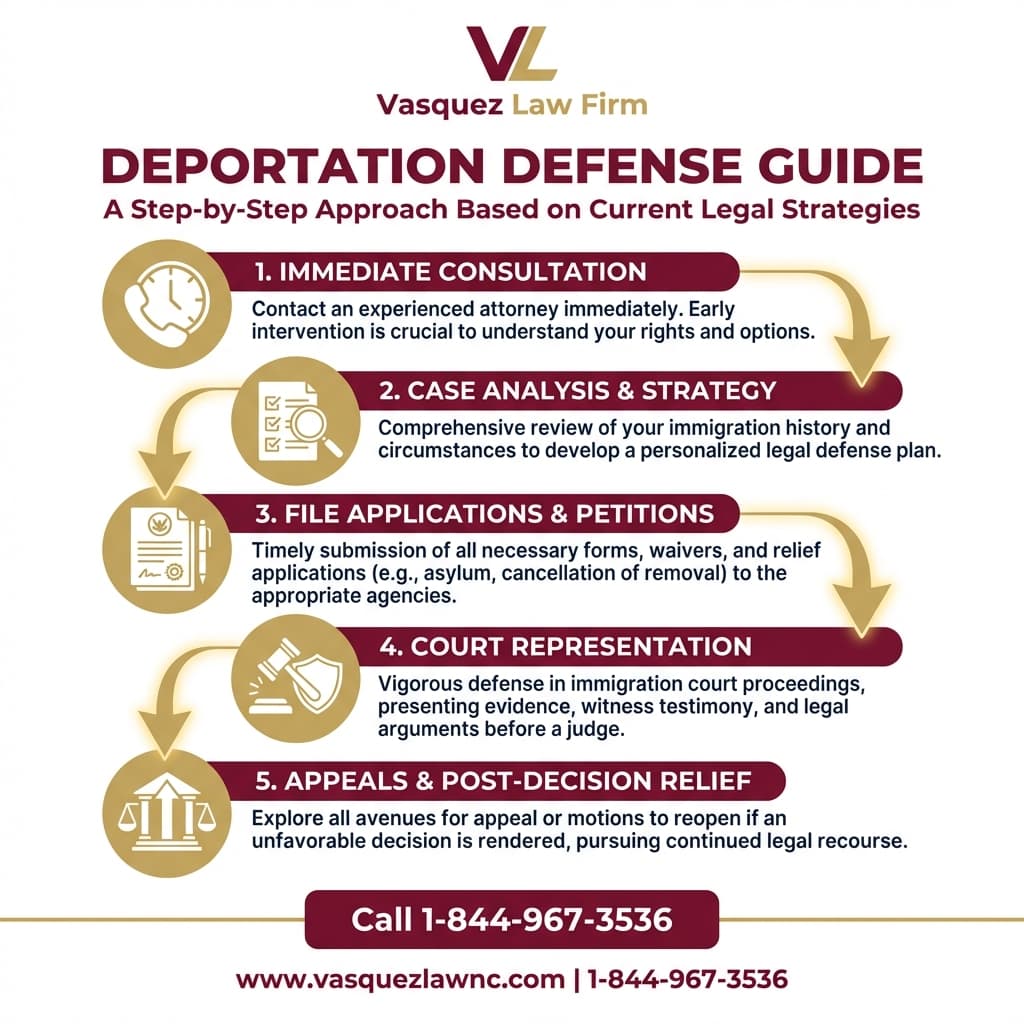
Deportation defense involves legal strategies to prevent an individual from being removed from the United States. This can include seeking various forms of relief, challenging the grounds for removal, or demonstrating eligibility for lawful status. Effective defense requires understanding immigration law and presenting a strong case in immigration court.
- Identify grounds for removal.
- Explore available forms of relief (e.g., asylum, cancellation of removal).
- Gather compelling evidence and documentation.
- Challenge legal or factual errors in the government's case.
- Seek experienced legal counsel immediately.
Understanding Deportation Defense: What It Means for You
Deportation, also known as removal, is the formal process by which the U.S. government orders a non-citizen to leave the country. This can happen for many reasons, including visa violations, criminal convictions, or overstaying a permitted period of stay. When you are placed in removal proceedings, it means the Department of Homeland Security (DHS) believes you are deportable under U.S. immigration law, and you will have a hearing before an Immigration Judge.
Deportation defense refers to the legal strategies and arguments used to fight against a removal order. This is not a lost cause; many individuals successfully avoid deportation with the right legal representation. The goal is to either terminate the proceedings, allow you to remain in the U.S. legally, or secure a form of relief that prevents your removal. Understanding the specific charges against you and the potential avenues for relief is the first critical step in building a strong defense.
Navigating the immigration court system can be incredibly complex, with strict deadlines and intricate legal procedures. An attorney specializing in deportation defense can analyze your case, identify potential defenses, and represent you effectively throughout the process. This expertise is essential for anyone facing such a serious legal challenge, particularly in areas like Orlando, Florida, or across North Carolina, where immigrant communities are significant.
Common Grounds for Deportation and How to Address Them
The U.S. Immigration and Nationality Act (INA) outlines numerous reasons why a non-citizen may be deemed deportable. These grounds can range from minor infractions to serious criminal offenses. Understanding the specific basis for your removal proceedings is paramount to developing an effective deportation defense. Some of the most common grounds include:
- Visa Overstays: Remaining in the U.S. beyond the authorized period of your visa.
- Criminal Convictions: Certain crimes, particularly aggravated felonies, crimes involving moral turpitude, and drug offenses, can lead to deportation.
- Immigration Fraud: Misrepresentation or fraud in obtaining a visa or other immigration benefit.
- Unlawful Entry: Entering the U.S. without inspection or parole.
- Violation of Visa Terms: Engaging in activities not permitted by your visa, such as unauthorized employment.
Each ground for deportation has specific legal nuances and potential defenses. For example, some criminal convictions might be challenged if they do not meet the legal definition of a deportable offense, or if you were not properly advised of the immigration consequences during your criminal case. For those facing deportation based on criminal charges, an attorney can often work to vacate or modify the criminal conviction, thereby eliminating the grounds for removal. This complex interplay between criminal and immigration law requires specialized knowledge, which a deportation defense attorney possesses.
Moreover, certain forms of relief may be available even if the grounds for deportation are clear. These include asylum for those fleeing persecution, cancellation of removal for long-term residents, and waivers for specific inadmissibility issues. Identifying the most suitable defense or relief option for your unique circumstances is a critical part of the legal strategy.
Key Deportation Defense Strategies and Forms of Relief
When facing removal proceedings, several legal avenues can be pursued to prevent deportation. The strategy chosen will depend heavily on the specific facts of your case, your immigration history, and any criminal record. An experienced attorney will evaluate all possible options to build the strongest possible deportation defense.
Asylum and Withholding of Removal
Individuals who fear persecution in their home country based on race, religion, nationality, political opinion, or membership in a particular social group may be eligible for asylum or withholding of removal. Asylum provides a path to legal permanent residency, while withholding of removal prevents deportation to a specific country where persecution is feared. Asylum claims require demonstrating a well-founded fear of persecution and are often complex, requiring extensive documentation and testimony. For more information on eligibility, you can refer to the U.S. Citizenship and Immigration Services (USCIS) website.
Cancellation of Removal
This form of relief is available to certain non-permanent residents who have been in the U.S. for a significant period, have good moral character, and can demonstrate that their removal would cause extreme and unusual hardship to a qualifying U.S. citizen or lawful permanent resident spouse, parent, or child. There are strict eligibility requirements, including a continuous physical presence in the U.S. for at least 10 years, and a limit on the number of approvals each year. For lawful permanent residents, cancellation of removal may be available if they have resided in the U.S. for at least five years and have been a lawful permanent resident for at least seven years, and have not committed certain serious offenses.
Adjustment of Status and Waivers
If you are eligible for a Green Card through a family petition or employment, you might be able to adjust your status while in removal proceedings, provided you meet certain criteria. Additionally, waivers of inadmissibility can forgive certain immigration violations or criminal offenses, allowing an individual to remain in the U.S. These waivers are often discretionary and require a compelling showing of hardship or other factors. For example, 8 U.S.C. § 1255 allows for adjustment of status for certain individuals. Further details on eligibility can be found in 8 C.F.R. § 245.1.
Prosecutorial Discretion
In some cases, the government attorney may agree to close or terminate removal proceedings through prosecutorial discretion. This often occurs when an individual has strong equities, no serious criminal history, and their removal is not deemed a priority by immigration enforcement. While not a form of relief itself, it can provide a temporary or permanent reprieve from deportation.
The Immigration Court Process: What to Expect in 2026
The immigration court process can be lengthy and confusing, often taking years to resolve. Knowing what to expect can help you prepare mentally and strategically for your deportation defense. The process typically begins with a Notice to Appear (NTA), which formally charges you with deportability and schedules your first hearing, known as a Master Calendar Hearing.
Master Calendar Hearings
These are preliminary hearings where you meet the Immigration Judge for the first time. The judge will confirm your identity, ensure you understand the charges, and ask you to admit or deny the allegations in the NTA. This is also where you or your attorney will inform the judge of your intent to seek any forms of relief from deportation. Multiple Master Calendar Hearings may be scheduled to allow time for document filing or to find an attorney.
Individual Hearings
If you pursue a form of relief, the judge will schedule an Individual Hearing, which is essentially a trial. During this hearing, you and your attorney will present evidence, call witnesses, and provide testimony to support your application for relief. The government attorney will also present their case and may cross-examine you and your witnesses. This is where your deportation defense strategy is fully executed, and a significant amount of preparation is required.
Appeals
If the Immigration Judge denies your application for relief, you generally have the right to appeal the decision to the Board of Immigration Appeals (BIA). If the BIA also denies your appeal, you may be able to appeal to a federal circuit court. The appellate process is complex and has strict deadlines, making experienced legal counsel indispensable. Understanding the appellate process is a key component of a comprehensive deportation defense.
Documents and Evidence Checklist for Deportation Defense
Building a strong deportation defense requires comprehensive documentation. Organizing your documents early can significantly impact your case's success. Your attorney will help you identify exactly what is needed, but here's a general checklist:
- Personal Identification: Passport, birth certificate, driver's license.
- Immigration Documents: Visa, I-94, Green Card (if applicable), previous immigration applications, notices from USCIS or ICE.
- Proof of Residence: Utility bills, leases, mortgage statements, showing continuous physical presence in the U.S.
- Financial Records: Tax returns, pay stubs, bank statements, demonstrating financial stability and contributions.
- Family Ties: Birth certificates of U.S. citizen or LPR children, marriage certificates, affidavits from family members.
- Medical Records: Especially if seeking asylum or claiming extreme hardship due to medical conditions.
- Criminal Records: Certified copies of all criminal court dispositions, even for minor offenses.
- Character Evidence: Letters of recommendation, community involvement proof, school records.
- Evidence of Persecution (for Asylum): News articles, human rights reports, affidavits from witnesses to persecution.
Remember, the more organized and complete your documentation, the smoother your deportation defense process will be. Missing or incomplete documents can cause delays or even lead to denial of relief. Your attorney will guide you through gathering and presenting this critical evidence to the immigration court.
Common Mistakes in Deportation Defense and How to Avoid Them
Navigating deportation proceedings is fraught with potential pitfalls. Avoiding common mistakes can significantly improve your chances of a successful outcome. Here are some critical errors and how to prevent them:
- Failing to Appear in Court: Missing a scheduled hearing can lead to an immediate removal order (in absentia), making it extremely difficult to reopen your case. Always confirm your hearing dates and arrive early.
- Providing False Information: Lying or submitting fraudulent documents to immigration authorities can result in permanent bars to future immigration benefits and severe penalties. Always be truthful and transparent.
- Not Disclosing Criminal History: Attempting to hide past arrests or convictions, even minor ones, can severely damage your credibility and complicate your deportation defense. Disclose everything to your attorney.
- Waiting Too Long to Seek Legal Help: Delaying consultation with an immigration attorney can mean missing critical deadlines or losing eligibility for certain forms of relief. Time is often of the essence in these cases.
- Signing Documents Without Understanding: Never sign any document from ICE or the court without fully understanding its contents and implications, ideally with legal counsel present.
- Representing Yourself: While you have the right to self-representation, the complexities of immigration law make it incredibly challenging for non-attorneys to succeed. This is a common and often fatal mistake in deportation defense.
- Not Gathering Sufficient Evidence: A weak case is often one with insufficient supporting documentation. Ensure you collect all relevant evidence as advised by your attorney.
- Ignoring Changes in Law: Immigration law is dynamic. Failing to stay updated or relying on outdated information can harm your case. An attorney remains current on all legal developments.
If you only remember one thing: Never underestimate the complexity of deportation proceedings and always seek qualified legal representation as early as possible. Your future in the U.S. depends on it.
NC, FL, and Nationwide Immigration Notes
Immigration law is primarily federal, meaning the core statutes and regulations apply uniformly across the United States. However, the practical application and local enforcement priorities can vary, impacting deportation defense strategies in different regions, including North Carolina and Florida.
North Carolina Notes
In North Carolina, immigration enforcement has seen various levels of cooperation with federal agencies. ICE maintains a presence, and individuals arrested for state criminal offenses may be subject to immigration detainers. Understanding local court procedures and having an attorney familiar with the specific immigration courts in North Carolina is crucial. Vasquez Law Firm has extensive experience helping individuals across the state, from Charlotte to Raleigh, navigate these challenges.
Florida Notes
Florida, particularly areas like Orlando, has a large and diverse immigrant population, leading to a high volume of immigration court cases. The state has also seen various legislative actions impacting immigrant communities. Detainers and arrests by ICE are common, making immediate legal intervention vital for anyone facing removal proceedings. Our firm serves clients throughout Florida, providing dedicated deportation defense.
Nationwide Concepts
While local factors can influence enforcement, the fundamental principles of deportation defense are consistent nationwide. The Immigration and Nationality Act (INA) governs all removal proceedings, and appeals often go through federal courts. This means that while local nuances exist, a strong understanding of federal immigration law is paramount for any effective deportation defense, regardless of your location. We leverage our federal experience to serve clients across both North Carolina and Florida, and nationwide for immigration matters.
When to Call a Lawyer for Deportation Defense Now
The moment you suspect you might be facing deportation or have any interaction with immigration enforcement, it's critical to act quickly. Delay can severely limit your options. Here are key triggers indicating you should call an attorney immediately:
- You have received a Notice to Appear (NTA) in immigration court.
- You or a family member has been detained by ICE.
- You are concerned about a past criminal conviction and its immigration consequences.
- You have overstayed your visa or violated its terms.
- You are considering applying for asylum or other forms of relief.
- You have been denied an immigration benefit and believe it was in error.
- You are a lawful permanent resident who has been arrested.
- You are a DACA recipient whose status is uncertain or who has had an interaction with law enforcement.
- You have been told you are inadmissible to the U.S.
Early intervention by an experienced attorney can make all the difference in a deportation defense case, potentially preventing detention, securing bond, or identifying crucial forms of relief before it's too late. Do not delay in seeking professional legal advice.
About Vasquez Law Firm
At Vasquez Law Firm, we combine compassion with aggressive representation. Our motto "Yo Peleo" (I Fight) reflects our commitment to standing up for your rights. We understand the immense stress and uncertainty that come with immigration challenges, especially when facing deportation.
- Bilingual Support: Se Habla Español - our team is fully bilingual and ready to communicate effectively in your preferred language.
- Service Areas: We proudly serve clients throughout North Carolina, Florida, and provide nationwide immigration services.
- Experience: With over 15 years of dedicated legal experience, we have a proven track record of helping clients navigate complex legal matters.
- Results: Our firm has achieved thousands of successful outcomes across various practice areas, fighting tirelessly for our clients' futures.
Attorney Trust and Experience
Attorney Vasquez holds a Juris Doctor degree and is admitted to practice in both the North Carolina State Bar and Florida Bar. With over 15 years of dedicated legal experience, Attorney Vasquez has built a reputation for providing personalized attention and achieving favorable outcomes for his clients. He leads a team committed to excellence in every case, ensuring that each client receives the focused and effective representation they deserve. You can learn more about Attorney Vasquez and our team on our website.
Don't face your legal challenges alone. Our team is here to help you every step of the way.
Call today: 1-844-967-3536 | Se Habla Español
Frequently Asked Questions
What is a deportation defense?
Deportation defense refers to the legal strategies employed to prevent an individual from being removed from the United States. This can involve challenging the government's grounds for removal, applying for various forms of relief such as asylum or cancellation of removal, or demonstrating eligibility to adjust status. An attorney specializing in deportation defense works to protect your right to remain in the U.S. legally.
Can a U.S. citizen get deported now?
No, a natural-born or naturalized U.S. citizen cannot be deported from the United States. Citizenship provides an absolute right to reside in the country. While there have been rare cases of denaturalization for fraud in obtaining citizenship, once citizenship is validly acquired, the individual is protected from deportation. If you are a U.S. citizen and facing such a threat, seek legal counsel immediately.
How do I defend against deportation?
Defending against deportation involves several steps: understanding the specific charges in your Notice to Appear, identifying any available forms of relief (like asylum, cancellation of removal, or adjustment of status), gathering comprehensive evidence, and presenting a strong case in immigration court. It is highly recommended to seek immediate assistance from an experienced immigration attorney to guide you through this complex process.
Can ICE deport permanent residents?
Yes, U.S. Immigration and Customs Enforcement (ICE) can deport lawful permanent residents (Green Card holders) if they commit certain offenses or violate immigration laws. Common grounds include aggravated felonies, crimes involving moral turpitude, and certain drug offenses. Permanent residents have stronger protections than other non-citizens, but they are not immune to removal proceedings, making a robust deportation defense crucial.
What is the difference between deportation and removal?
Historically, "deportation" and "removal" were distinct legal terms, but with the passage of the 1996 immigration laws, they are now largely used interchangeably to refer to the government's process of expelling a non-citizen from the U.S. The formal term used in current legal proceedings is "removal proceedings." Both terms signify the same serious legal action, requiring a strong deportation defense.
How long does a deportation case take?
The length of a deportation case can vary significantly, ranging from a few months to several years, depending on factors such as the complexity of the case, the specific immigration court, the judge's docket, and whether appeals are filed. Cases involving asylum claims or complex criminal issues often take longer. An attorney can provide a more specific timeline estimate for your situation.
What happens if I lose my deportation case?
If you lose your deportation case and all appeals are exhausted, the Immigration Judge's removal order becomes final. At this point, ICE will typically issue a Warrant of Removal and take steps to physically remove you from the United States. It is crucial to explore all possible avenues of relief and appeal options with an attorney before a final order is issued.
Can I reopen a deportation case?
It is sometimes possible to reopen a deportation case, but it is very difficult. Motions to reopen are typically filed with the Immigration Judge or the Board of Immigration Appeals and must meet strict legal requirements, such as presenting new, material evidence that was not available at the time of the original hearing. Deadlines are usually very tight, making immediate legal action essential.
What is prosecutorial discretion in deportation cases?
Prosecutorial discretion refers to the government's power to decide whether to pursue or terminate removal proceedings against a non-citizen. It's not a form of relief but an exercise of discretion by ICE attorneys. They might agree to close a case based on humanitarian factors, strong family ties, or other equities, especially if the individual is not deemed a public safety threat. An attorney can advocate for its use.
Can I get a work permit while in deportation proceedings?
Yes, in many instances, individuals in deportation proceedings may be eligible to apply for an Employment Authorization Document (EAD), also known as a work permit. Eligibility often depends on the specific form of relief they are seeking (e.g., asylum, cancellation of removal). Your immigration attorney can assess your eligibility and help you file the necessary application with USCIS.
Sources and References
- U.S. Citizenship and Immigration Services (USCIS)
- Executive Office for Immigration Review (EOIR)
- 8 U.S. Code § 1255 - Adjustment of status of nonimmigrant to that of person admitted for permanent residence
- 8 C.F.R. § 245.1 - Eligibility
Need immigration help? Our immigration attorneys can review your case.
Ready to take the next step? Contact Vasquez Law Firm today for a free, confidential consultation. We're committed to fighting for your rights and achieving the best possible outcome for your case.
Start Your Free Case Evaluation Now
Call us: 1-844-967-3536
Se Habla Español - Estamos aquí para ayudarle.


William Vasquez
Founder & CEO, Vasquez Law Firm, PLLC
William Vasquez is the founder and CEO of Vasquez Law Firm, PLLC, a results-driven firm specializing in immigration, criminal defense, personal injury, and workers' compensation. A U.S. Air Force veteran and recipient of the Joint Service Achievement Medal, William is dedicated to fiercely fighting for his clients' rights.
Related Legal Services
Need legal help? Learn more about our immigration law practice, or contact us for a free evaluation.
You can also visit immigration lawyers serving all of North Carolina for more information.