What to Expect From ICE Restrictions in Portland in 2026
Understand ICE restrictions in Portland, Oregon, and your immigration rights in 2026. Get legal help and protect your family. Contact Vasquez Law for a free consultation.
Published on February 28, 2026
Talk to an immigration attorney
Free call. A clear plan for your case.
Free & confidential · Se habla espanol · Mon-Fri 8am-7pm, Sat 9am-2pm (ET)
Have questions? Talk to an attorney - free evaluation.
Call 1-844-967-3536Worried how the latest immigration news affects you?
Schedule a confidential case review with an immigration attorney - know exactly where you stand.
USCIS Case Status
Check your USCIS case status
Enter your receipt number and get the official status. Free, no registration.
What to Expect From ICE Restrictions in Portland in 2026
Navigating immigration enforcement can be complex, especially with specific legal developments like the ongoing ICE restrictions Portland has seen. As of 2026, understanding your rights and the legal framework governing U.S. Immigration and Customs Enforcement (ICE) operations is crucial for individuals and families in Portland, across North Carolina, Florida, and nationwide. This guide will help you understand the current landscape of ICE enforcement and how to protect yourself and your loved ones.
Need help with your immigration case? Our experienced attorneys are ready to fight for you. Se Habla Español.
Schedule Your Free Case Evaluation
Or call us now: 1-844-967-3536
Table of Contents
- Quick Answer
- Understanding ICE Enforcement in 2026
- ICE Restrictions Portland and Court Orders
- Know Your Rights During ICE Encounters
- Steps to Take if ICE Contacts You
- Common Mistakes to Avoid with ICE
- Immigration Detention and Bond Process
- When to Call an Immigration Lawyer Now
- About Vasquez Law Firm
- Frequently Asked Questions
- Sources and References
Quick Answer
ICE restrictions in Portland, Oregon, primarily stem from federal court orders limiting certain enforcement tactics, particularly regarding the use of force and crowd control during protests. These restrictions aim to protect civil liberties while ICE carries out its mission. It is vital for immigrants and their allies to stay informed about these specific rulings and their broader implications for immigration enforcement policies nationwide as of 2026.
- Federal court orders limit specific ICE tactics in Portland.
- Restrictions often relate to use of force during demonstrations.
- These orders can influence ICE operations in other localities.
- Knowing your rights is paramount during any ICE encounter.
- Always seek legal counsel for specific immigration concerns.
Understanding ICE Enforcement in 2026
U.S. Immigration and Customs Enforcement (ICE) is a federal agency responsible for enforcing immigration laws. Their operations can range from border security to interior enforcement, including arrests, detentions, and deportations. In 2026, ICE's mandate continues to be broad, but the manner in which they operate can be shaped by local policies, federal court rulings, and community advocacy, particularly in areas like Portland.
It's important to differentiate between federal immigration law, which applies nationwide, and specific operational guidelines or court-ordered restrictions that might apply to a particular region or facility. These localized restrictions, such as those impacting ICE operations in Portland, do not change federal law but can alter how enforcement is carried out on the ground. For example, a court order might specify conditions under which agents can use certain tactics or interact with the public, without changing who is subject to immigration laws.
Understanding the distinction is crucial for anyone interacting with ICE. While federal law dictates who can be arrested or deported, local restrictions or policies might dictate the procedures ICE must follow. This nuanced environment requires informed action and, often, the guidance of an experienced immigration attorney. If you have questions about ICE enforcement in Raleigh, North Carolina, or anywhere else, contact Vasquez Law Firm.
Infographic: Your Rights During an ICE Encounter
This infographic outlines the fundamental rights individuals have when encountering ICE. It details actions to take and avoid to protect your civil liberties.
ICE Restrictions Portland and Court Orders
The city of Portland, Oregon, has been a focal point for significant discussions and legal challenges regarding ICE operations. In 2026, the primary ICE restrictions Portland faces are largely a result of federal court interventions, often in response to public protests and concerns over the conduct of federal agents. These court orders typically aim to regulate the use of force, surveillance, and crowd control tactics by federal officers, including ICE agents, during public demonstrations.
For instance, a federal judge may issue an injunction preventing agents from using specific chemical agents or less-lethal munitions against protesters without clear justification, or may mandate specific identification and warning protocols. These restrictions are not a blanket prohibition on ICE enforcement but rather a directive on how agents must conduct themselves in certain situations. They reflect a balance between federal enforcement powers and the constitutional rights of individuals, including non-citizens.
It is important to note that these specific court orders are often dynamic and can be subject to appeals or modifications. While they may originate from events in Portland, their legal precedents can influence how federal agencies operate in other jurisdictions, including in North Carolina and Florida. Staying informed about these legal developments is part of preparing for potential ICE encounters, regardless of where you reside. Understanding the scope of these ICE restrictions Portland has experienced can help individuals better assert their rights.
Impact on Immigration Detentions
While court orders in Portland often focus on street-level enforcement during protests, they can indirectly impact the broader landscape of immigration detentions. When ICE operations face increased scrutiny, there may be shifts in how and where arrests are made, or a greater emphasis on due process. However, the fundamental authority of ICE to detain individuals suspected of immigration violations remains largely unchanged by these localized restrictions.
For those facing immigration detention, the location of the detention facility and the specific policies governing it are critical. Even with ICE restrictions Portland has implemented, individuals detained in Oregon or elsewhere are subject to federal immigration laws. Seeking legal counsel immediately upon detention is paramount to understanding bond eligibility and deportation defense strategies. Vasquez Law Firm assists clients with immigration detention matters across North Carolina and Florida.
Know Your Rights During ICE Encounters
Regardless of where you are in the United States, including Portland, Raleigh, or Miami, you have fundamental rights when encountering ICE agents. Knowing these rights can significantly impact the outcome of an interaction. These rights are guaranteed by the U.S. Constitution and apply to all individuals, regardless of immigration status.
- Right to Remain Silent: You have the right to refuse to answer questions from ICE agents. You can state, "I do not wish to speak with you."
- Right to an Attorney: You have the right to speak with an attorney. You can state, "I want to speak to my lawyer." Do not sign anything without consulting an attorney.
- Right to Refuse Search: ICE agents generally cannot search your home or property without a warrant signed by a judge. This warrant must specifically name you and your address. You do not have to open your door unless they have a warrant.
- Do Not Lie: While you have the right to remain silent, never provide false information to a federal agent.
- Document Everything: If possible, write down or remember everything that happened, including agent names, badge numbers, vehicle descriptions, and what was said.
Exercising these rights can be intimidating, especially when faced with federal agents. However, asserting them calmly and clearly is the best way to protect yourself. Remember that these rights are universal, even amid specific ICE restrictions Portland might enforce. For more information on your rights, visit the USCIS website.
Steps to Take if ICE Contacts You
An encounter with ICE can be a frightening experience. Knowing the right steps to take can help you protect your rights and potentially avoid severe consequences. These steps are applicable whether ICE approaches you in Portland, North Carolina, Florida, or any other state.
- Stay Calm and Do Not Resist: Even if you believe an arrest is unlawful, resisting can lead to additional charges. Remain calm and follow instructions while asserting your rights.
- Do Not Open Your Door: If ICE agents come to your home, do not open the door unless they show you a warrant signed by a judge. A warrant for arrest is different from a search warrant. If they have a search warrant for your address, they may enter. If they only have an administrative warrant (Form I-200 or I-205), you are not required to open the door. Ask them to slide the warrant under the door or hold it up to a window.
- Exercise Your Right to Remain Silent: You are not required to answer questions about your immigration status, birthplace, or how you entered the U.S. Clearly state, "I do not wish to answer any questions without my attorney present."
- Do Not Sign Anything: Never sign any document without first reviewing it with an attorney. Signing documents can waive important rights or admit to deportable offenses.
- Contact an Attorney Immediately: As soon as possible, contact an immigration lawyer. Provide them with all the details of your encounter. If you are detained, ensure your family knows to contact an attorney for you. Vasquez Law Firm can help with immigration defense.
- Document the Encounter: If safe to do so, document the interaction. Note agent names, badge numbers, agency, vehicle descriptions, and details of what happened. This information is critical for your attorney.
These proactive steps are essential for anyone who might encounter ICE. The legal landscape, even with specific ICE restrictions Portland might have, still grants agents broad powers, making informed action your best defense.
Common Mistakes to Avoid with ICE
When interacting with ICE, certain common mistakes can inadvertently jeopardize your immigration case or civil liberties. Being aware of these pitfalls can help you navigate potentially stressful situations more effectively, whether you're in Portland, North Carolina, or Florida.
- Opening the Door Without a Warrant: Many people mistakenly believe they must open their door when ICE knocks. Unless agents present a judicial search warrant (not an administrative warrant), you are not obligated to open your door. Opening it can grant them implied consent to enter.
- Answering Questions About Your Status: You have the right to remain silent. Providing information about your immigration status, country of origin, or how you entered the U.S. can be used against you in removal proceedings.
- Signing Documents Without Legal Review: Never sign any document presented by ICE without first having an attorney review it. These documents could include a Notice to Appear (NTA), a voluntary departure agreement, or a waiver of rights.
- Carrying False Documents: Presenting false identification or immigration documents to federal agents is a serious federal offense that can lead to criminal charges and complicate any future immigration relief.
- Lying to Agents: While you can remain silent, you should never lie to federal agents. Providing false information can result in criminal charges for making false statements to a federal officer.
- Resisting Arrest: Even if you believe the arrest is unlawful, physically resisting can lead to additional criminal charges, making your immigration case much harder to defend.
- Failing to Inform Family/Attorney of Detention: If you are detained, it's crucial that your family knows how to contact an attorney on your behalf. Delays in legal representation can severely impact your case.
If you only remember one thing: Always assert your right to remain silent and your right to an attorney. Do not open your door to ICE without a judicial warrant. These two actions are your strongest protections during an ICE encounter, even with specific ICE restrictions Portland has in place.
Immigration Detention and Bond Process
If an individual is arrested by ICE, they may be placed in immigration detention. This can happen in various facilities, from local jails under contract with ICE to dedicated immigration detention centers. The location of detention can impact access to legal counsel and family, making the process even more challenging. Even with ICE restrictions Portland may have, the detention process largely follows federal guidelines.
Once detained, an individual may be eligible for an immigration bond. An immigration bond allows a detained individual to be released from custody while their immigration case proceeds. The decision to grant bond, and the amount of the bond, is typically made by an Immigration Judge or, in some cases, by ICE. Factors influencing bond decisions include the individual's ties to the community, criminal history, flight risk, and whether they pose a danger to the community.
Navigating the bond process requires a deep understanding of immigration law and court procedures. An experienced immigration attorney can argue for a lower bond amount or for release without bond. If a bond is granted, a surety bond (through a bond agency) or a cash bond can be posted. Vasquez Law Firm helps families in North Carolina and Florida understand the immigrant bond process and works to secure the release of loved ones. See 8 U.S.C. § 1226 for federal statutes on apprehension and detention of aliens.
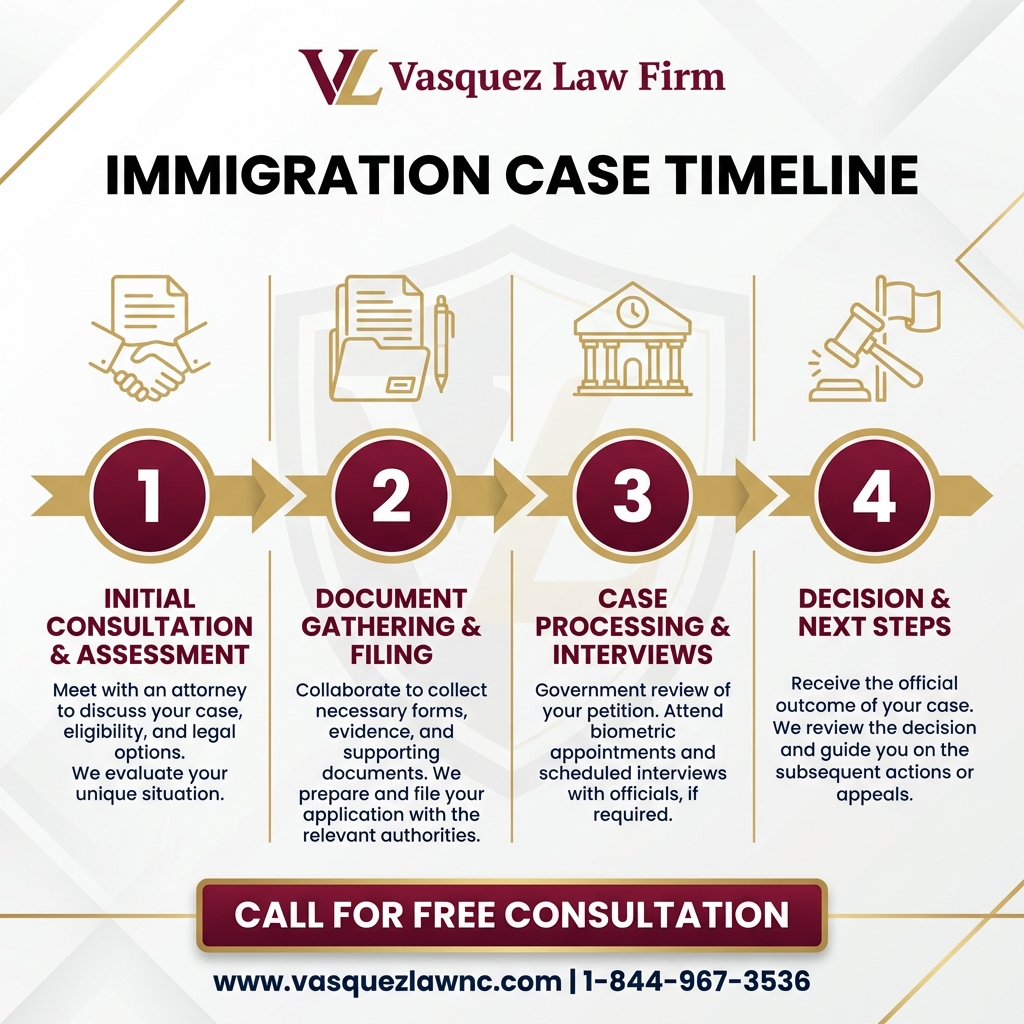
Infographic: Immigration Bond Process Overview
This infographic provides a clear, step-by-step overview of the immigration bond process, from arrest to release.
For help with immigration bonds, call 1-844-967-3536
When to Call an Immigration Lawyer Now
The complexities of immigration law, combined with the stress of potential ICE encounters or detention, make legal representation invaluable. Knowing when to contact an immigration lawyer immediately can be the difference between a successful outcome and a devastating one. Here are critical situations where you should call Vasquez Law Firm without delay, whether you are in Portland, North Carolina, or Florida:
- If ICE Contacts You: Even for a routine inquiry, do not speak with ICE without legal counsel.
- If You Are Arrested or Detained by ICE: This is the most urgent situation. An attorney can work to secure your release and begin preparing your defense against deportation.
- If You Receive a Notice to Appear (NTA): An NTA is the official document initiating removal proceedings. It requires immediate attention from a lawyer.
- If You Have a Prior Deportation Order: Re-entry after deportation has severe consequences, and legal advice is crucial.
- If You Believe Your Rights Were Violated by ICE: An attorney can investigate and pursue legal remedies for civil rights violations.
- If You Are Seeking Asylum or Refugee Status: These cases are highly complex and require expert legal guidance.
- If You Have Criminal Charges: Criminal convictions can significantly impact your immigration status, making legal advice from an attorney familiar with both criminal and immigration law essential.
- If You Need Help with an Immigrant Bond: An attorney can argue for bond eligibility and a reasonable bond amount.
Don't wait until it's too late. The sooner you involve an experienced immigration attorney, the better your chances of protecting your rights and achieving a favorable resolution. The specific ICE restrictions Portland sees may offer some protections, but federal law applies everywhere.
About Vasquez Law Firm
At Vasquez Law Firm, we combine compassion with aggressive representation. Our motto "Yo Peleo" (I Fight) reflects our commitment to standing up for your rights. We understand the anxieties and challenges that come with immigration matters, and we are dedicated to providing the highest level of legal advocacy for our clients.
- Bilingual Support: Se Habla Español - our team is fully bilingual, ensuring clear communication and understanding.
- Service Areas: We proudly serve clients across North Carolina, Florida, and provide comprehensive immigration services nationwide.
- Experience: With over 15 years of dedicated experience, we have a proven track record of helping clients navigate complex legal matters successfully.
- Results: Our firm has achieved thousands of successful outcomes across multiple practice areas, including immigration, personal injury, workers' compensation, and criminal defense.
Attorney Trust and Experience
Attorney Vasquez holds a Juris Doctor degree and is admitted to practice in the North Carolina State Bar. With over 15 years of dedicated legal experience, he has built a reputation for providing personalized attention and achieving favorable outcomes for his clients. He is committed to fighting for justice and ensuring every client receives the zealous representation they deserve, whether dealing with ICE restrictions Portland has implemented or navigating complex visa applications.
Don't face your legal challenges alone. Our team is here to help you every step of the way.
Call today: 1-844-967-3536 | Se Habla Español
Frequently Asked Questions
What exactly are the ICE restrictions in Portland?
The ICE restrictions in Portland primarily refer to federal court orders issued in response to protests. These orders typically limit how federal agents, including ICE, can use force, surveillance, and crowd control tactics during demonstrations. They do not prevent ICE from enforcing immigration laws but rather regulate the methods used in specific contexts. These restrictions are dynamic and subject to ongoing legal review, reflecting a balance between enforcement and civil liberties.
Do these restrictions apply nationwide or just in Portland, Oregon?
The specific court orders regarding ICE restrictions are generally localized to Portland, Oregon, stemming from events and legal challenges within that jurisdiction. However, the legal precedents set by these cases can influence federal agency policies and operations in other parts of the country, including North Carolina and Florida. While not directly applicable everywhere, they contribute to the broader legal discourse on federal enforcement powers and individual rights.
Can ICE still detain people in Oregon despite these restrictions?
Yes, ICE can still detain people in Oregon. The restrictions primarily govern the *methods* of enforcement during certain public interactions, not ICE's fundamental authority to enforce immigration laws, arrest, and detain individuals suspected of immigration violations. If an individual is found to be in violation of immigration law, ICE retains its power to apprehend and place them in federal immigration custody for removal proceedings, regardless of the localized restrictions.
What should I do if ICE agents come to my home in Portland or Raleigh?
If ICE agents come to your home, do not open the door unless they present a judicial warrant signed by a judge. Ask them to slide the warrant under the door or hold it up to a window. You have the right to remain silent and do not have to answer questions about your immigration status. Do not sign anything without consulting an attorney. Contact an immigration lawyer immediately for guidance specific to your situation.
Are there any changes to immigration laws that affect ICE operations in 2026?
As of 2026, there have been no significant federal legislative changes that fundamentally alter ICE's enforcement authority nationwide. However, enforcement priorities and operational guidelines can shift based on executive policies. Localized court orders, like the ICE restrictions Portland has experienced, also impact how these laws are applied on the ground. It is essential to stay informed about any new policies or court rulings that may affect your rights or immigration status.
How can an immigration lawyer help with ICE encounters?
An immigration lawyer can provide crucial assistance during ICE encounters by advising you on your rights, communicating with agents on your behalf, and intervening if your rights are violated. If you are detained, an attorney can work to secure your release on bond, prepare a defense against deportation, and represent you in immigration court. Their expertise ensures you navigate the complex legal system effectively and protect your interests.
What is the difference between a judicial warrant and an administrative warrant?
A judicial warrant is issued by a judge and authorizes law enforcement to enter a property or arrest an individual, based on probable cause. An administrative warrant (like an ICE Form I-200 or I-205) is issued by an immigration officer, not a judge. You are generally not required to open your door to agents presenting only an administrative warrant. Understanding this distinction is vital for protecting your Fourth Amendment rights during an ICE encounter.
What if I am a U.S. citizen or legal permanent resident and encounter ICE?
Even if you are a U.S. citizen or Legal Permanent Resident (LPR), you still have rights when encountering ICE. You are not required to answer questions about your citizenship or immigration status. You should carry proof of your status (passport, Green Card) but do not present false documents. If you are detained, state that you are a U.S. citizen or LPR and request to speak with an attorney immediately. Your rights, even with ICE restrictions Portland may have, are still protected.
Can ICE agents enter my workplace in North Carolina or Florida?
ICE agents generally need consent from your employer or a judicial warrant to enter private areas of a workplace that are not open to the public. However, they can enter public areas of a business without a warrant. If ICE agents enter your workplace, you still have the right to remain silent and request to speak with an attorney before answering any questions. Inform your employer and contact an immigration lawyer immediately.
What are the penalties for lying to an ICE agent?
Lying to a federal agent, including an ICE agent, is a serious federal crime punishable by fines and imprisonment under 18 U.S.C. § 1001. While you have the right to remain silent and refuse to answer questions, providing false information can lead to severe criminal charges, complicate your immigration case, and make it far more difficult to obtain any future immigration relief. Always assert your right to silence rather than providing false statements.
Sources and References
- U.S. Citizenship and Immigration Services (USCIS)
- Executive Office for Immigration Review (EOIR)
- 8 U.S. Code § 1226 - Apprehension and detention of aliens
- U.S. Department of State - Visas
Ready to take the next step? Contact Vasquez Law Firm today for a free, confidential consultation. We're committed to fighting for your rights and achieving the best possible outcome for your case.
Start Your Free Case Evaluation Now
Call us: 1-844-967-3536
Se Habla Español - Estamos aquí para ayudarle.


William Vasquez
Founder & CEO, Vasquez Law Firm, PLLC
William Vasquez is the founder and CEO of Vasquez Law Firm, PLLC, a results-driven firm specializing in immigration, criminal defense, personal injury, and workers' compensation. A U.S. Air Force veteran and recipient of the Joint Service Achievement Medal, William is dedicated to fiercely fighting for his clients' rights.
Related Legal Services
Need legal help? Learn more about get immigration legal help today, or contact us for a free evaluation.
You can also visit North Carolina immigration lawyers for more information.