USCIS Under 21 Age Rules Matter for Families in 2026
Will USCIS treat your child as under 21? See how Form I-130, CSPA age calculations, and visa availability affect family cases. Request an evaluation.
Published on September 25, 2026
Talk to an immigration attorney
Free call. A clear plan for your case.
Free & confidential · Se habla espanol · 24/7

Have questions? Talk to an attorney - free evaluation.
Call 1-844-967-3536Free Tool
Check Your USCIS Case Status Now
Enter your receipt number - get the official USCIS status in English or Spanish. No registration.
A child nearing age 21 may face a different immigration category. This can happen even when a parent filed a petition on time. A report shared through Google News raised a question about when USCIS considers someone under 21 years of age. However, the supplied report includes no USCIS notice, policy alert, date, or decision. That missing information matters. A family should not change its plan based only on a headline.
Federal rules apply in Raleigh, NC, Orlando, FL, and nationwide. Families filing Form I-130 should review the age rules with Vasquez Law Firm's immigration attorneys before a birthday changes the available path. This article gives general legal information. It is not legal advice for any individual case.
For a U.S. citizen's petition for a child under 21, the Child Status Protection Act, or CSPA, may decide the result. CSPA is a law that can preserve a child's immigration age in some cases. It does not protect every beneficiary. It also does not remove the rule that a qualifying child must remain unmarried.
What did the USCIS under-21 report actually establish?
The only supplied news item is a Google News headline. The headline says, “USCIS Answers Thorny Question of When an Alien ‘Is Under 21 Years of Age.’” It credits a third-party publication. It does not give a USCIS document number, publication date, quoted agency language, affected form type, or effective date.
For that reason, this report cannot responsibly be called a new USCIS rule. USCIS publishes controlling agency guidance in its Policy Manual. A Policy Manual update, regulation, Federal Register notice, or binding court ruling would provide the text needed to decide whether agency practice changed.
The issue itself is not new. Immigration law generally defines a “child” as an unmarried person under 21. Congress enacted CSPA in 2002 because visa backlogs could cause children to age out. This could happen while petitions or visa processing remained pending. Therefore, the phrase USCIS under 21 years of age has a legal meaning. The meaning depends on the petition category and the order of important dates.
Why a headline cannot determine a family case
A parent may have an approved Form I-130. The parent may instead have a pending petition. A visa number may not yet be available. The child may also be in a separate application stage. These facts can lead to different CSPA results. The relevant dates must be compared with the statute, visa category, and case record.
In our experience, families first ask whether a birthday alone ends the case. Usually, more facts matter. These facts can include the filing date, approval period, visa availability, and marital status.
Who can use the USCIS under-21 rules?
USCIS under 21 years of age rules matter most in family-based immigration cases. A U.S. citizen may file Form I-130 for an unmarried child under 21. The child may qualify as an immediate relative. An immediate relative is a close family member of a U.S. citizen. Immediate relatives are not subject to the annual numerical limits for family preference categories. Processing still takes time.
A lawful permanent resident may petition for an unmarried child under 21 in the F2A category. A lawful permanent resident is a person with a green card. The F2A category depends on visa availability. A child who turns 21 may move into another family preference category. This can happen if CSPA does not preserve the child classification. The beneficiary must remain unmarried in these child-based categories.
Children who may have CSPA protection
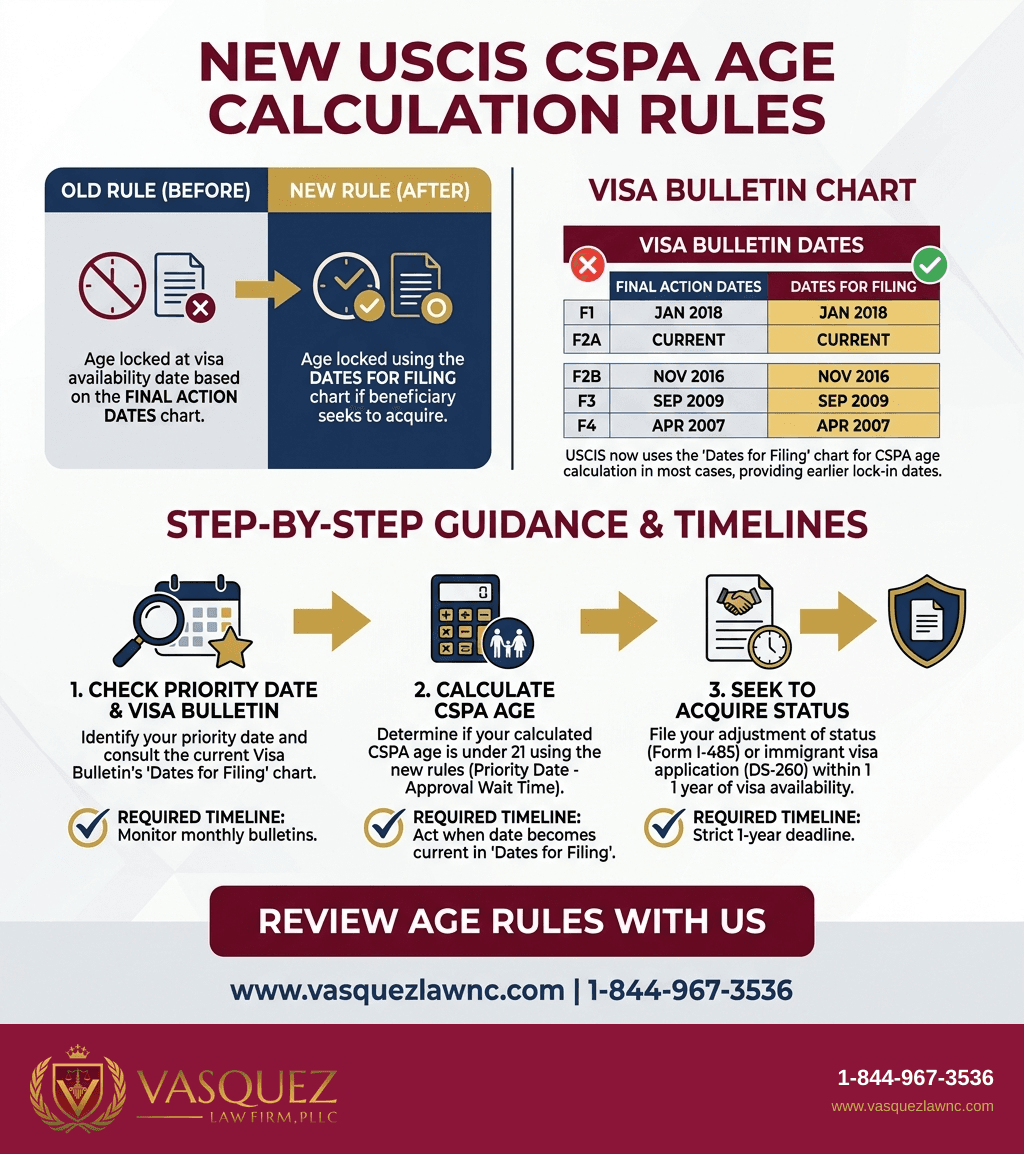
CSPA uses different methods for different immigration paths. For an immediate relative child of a U.S. citizen, the statutory age is generally fixed when the U.S. citizen properly files Form I-130. “Statutory age” means the age used under the law.
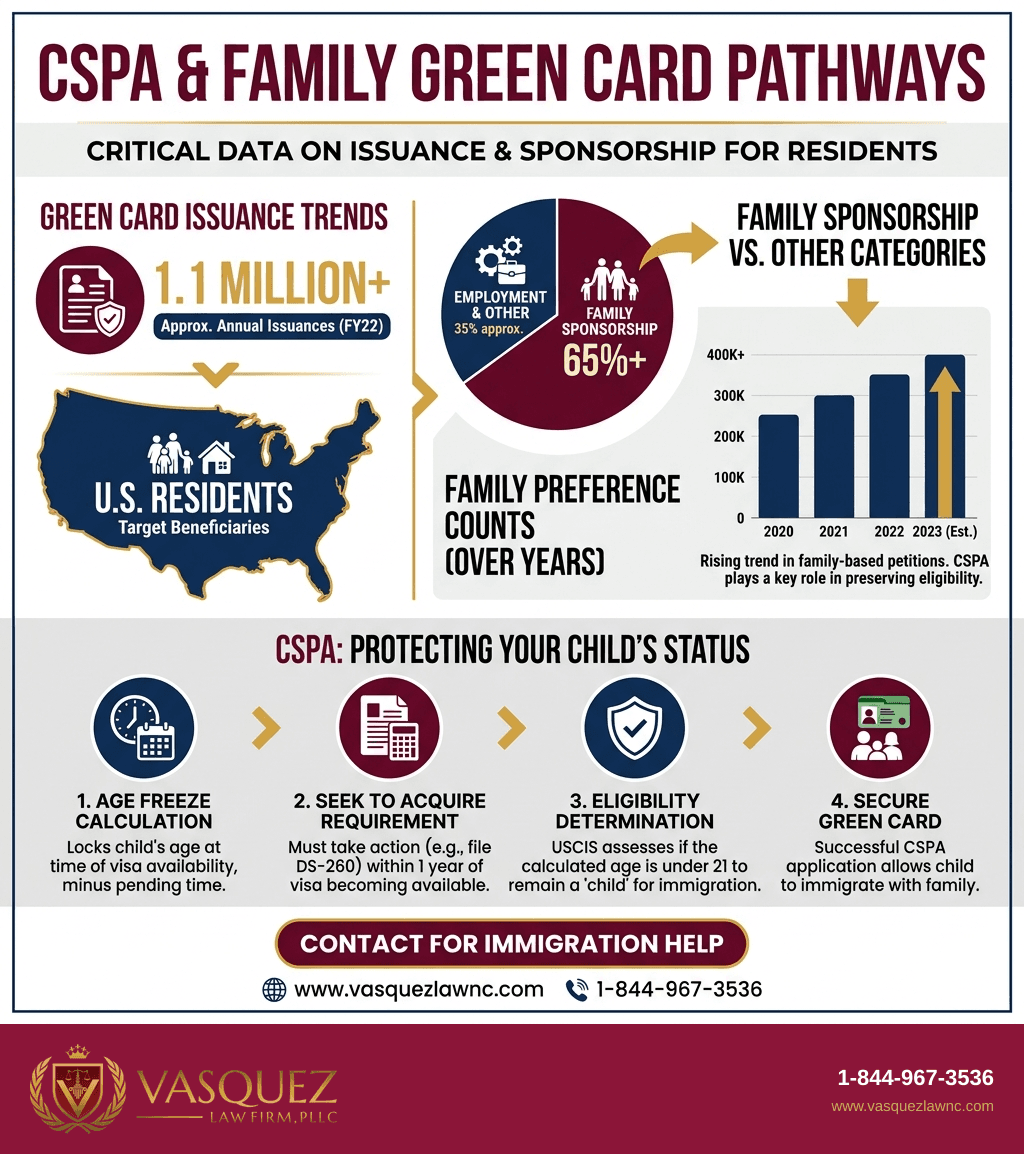
For family preference beneficiaries, the CSPA age is generally the beneficiary's age when a visa becomes available. The number of days the petition was pending is then subtracted. A beneficiary is the person seeking the immigration benefit. A family preference category is a category with yearly visa limits.
This calculation explains why a CSPA age calculator can help organize information. It cannot replace review of the official record. The calculation needs correct dates for receipt, approval, visa availability, and required action after availability. Families should compare their documents with the USCIS Policy Manual. That manual is the agency source for this guidance.
People who may not receive the same result
USCIS under 21 years of age protections do not make every person eligible. A beneficiary whose CSPA age remains 21 or older may move into an adult-son-or-daughter category when one exists. A beneficiary who marries may lose eligibility as a “child.” This can happen even when the person's numerical CSPA age is under 21.
Raleigh families should remember that USCIS decides immigration classifications under federal law. A North Carolina family-law age rule does not control an I-130 petition. The same federal analysis applies to families in Orlando, FL, and elsewhere in the country.
What laws decide whether a child remains under 21?
Congress defines “child” in Immigration and Nationality Act section 101(b)(1), codified at 8 U.S.C. § 1101(b)(1). This provision generally requires that the person be unmarried and under 21. It also lists relationships that can qualify. These include certain biological, step, adopted, and orphan relationships.
The immediate-relative provision is INA section 201(b)(2)(A)(i), 8 U.S.C. § 1151(b)(2)(A)(i). The family-sponsored preference system appears in INA section 203(a), 8 U.S.C. § 1153(a). These provisions explain different timing rules. A U.S. citizen filing for a child under 21 may face a different structure than a green card holder filing for a child under 21.
CSPA is found in INA section 203(h), 8 U.S.C. § 1153(h). Immediate-relative protection appears in INA section 201(f), 8 U.S.C. § 1151(f). For many preference cases, section 203(h) requires the beneficiary to seek to acquire lawful permanent residence within one year of visa availability. Lawful permanent residence means the status commonly called a green card. “Seek to acquire” is a legal phrase. It can include qualifying actions, but the facts must fit USCIS guidance.
What the CSPA calculation does not do
The CSPA calculation does not speed up a petition. Processing times vary by form and service center. USCIS posts public estimates at its processing-times tool. CSPA also does not turn an unmarried adult child into an immediate relative. This remains true after the age is no longer protected.
An F4 CSPA age calculator question may involve the same statutory formula. However, careful review is still needed. The review must consider the petition category, priority date, visa bulletin movement, and one-year requirement. A priority date is the date that establishes a person's place in line. Do not rely on a generic online calculator when a family relationship or date is uncertain.
What should families do before a child turns 21?
Start with a one-page timeline. List the child's date of birth. List the Form I-130 receipt date, approval date, and priority date. Also list every date when a visa may have been available. Keep the following records together:
Keep USCIS receipt notices and approval notices. Also keep passport biographic pages, birth certificates, marriage records, and Department of State notices. These records can help establish the relationship and the important dates.
Next, identify the petitioner's immigration status on the filing date. A U.S. citizen's petition for a child under 21 is analyzed differently from a permanent resident's petition. If the petitioner naturalized after filing, keep the naturalization certificate. Note its date. Naturalization is the process through which a person becomes a U.S. citizen. That event can affect classification.
Then check marital status. Do not assume age is the only issue. A marriage can change eligibility. A divorce after marriage does not automatically restore the earlier child classification. Families should get case-specific advice before filing a new form or withdrawing an existing petition.
Review the current USCIS under 21 years of age guidance and case record. Do this before answering a request for evidence or scheduling a consular step. A request for evidence is a USCIS request for more documents or information. Our family immigration legal team can assess the dates, category, and available documents under federal rules. For related filing fundamentals, see our 2026 family immigration petitions overview.
What is still unknown about the reported USCIS question?
The supplied report does not identify the exact question USCIS allegedly answered. It does not say whether the issue involved an I-130 petition, adjustment of status, consular processing, a family preference category, or another immigration benefit. Adjustment of status is the process of applying for a green card from inside the United States. Consular processing is the process through a U.S. consulate abroad.
The report also does not state whether USCIS changed any Policy Manual language. Therefore, it is unknown whether the report reflects a binding agency interpretation, a court filing, training material, or commentary about existing law.
No deadline, transition rule, or affected-case total was supplied. Families should not infer a filing deadline from the headline. A transition rule explains how a change applies to older or pending cases.
Check official USCIS communications. Keep copies of every notice issued in your own case. A change in agency guidance can be important. Still, the governing question is how the law applies to the specific relationship, dates, and category. Our article on USCIS rulemaking and Federal Register notices explains why the source of a claimed policy change matters.
Frequently Asked Questions
Can a U.S. citizen file a petition for a child under 21?
Yes. A U.S. citizen can generally file Form I-130 for an unmarried child under 21. That child may qualify as an immediate relative under INA section 201(b)(2)(A)(i). The petitioner must prove the qualifying relationship, and the child must meet all other immigration requirements. Filing the form does not itself grant a green card.
What happens if a child turns 21 while Form I-130 is pending?
The answer depends on the petition category and CSPA. For many immediate-relative petitions filed by U.S. citizens, CSPA fixes age on the I-130 filing date. Preference cases use a different formula that subtracts the petition's pending time from the age when a visa becomes available. The child must also remain unmarried where required.
What happens if my CSPA age is over 21?
If the calculated CSPA age is 21 or older, the beneficiary may move to an adult-child preference category if the law provides one. That can mean a longer wait because those categories have visa limits. A family should verify the category, priority date, and marital-status consequences before assuming the petition has ended.
How long does it take for a green card holder to sponsor a child under 21?
There is no single reliable number. A permanent resident's unmarried child under 21 is generally in F2A, where visa availability and USCIS processing both matter. Check the agency's processing-time tool and the Department of State Visa Bulletin, then compare those resources with the receipt date and priority date.
Does an online CSPA calculator give an official answer?
No. A CSPA calculator can help organize dates, but USCIS or a consular officer applies the law to the record. A calculator may not capture a classification change, visa availability issue, one-year seek-to-acquire rule, or incorrect date. Keep primary documents and request legal review when the result is close.
Does moving to Raleigh change my child's immigration age?
No. Immigration age classifications arise under federal law, not a Raleigh or North Carolina rule. Address changes should be reported properly to USCIS, but they do not alter the statutory CSPA formula. The same federal standards apply nationwide, including cases handled through USCIS offices or consular processing.
Reviewed by Attorney Vasquez, Managing Attorney
Need a Work Visa or Permit?
H-1B, TN, L-1, and more. We help workers and employers navigate the visa process.
Reviewed by Attorney Vasquez, Managing Attorney
Keep Reading

William Vasquez
Founder & CEO, Vasquez Law Firm, PLLC
William Vasquez is the founder and CEO of Vasquez Law Firm, PLLC, a results-driven firm specializing in immigration, criminal defense, personal injury, and workers' compensation. A U.S. Air Force veteran and recipient of the Joint Service Achievement Medal, William is dedicated to fiercely fighting for his clients' rights.
Related Legal Services
Need legal help? Learn more about get immigration legal help today, or contact us for a free evaluation.
You can also visit immigration lawyers serving all of North Carolina for more information.