How ICE Bond Hearings Work and What Happens in 2026
Wondering how ICE bond hearings work in 2026? Learn about bond eligibility, process, and your rights. Contact Vasquez Law for a free evaluation.
Published on June 21, 2026
Talk to an immigration attorney
Free call. A clear plan for your case.
Free & confidential · Se habla espanol · 24/7
Have questions? Talk to an attorney - free evaluation.
Call 1-844-967-3536Check your case status now
Look up your immigration case below, then talk to an attorney about what it means — free.
Questions about your result?
Talk to an attorney about your case — free, no obligation.
How ICE Bond Hearings Work and What Happens in 2026
If you or a loved one is detained by ICE, understanding ICE bond hearings can be crucial for obtaining release while awaiting immigration court proceedings. These hearings determine whether detained people can pay a bond and be released. In 2026, bond hearings remain an important part of immigration enforcement, governed by federal laws and the Executive Office for Immigration Review. Learn the steps, requirements, timelines, and common mistakes to avoid for bond hearings in Raleigh, NC, Orlando, FL, and nationwide. This guide from Vasquez Law Firm provides clarity for Dreamers and immigrants navigating this process.
Need help with your case? Our experienced attorneys are ready to fight for you. Se Habla Español.
Or call us now: 1-844-967-3536
Quick Answer
ICE bond hearings are court proceedings where a judge decides if a detained immigrant can be released by paying a bond. The hearing evaluates flight risk and community danger. Bond hearings help many detained immigrants in Raleigh and Orlando secure their freedom while their immigration cases continue.
- Bond hearings handled by immigration judges at EOIR
- Eligibility depends on legal and case factors
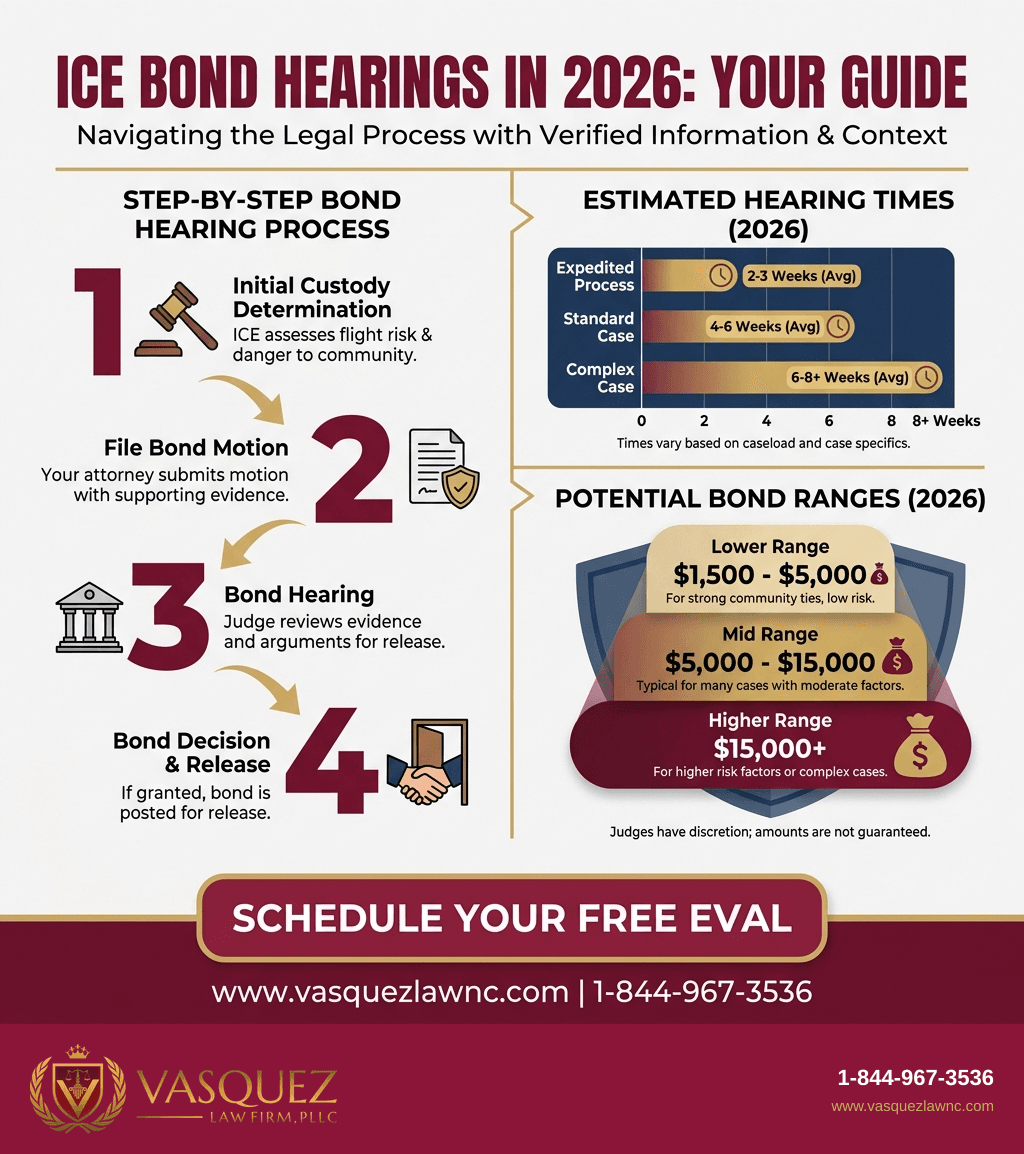
- Bond amounts vary, usually $1,500 to $25,000
- People detained by ICE can request bond hearings
- Legal representation improves bond hearing outcomes
Understanding ICE Bond Hearings
A bond hearing is a critical event in immigration detention cases. When someone arrested by Immigration and Customs Enforcement (ICE) is placed in detention, they may be eligible to request a bond hearing to seek release while their removal proceedings continue.
ICE bond hearings take place within the Executive Office for Immigration Review (EOIR), the federal body that manages immigration courts. The hearing’s purpose is to determine whether the detainee poses a flight risk or a danger to the community and to set a bond amount if release is appropriate. According to INA § 236(a), the immigration judge has discretion to grant bond unless the detainee falls under an ineligible category, such as certain criminal convictions or pending expedited removal orders.
However, bond eligibility can be complex. Factors like the detainee’s family connections, length of residence in the United States, employment history, and criminal record impact the judge’s decision. The bond amount, if set, can range from as low as $1,500 to upwards of $25,000 or more in some cases.
Being detained by ICE is stressful. Understanding the bond hearing procedure is vital for Dreamers and detained individuals in Raleigh, NC, and Orlando, FL. This knowledge helps you prepare effectively, assert your rights, and improve your chances of release.
For legal help, our immigration attorneys in Raleigh and Orlando are experienced in bond hearings and can guide you through each step.
Step-by-Step Guide to Bond Hearings
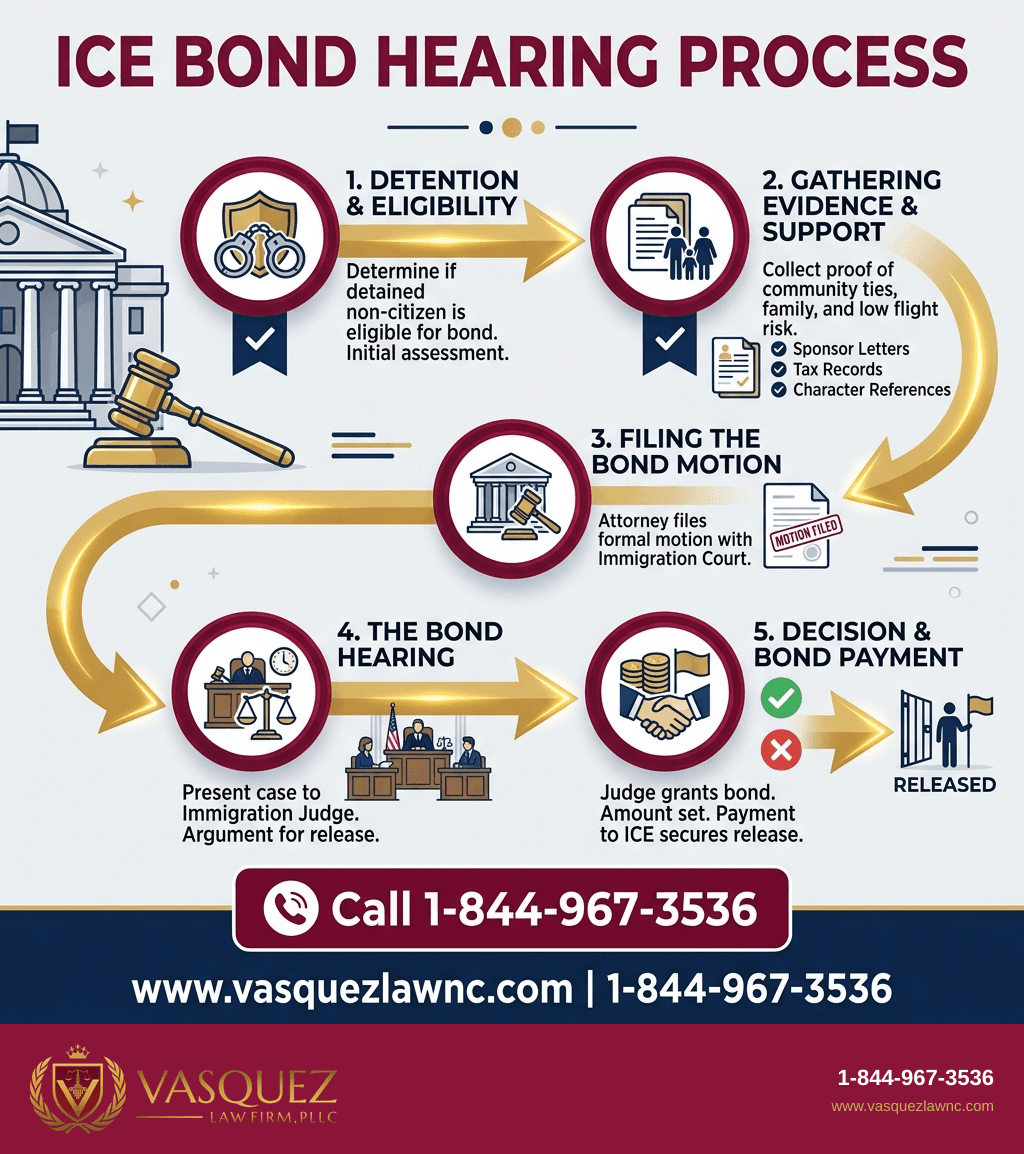
- Request a bond hearing: Typically, ICE or a detained person’s attorney files a request for bond hearing with the immigration court where the case is pending.
- Scheduling: The immigration court schedules a hearing date, usually within 15-30 days after detention, per EOIR guidelines.
- Prepare evidence: Gather documents demonstrating community ties, identity, and reliability. An immigration bond hearing worksheet can help organize this information.
- Attend the hearing: Both the detainee’s attorney and ICE present arguments. The immigration judge asks questions to assess risks.
- Judge’s decision: The judge may grant bond with a specified amount or deny bond, requiring continued detention.
- Bond payment and release: If bond is granted, the detainee or family must pay the full bond amount to ICE for release.
- Pending case: After release, the detainee must attend all immigration court proceedings and comply with requirements.
Common Bond Hearing Scenarios
Some detainees successfully secure bond when they have strong family ties and no serious criminal history. Others face bond denial due to prior convictions. Cases where the detainee is detained for immigration violations without criminal records generally have higher bond approval rates.
Understanding this helps in making informed decisions. Our attorneys can assist in preparing the strongest case possible to present at bond hearings.
Documents and Checklist for Bond Hearings
- Passport or government-issued ID
- Immigration paperwork (e.g., notices, release requests)
- Proof of community ties: family photos, lease agreements, school enrollment
- Employment verification letters or pay stubs
- Criminal records or court dispositions, if applicable
- Immigration bond hearing worksheet to organize your case
- Letters of support from community members or employers
Having complete and well-organized evidence helps you show the judge you are not a flight risk and do not pose danger.
Timeline and What to Expect
- Day 1 to 15: Detention period before bond hearing requested and scheduling.
- Day 15 to 30: Bond hearing usually scheduled by EOIR within 15-30 days.
- Within 1 week: After the hearing, judge issues bond decision.
- Days 7 to 14 after bond: Bond payment processed; detainee released if paid in full.
- Ongoing: Released individual must attend all immigration court hearings and comply with terms.
Delays may happen in some courts, but knowing this timeline helps prepare and avoid missing crucial deadlines.
Costs and Fees for Bonds
- Bond amounts typically range from $1,500 to $25,000 or more.
- Payment must be in full before release; no payment plans.
- If you cannot pay full bond, you might consider bond companies that charge fees (often 10-20% of bond).
- Legal fees for bond hearing representation vary, but skilled lawyers improve chances.
- Some bonds might be higher depending on the case severity and judge’s discretion.
Discuss costs upfront with your lawyer. Our team at Vasquez Law Firm can provide clear estimates based on your case.
Common Mistakes to Avoid at Bond Hearings
- Missing the bond hearing date – Always attend on time to avoid automatic denial.
- Failing to bring required documents – Incomplete evidence weakens your case.
- Not hiring an experienced immigration attorney – Legal advice is critical for success.
- Ignoring community ties evidence – Showing strong ties reduces flight risk concerns.
- Not answering judge’s questions directly – Be clear and respectful to the judge.
- Assuming bond will be automatic – Be prepared to argue your case effectively.
- Failing to follow up after hearing – Pay bond promptly if granted to secure release.
If you only remember one thing: Preparing with a lawyer and strong evidence is your best chance at bond approval.
Important Jurisdictional Notes (NC and FL)
North Carolina Notes
In Raleigh, NC, bond hearings are conducted at immigration courts overseen by EOIR. Vasquez Law Firm provides direct assistance with bonds and deportation defense in NC. Local ICE offices coordinate bond logistics. Processing times generally align with federal guidelines but can vary based on court backlog.
Florida Notes
In Orlando, FL, immigration courts also manage bond hearings. Similar eligibility rules apply statewide. Vasquez Law Firm helps detained immigrants in Orlando navigate bond hearings, ensuring timely requests and preparation to increase chances of release during lengthy immigration proceedings.
Nationwide Concepts
ICE bond hearings follow federal law under INA § 236 and 8 CFR Part 236 nationwide. Eligibility, bond amounts, and hearing procedures are consistent, though courthouse backlogs and ICE detention center processing times vary. Detained individuals should take immediate legal action once detained.
When to Contact a Lawyer
- Immediately after detention by ICE
- If you have a bond hearing scheduled
- When ICE denies bond eligibility
- If you miss a bond hearing date
- If you have criminal convictions affecting bond
- When unsure about bond hearing requirements or paperwork
- If bond is set too high to pay
- To appeal a bond denial
Our team at Vasquez Law Firm is ready to assist Dreamers and all detained immigrants through every step. Contact our Raleigh or Orlando offices today.
About Vasquez Law Firm
At Vasquez Law Firm, we combine compassion with aggressive representation. Our motto "Yo Peleo®" (I Fight) reflects our commitment to standing up for your rights.
- Bilingual Support: Se Habla Español — Spanish-speaking attorneys and staff available
- Service Areas: North Carolina, Florida, and nationwide immigration services
- Experience: Over 30 years helping clients navigate complex legal matters
- Results: Thousands of successful cases across multiple practice areas
Attorney Trust and Experience
William J. Vásquez is admitted to the North Carolina State Bar (2011) and to the U.S. Courts of Appeals for the 4th, 5th, 6th, and 11th Circuits. Florida-jurisdiction matters at the firm are handled by Florida Bar attorney Alekssandra Lopez. The firm has provided dedicated legal representation since 2011, with personalized attention to each client's case.
Don't wait to get the help you deserve. Call us now for immediate assistance.
Se Habla Español
Frequently Asked Questions
Can people detained by ICE get bonds?
Yes, many people detained by ICE can request a bond hearing to seek release. The immigration judge determines eligibility based on flight risk, danger to the community, and bond amount. However, certain detainees with serious criminal convictions or removal orders may be ineligible under INA § 236(a).
How long does it take for ICE to approve a bond?
Bond hearings typically occur within 15 to 30 days after detention. After a decision, bond payment and release often happen within one to two weeks, depending on ICE processing. Times vary based on location and case backlog.
What happens at a bond hearing in immigration court?
The judge reviews evidence about the detainee’s risk and listens to arguments from ICE and the detainee’s attorney. The judge sets a bond amount or denies bond, affecting detention status while the case proceeds.
Are bond hearings back for immigrants in 2026?
Yes, bond hearings continue in 2026, providing a chance for many detained immigrants to request release. Eligibility depends on the case type and recent federal court rulings supporting bond access.
How can I check the status of an immigration bond hearing?
You can contact the immigration court or check the EOIR case status hotline. Attorneys also have access to electronic systems to monitor hearing dates and decisions.
What documents are needed for an immigration bond hearing?
Bring proof of identity, immigration status, community ties, employment, and any relevant criminal records. Organizing these with a bond hearing worksheet improves your case presentation.
What are the immigration bond requirements?
You must show that you pose no flight risk or community danger. The judge will set a bond amount based on the case details, and full payment is required for release. Ineligible detainees cannot request bond.
Can bond be denied at a hearing?
Yes, bond can be denied if the judge finds you risky or ineligible under the law. This means continued detention until case resolution.
Sources and References
- U.S. Citizenship and Immigration Services
- Executive Office for Immigration Review
- Legal Information Institute
Take the first step toward justice today. Our team is standing by to help.
Start Your Free Evaluation Now
Call us: 1-844-967-3536
Se Habla Español - Estamos aquí para ayudarle.
Regulatory Analysis: Hearing Requirements for Commercial Drivers
Federal hearing requirements for commercial drivers directly affect immigrant communities who rely on driving jobs for economic stability.
These regulations ensure road safety while providing pathways for qualified drivers to maintain their commercial licenses.
Understanding exemption processes is crucial for immigrant drivers who may have different medical standards or documentation from their home countries.

William Vasquez
Founder & CEO, Vasquez Law Firm, PLLC
William Vasquez is the founder and CEO of Vasquez Law Firm, PLLC, a results-driven firm specializing in immigration, criminal defense, personal injury, and workers' compensation. A U.S. Air Force veteran and recipient of the Joint Service Achievement Medal, William is dedicated to fiercely fighting for his clients' rights.
Related Legal Services
Need legal help? Learn more about experienced immigration attorneys in Charlotte, or contact us for a free evaluation.
You can also visit statewide immigration legal services for more information.