26 Federal Plaza ICE Detention Order in 2026 Explained
The 26 Federal Plaza ICE detention order addresses abusive conditions. See its limits, protect records, and request a free evaluation today.
Published on September 25, 2026
Talk to an immigration attorney
Free call. A clear plan for your case.
Free & confidential · Se habla espanol · 24/7
Have questions? Talk to an attorney - free evaluation.
Call 1-844-967-3536Worried how the latest immigration news affects you?
Schedule a confidential case review with an immigration attorney - know exactly where you stand.
USCIS Case Status
Check your USCIS case status
Enter your receipt number and get the official status. Free, no registration.
26 Federal Plaza ICE Detention Order in 2026 Explained
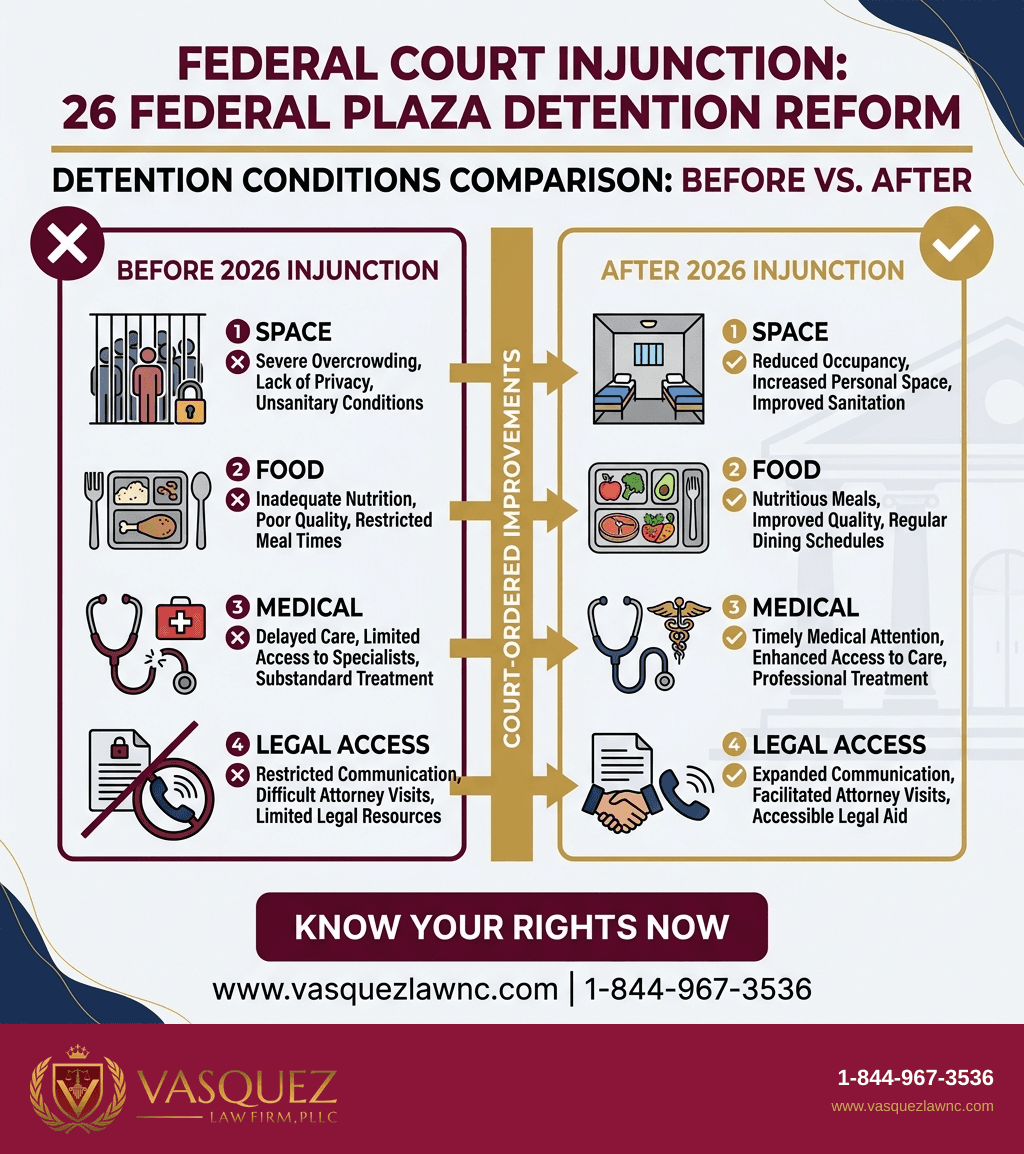
A federal district court has granted an order barring ICE from detaining immigrants in abusive conditions at 26 Federal Plaza, according to the reported announcement from the American Civil Liberties Union. The reported order concerns a federal immigration facility in New York. It does not concern an Orlando facility. Still, the constitutional and statutory limits discussed in the case matter to immigrants nationwide. They may also matter to people reporting to immigration appointments in Orlando, Florida.
This article gives general legal information. It does not give individual legal advice. Detention authority and release options depend on several facts. These include a person’s immigration history, criminal record, custody status, court posture, and the facts documented in the individual case.
For people facing an ICE check-in, detention, or removal concern, our immigration attorneys can assess the federal rules that apply wherever the person is located. The reported 26 Federal Plaza ICE detention order does not automatically decide another person’s case. However, it shows why records and prompt legal review matter.
What happened at 26 Federal Plaza?
The reported announcement says that a federal district court granted an order. The order prohibits ICE from detaining immigrants in abusive conditions at 26 Federal Plaza. The announcement identifies the location and the subject of the order. However, the supplied report does not give the order’s date, case caption, judge, docket number, duration, or full text.
That difference matters. A court order can impose immediate duties on one agency office. At the same time, it can leave broader immigration detention statutes in place. An order can also require better conditions. It does not necessarily require the release of every person held there.
The reported title places the dispute at 26 Federal Plaza. This is a federal building in New York City. It is associated with Department of Homeland Security operations and immigration proceedings. Searchers often seek a 26 Federal Plaza ICE check-in, a 26 Federal Plaza 5th floor appointment, a directory, opening hours, an address, or a phone number. Confirm these practical details directly with the notice issuer. Building procedures can change.
What the reported announcement establishes
The available source supports one narrow conclusion. A district court granted relief aimed at stopping abusive detention conditions at that location. The source does not support a claim that ICE must stop all detention. It does not show that every detained person must be released. It also does not show that the ruling covers every federal facility.
This case occurred in New York. The legal principle is federal. People in Orlando, Florida and Raleigh, NC can still raise concerns about custody conditions. They can do so through counsel, agency processes, and, where appropriate, federal court. The USCIS Policy Manual is also a useful official reference for many benefit and procedure questions. USCIS is separate from ICE.
Who does the 26 Federal Plaza ICE detention order cover?
The order described in the reported announcement concerns immigrants detained at 26 Federal Plaza. It covers the conditions addressed by the court. The supplied report does not identify covered nationalities, visa categories, immigration court case types, or a total number of people. It also does not say whether the relief reaches people transferred to other facilities.
Families should therefore avoid treating the 26 Federal Plaza ICE detention order as blanket protection. A person may have an ICE reporting obligation, a pending removal case, a final removal order, an asylum claim, a green card application, or a prior removal history. Each fact can change the agency’s claimed custody authority. Each fact can also change the legal arguments that may be available.
What it does not automatically decide
The reported order does not answer whether ICE is deporting people with green cards in every situation. Lawful permanent residents have important rights. However, they can still face removal proceedings under grounds listed in the Immigration and Nationality Act. ICE also cannot lawfully detain a United States citizen as an immigration detainee. If a person claims citizenship, the person should raise and preserve supporting proof quickly.
The report also does not create a public ICE detention list. ICE may provide custody information through its own detainee locator system. Family members should use care with names, dates of birth, and immigration identifiers. A wrong record can delay communication. This is especially possible after a transfer.
In our experience, families often ask where a person was taken after an unexpected detention. They soon ask whether a hearing, bond request, or filing deadline is approaching. Preserve the appointment notice, identification documents, and copies of prior immigration filings. Also preserve any medication or medical documentation.
Why location-specific relief can still matter
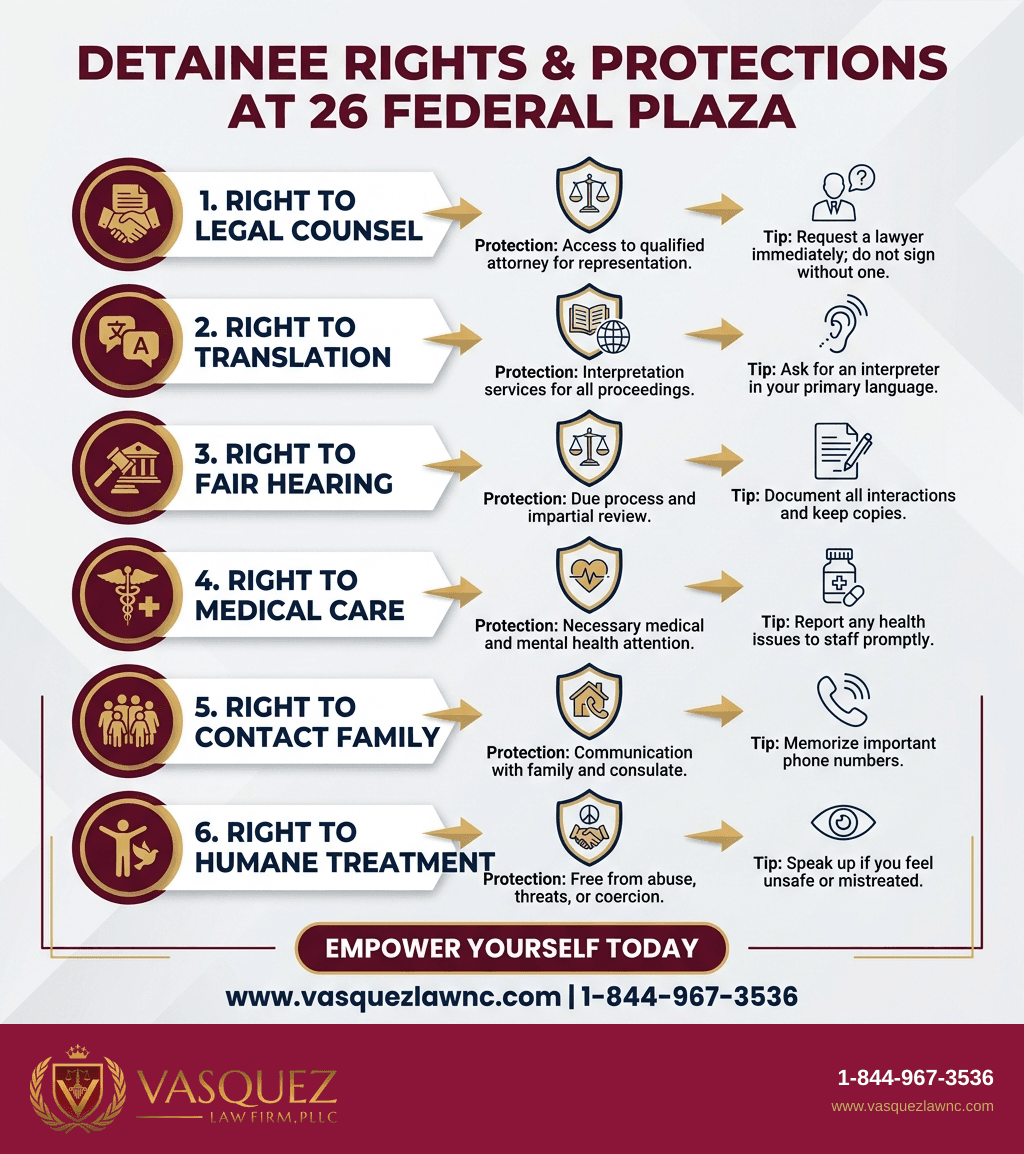
A location-specific court order can show that people may ask courts to review confinement conditions. It does not make a New York court’s remedy an automatic rule for an Orlando ICE check-in or any other office. Still, detailed records may be important if conditions become part of a legal claim. Record crowding, medical needs, access to counsel, notices, transfers, and communications.
Families with pending petitions should also separate a USCIS benefit case from ICE custody. A pending I-130 petition, for example, does not by itself halt removal proceedings. Review our discussion of family immigration petitions in 2026 before assuming that a pending family filing resolves an enforcement issue.
What federal law controls ICE detention?
Federal detention authority mainly comes from the Immigration and Nationality Act. It does not come from one local ICE office policy. Under 8 U.S.C. § 1226, the government may take certain noncitizens into custody while removal proceedings are pending. Section 1226(a) generally describes arrest, detention, and possible release on bond or conditional parole in many cases.
Section 1226(c) requires custody for specified categories. Major legal and factual questions can still arise in individual cases. Under 8 U.S.C. § 1231, detention authority changes after a removal order becomes administratively final. An administratively final order is a removal order that has reached the final stage of the administrative process. The statute creates a removal period. It also addresses detention after that period. It does not remove constitutional limits.
The regulations at 8 C.F.R. § 236.1 address custody and release decisions. They include notices and review procedures. The Board of Immigration Appeals and federal courts may become relevant, depending on the reason for detention. A habeas corpus petition is a federal court challenge to unlawful custody. It can be available in limited circumstances. It is not a replacement for a case-specific analysis.
The reported 26 Federal Plaza ICE detention order focuses on conditions. That issue is legally different from removability, bond eligibility, or the chance of receiving immigration relief. People should not miss immigration court hearings while challenging detention conditions.
Check official benefit timing through USCIS Processing Times. Do not confuse a processing-time page with an ICE custody decision. USCIS, ICE, and the immigration courts have separate roles within the federal immigration system.
What should you do before an ICE appointment?
First, read the notice closely. Confirm the agency name, address, reporting date, time, reporting purpose, and any reference number. Follow a 26 Federal Plaza immigration appointment according to the written notice. Do not rely on search-result summaries about a 26 Federal Plaza phone number or opening hours.
Second, make a secure paper and digital file. Include passports, green cards, work permits, I-94 records, immigration court notices, USCIS receipt notices, and prior decisions. Include criminal dispositions if any, proof of family relationships, and medical records. Do not alter a document. Do not provide false information.
Third, prepare an emergency contact plan. Give a trusted person copies of key documents. Give that person your A-number if you have one. Also give the person the name of any representative. Discuss care arrangements for children and access to medications. These steps are useful preparation. They are not evidence that detention will occur.
Fourth, seek individualized advice before the appointment whenever possible. Our federal immigration legal team assists clients from Raleigh, NC and Orlando, FL with immigration matters nationwide. We can identify whether a benefit filing, court notice, final order, or custody issue needs immediate attention.
Need a clear plan before an ICE appointment? Contact Vasquez Law Firm for a confidential case evaluation at our consultation page or call 1-844-967-3536. Se Habla Espanol.
What does the reported order still not answer?
The supplied report does not include the court’s written findings. It also does not identify the exact prohibited conduct, inspection requirements, reporting terms, enforcement mechanism, or expiration date. The report does not say whether ICE appealed, changed operations, or transferred people after the ruling.
These missing facts prevent responsible conclusions about the order’s reach. They also prevent a reliable answer about how long a specific person can remain in ICE detention. Detention length depends on the claimed legal authority, the status of the removal case, review procedures, and court rulings.
Watch for the filed order, agency statements, and later court entries. Do not rely on social media claims. People with DACA questions should use the official USCIS DACA page for program information. DACA questions and ICE custody questions can involve different agencies and facts.
For related federal developments, review our report on USCIS rulemaking in 2026. The central lesson from the 26 Federal Plaza ICE detention order is narrow but meaningful. Documented conditions and prompt legal action can matter. This remains true even when the available public report leaves major details unresolved.
Frequently Asked Questions
Does the 26 Federal Plaza ICE detention order apply in Orlando?
No public fact supplied with the reported announcement says that it applies to an Orlando facility. The reported order concerns 26 Federal Plaza in New York. Immigration detention law is federal, so legal arguments about conditions may be relevant elsewhere, but the court’s actual remedy depends on its written scope. Do not assume an appointment in Orlando is cancelled or changed.
Is ICE deporting people with green cards?
A green card holder is a lawful permanent resident, but permanent residence does not eliminate all removal grounds. The government must generally use removal proceedings and prove an applicable charge. The exact process can vary, particularly for allegations involving travel, abandonment, criminal convictions, or fraud. A green card holder should obtain advice before signing papers or waiving rights.
How long can someone stay in ICE detention?
There is no single detention period for every case. Authority can arise during pending removal proceedings under 8 U.S.C. § 1226 or after a final order under 8 U.S.C. § 1231. Bond eligibility, custody reviews, litigation, and removal logistics can affect timing. A lawyer must review the person’s precise custody authority and immigration record.
Is there an ICE detention list that families can use?
There is not a complete public list that reliably identifies every detained person. ICE operates a detainee locator process, but records can lag after an arrest or transfer. Families should retain the person’s full name, date of birth, country of birth, and A-number if known. They should also document the time and location of the last contact.
Can ICE detain a United States citizen?
ICE has no authority to hold a United States citizen for civil immigration removal. Identity errors can occur, so citizenship evidence should be raised immediately. Useful records may include a United States passport, birth certificate, certificate of citizenship, certificate of naturalization, or other official proof. The appropriate response depends on the facts and should be assessed promptly.
Should I miss an ICE check-in because I fear detention?
Do not make that decision based only on an online report. Missing a required check-in can create serious consequences, including enforcement concerns or adverse inferences. Obtain legal advice as soon as possible, bring relevant documents, and ensure a trusted person knows where you are expected to report. The notice itself is the controlling starting point.
Does a pending family petition stop ICE detention?
Usually, a pending family petition does not automatically prevent detention or end removal proceedings. It may be important evidence of a potential immigration pathway, but eligibility and timing matter. Keep receipt notices and relationship evidence available. A legal review can determine whether a petition, adjustment strategy, waiver issue, or court filing has a realistic role in the case.
Legal disclaimer: This article is general information, not legal advice or a promise of any result. If ICE custody, an immigration court hearing, or a reporting notice affects your family, request a consultation with Vasquez Law Firm or call 1-844-967-3536. Our team can review the documents and facts specific to your situation.
Reviewed by Attorney Vasquez, Managing Attorney
Worried About Immigration Policy Changes?
New policies can affect your case. Get current legal advice from an experienced immigration attorney.
Reviewed by Attorney Vasquez, Managing Attorney
Keep Reading

William Vasquez
Founder & CEO, Vasquez Law Firm, PLLC
William Vasquez is the founder and CEO of Vasquez Law Firm, PLLC, a results-driven firm specializing in immigration, criminal defense, personal injury, and workers' compensation. A U.S. Air Force veteran and recipient of the Joint Service Achievement Medal, William is dedicated to fiercely fighting for his clients' rights.
Related Legal Services
Need legal help? Learn more about our immigration legal services, or contact us for a free evaluation.
You can also visit North Carolina immigration law firm for more information.