Green Card Drug Trafficking Faces New Review in 2026
Could a drug allegation block your green card? Green card drug trafficking rules can trigger removal risks. Get a free evaluation today.
Published on September 25, 2026
Talk to an immigration attorney
Free call. A clear plan for your case.
Free & confidential · Se habla espanol · 24/7
Have questions? Talk to an attorney - free evaluation.
Call 1-844-967-3536Talk to an Immigration Attorney Today
A clear plan for your case in one call - no obligation.
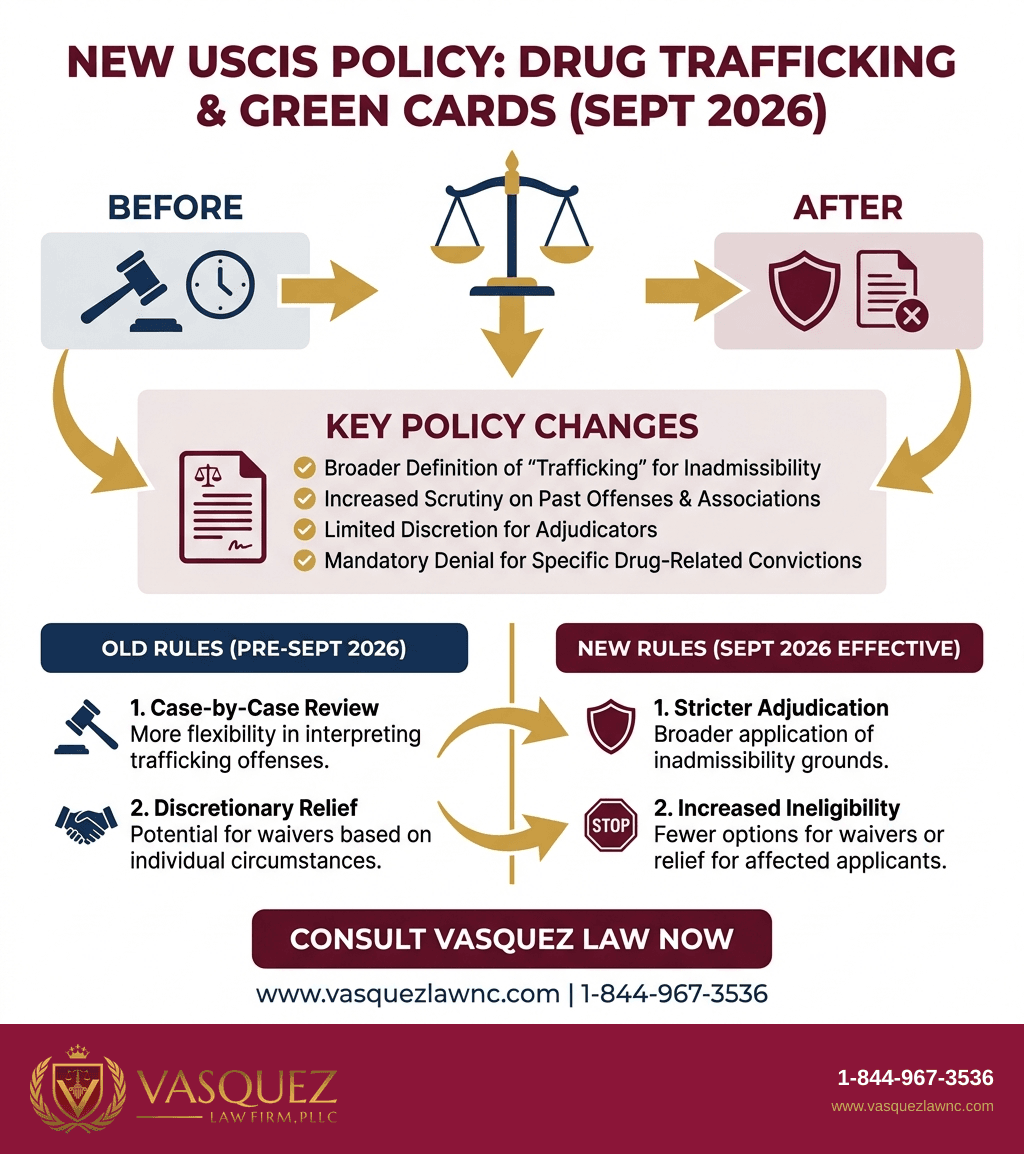
The supplied news summary says that the United States has set rules that could block green cards for people linked to drug trafficking or money laundering. It does not name a USCIS notice, rule number, effective date, or text from any new policy. That missing record matters. Federal statutes already create green card drug trafficking consequences. The exact facts of an arrest, charge, plea, or conviction can change the result.
People who file Form I-485, the application to adjust status to lawful permanent residence, may face urgent questions after an accusation. Those questions can arise long before USCIS decides the case. Our immigration attorneys represent clients from Raleigh, NC and Orlando, FL. We handle federal immigration matters that apply nationwide.
This article separates the unverified news claim from the law already on the books. It gives general information, not legal advice. Anyone facing a drug-related allegation while seeking permanent residence should get case-specific advice from an immigration law team. Get that advice before filing forms, making admissions, or accepting a criminal disposition.
What was actually announced about green card drug trafficking?
The supplied September 2026 news item is titled, “US sets new rules that could block Green Cards for drug traffickers and money launderers.” Its summary makes the same broad claim. However, it names no issuing agency, publication date, Federal Register citation, policy alert, or direct quote. It does not quote USCIS, the Department of Homeland Security, or the Department of State.
That limitation is important. USCIS policy changes usually need a clear official source. Applicants need that source to learn whether a standard changed. They also need it to learn when the change applies. They need to know whether it affects pending Form I-485 cases. Readers can check the agency’s USCIS Policy Manual. USCIS uses this public repository for adjudication guidance.
The report could refer to stronger enforcement of existing inadmissibility rules. Inadmissibility means a person may be barred from entering the United States or getting a green card. The report could also refer to an internal screening practice or a future proposal. Based on the information provided, it cannot be confirmed as a new nationwide rule. A news headline alone cannot prove that every drug allegation now automatically blocks a green card.
Why the distinction matters
Federal immigration law separates conduct, criminal charges, convictions, admissions, and evidence. Immigration officials may review each item differently. A state court result that looks favorable can still need immigration review. On the other hand, a charge alone does not always establish every ground of inadmissibility or removability.
Removability means the legal basis for removing a person from the United States. The immediate practical point is to use caution. Do not assume a report creates a new deadline or filing requirement. Wait for USCIS to publish one. Track official updates. Keep every document that shows what happened in the criminal case.
Who could face green card drug trafficking consequences?
People seeking admission or adjustment of status are the clearest group affected by green card drug trafficking rules. Adjustment of status means applying for a green card without leaving the United States. INA section 212(a)(2), codified at 8 U.S.C. § 1182(a)(2), lists criminal and controlled-substance grounds of inadmissibility. These grounds can bar a person from entering the United States or receiving a green card. An exception or waiver may sometimes apply.
Section 212(a)(2)(C) covers a person whom an immigration officer knows, or has reason to believe, is or has been an illicit trafficker in a controlled substance. It can also cover a person who knowingly aided, abetted, assisted, conspired, or colluded in trafficking. This statutory language is broader than a final criminal conviction. For that reason, the facts and the government’s evidence matter.
The same provision can affect a spouse, son, or daughter who received a financial or other benefit from trafficking within the prior five years. The relative must have known, or reasonably should have known, the benefit’s source. This family-benefit language creates risk for relatives. It does not mean that every relative is automatically barred.
Charges, convictions, and records are not identical
A conviction for a controlled-substance violation can trigger a separate inadmissibility provision. That provision is 8 U.S.C. § 1182(a)(2)(A)(i)(II). The statute has a narrow exception for one offense involving possession of 30 grams or less of marijuana for personal use. That exception does not erase a trafficking allegation.
People who already hold green cards may face a different legal position. Deportability means the legal basis for removing someone who has already been admitted to the country. INA section 237, 8 U.S.C. § 1227, addresses deportability. A permanent resident should not assume that renewing a green card resolves a possible removal issue.
In our experience, people often first ask whether a dismissed charge has disappeared from an immigration file. The answer depends on the exact record and the immigration ground involved. This is federal law wherever the reader lives, including Orlando. It is not a local Orlando rule.
What law already governs drug trafficking and green cards?
Congress placed drug-related inadmissibility grounds in the Immigration and Nationality Act decades before this 2026 report. The main background rule begins with INA section 212(a)(2), 8 U.S.C. § 1182(a)(2). It covers crimes involving moral turpitude, controlled-substance violations, multiple criminal convictions, trafficking, prostitution-related grounds, and certain serious criminal activity.
For green card drug trafficking analysis, section 212(a)(2)(C) is especially important. It uses the “reason to believe” standard. This standard allows immigration authorities to examine reliable evidence beyond a conviction. The statute does not require a person to have a trafficking conviction before officials may consider the ground.
Adjustment is discretionary
Form I-485 adjustment is governed by INA section 245, 8 U.S.C. § 1255. An applicant generally must be admissible to adjust status. A specific waiver or exception may change that result. USCIS also reviews eligibility for the underlying immigrant petition. It reviews identity, medical requirements, prior immigration history, and other statutory conditions.
Waivers are not all the same. A waiver is legal permission that can excuse a ground when the law allows it. INA section 212(h), 8 U.S.C. § 1182(h), can forgive certain criminal grounds in limited situations. However, the statute excludes some controlled-substance issues. It does not provide a general waiver for trafficking. Relief depends on the actual ground, immigration history, qualifying relatives, and case record.
USCIS policy can guide officers. It cannot override the text enacted by Congress. Readers who follow agency practice should separate binding statutes and regulations from guidance. Our report on USCIS rulemaking and Federal Register notices explains why the official publication date and text matter.
What should I do if a drug allegation affects my green card?
First, collect the complete criminal record. Include the complaint or indictment. Include the arrest report, if available. Also collect the plea agreement, judgment, sentencing papers, dismissal order, probation records, and certified docket. Do not rely on memory. Do not rely on a background-check summary. Do not rely on a lawyer’s informal description of what happened.
Second, collect your immigration records. Bring prior visa applications, Forms I-485 and I-130, USCIS notices, travel history, passports, prior removal paperwork, and answers given to government officers. Differences between a court file and an immigration form can create separate problems.
Third, do not plead guilty, accept a diversion program, or sign a factual admission without understanding the immigration consequences. Criminal labels differ from state to state. Immigration law uses its own federal definitions. It may treat a disposition differently from state law.
Check facts before filing
Fourth, identify the exact green card stage. A person preparing an I-485 may face one procedure. A person responding to a request for evidence may face another. An interview, return from travel, or removal defense may create different issues. USCIS posts estimated case ranges through its processing-times tool. That tool does not answer admissibility questions.
Fifth, get an individualized review before submitting an explanation or affidavit. A careful review should identify the statute of conviction and the record of conviction. It should also identify the alleged conduct, possible inadmissibility grounds, and available relief. Review our 2026 family immigration petition guidance if a relative’s petition is part of the case.
Need to assess a green card drug trafficking concern before you file? Vasquez Law Firm offers a confidential evaluation for immigration matters nationwide from Raleigh, NC and Orlando, FL. Se Habla Espanol. Schedule a free evaluation.
What remains unknown about the reported policy?
The source summary does not answer the questions that control the legal effect. It does not identify the federal agency, legal authority, implementation date, or whether the measure is final. It does not say whether the measure applies to pending applications. It also gives no text defining “drug traffickers” or “money launderers.”
There is no supplied evidence that USCIS changed Form I-485 questions, interview procedures, burden-of-proof standards, or waiver rules. There is also no identified court case testing the reported policy. Readers should not share unsupported claims. A green card is not necessarily denied because of any arrest or family connection.
Monitor official USCIS publications and written notices in your own case. Save screenshots and copies. Add dates to those records. If USCIS issues a request for evidence, notice of intent to deny, or interview notice, respond by the deadline printed on that document. Do not create a deadline from a news report.
Federal law can be difficult. Records and timing can still give people options. A careful legal review can show what the government must prove. It can show which documents answer the government’s concerns. It can also show whether a form of relief may be available.
Frequently Asked Questions
Can an arrest alone deny my green card?
An arrest is not the same as a conviction. Still, immigration authorities may review underlying conduct under some grounds, including the trafficking provision’s “reason to believe” standard. The result depends on the charging documents, police evidence, disposition, admissions, and immigration category. Obtain the complete record before making conclusions or submitting an explanation to USCIS.
Does dismissed mean immigration-safe?
Not always. A dismissal may eliminate a conviction under one analysis, but it does not necessarily prevent USCIS or immigration court from examining conduct or admissions. Diversion, deferred prosecution, and expungement results need special care. Ask for an immigration review of certified court documents rather than relying only on a state criminal record check.
Can a trafficking ground be waived?
Trafficking allegations are among the hardest immigration issues to waive. INA section 212(h) offers limited relief for certain criminal grounds, but it is not a general waiver for trafficking under section 212(a)(2)(C). Whether any exception, waiver, or other defense applies depends on the precise ground alleged and the person’s immigration history.
Can a green card holder be removed for a drug conviction?
Yes, some controlled-substance convictions can create deportability under 8 U.S.C. § 1227(a)(2)(B). Trafficking-related convictions may also create additional removal grounds. A permanent resident has procedural rights in removal proceedings, but should not travel, sign documents, or concede allegations without legal advice tailored to the record.
Does money laundering automatically bar adjustment?
No single headline supplies that answer. Money-laundering conduct may create criminal, inadmissibility, or discretionary concerns depending on the statute, sentence, facts, and immigration benefit sought. USCIS must identify a legal basis for a denial. A person should obtain the actual accusation and court records before assuming an automatic bar applies.
Should I disclose a sealed or expunged case on Form I-485?
Read each Form I-485 question exactly as written. Immigration forms often request information about arrests, charges, and convictions even when a state record was sealed or expunged. Failure to disclose required information can create a separate issue. Get the certified disposition and obtain individualized advice before filing the form.
How can I verify whether a new USCIS policy exists?
Check the USCIS Policy Manual, USCIS news releases, and the written notice in your own case. A legitimate policy should identify its agency source and effective date. If a news item does not provide those details, treat it as a lead to verify, not as a legal command. Preserve copies of official materials you find.
Legal disclaimer: This article is general legal information, not legal advice or a promise of results. Green card drug trafficking issues are fact-specific and can affect admissibility, removal, and travel. Contact Vasquez Law Firm at 1-844-967-3536 or request a consultation for guidance about your circumstances. Yo Peleo®.
Reviewed by Attorney Vasquez, Managing Attorney
Filing or renewing a green card?
Adjustment-of-status timing, RFEs, and travel risks all change with new policy. 15-min review of your specific case.
Reviewed by Attorney Vasquez, Managing Attorney
Keep Reading

William Vasquez
Founder & CEO, Vasquez Law Firm, PLLC
William Vasquez is the founder and CEO of Vasquez Law Firm, PLLC, a results-driven firm specializing in immigration, criminal defense, personal injury, and workers' compensation. A U.S. Air Force veteran and recipient of the Joint Service Achievement Medal, William is dedicated to fiercely fighting for his clients' rights.
Related Legal Services
Need legal help? Learn more about how our immigration attorneys can help, or contact us for a free evaluation.
You can also visit North Carolina immigration lawyers for more information.