How ICE Partnership Programs Work: What to Expect in 2026
Wondering how ICE partnership programs affect you in 2026? Learn key facts, incentives, and protections. Contact Vasquez Law Firm for a free consultation.
Published on September 12, 2026
Talk to an immigration attorney
Free call. A clear plan for your case.
Free & confidential · Se habla espanol · 24/7
Have questions? Talk to an attorney - free evaluation.
Call 1-844-967-3536Worried how the latest immigration news affects you?
Schedule a confidential case review with an immigration attorney - know exactly where you stand.
USCIS Case Status
Check your USCIS case status
Enter your receipt number and get the official status. Free, no registration.
How ICE Partnership Programs Work: What to Expect in 2026
Understanding the ICE partnership is very important for immigrants and communities in North Carolina and Orlando, FL. These partnerships include the ICE 287(g) program. They are agreements between local agencies and ICE to help enforce immigration laws. In 2026, knowing how these partnerships work helps immigrants protect their rights. This article explains how ICE partnerships are set up, the training involved, and what they mean for you. It also tells you what to know to stay safe and informed.
Need help understanding how ICE partnerships affect your immigration case? Our experienced attorneys are ready to fight for you. Se Habla Español.
Or call us now: 1-844-967-3536
Quick Answer
ICE partnership programs let local police work with federal ICE officers to enforce immigration laws. Programs like 287(g) train local officers to find, hold, and transfer immigrants who may be deported. These agreements affect immigrant communities by increasing local enforcement and raising important legal rights to know.
- ICE works with local agencies under formal agreements.
- Local officers get ICE 287(g) training to enforce immigration laws.
- These partnerships affect law and communities in NC and Orlando.
- Immigrants should know their rights when meeting ICE.
- Legal help is very important if detained or questioned under these programs.
What Is ICE Partnership?
In 2026, an ICE partnership means formal agreements between U.S. Immigration and Customs Enforcement (ICE) and state or local police agencies.
These agreements give trained local officers specific immigration enforcement duties. This helps federal ICE officers. The most known program is ICE 287(g), allowed by law under INA §287(g). It lets trained state or local officers enforce immigration law in their area.
How The 287(g) Program Operates
Under ICE 287(g), local officers get special training from ICE. This training lets them find people who can be removed under federal immigration law. They can hold these people and start enforcement actions. The training covers immigration laws, detainee rights (rights of people held by police), and procedures.
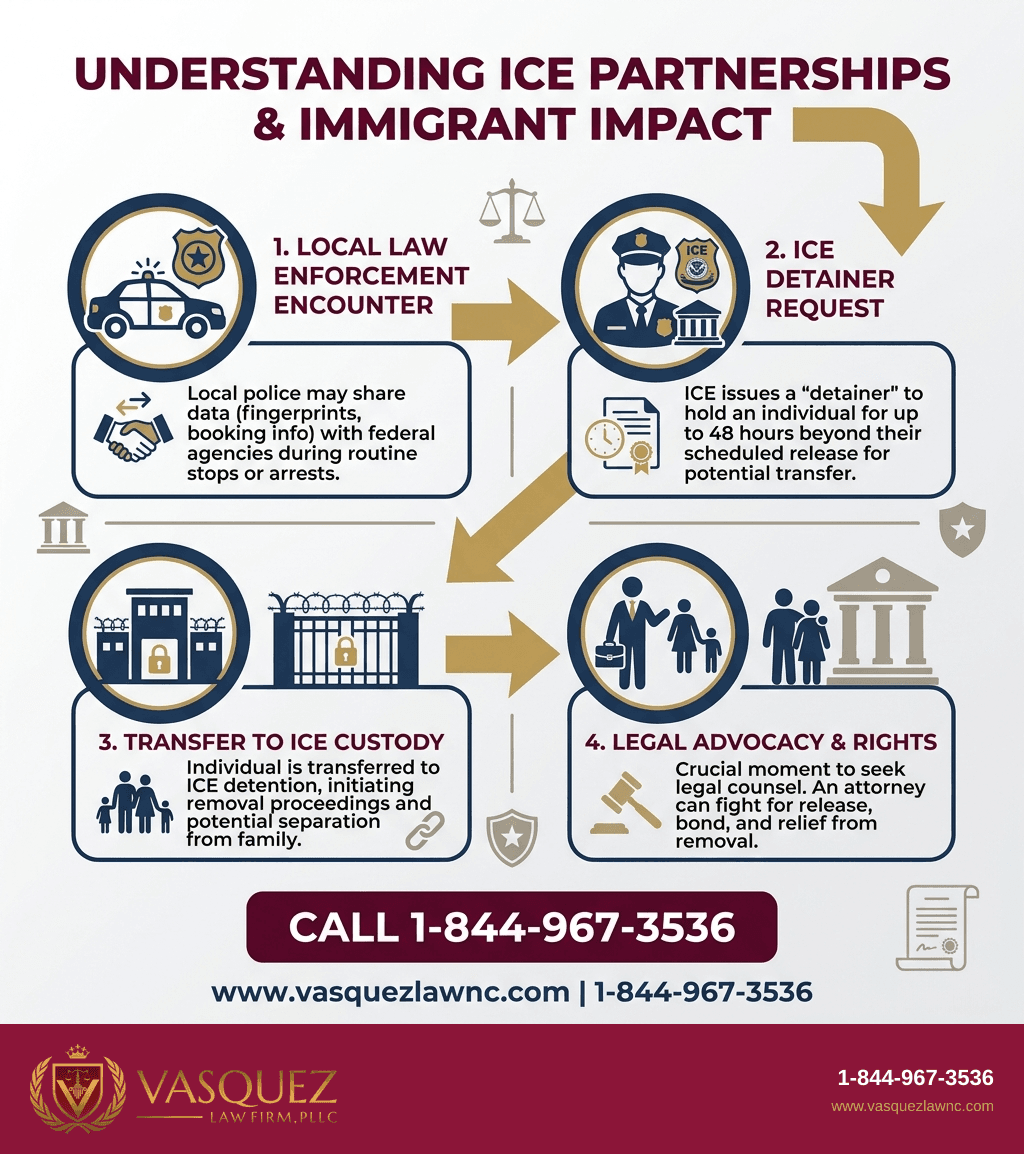
With this power, agencies can check people booked in jail for immigration problems. They can hold them until ICE decides if they should be removed.
For example, a sheriff’s office in a county jail might screen detainees at booking to identify undocumented immigrants. If an immigrant is found to be removable, the officers can initiate the transfer process to ICE custody. This local involvement streamlines enforcement but can also raise concerns about racial profiling or civil liberties.
Another practical scenario is when local police, during a traffic stop, discover information suggesting a person may be unlawfully present. In some agreements, officers may detain the individual for ICE processing, depending on their 287(g) authority. This expands the scope of immigration enforcement beyond federal agents, embedding it into routine local policing.
Types of Partnership Agreements
Partnership agreements differ. Some give officers full enforcement power like ICE agents. Others only allow sharing information or referrals. The power depends on the signed agreement.
For instance, some counties opt for a "task force" model where local officers act almost as ICE agents, including making arrests for immigration violations. Other jurisdictions may limit their role to providing ICE with information about detainees or referring cases without direct enforcement action. This variance affects how visible and intrusive enforcement is in different communities.
Additionally, certain agreements focus on specific populations or offenses — such as targeting individuals with criminal records — to balance community safety concerns with immigration enforcement. Understanding the scope of an agreement in your area can help immigrants anticipate how local law enforcement might engage with ICE.
Why ICE Partnerships Exist
The federal government made ICE partnerships to use local police in immigration enforcement. This aims to work better, lower illegal immigration, and keep public safety. But these programs also get criticism for possible civil rights problems and effects on communities.
One reason for these partnerships is resource efficiency — ICE alone may not have enough agents to cover all areas, so deputizing local officers increases coverage. This can be especially important in border states or areas with large immigrant populations where federal presence is limited.
However, critics argue that these partnerships may erode trust between immigrant communities and local law enforcement. When police serve dual roles, immigrants may avoid reporting crimes or cooperating with police, fearing deportation. This creates public safety challenges and social tension.
Moreover, concerns about racial profiling, wrongful detentions, and civil rights violations have prompted calls for reform or termination of certain 287(g) agreements. Balancing enforcement goals with protecting constitutional rights remains a key policy debate.
ICE 287(g) Program Details and Agencies
North Carolina has several agencies in the ICE 287(g) program in 2026. These include some county sheriff’s offices and detention centers allowed to enforce immigration laws locally.
Mapping Participating Agencies
The ICE 287(g) program map shows which state and local agencies signed agreements and got training. ICE updates this map often. It is public so communities know where enforcement happens.
For example, in North Carolina, counties such as Mecklenburg and Wake have active 287(g) agreements, meaning local sheriffs’ offices there participate in immigration enforcement. In Orlando, Florida, Orange County Sheriff's Office is a key participant.
This transparency helps community members and advocates track enforcement patterns. It also informs immigrants about where they might encounter local officers with immigration authority, helping them take precautionary measures.
Another practical use of this map is for attorneys and legal aid groups who provide targeted outreach and education in areas with active 287(g) programs, ensuring vulnerable populations understand their rights and available resources.
Training Requirements for Agents
Officers in the program go through strict ICE 287(g) training. They learn federal immigration laws (8 U.S.C. §1357), detainee rights, and procedures. They also learn to recognize valid documents and legal reasons for holding or removing someone.
The training lasts several weeks and includes classroom instruction and practical exercises. This ensures officers understand complex immigration statutes and procedural safeguards to avoid unlawful detentions.
For example, officers are trained to identify forged or altered documents, which helps prevent wrongful arrests. They also learn about the limits of their authority, so they do not overstep legal boundaries during encounters with immigrants.
Continued education and recertification may be required to maintain their 287(g) authority. This ongoing training aims to keep officers up to date on changes in immigration law and policy.
Program Incentives
Agencies get federal money to join. This helps local resources. ICE also gives technical help and pays for training. This makes the program attractive for agencies with tight budgets.
For example, some counties use the funding to purchase equipment or offset overtime costs for officers assigned to immigration enforcement duties. This financial support can make the difference for smaller agencies to participate.
In addition to money, agencies benefit from access to ICE databases and technology, enhancing their investigative capabilities beyond typical local resources.
However, some critics argue that financial incentives may encourage jurisdictions to join 287(g) programs without fully considering community impacts or the strain on local relationships with immigrant residents.
How ICE Partnership Affects Immigrants
ICE partnerships affect immigrant communities in many ways, especially in North Carolina and Orlando, FL.
Increased Enforcement Presence
When a local agency partners with ICE under 287(g), immigration enforcement becomes more visible. Local jails may help process detainees. Local officers can enforce immigration laws during normal police work.
This increased presence may lead to more frequent encounters between immigrants and law enforcement, even during routine stops like traffic violations or calls for service. For example, an immigrant stopped for a minor traffic infraction might be questioned about their immigration status if local officers have 287(g) authority.
In some communities, this enforcement visibility creates anxiety and fear among immigrant residents, affecting daily interactions outside of law enforcement, such as school attendance or healthcare visits.
On the other hand, some proponents argue that this partnership helps identify and remove individuals with serious criminal records who pose threats to public safety, thus benefiting the broader community.
Immigrant Rights During ICE Encounters
Every immigrant has rights when stopped, held, or questioned by ICE or local officers with enforcement power. These rights include the right to remain silent, the right to refuse a search without a warrant, and the right to a lawyer. Knowing these rights lowers risks during enforcement.
For example, during an ICE interview or local enforcement questioning, an immigrant can politely decline to answer questions and request a lawyer. Exercising this right can prevent self-incrimination or misunderstandings that might lead to detention.
Additionally, immigrants have the right to refuse consent to searches of their person or property unless officers have a valid warrant or probable cause. Understanding this can prevent unlawful searches and seizures.
It's important to note that undocumented immigrants still have constitutional protections, and officers who violate these rights may be challenged in court, potentially affecting the outcome of removal proceedings.
Effect in Raleigh, NC and Orlando, FL
ICE partnerships in Raleigh and Orlando affect how immigrants experience enforcement daily. These partnerships often lead to more detention referrals. Local immigrant communities should stay informed about policies and legal protections.
For example, in Raleigh, the presence of 287(g) agreements in certain counties means local law enforcement can detain undocumented immigrants encountered during arrests for unrelated offenses. This has increased the number of immigrants entering ICE custody from the area.
Similarly, in Orlando, the partnership has led to increased collaboration between local jails and ICE, with detainees being screened for immigration status. Community organizations have responded by providing know-your-rights workshops and legal clinics.
These local dynamics may also influence immigrant decisions about reporting crimes or accessing public services, as fear of enforcement may deter participation, impacting overall community well-being.
Don’t face enforcement alone. Call us now for expert advice and support in Raleigh, NC, and Orlando, FL.
Se Habla Español
Common Mistakes Immigrants Make
- Thinking ICE can stop and question anyone anytime without a good reason. This is false; there must be legal grounds (8 U.S.C. §1357).
- Not knowing your right to stay silent and talk to a lawyer before answering questions.
- Not carrying valid immigration papers if required, but also not giving extra information without a lawyer.
- Assuming local police cannot work with ICE under 287(g).
- Not getting legal advice quickly after detention or questioning.
- Ignoring notices or summons about immigration court.
If you only remember one thing: Always know your rights and contact an immigration lawyer if ICE or local officers working with ICE approach or detain you.
Many immigrants mistakenly believe that carrying certain documents guarantees safety from enforcement, but even with papers, an officer may question or detain you if they suspect violations.
Another common error is trying to handle enforcement encounters alone without legal guidance, which can lead to missed opportunities for relief or protection.
Also, some immigrants delay responding to immigration court notices, which can result in removal orders by default. Timely legal help is critical to avoid such outcomes.
When to Get Legal Help
- If ICE or local officers with immigration enforcement power detain or question you.
- If you get immigration court notices or removal orders.
- If local police in your area join ICE partnership programs like 287(g).
- If you fear detention because of your immigration status or have faced raids or arrests.
- If you want to know how these programs affect your immigration applications.
- If you want to prepare your rights and papers before any enforcement encounter.
Legal help is crucial not only after detention but also before any enforcement encounter. Early advice can help you understand your options, avoid mistakes, and prepare documents correctly.
For example, an attorney can guide you on how to respond to ICE questions or notices, represent you in immigration court, and negotiate alternatives to detention or deportation.
Additionally, if your local police department has recently partnered with ICE, consulting a lawyer can help you understand new risks and strategies to protect yourself and your family.
About Vasquez Law Firm
At Vasquez Law Firm, we mix care with strong representation. Our motto "Yo Peleó" (I Fight) shows our promise to protect your rights.
- Bilingual Support: Se Habla Español — Spanish-speaking lawyers and staff available
- Service Areas: North Carolina, Orlando, FL, and nationwide for immigration
- Experience: Over 15 years helping clients with complex legal issues
- Results: Thousands of cases handled in immigration and related areas
Attorney Trust and Experience
William J. Vásquez joined the North Carolina State Bar in 2011 and the Florida Bar. He has handled thousands of immigration and enforcement cases. He gives personal attention to protect immigrant rights.
His experience includes representing clients in removal defense, bond hearings, asylum claims, and citizenship applications. He understands the unique challenges immigrants face, especially in areas with active ICE partnerships.
Clients praise his compassionate approach combined with vigorous advocacy, which helps them navigate complex legal processes with confidence.
Frequently Asked Questions
What is the ICE 287(g) program?
The ICE 287(g) program lets local police trained by ICE enforce federal immigration laws in their areas. Officers can find and hold immigrants who may have broken immigration laws. This expands enforcement beyond federal agents.
This program requires formal agreements and specialized training so local officers understand immigration laws and detainee rights. It allows local agencies to identify removable immigrants during routine law enforcement activities, such as jail bookings or traffic stops. However, the scope of authority depends on each agreement.
How does ICE partnership affect immigrants in North Carolina and Orlando?
It means more local officers can enforce immigration rules. This raises enforcement visibility and detentions. Immigrants must know their rights and get legal help when needed.
In practical terms, immigrants in these areas may face greater chances of being stopped, questioned, or detained by local police with immigration authority. This can lead to increased fear and reluctance to engage with law enforcement or public services. Being informed about your rights and having legal support is essential to navigate these challenges safely.
Do ICE agents make $200,000 a year?
Some ICE agents earn close to $200,000 a year, including overtime and bonuses. Base pay varies, but this shows federal spending on immigration enforcement.
Salary depends on rank, experience, and hours worked. While base pay may be lower, agents often receive overtime pay, hazard pay, and other incentives that can increase total compensation significantly. This reflects the demanding and sometimes risky nature of immigration enforcement work.
Can ICE agents stop me and ask for ID without cause?
No. Under the Fourth Amendment, ICE agents must have reasonable suspicion or proper authority to stop and question you. Know your rights and get legal help if detained.
This means ICE cannot randomly stop and question people without a valid reason. If they detain you, they must have probable cause or a warrant. If you believe your rights were violated during a stop, consult an immigration lawyer who can assess whether there was unlawful detention or search.
What companies partner with ICE in 2026?
Private companies provide ICE with detention centers, technology, and transport. These partnerships support enforcement logistics but do not enforce laws directly.
Companies such as private prison operators manage detention facilities under contract with ICE. Others supply technology for tracking and data management or provide transportation services for detainees. These arrangements facilitate ICE operations but separate from direct law enforcement authority.
What training do local agents receive under the 287(g) program?
Officers get full training on immigration laws, detainee rights, and enforcement steps. This helps them act properly and follow federal rules.
The training includes classroom instruction on immigration statutes, hands-on exercises in document verification, and instruction on respecting constitutional protections. Officers also learn protocols for interviewing detainees and coordinating with ICE to ensure lawful enforcement actions.
Why was ICE created initially?
ICE was created in 2003 to bring immigration enforcement and investigations together under the new Department of Homeland Security. The goal was to improve national security and immigration control.
This reorganization combined several agencies to create a focused entity responsible for enforcing immigration laws, investigating immigration-related crimes, and protecting the homeland from security threats. Since then, ICE has expanded its programs, including partnerships with local agencies.
Can partnering with ICE impact immigrant communities in NC and FL?
Yes, these partnerships increase local enforcement. This affects how safe communities feel and the number of detentions. Legal help is important to handle these effects.
The increased enforcement presence can lead to fear and mistrust of police, reducing community cooperation with law enforcement. This may affect crime reporting and community health. Legal assistance helps immigrants understand their rights, navigate enforcement encounters, and protect their families from unjust removal.
Sources and References
- U.S. Citizenship and Immigration Services
- Executive Office for Immigration Review
- Legal Information Institute
Take the first step toward legal protection today. Our team is ready to help.
Start Your Free Evaluation Now
Call us: 1-844-967-3536
Se Habla Español - We are here to help you.
If you need legal assistance, learn more about how our immigration attorneys can help, or call us at 1-844-967-3536 for a free evaluation.


William Vasquez
Founder & CEO, Vasquez Law Firm, PLLC
William Vasquez is the founder and CEO of Vasquez Law Firm, PLLC, a results-driven firm specializing in immigration, criminal defense, personal injury, and workers' compensation. A U.S. Air Force veteran and recipient of the Joint Service Achievement Medal, William is dedicated to fiercely fighting for his clients' rights.
Related Legal Services
Need legal help? Learn more about how our immigration attorneys can help, or contact us for a free evaluation.
You can also visit North Carolina immigration law firm for more information.