How H-1B Grace Period Works and Its Changes in 2026
Wondering about the H-1B grace period in 2026? Learn updates, timelines, and your rights. Contact Vasquez Law for a free evaluation today.
Published on September 11, 2026
Talk to an immigration attorney
Free call. A clear plan for your case.
Free & confidential · Se habla espanol · 24/7
Have questions? Talk to an attorney - free evaluation.
Call 1-844-967-3536Worried how the latest immigration news affects you?
Schedule a confidential case review with an immigration attorney - know exactly where you stand.
USCIS Case Status
Check your USCIS case status
Enter your receipt number and get the official status. Free, no registration.
How H-1B Grace Period Works and Its Changes in 2026
The H-1B grace period allows certain nonimmigrant workers to remain in the U.S. after their employment ends. In 2026, proposed changes to this grace period are gaining attention. It is essential for H-1B visa holders in Orlando, FL, and Raleigh, NC, to understand what the current grace period entails, the latest updates from USCIS, and the implications for lawful status. This guide explains the grace period rules, timelines, documents needed, common mistakes, and when to seek help to protect your immigration status.
Need help with your case? Attorney William J. Vasquez is ready to fight for you. Se Habla Español.
Or call us now: 1-844-967-3536
Quick Answer
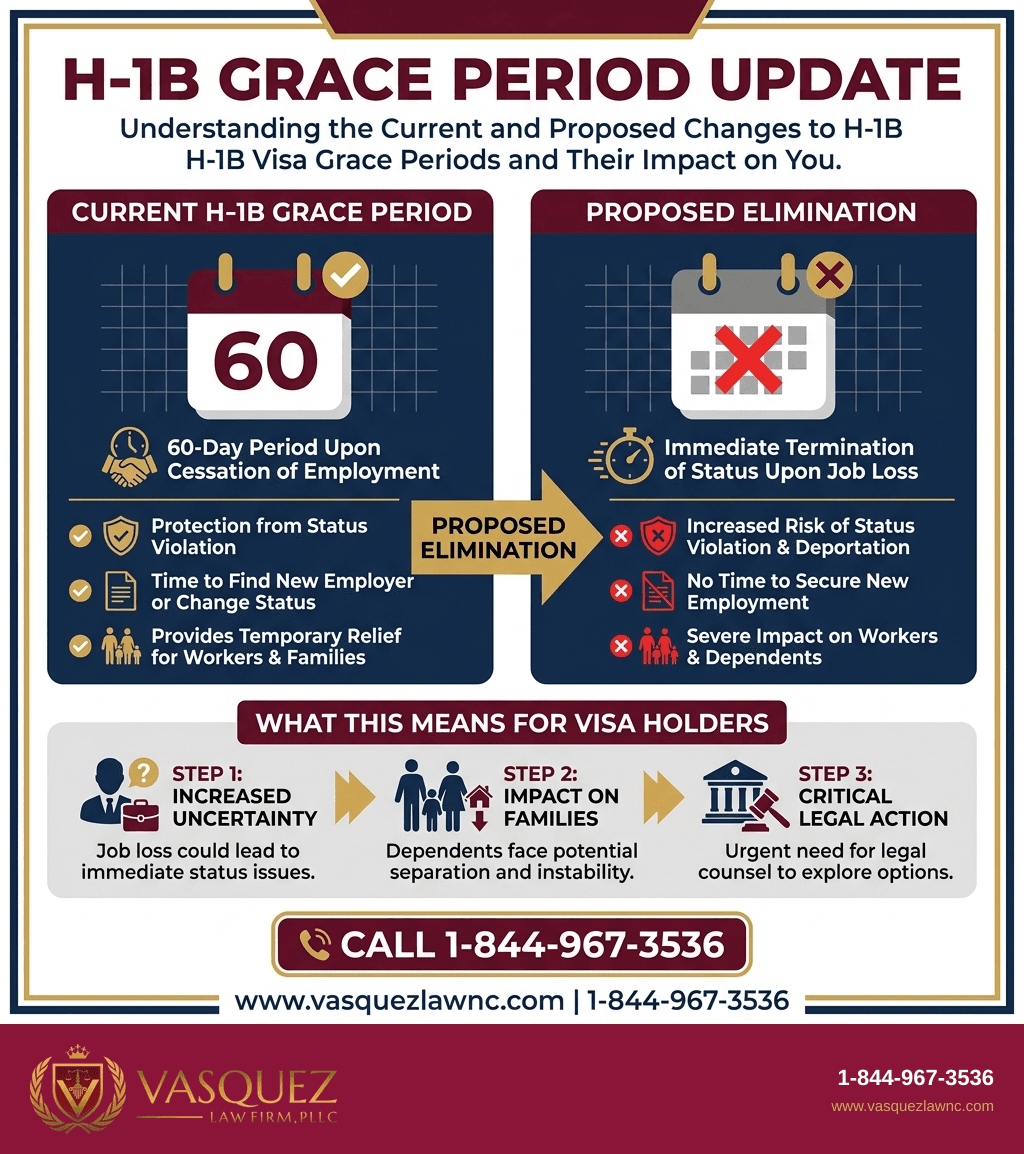
The H-1B grace period gives workers 60 days after their job ends to find a new employer, change status, or leave the U.S. Proposed changes in 2026 could remove this grace period, impacting visa holders significantly.
- The grace period starts immediately after job termination.
- Allows up to 60 days to remain lawfully.
- Proposed DHS rules may eliminate this period.
- Legal options include filing transfers or changes during the period.
- Act promptly to avoid falling out of status.
Understanding the H-1B Grace Period
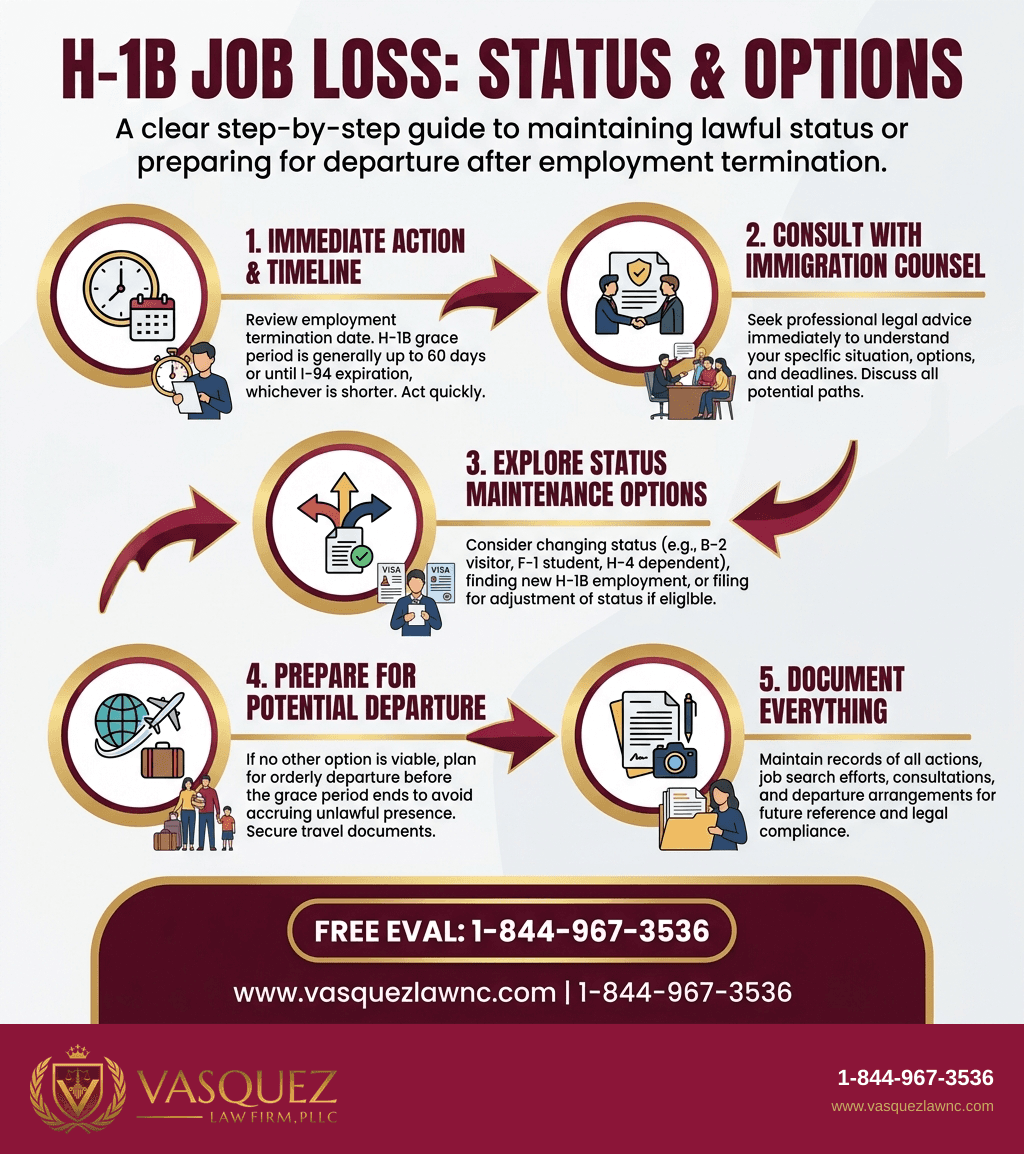
In 2026, the H-1B grace period remains a vital protection for workers. Normally, after an H-1B job ends, the worker has 60 calendar days or until the end of their authorized validity period, whichever is shorter, to seek new employment or change status without accruing unlawful presence. The grace period started with a 2016 USCIS memo to avoid immediate deportation risks after job loss.
For H-1B visa holders in Raleigh, NC, and Orlando, FL, this period can mean the difference between maintaining lawful presence or facing removal proceedings. USCIS recognizes this time as a window to file a new petition or transition to another visa category. Without it, workers would face immediate loss of status upon job termination.
Legal references include INA § 214 and regulations in 8 C.F.R. § 214.1. The DHS proposed in early 2026 to remove the 60-day grace period. This proposed rule aims to align with strict interpretations of visa duration, but as of September 2026, it has not been finalized. H-1B workers should monitor USCIS announcements carefully to stay up to date and maintain compliance.
What Happens When the Grace Period Ends
If the grace period expires without new status or employment, USCIS may issue a Notice to Appear (NTA) for removal. This triggers immigration court proceedings. In Orlando and Raleigh, immigration courts follow federal law strictly. Early legal intervention helps avoid these complications.
Grace Period Versus Unlawful Presence
Time spent within the authorized grace period does not count as unlawful presence, which is crucial to avoid triggering bars to re-entry. Overstaying beyond the grace period without an approved extension or new status results in unlawful presence under INA § 212(a)(9)(B).
USCIS Policy and Processing
USCIS guidance via the Policy Manual highlights the grace period's importance in maintaining status continuity. Processing times for petitions filed during the grace period vary; typically, Form I-129 petitions take 60 to 180 days. Premium processing shortens these times but is not always available.
Step-by-Step: What to Do After Job Loss
- Day 1: Confirm Employment Termination – Document the exact date your employment ended. This date starts the 60-day grace period.
- Check USCIS Processing Times – Check current processing times for Form I-129 or change of status forms on USCIS processing times.
- Explore Employer Options – Find a new employer to file an H-1B transfer petition. Your new employer must file Form I-129 within the grace period.
- File for Change of Status – If changing to another visa category, file the required application before the grace period ends.
- Prepare Documents – Gather pay stubs, your Form I-797 approval notice, and any communication with USCIS.
- Consult an Immigration Attorney – Contact immigration lawyers in Orlando or Raleigh promptly to ensure all actions comply with regulations.
- Plan for Departure – If you cannot secure new status or employment in time, prepare to leave the U.S. to avoid unlawful presence penalties.
Key Points
- Do not delay—missing deadlines can lead to loss of status.
- Maintain all documents proving your legal status.
- Know the timeline and USCIS procedures for extensions or transfers.
Common Mistakes to Avoid During the Grace Period
- Ignoring the 60-Day Limit: Waiting too long to act risks falling out of status.
- Unauthorized Employment: Working without approval voids your grace period.
- Failing to File Petitions Correctly: Incomplete or late filings can deny benefits.
- Not Consulting a Lawyer: DIY attempts often miss critical procedural steps.
- Not Retaining Documentation: Losing evidence can complicate status verifications.
- Assuming Grace Period Permanence: Proposed rules could remove it, so monitor updates.
- Confusing Grace Period With Visa Duration: The grace period is distinct from visa expiration date.
If you only remember one thing: Always act promptly after job loss. Time is your most valuable resource in protecting status.
Don't wait to get the help you deserve. Call us now for immediate assistance.
Se Habla Español
Timeline: What to Expect in 2026
- Day 1 (Job Termination): Grace period starts.
- Day 15-30: Start new job search or consult immigration attorney.
- Day 30-45: New employer files transfer petition or you file change of status.
- Day 60: Grace period ends; if no new status, prepare for departure.
- After 60 Days: Risk of removal proceedings initiation (NTA issuance).
Processing times for new petitions might extend beyond 60 days, but filing before deadline preserves lawful status during adjudication.
Frequently Asked Questions
Is the 60-day H-1B grace period eliminated in 2026?
As of now, the DHS has proposed ending the 60-day grace period, but the rule is not finalized. H-1B workers should continue to rely on the current grace period and consult attorneys for updates.
When does the H-1B grace period start after job termination?
The grace period begins the day after the employment ends, giving 60 days to take action such as finding new employment or changing status.
Can the H1B grace period be used multiple times?
Yes, the 60-day grace period resets with each employment termination but frequent job changes may complicate legal status adjustments.
What happens if I do not find employment during the grace period?
Failing to secure status could lead to a Notice to Appear in immigration court and possible removal proceedings.
Does USCIS always allow the 60-day grace period?
Generally yes, unless violations such as fraud or unauthorized work occur, which may void the grace period.
Can I file for extension or change of status during the grace period?
Yes, filing within the 60-day window preserves status while USCIS processes your petition, though processing times vary.
What documents should I prepare during the grace period?
Key documents include I-797 approval notices, recent pay stubs, employment letters, and correspondence from USCIS.
How do changes to the H-1B grace period affect workers in Orlando and Raleigh?
Changes could limit options to remain lawfully after job loss; local workers should consult Vasquez Law Firm for proactive legal counsel.
Jurisdiction Notes
North Carolina and Florida Notes
H-1B visa status is governed federally under the Immigration and Nationality Act. However, for workers living in Raleigh, NC, and Orlando, FL, local resources include immigration law attorneys familiar with regional immigration courts and USCIS service centers. While law is federal, practical impacts involve local representation for court hearings or employer consultations.
When to Call a Lawyer Now
- If your 60-day grace period is about to end and you have no new job offer.
- If you receive a Notice to Appear (NTA) from immigration authorities.
- If you want to file a change of status or extension petition during the grace period.
- If you face a job termination and want guidance on lawful options.
- If you have complex immigration history that could affect eligibility.
- If you want to understand how proposed rule changes impact your case.
About Vasquez Law Firm
At Vasquez Law Firm, we combine compassion with aggressive representation. Our motto "Yo Peleo®" reflects our commitment to standing up for your rights.
- Bilingual Support: Se Habla Español — fully bilingual support staff.
- Service Areas: North Carolina, plus Florida and nationwide for immigration.
- Experience: 15+ years helping clients navigate complex legal matters.
- Focus Areas: Immigration, personal injury, workers' compensation, criminal defense, and traffic violationssuccessful across multiple practice areas.
Attorney Trust and Experience
William J. Vásquez is admitted to the North Carolina State Bar and the Florida Bar, with 15 years of experience handling immigration cases throughout the U.S., including H-1B status matters.
Take the first step toward justice today. Our team is standing by to help.
Start Your Free Evaluation Now
Call us: 1-844-967-3536
Se Habla Español - Estamos aquí para ayudarle.
If you need legal assistance, learn more about our immigration law practice, or call us at 1-844-967-3536 for a free evaluation.

William Vasquez
Founder & CEO, Vasquez Law Firm, PLLC
William Vasquez is the founder and CEO of Vasquez Law Firm, PLLC, a results-driven firm specializing in immigration, criminal defense, personal injury, and workers' compensation. A U.S. Air Force veteran and recipient of the Joint Service Achievement Medal, William is dedicated to fiercely fighting for his clients' rights.
Related Legal Services
Need legal help? Learn more about our immigration law practice, or contact us for a free evaluation.
You can also visit immigration lawyers serving all of North Carolina for more information.