How ICE Cooperation Works with Local Enforcement in 2026
Learn how ICE cooperation with local enforcement works in 2026 and how it may affect you. Contact Vasquez Law Firm for a free consultation today.
Published on August 31, 2026
Talk to an immigration attorney
Free call. A clear plan for your case.
Free & confidential · Se habla espanol · 24/7

Have questions? Talk to an attorney - free evaluation.
Call 1-844-967-3536Worried how the latest immigration news affects you?
Schedule a confidential case review with an immigration attorney - know exactly where you stand.
How ICE Cooperation Works with Local Enforcement in 2026
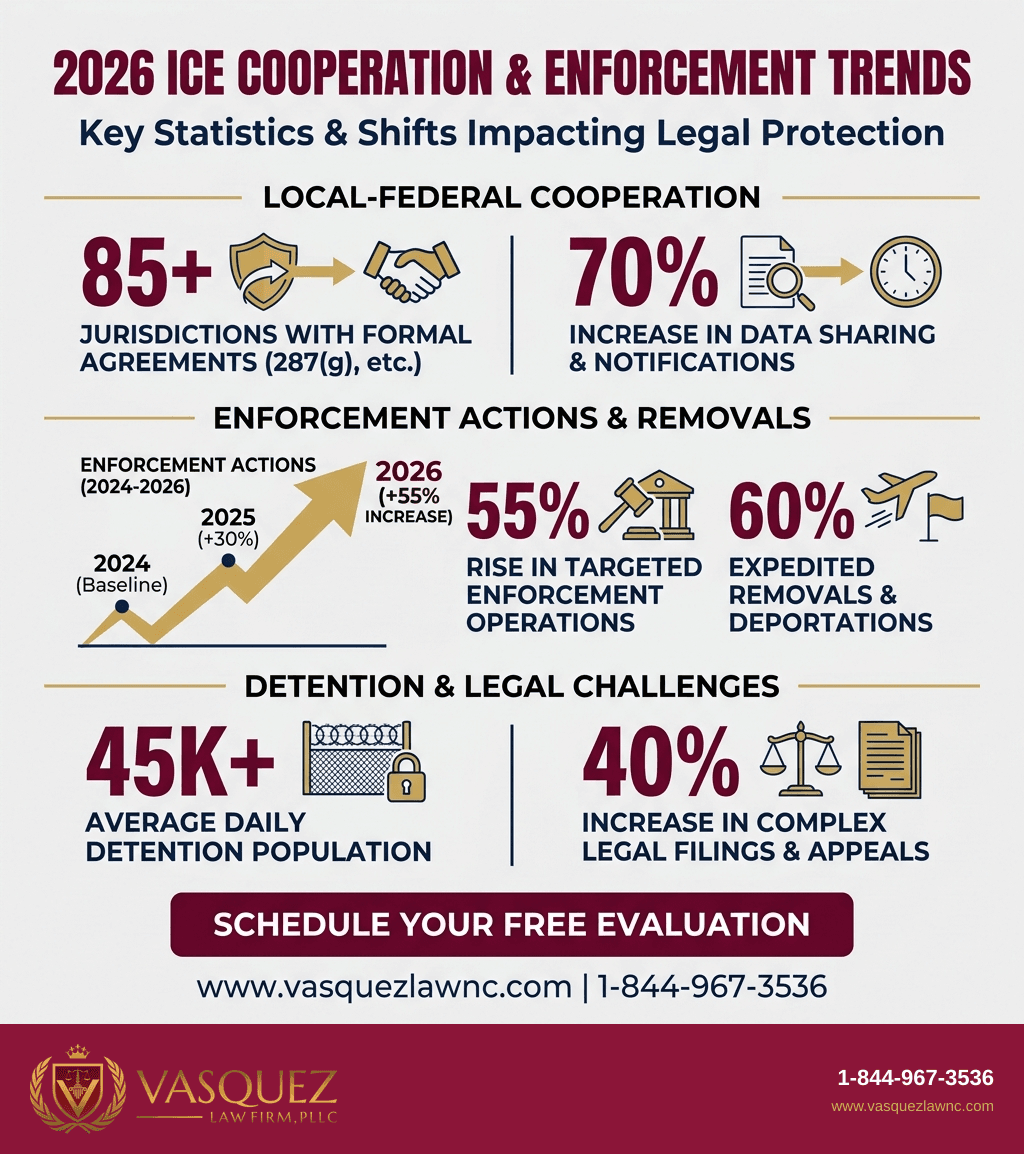
In 2026, ICE cooperation with local law enforcement agencies plays a critical role in immigration enforcement across the United States, including Raleigh, NC, and Orlando, FL. This cooperation involves programs like the ICE 287(g) delegation which allows local agencies to perform immigration enforcement under federal supervision. Understanding how ICE cooperation functions, who participates, and the rights of immigrants and residents in these areas can help you navigate potential interactions with law enforcement. This guide explains the main aspects of ICE cooperation and offers practical advice for protecting your rights.
Need help with your case? Our experienced attorneys are ready to fight for you. Se Habla Español.
Or call us now: 1-844-967-3536
Quick Answer
ICE cooperation refers to agreements that allow local law enforcement to assist in immigration enforcement under federal supervision, such as the ICE 287(g) program. It affects Raleigh, NC, and Orlando, FL, where local authorities may perform immigration duties after specialized training. Individuals should know their rights and seek legal advice if approached by ICE or cooperating agencies.
- Local agencies may perform immigration enforcement.
- Participation varies by state and locality.
- ICE 287(g) requires officer training and federal oversight.
- You have rights during encounters with ICE or local officers.
Understanding ICE Cooperation
Imagine a Raleigh police officer who can not only enforce state laws but also identify and detain people for federal immigration violations. This scenario results from ICE cooperation, especially the 287(g) program authorized by federal law (8 U.S.C. § 1357(g)). This program grants local officers delegated immigration enforcement authority under ICE supervision.
ICE, or U.S. Immigration and Customs Enforcement, is a federal agency within the Department of Homeland Security. It serves to investigate and enforce immigration laws, often working with conventional law enforcement but also operating specialized programs with local agencies. Cooperation can speed up immigration enforcement but also raises concerns about civil rights.
Local participation differs in Raleigh (North Carolina) and Orlando (Florida). Some local agencies fully cooperate by signing 287(g) agreements and sending officers for ICE 287g training. Others maintain a limited relationship or none at all. Understanding whether your local law enforcement cooperates is crucial for residents and immigrants.
Knowing the organization behind ICE clears confusion around its roles. It is not a police agency focused on general crime but a specialized federal entity handling immigration, deportation, and related violations. This distinction helps clarify questions like, "Is ICE police?" The answer is nuanced: ICE is federal law enforcement, but its scope is strictly immigration and customs related (see 8 C.F.R. § 287.3).
Learn more about our immigration services and how we protect clients facing enforcement actions in Raleigh or Orlando.
Step-by-step: What to Do If Approached by ICE or Cooperating Officers
- Stay Calm and Be Polite: Do not resist or run. Conflicts can worsen your situation.
- Ask If You Are Free to Leave: You have the right to know if you must stay or can leave.
- Do Not Volunteer Information: Provide only your name if asked, but avoid detailed answers.
- Request an Attorney: You have the right to legal representation before answering questions or signing documents.
- Do Not Sign Anything Without Advice: Documents can have significant legal consequences.
- Contact an Immigration Attorney: Reach out to a knowledgeable legal team, such as Attorney Vasquez at Vasquez Law Firm for guidance.
Documents and Evidence Checklist
- Identification documents (passport, driver's license, state ID)
- Immigration papers (visa, I-94, Permanent Resident Card, work permits)
- Any Notice to Appear (NTA) or previous ICE documents
- Proof of residency or family ties in NC or FL
- Contact information for your attorney or legal representative
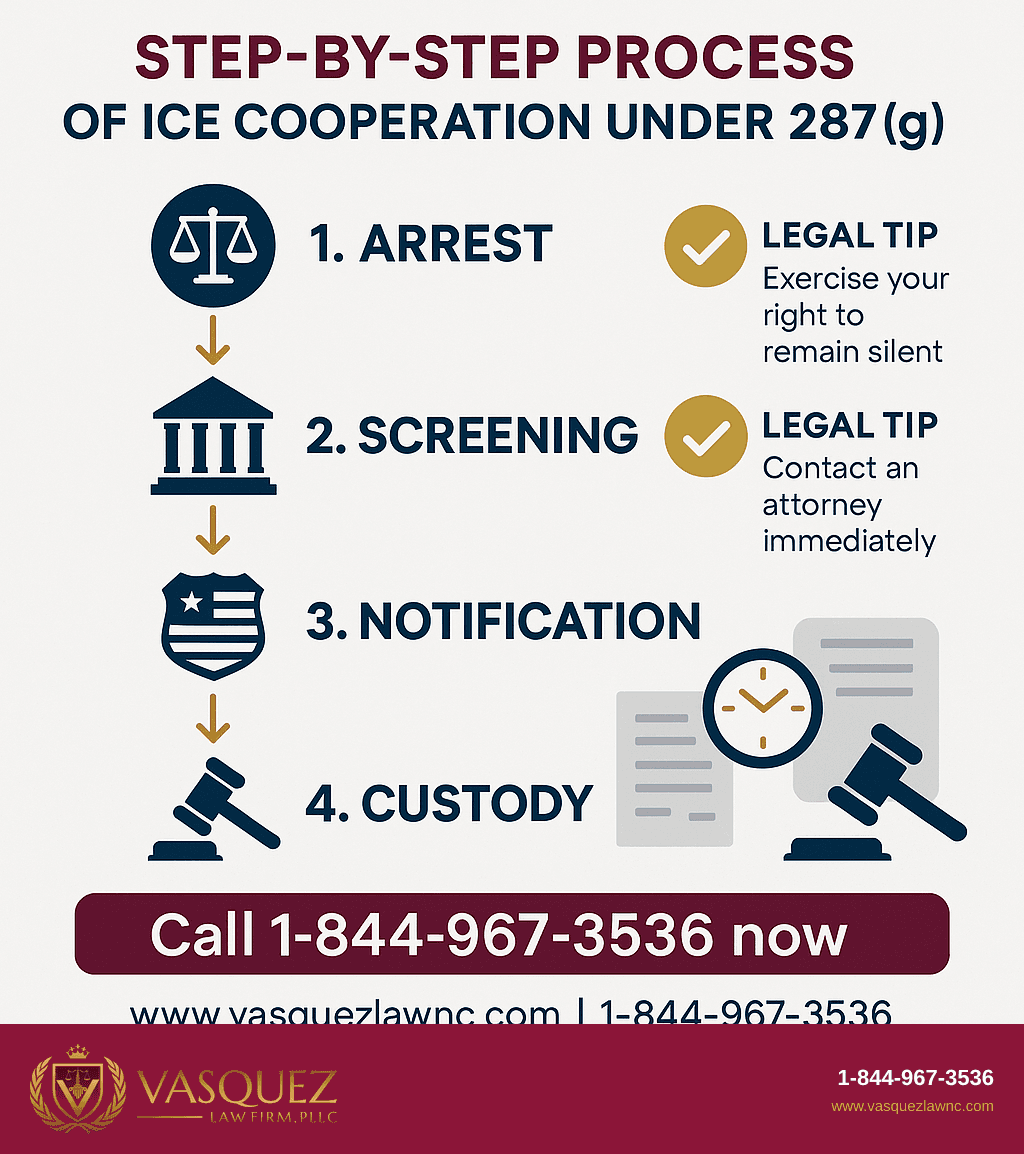
Timeline: What to Expect in Enforcement Activities
- Initial Contact: Local officers with ICE authority question or detain individuals during routine law enforcement activities such as traffic stops or arrests.
- Verification: Immigration status is checked using federal databases and ICE resources.
- Detainment: If unauthorized presence is suspected, ICE-certified officers can detain individuals pending further action.
- Removal Proceedings: Individuals may receive a Notice to Appear in immigration court, starting formal removal (deportation) processes managed by the Executive Office for Immigration Review.
- Legal Relief and Hearings: Possible defenses and reliefs may be pursued, including adjustment of status (8 U.S.C. § 1255) or cancellation of removal under INA § 240A(b).
Costs and Fees Related to Legal Help in ICE Cases
- Consultation fees vary but many immigration attorneys offer free evaluations.
- Filing fees for forms like adjustment of status (Form I-485) currently range from $1,140 to $1,225 with biometric fees.
- Legal representation fees depend on case complexity, ranging from a few thousand to more for removal defense cases.
- Additional costs may include expert witnesses, translations, or travel expenses for hearings.
Common Mistakes to Avoid
- Volunteering information or signing documents without lawyer advice — fix: consult an attorney first.
- Ignoring local laws or policies about ICE cooperation — fix: stay informed on Raleigh and Orlando enforcement practices.
- Not carrying important documents or contacts — fix: keep a document checklist ready.
- Assuming all local police enforce immigration — fix: verify if your local agency participates in ICE programs to know your exposure.
- Delaying legal consultation after ICE interaction — fix: contact Vasquez Law Firm immediately to understand options.
- Failing to understand the distinction between immigration enforcement and criminal law enforcement — fix: ask for clarification when approached.
- Not knowing your constitutional rights — fix: learn your rights during ICE or cooperating law enforcement encounters.
If you only remember one thing: always seek legal advice before making decisions during encounters with ICE or local authorities cooperating with ICE.
Jurisdiction Notes for Raleigh and Orlando
North Carolina Notes
North Carolina has local law enforcement agencies that participate in the ICE 287(g) program. If you live in Raleigh or nearby, your local law enforcement might cooperate directly with ICE. This means local officers could question or detain individuals for immigration issues. Knowing your rights helps protect you in these situations. For detailed legal assistance, reach out to our Raleigh office.
Florida Notes
In Orlando, Florida, cooperation with ICE tends to be more centralized with federal officers conducting immigration enforcement. Florida local law enforcement varies by county in their participation. Vasquez Law Firm's Orlando office provides specialized immigration defense services to help clients navigate these complexities.
Nationwide Context
Across the United States, cooperation policies between ICE and local law enforcement differ widely. The 287(g) program map shows varying participation dependent on local government decisions and political climates. Always consult local and state resources to understand your area's policies.
When to Call a Lawyer Now
- If you are detained or questioned by ICE or local officers with immigration enforcement authority.
- If you receive a Notice to Appear in immigration court from the EOIR.
- If you are arrested and fear immigration consequences.
- If you face removal or deportation proceedings.
- If you want to apply for adjustment of status or other immigration relief.
- If you need help understanding your rights during an ICE encounter.
- If you need advice about the ICE 287(g) program or local cooperation policies in Raleigh or Orlando.
About Vasquez Law Firm
At Vasquez Law Firm, we combine compassion with aggressive representation. Our motto "Yo Peleo®" (I Fight) reflects our commitment to standing up for your rights.
- Bilingual Support: Se Habla Español — Spanish-speaking attorneys and staff available
- Service Areas: North Carolina, plus Florida and nationwide for immigration
- Experience: Over 30 years helping clients navigate complex legal matters
- Results: Thousands of successful cases across multiple practice areas
Attorney Trust and Experience
William J. Vásquez is admitted to the North Carolina State Bar (2011) and to the U.S. Courts of Appeals for the 4th, 5th, and 11th Circuits. The firm has provided dedicated legal representation since 2011, with personalized attention to each client's case.
Don't wait to get the help you deserve. Call us now for immediate assistance. Se Habla Español.
Frequently Asked Questions
What is ICE cooperation with local law enforcement?
ICE cooperation involves agreements between U.S. Immigration and Customs Enforcement and local law enforcement agencies who assist in immigration enforcement. Programs like 287(g) enable trained officers in these local agencies to perform certain immigration functions under federal supervision, which can affect individuals residing in Raleigh, NC, and Orlando, FL.
Are local police required to cooperate with ICE?
No, local law enforcement agencies in North Carolina and Florida can decide independently whether to cooperate with ICE. Some states have policies restricting cooperation, while others participate more actively in ICE programs, such as the 287(g) program. Cooperation policies can vary even by county or city.
What does the ICE 287(g) program entail?
The 287(g) program allows ICE to train and deputize local law enforcement officers to perform immigration enforcement duties, such as identifying and detaining undocumented immigrants. These officers operate under ICE supervision and are required to complete training, known as ICE 287(g) training, before enforcement actions.
Is ICE considered a police agency?
ICE is a federal law enforcement agency under the Department of Homeland Security responsible for immigration enforcement, investigations, and deportations. While ICE has policing powers relating to immigration, it is not a typical police force and focuses on immigration and customs enforcement rather than criminal law enforcement broadly.
What states are cooperating with ICE through 287(g)?
As of 2026, several states, including parts of North Carolina, have local agencies participating in the ICE 287(g) program. Participation depends on local policies and federal agreements. North Carolina has some counties where local officials cooperate with ICE, while Florida generally relies more on ICE directly without broad local agreements.
Why was ICE created and what is its mission?
ICE was created in 2003 as part of the Department of Homeland Security to enforce U.S. immigration laws and investigate cross-border crime, including human trafficking and smuggling. Its mission includes securing the nation by identifying and removing individuals who violate immigration law, while also investigating customs violations.
What rights do individuals have when interacting with ICE or cooperating local officers?
Individuals have constitutional rights, including the right to remain silent and the right to legal representation. You should ask if you are free to leave and not consent to searches without a warrant. In Raleigh and Orlando, contacting an immigration attorney is important if you encounter ICE or local enforcement cooperating with ICE.
How can Vasquez Law Firm help with ICE-related cases?
Vasquez Law Firm offers experienced immigration legal representation to residents in Raleigh, NC and Orlando, FL facing ICE enforcement. We provide guidance on rights during ICE encounters, assist with removal defense, adjustment of status, and other immigration relief. Contact us for a free case evaluation with bilingual support available.
Sources and References
- U.S. Citizenship and Immigration Services
- Executive Office for Immigration Review
- Legal Information Institute
Take the first step toward justice today. Our team is standing by to help. Se Habla Español.
Start Your Free Evaluation Now
Call us: 1-844-967-3536
Se Habla Español - Estamos aquí para ayudarle.


William Vasquez
Founder & CEO, Vasquez Law Firm, PLLC
William Vasquez is the founder and CEO of Vasquez Law Firm, PLLC, a results-driven firm specializing in immigration, criminal defense, personal injury, and workers' compensation. A U.S. Air Force veteran and recipient of the Joint Service Achievement Medal, William is dedicated to fiercely fighting for his clients' rights.
Related Legal Services
Need legal help? Learn more about immigration lawyers in North Carolina, or contact us for a free evaluation.
You can also visit immigration legal services throughout NC for more information.