How the Alien Terrorist Removal Court Works in 2026
The Alien Terrorist Removal Court removed its first alien terrorist in 2026, Nazira Haji Zada, under 8 U.S.C. § 1227. This historic case involved an ISIS-inspired Election Day plot. Learn who is affected, what the law says, and what steps to take if facing similar proceedings in Raleigh, NC or Orlando, FL.
Published on September 12, 2026
Talk to an immigration attorney
Free call. A clear plan for your case.
Free & confidential · Se habla espanol · 24/7
Have questions? Talk to an attorney - free evaluation.
Call 1-844-967-3536Worried how the latest immigration news affects you?
Schedule a confidential case review with an immigration attorney - know exactly where you stand.
USCIS Case Status
Check your USCIS case status
Enter your receipt number and get the official status. Free, no registration.
This article gives general legal information, not personal legal advice. Reading it does not create an attorney-client relationship. For advice about your own case, contact Vasquez Law Firm.
How the Alien Terrorist Removal Court Works in 2026
Facing Deportation?
Time is critical. Our deportation defense attorneys are available 24/7 for emergency cases.
What happened in the first case before the Alien Terrorist Removal Court?
The Alien Terrorist Removal Court (ATRC) removed Nazira Haji Zada, an Afghan national living in Texas, from the United States in 2026. This was the first time the ATRC was used since it was created decades ago. Zada admitted she is an alien terrorist, which means a foreign person who supports terrorism. She helped a family plan an ISIS-inspired mass shooting on Election Day 2024. The court issued a removal order on August 20, 2026. She gave up her right to appeal and returned to Afghanistan, making the order final.
This important removal was the ATRC’s first use as a federal court tool to quickly remove alien terrorists from the U.S. The Department of Justice filed the case on July 15, 2026. The case was heard before the Alien Terrorist Removal Court. The court used secret evidence to prove Zada’s terrorist status. Her lawyers got many documents to prepare her defense. The removal cancels her legal status and stops her from ever legally entering the U.S. again.
This case shows a team effort by the Departments of Justice, Homeland Security, and State. It follows President Trump’s order to focus on national security. Congress created the ATRC law in 1996, but it had never been used until now. This case shows how the government can use special courts and secret evidence to protect the country from terrorist threats inside its borders.
For more details, see the official Department of Justice announcement at USCIS.gov.
Who is affected by the Alien Terrorist Removal Court’s first case?
The first ATRC case affects Nazira Haji Zada, her family members involved in the terrorist plan, and the larger immigrant community watched closely for national security reasons. Zada, a legal resident alien (a foreign person allowed to live in the U.S.), helped her son Abdullah Haji Zada and son-in-law Nasir Ahmad Tawhedi plan an ISIS-inspired mass shooting on Election Day 2024. Abdullah was arrested as a juvenile, pleaded guilty as an adult, and got a 15-year sentence. Tawhedi pleaded guilty to terrorism crimes and is waiting for sentencing.
People living in Raleigh, NC and Orlando, FL, where our offices are, should know that cases like this show the government can quickly remove alien terrorists. Even though this case happened in Texas, the ATRC’s power covers the whole country. Alien terrorists living anywhere in the U.S., including North Carolina and Orlando, FL, could face similar removal cases if there is enough evidence.
The Department of Justice says the family sold property and bought one-way tickets to Afghanistan before Election Day. This shows they planned the attack ahead of time. The ATRC uses secret information and federal public defenders to make sure the alien gets a fair process, even with sensitive evidence. The government’s power to cancel legal permanent resident status, like in Abdullah’s case, shows how serious the immigration consequences are for terrorism involvement.
This case also shows that federal agencies like the FBI and Homeland Security Investigations are watching immigrant groups more closely for terrorism risks. The ATRC only targets people proven to be terrorists by a preponderance of evidence, which means more likely than not. But this case may change how the public sees immigration and how immigration laws are enforced across the country.
What does the law say about the Alien Terrorist Removal Court and removal of alien terrorists?
The Alien Terrorist Removal Court is a special federal court created by Congress in 1996 under Title 8 of the United States Code, Sections 1531 to 1537. It can remove alien terrorists when the government shows by a preponderance of the evidence that the alien is a terrorist. The court is run by federal judges appointed under Article III of the Constitution by the Chief Justice of the United States.
The ATRC law lets the government use secret information in removal cases without making it public if that would hurt national security. The law also provides paid lawyers for the alien if needed. The alien can appeal to the United States Court of Appeals for the District of Columbia Circuit.
"The ATRC is a specialized federal court, which Congress established in 1996. The court has jurisdiction to swiftly remove alien terrorists from the United States when the government establishes by a preponderance of the evidence that an alien is a terrorist. See Title 8 of the United States Code, Sections 1227(a)(4)(B), 1531(1), and 1534(g). It is run and staffed by U.S. federal district court judges confirmed to the judiciary pursuant to Article III of the Constitution and then appointed to the ATRC by the Chief Justice of the United States." (Source: Department of Justice, https://www.uscis.gov/newsroom/news-releases/department-of-justice-removes-alien-terrorist-in-first-use-of-united-states-alien-terrorist-removal)
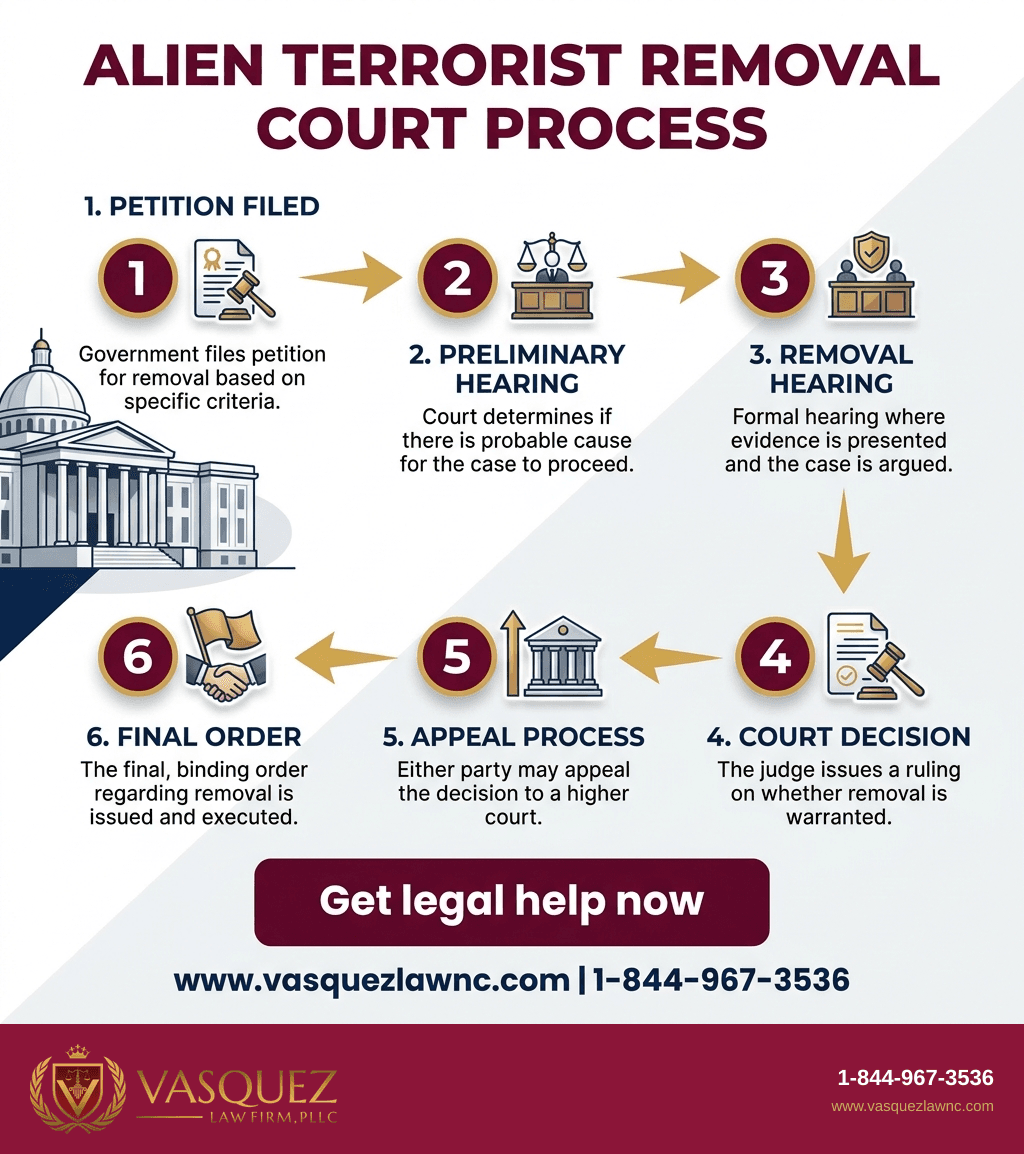
Under immigration law, alien terrorists can be deported under 8 U.S.C. § 1227. This law lists groups of aliens who can be deported, including those involved in terrorism. Removal orders cancel any legal status the alien has, like lawful permanent residence. For example, Abdullah Haji Zada lost his lawful permanent resident status when his removal order was made.
The court’s rules balance national security with fair legal rights. The government must give the alien and their lawyer the evidence that shows the alien is a terrorist, even if it is secret. The alien can give up their right to appeal, like Zada did, or try limited appeals. The ATRC is a strong but focused tool to protect the U.S. from terrorist threats living inside the country.
What should you do if you or a family member face an alien terrorist removal proceeding?
If you or a family member face removal proceedings before the Alien Terrorist Removal Court, it is very important to get an experienced lawyer right away. These cases use secret evidence and complex national security laws. They need special defense plans. The ATRC provides paid lawyers if the alien cannot pay for one.
At our Raleigh, NC and Orlando, FL offices, we often see that the biggest mistake is not understanding how serious ATRC cases are and not acting quickly. Getting legal help early can protect your rights and look for all options, like challenging the evidence or negotiating removal terms.
Here are important steps to take if you are in an ATRC case:
- Get a lawyer who knows immigration and national security law right away.
- Ask for all evidence and review secret documents with your lawyer.
- Get ready for court hearings and learn what it means to give up appeal rights.
- Look for possible defenses or relief, though options are limited in terrorism cases.
- Work with family and community groups for support during the case.
Because ATRC cases cancel legal status, people should understand how this affects future immigration benefits, like applying for a green card under 8 U.S.C. § 1255. Removal orders for terrorism usually stop reentry permanently.
If you do not act fast, removal orders can become final without a real chance to fight. The stakes are very high, and the ATRC process is different from normal removal cases. Legal help is needed to understand the ATRC’s special rules and protect your rights.
What happens next after an ATRC removal order is issued?
After the Alien Terrorist Removal Court issues a removal order, the alien must leave the United States quickly. In the first ATRC case, Nazira Haji Zada gave up her right to appeal and went back to Afghanistan. This made the removal order final. The government then enforces the removal and stops the alien from entering the U.S. again.
The ATRC law lets either side appeal to the United States Court of Appeals for the District of Columbia Circuit. But aliens who give up their appeal rights, like Zada, lose the chance to challenge the order further. The government works with agencies like the U.S. Marshals Service and Homeland Security Investigations to make sure removal happens safely.
The Department of Justice said this removal is a win for national security and the rule of law. The FBI said people who betray U.S. hospitality by supporting terrorism will face consequences. The government will keep using all legal tools to find, charge, and remove alien terrorists.
"This landmark case, resulting in the prompt removal of this alien terrorist to her country of origin, is a win for national security and the rule of law," the Department of Justice said. "Those who support and condone terrorism should not be living in the United States, and this first-ever case before the ATRC shows how the Department will use every tool at its disposal to protect our country." (Source: Department of Justice, https://www.uscis.gov/newsroom/news-releases/department-of-justice-removes-alien-terrorist-in-first-use-of-united-states-alien-terrorist-removal)
For people living in Raleigh, NC and Orlando, FL, this case shows the federal government’s strong focus on national security and the serious consequences for alien terrorists. The ATRC will probably be used more often to quickly remove threats. Lawyers should watch for new cases and get ready.
| Step | Action | Outcome |
|---|---|---|
| 1 | Government files ATRC removal application | Alien notified; court sets hearing |
| 2 | Alien and counsel review evidence (including classified) | Alien prepares defense or admits guilt |
| 3 | ATRC hearing and removal order issued | Order becomes final if no appeal |
| 4 | Alien removed from U.S. | Permanent inadmissibility imposed |
| 5 | Possible appeal to D.C. Circuit | Order upheld or reversed |
What's Your Immigration Situation?
Answer 3 questions - we'll tell you your options
Question 1 / 3
What best describes your situation?
Keep Reading
What are common questions about the Alien Terrorist Removal Court?
What is the Alien Terrorist Removal Court?
The ATRC is a special federal court created by Congress in 1996 to remove alien terrorists from the United States. It lets the government use secret evidence and provides lawyers for the alien. The court’s goal is to quickly remove aliens who threaten terrorism.
Who can be removed by the ATRC?
Aliens who the government shows by a preponderance of the evidence are terrorists or support terrorism can be removed by the ATRC. This includes legal permanent residents and other aliens living in the U.S.
Can an alien appeal an ATRC removal order?
Yes, aliens can appeal to the United States Court of Appeals for the District of Columbia Circuit. But they can also give up their appeal rights, like in the first case with Nazira Haji Zada.
Does the ATRC use classified evidence?
Yes, the ATRC law allows the use of secret information that cannot be made public to protect national security. The alien and their lawyer get access to this evidence in secure ways.
What happens to lawful status after an ATRC removal order?
Removal orders cancel any legal status, including lawful permanent residence, held by the alien. The alien becomes permanently barred from entering the U.S. again and cannot get future immigration benefits.
This article gives general legal information, not personal legal advice. Reading it does not create an attorney-client relationship. For advice about your own case, contact Vasquez Law Firm.
Reviewed by William Vasquez, Founder & CEO, Vasquez Law Firm, PLLC.
If you need legal help, learn more about NC immigration legal team, or call us at 1-844-967-3536 for a free evaluation.
Related Topics

William Vasquez
Founder & CEO, Vasquez Law Firm, PLLC
William Vasquez is the founder and CEO of Vasquez Law Firm, PLLC, a results-driven firm specializing in immigration, criminal defense, personal injury, and workers' compensation. A U.S. Air Force veteran and recipient of the Joint Service Achievement Medal, William is dedicated to fiercely fighting for his clients' rights.
Related Legal Services
Need legal help? Learn more about NC immigration legal team, or contact us for a free evaluation.
You can also visit statewide immigration attorneys for more information.