Federal Trucking Regulations: What You Should Know in 2026
Understand federal trucking regulations in 2026 and protect your rights after an accident. Contact Vasquez Law Firm today for a free consultation.
Published on March 12, 2026
Injured? Get what your case is worth
Free review.
Free & confidential · Se habla espanol · 24/7

Have questions? Talk to an attorney - free evaluation.
Call 1-844-967-3536Get What Your Injury Is Worth
Schedule your consultation.
Federal Trucking Regulations: What You Should Know in 2026
Federal trucking regulations are critical for ensuring safety on roads, especially for truck drivers and accident survivors in Smithfield, North Carolina, and Florida. In 2026, these rules continue to evolve, affecting not only how truck companies and drivers operate, but also how personal injury cases resulting from truck accidents are handled in court. Understanding these regulations can help you protect your legal rights if you are involved in a trucking accident. This article covers the key federal trucking regulations, their impact on accident claims, and what survivors need to know to seek compensation.
Need help with your case? Our experienced attorneys are ready to fight for you. Se Habla Español.
Schedule Your Free Case Evaluation
Or call us now: 1-844-967-3536
Quick Answer
Federal trucking regulations set by the FMCSA govern how commercial trucks operate to promote safety. Violations of these rules often play a key role in trucking accident personal injury claims. Survivors in Smithfield and nearby areas should know these regulations to protect their rights and pursue fair compensation.
- FMCSA sets driver hours and vehicle standards
- Rules cover driver qualifications and maintenance
- Violations can support negligence claims in court
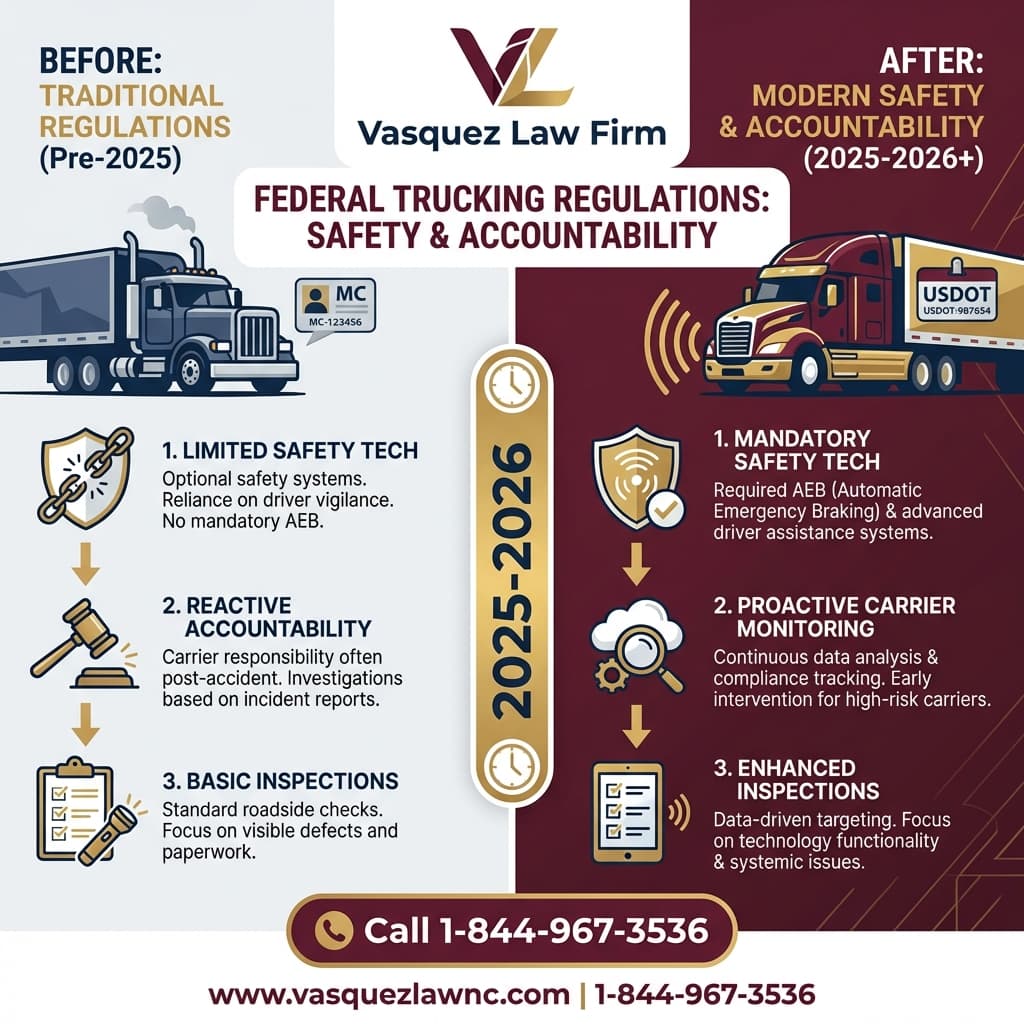
- New 2026 rules add stricter inspections and training
- North Carolina and Florida have specific applications
How Federal Trucking Regulations Affect Accidents
Imagine a 2026 truck accident in Smithfield where the driver had exceeded the federally allowed driving hours and failed to complete required vehicle inspections. Such violations can directly contribute to accidents due to driver fatigue or mechanical failure. Federal trucking regulations establish clear standards to prevent these risks. For example, the Hours of Service (HOS) rules limit continuous driving time and mandate rest breaks to reduce fatigue-related crashes.
These regulations also require commercial motor vehicles to undergo regular safety inspections and maintenance. Failure to comply may lead to unsafe trucks on roads, increasing accident chances. In personal injury cases, these federal rules provide a legal framework to prove that a trucking company or driver was negligent.
For survivors of trucking accidents in Smithfield, understanding which federal rules were broken can help build a solid case. Accident victims should focus on violations like:
- Exceeding HOS limits
- Not maintaining vehicle inspection records
- Improper cargo securement
- Failure to follow driver qualification standards
These breaches of federal regulations show fault, which supports injury claims. To see the official list, you can view the Federal Motor Carrier Safety Administration regulations.
DOT Rules and Regulations Handbook
The DOT provides a comprehensive rules and regulations handbook outlining all federal requirements for truck drivers and companies. This handbook is essential for anyone working in or affected by the trucking industry to understand the safety standards enforced nationwide. It includes important topics like drug testing, vehicle marking, and accident reporting procedures.
FMCSA Safety Regulations Handbook PDF
The FMCSA Safety Regulations Handbook PDF is available free online and serves as a guide for enforcement officers, motor carriers, and drivers. It helps explain the detailed rules, including new 2026 updates. Survivors considering a personal injury case should consult these documents to identify violations related to their accidents.
New Rules for Truck Drivers in 2026
One significant change in 2026 includes stronger mandates for electronic logging devices (ELDs) to track driver hours accurately. This reduces risks of falsified logs and unreported fatigue. Additionally, stricter vehicle inspection cycles and mandatory additional driver training aim to improve safety outcomes nationwide.
Step-by-Step: Handling a Trucking Accident Claim
- Ensure Safety and Medical Care: Immediately call 911 and seek medical treatment for injuries sustained.
- Collect Evidence: Get truck driver information, vehicle details, witness contacts, and take photos of the accident scene and injuries.
- Report to Authorities: File a police report as it documents the accident officially.
- Notify Insurance Companies: Inform your insurer and the trucking company’s insurer about the accident.
- Consult a Personal Injury Lawyer: Seek legal advice from a lawyer experienced with federal trucking regulations to evaluate your claim’s strength.
- Gather Documents: Obtain medical records, accident reports, and maintenance logs of the truck involved.
- Demand or Negotiate Settlement: Your lawyer will help demand fair compensation or negotiate a settlement based on the evidence.
- Litigation if Necessary: If settlement is not possible, your lawyer may file a lawsuit to pursue damages in court.
Important Early Steps for Survivors
Survivors should avoid giving recorded statements to insurance adjusters without a lawyer present to protect their interests. Acting fast to preserve evidence such as dashcam footage or logbooks is crucial.
Using Trucking Regulations in Your Claim
Your lawyer will review if the trucking company or driver violated federal regulations — such as hours of service or vehicle maintenance — since these violations demonstrate negligence required in personal injury claims.
Documents and Evidence Checklist
- Police accident report
- Photographs of accident scene and vehicles
- Medical and hospital records and bills
- Truck driver employment records and logbooks
- Electronic logging device (ELD) data
- Vehicle maintenance and inspection records
- Witness statements and contact information
- Insurance policies and correspondences
Why Each Document Matters
Police reports provide official accident details. Medical records prove injuries and treatment costs. Logbooks and inspection documents show compliance or violations of trucking regulations. Witness accounts can help clarify fault and accident circumstances.
Collecting Evidence Quickly
Time is critical for preserving evidence because trucking companies may modify or lose records. Act promptly after an accident to request important documentation with your lawyer’s help.
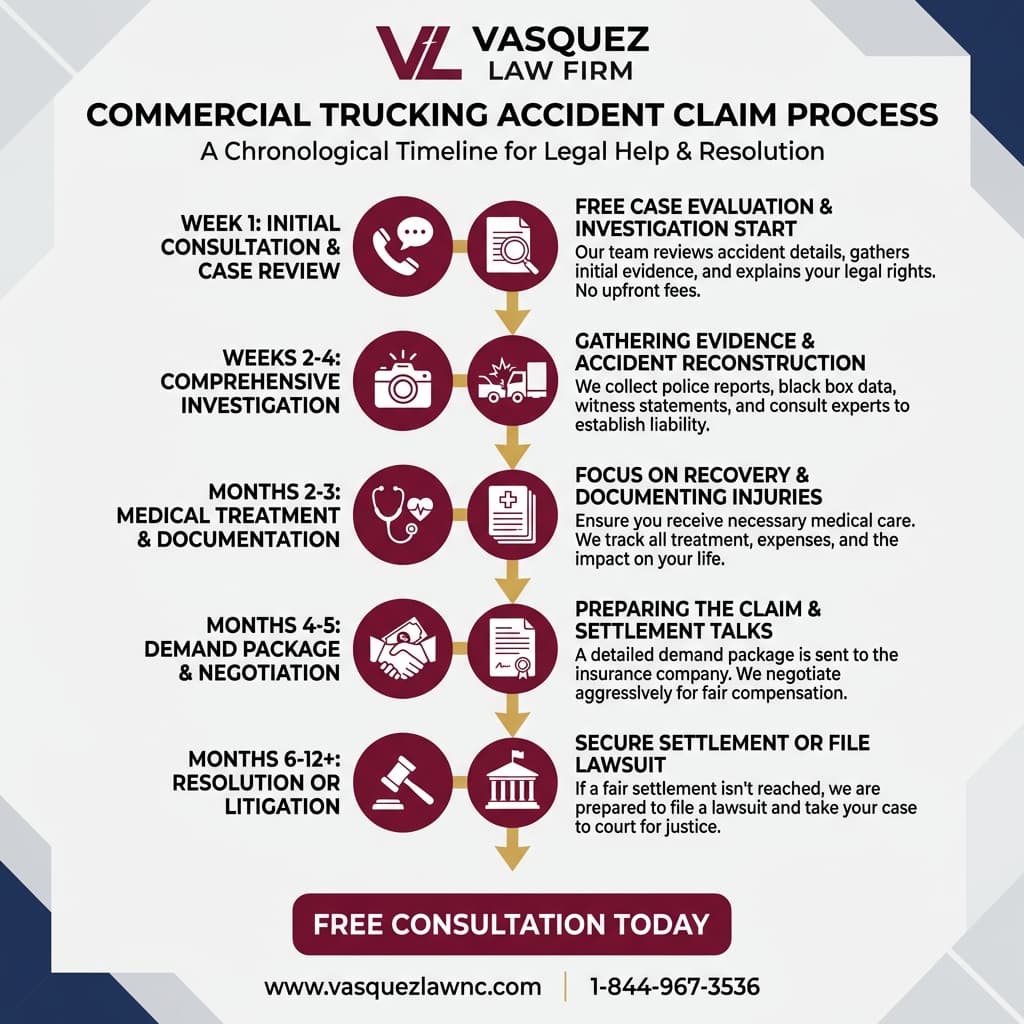
Timeline: What to Expect After an Accident
- Within 24-48 hours: Report accident, seek medical care, start evidence collection.
- Week 1: Begin working with a personal injury attorney; send initial insurance notices.
- First 30 days: Collect medical records, truck maintenance logs, and driver logs.
- 1-3 months: Insurance negotiations happen; possible settlement offers.
- 3-6 months: If no settlement, prepare for possible lawsuit filing and pre-trial discovery.
- 6-12 months or more: Trial or case resolution through settlement or court judgment.
Each case varies but acting quickly enhances your claim's success chances.
Common Mistakes in Trucking Accident Cases
- Failing to seek immediate medical treatment: Fix by seeing a doctor to document injuries early.
- Not collecting sufficient evidence: Fix by gathering photos, witness contacts, and police reports promptly.
- Giving recorded statements without a lawyer: Fix by consulting your lawyer first.
- Ignoring federal trucking regulations violations: Fix by having a lawyer review truck driver logs and maintenance records.
- Delaying legal action: Fix by contacting a personal injury lawyer quickly to meet statute deadlines.
- Underestimating damages: Fix by including all medical costs, lost wages, and pain suffered.
- Accepting the first insurance offer: Fix by allowing your lawyer to negotiate for fair compensation.
If you only remember one thing: Protect your legal rights by acting fast, collecting evidence, and seeking experienced legal help.
North Carolina and Florida Specific Notes
North Carolina Notes
In North Carolina, trucking accident cases are governed by state personal injury laws alongside federal trucking regulations. The state's three-year statute of limitations applies to injury claims. North Carolina courts recognize strong negligence evidence from FMCSA regulation violations. Local factors like Smithfield road conditions may also impact cases.
Nationwide Concepts
Federal trucking regulations under the FMCSA apply to all states uniformly, forming a foundation for safety and liability. States add local laws, but federal rules about hours of service, driver qualifications, and vehicle maintenance remain consistent nationwide. Understanding this layered legal framework helps accident victims everywhere.
When to Call a Lawyer Immediately
- You or others suffer serious injuries requiring hospitalization
- Truck driver or company disputes fault
- Potential violation of Hours of Service or driver fatigue is suspected
- Trucking company insurance denies or delays claims
- Insurance adjusters seek recorded statements or quick settlements
- Complex liability issues, such as multiple vehicles involved
- Loss of income or permanent disability occurs
- Confusing regulatory or legal questions arise
About Vasquez Law Firm
At Vasquez Law Firm, we combine compassion with aggressive representation. Our motto "Yo Peleo" (I Fight) reflects our commitment to standing up for your rights.
- Bilingual Support: Se Habla Español - our team is fully bilingual
- Service Areas: Personal injury in North Carolina; immigration nationwide, including Florida
- Experience: Over 15 years helping clients navigate complex legal matters
- Results: Thousands of successful cases across multiple practice areas
Attorney Trust and Experience
Attorney Vasquez holds a Juris Doctor degree and is admitted to practice in both the North Carolina State Bar and Florida Bar. With over 15 years of dedicated legal experience, he has built a reputation for providing personalized attention and achieving favorable outcomes for his clients.
Don't wait to get the help you deserve. Call us now for immediate assistance.
Se Habla Español
Frequently Asked Questions
What are federal trucking regulations?
Federal trucking regulations are rules set by the Federal Motor Carrier Safety Administration (FMCSA) to promote safety in the trucking industry. These include requirements on driver qualifications, hours of service, vehicle maintenance, cargo securement, and drug testing. These regulations aim to reduce accidents caused by driver fatigue, mechanical defects, and unsafe practices.
How do federal trucking regulations impact personal injury claims?
Federal trucking regulations often provide the framework to establish liability in personal injury claims after a truck accident. Violations such as exceeding hours of service or improper vehicle maintenance can be used as evidence to prove negligence. Understanding these rules helps survivors build stronger cases for compensation.
What is the 7 3 rule in trucking?
The 7 3 rule refers to regulations on drivers' work and rest hours to prevent fatigue. Truck drivers cannot drive more than 7 hours continuously without taking a 30-minute break. Additionally, they have daily and weekly hour limits to ensure safety on the road, as specified by the FMCSA's Hours of Service rules.
Are 49 CFR regulations the same as DOT rules?
Yes, 49 CFR (Code of Federal Regulations Title 49) contains the regulations enforced by the Department of Transportation (DOT), including the FMCSA. These cover various aspects of commercial trucking such as safety, driver qualifications, and vehicle standards.
What new trucking regulations took effect in 2026?
In 2026, new federal regulations focus on enhancing electronic logging device (ELD) requirements, stricter vehicle inspection protocols, and expanded training for drivers. These changes aim to improve safety and reduce accidents caused by human error and mechanical failures.
What should I do immediately after a trucking accident in Smithfield?
After a trucking accident, ensure safety first and call emergency services. Collect information such as truck driver details, vehicle information, and witness contacts. Document injuries and damages with photos if possible. Report the accident to local authorities and contact a personal injury lawyer familiar with federal trucking regulations.
Can I file a personal injury claim if the truck driver violated federal regulations?
Yes, violations of federal trucking regulations such as exceeding driving hours or failure to maintain the truck properly can support a personal injury claim. These violations may demonstrate negligence, strengthening your case for compensation.
How long do I have to file a trucking accident claim in North Carolina?
In North Carolina, the statute of limitations for personal injury claims, including trucking accidents, is generally three years from the date of the accident. It is important to act promptly to preserve evidence and your claim.
Sources and References
- Federal Motor Carrier Safety Administration regulations
- North Carolina Department of Transportation
- Florida Highway Safety and Motor Vehicles
Injured in an accident? Our personal injury attorneys can review your claim.
Take the first step toward justice today. Our team is standing by to help.
Start Your Free Case Evaluation Now
Call us: 1-844-967-3536
Se Habla Español - Estamos aquí para ayudarle.

William Vasquez
Founder & CEO, Vasquez Law Firm, PLLC
William Vasquez is the founder and CEO of Vasquez Law Firm, PLLC, a results-driven firm specializing in immigration, criminal defense, personal injury, and workers' compensation. A U.S. Air Force veteran and recipient of the Joint Service Achievement Medal, William is dedicated to fiercely fighting for his clients' rights.
Related Legal Services
Need legal help? Learn more about NC personal injury legal team, or contact us for a free evaluation.
You can also visit NC personal injury legal help for more information.