How USCIS May 2026 Policy Updates Deferred Action Use?
The USCIS May 2026 policy update clarifies that deferred action is an extraordinary use of prosecutorial discretion, reserved for exceptional cases. This update affects individuals seeking temporary relief from removal, including many in Raleigh, NC and Orlando, FL. Deferred action remains discretionary, temporary, and does not confer lawful status but may allow work authorization. Learn who qualifies, how to apply, and what the law says about this important immigration policy change.
Published on July 30, 2026· Updated September 9, 2026
Talk to an immigration attorney
Free call. A clear plan for your case.
Free & confidential · Se habla espanol · 24/7

Have questions? Talk to an attorney - free evaluation.
Call 1-844-967-3536Free Tool
Check Your USCIS Case Status Now
Enter your receipt number - get the official USCIS status in English or Spanish. No registration.
This article gives general legal information. It is not personalized legal advice. Reading it does not create a lawyer-client relationship. For advice about your own case, contact Vasquez Law Firm.
What changed in the USCIS May 2026 policy update regarding deferred action?
Facing Deportation?
Time is critical. Our deportation defense attorneys are available 24/7 for emergency cases.
The USCIS May 2026 policy update explains that deferred action is a rare use of prosecutorial discretion. Prosecutorial discretion means the government’s choice to decide how to enforce laws. Deferred action is only for very special cases. It is not a usual benefit. Instead, it is a temporary, optional pause on removal (deportation). The update combines and replaces older rules. Now, the USCIS Policy Manual is the main guide for deferred action policy.
This update shows USCIS wants to make decisions more consistent and clear. Deferred action will only be given in rare, special situations after careful review. The policy manual replaces the older Adjudicator’s Field Manual and policy memos. It puts all USCIS immigration policies in one place.
The manual says deferred action does not give lawful status or a way to get permanent residence. But it may let some people get permission to work under certain rules. USCIS officers still have the choice to approve or deny deferred action based on all the facts.
By calling deferred action an extraordinary (very rare) step, USCIS shows it will be more careful. It wants to focus on cases with strong humanitarian or public interest reasons. This policy update was posted on the USCIS website on July 13, 2026. It is part of the ongoing move to the USCIS Policy Manual system (Source: USCIS Policy Manual, https://www.uscis.gov/policy-manual).
Who is affected by the USCIS May 2026 deferred action policy update?
The May 2026 update affects people who ask for deferred action to avoid removal (deportation). This includes undocumented immigrants, some visa overstayers, and others without legal status who want temporary relief. The policy applies to applicants across the country, including in Raleigh, NC and Orlando, FL. Our offices serve many immigrants at risk of removal in these cities.
Deferred action is usually considered for people with urgent humanitarian needs, strong ties to the U.S., or who meet specific USCIS rules. The update makes clear that deferred action is not general relief. It is only for very rare cases. This means fewer people qualify compared to before.
In Raleigh, NC and Orlando, FL, many clients ask for deferred action to stop removal while they try other immigration options. Because the policy focuses on rare use, fewer requests will be approved unless applicants provide strong proof. USCIS officers will look at family ties, how long someone has lived in the U.S., community involvement, and humanitarian reasons.
The policy also affects lawyers and representatives. They must now carefully show why deferred action is a rare and special request. The update also guides USCIS officers to use the same rules everywhere. Overall, the policy limits who can get deferred action. This affects thousands of people and their families in Raleigh, NC and Orlando, FL.
What does the law say about deferred action as prosecutorial discretion?
Deferred action is a type of prosecutorial discretion. Prosecutorial discretion means the government’s choice to decide how to enforce laws. It lets USCIS delay removal action against a person for a time. Deferred action is not a formal immigration status. It is a choice by immigration officials. The legal basis comes from the executive branch’s power to decide how to use enforcement resources and make decisions in removal cases.
The Immigration and Nationality Act (INA) does not clearly define deferred action. But it lets the Secretary of Homeland Security run immigration laws, including the power to give relief. The USCIS Policy Manual explains that deferred action is given under USCIS’s prosecutorial discretion power. It is a rare and special measure.
Specifically, adjustment of status under 8 U.S.C. § 1255 (INA § 245(a)) lets some people apply to become lawful permanent residents. Deferred action does not give this status. But it may let applicants stay in the U.S. temporarily while they try to get adjustment or other benefits.
USCIS says in the Policy Manual:
"Deferred action is an extraordinary use of prosecutorial discretion to defer removal action against an individual for a certain period of time. It does not confer lawful status or provide an immigration benefit but may be considered in conjunction with other forms of relief." (Source: USCIS Policy Manual, https://www.uscis.gov/policy-manual)
Also, work permission may be given under certain rules in 8 CFR § 274a.12 to people with deferred action. This lets them work legally during the deferral time.
Deferred action is still optional and can be taken away anytime. It is different from formal relief like asylum under 8 U.S.C. § 1158 or cancellation of removal. The policy update stresses that deferred action is only for rare cases after other options are tried.
What should you do if you want to apply for deferred action under the new USCIS guidance?
If you want to apply for deferred action under the May 2026 USCIS policy update, you must know this relief is only for very rare cases. You should prepare a complete application that shows strong humanitarian or public interest reasons for deferral.
At our Raleigh, NC and Orlando, FL offices, we often see applicants with strong family ties, community involvement, or urgent medical needs ask for deferred action. A common mistake is sending incomplete proof or not explaining why other immigration options do not work. Detailed proof and legal explanation are very important.
Here are suggested steps to apply for deferred action:
- Talk to an experienced immigration lawyer to check if you qualify and learn about other options.
- Collect proof of your community ties, family relationships, how long you have lived in the U.S., and any humanitarian reasons (like health problems or safety threats).
- Write a statement explaining why deferred action is a rare and special use of prosecutorial discretion in your case.
- Send Form I-821D (if it applies, for example for DACA) or a written request for deferred action with your proof to the right USCIS office.
- Ask for work permission if you qualify, referring to 8 CFR § 274a.12 for deferred action recipients.
- Watch for USCIS updates and answer quickly to any Requests for Evidence (RFEs) or notices.
Remember, deferred action does not give permanent legal status. Your application should be part of a bigger immigration plan. This may include applying for adjustment of status under 8 U.S.C. § 1255 or other relief.
You should also know that USCIS officers can deny deferred action even if you meet the rules. The policy manual says:
"USCIS officers have the discretion to grant or deny deferred action based on the totality of circumstances, including the applicant’s immigration history, criminal record, and other factors." (Source: USCIS Policy Manual, https://www.uscis.gov/policy-manual)
Working with a skilled lawyer can help your chances. They can make sure your application fully meets USCIS’s rules and concerns.
| Step | Action | Notes |
|---|---|---|
| 1 | Consult an Immigration Attorney | Check if you qualify and look at other options |
| 2 | Gather Evidence | Family, community, and humanitarian reasons |
| 3 | Prepare Written Request | Explain why your case is rare and special |
| 4 | Submit Request to USCIS | Include Form I-821D if it applies |
| 5 | Request Work Authorization | Refer to 8 CFR § 274a.12 |
| 6 | Respond to USCIS Notices | Reply quickly to RFEs or interviews |
What happens next after the USCIS May 2026 deferred action policy update?
After the May 2026 update, USCIS will use the clearer deferred action rules across the country. Officers will follow the new policy manual for all deferred action decisions. They will focus on rare and special uses. This may lead to more consistent and careful approvals.
Applicants should expect USCIS to look closely at deferred action requests. The agency will keep moving all immigration policies into the Policy Manual. It will stop using older memos and the Adjudicator’s Field Manual. This change aims to make rules clearer and more consistent.
USCIS tells everyone to watch the Policy Manual website for updates and alerts. The agency asks applicants to send complete and well-organized requests to avoid delays or denials.
The Policy Manual says:
"The Policy Manual provides all the latest policy updates; an expanded table of contents; keyword search function; and links to the Immigration and Nationality Act and Code of Federal Regulations, as well as public use forms." (Source: USCIS Policy Manual, https://www.uscis.gov/policy-manual)
What's Your Immigration Situation?
Answer 3 questions - we'll tell you your options
Question 1 / 3
What best describes your situation?
Keep Reading
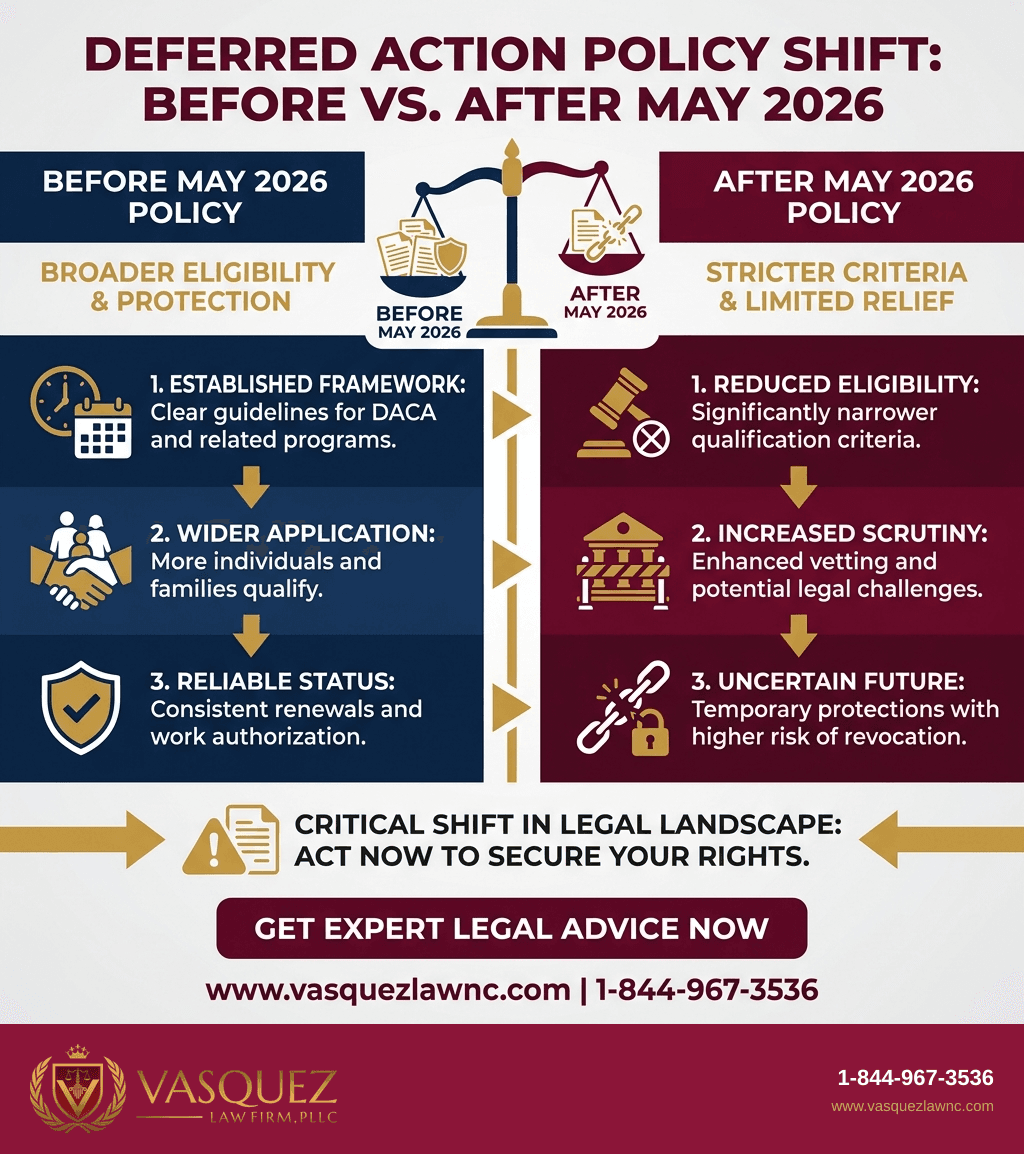
For people in Raleigh, NC and Orlando, FL, this means USCIS officers in local offices will use the same rules. This will reduce differences between regions. Lawyers and applicants should get ready for a stricter deferred action process. They should also think about other immigration options at the same time.
In short, the May 2026 policy update shows a move toward fewer, more carefully chosen deferred action grants. USCIS’s focus on rare use shows why legal help and good preparation are very important.
Frequently Asked Questions about USCIS May 2026 deferred action policy update
What is deferred action under the new USCIS policy?
Deferred action is a discretionary, temporary relief from removal, granted only in extraordinary cases. It does not provide lawful status but may allow work authorization. The May 2026 update clarifies this limited, exceptional use of prosecutorial discretion.
Who can apply for deferred action after this policy change?
Individuals facing removal who demonstrate compelling humanitarian or public interest reasons may apply. The policy narrows eligibility to extraordinary cases, affecting many undocumented immigrants in Raleigh, NC and Orlando, FL.
Does deferred action grant permanent legal status?
No. Deferred action is temporary and revocable. It does not confer lawful permanent residence or other immigration status but may be a step while pursuing other benefits like adjustment of status under 8 U.S.C. § 1255.
How do I apply for deferred action under the new guidance?
You should submit a detailed written request to USCIS explaining the extraordinary circumstances, supported by evidence. Consulting an immigration attorney is highly recommended to improve your chances.
What should I do if USCIS denies my deferred action request?
If denied, you should explore other immigration relief options immediately. An attorney can advise on appeals, motions to reopen, or alternative benefits like asylum or cancellation of removal.
This article gives general legal information. It is not personalized legal advice. Reading it does not create a lawyer-client relationship. For advice about your own case, contact Vasquez Law Firm.
Reviewed by William Vasquez, Founder & CEO, Vasquez Law Firm, PLLC.
If you need legal help, learn more about how our immigration attorneys can help, or call us at 1-844-967-3536 for a free evaluation.
Related Topics

William Vasquez
Founder & CEO, Vasquez Law Firm, PLLC
William Vasquez is the founder and CEO of Vasquez Law Firm, PLLC, a results-driven firm specializing in immigration, criminal defense, personal injury, and workers' compensation. A U.S. Air Force veteran and recipient of the Joint Service Achievement Medal, William is dedicated to fiercely fighting for his clients' rights.
Related Legal Services
Need legal help? Learn more about how our immigration attorneys can help, or contact us for a free evaluation.
You can also visit North Carolina immigration law firm for more information.