Supreme Court Immigration Ruling: What It Means in 2026
Learn how the Supreme Court immigration ruling affects NC and FL families in 2026. Get expert insights and contact us for a free consultation.
Published on June 26, 2026· Updated September 9, 2026
Talk to an immigration attorney
Free call. A clear plan for your case.
Free & confidential · Se habla espanol · 24/7
Have questions? Talk to an attorney - free evaluation.
Call 1-844-967-3536Worried how the latest immigration news affects you?
Schedule a confidential case review with an immigration attorney - know exactly where you stand.
USCIS Case Status
Check your USCIS case status
Enter your receipt number and get the official status. Free, no registration.
Supreme Court Immigration Ruling: What It Means in 2026
The Supreme Court immigration ruling in 2026 has big effects on families and immigrants in North Carolina and Orlando, FL. This article explains what the ruling means, the changes to immigration law and enforcement, and practical steps Dreamers and immigrant families should take to protect their rights. Stay updated on the latest immigration news today and learn how to respond well.
Need help with your case? Our experienced attorneys are ready to fight for you. Se Habla Español.
Or call us now: 1-844-967-3536
Quick Answer
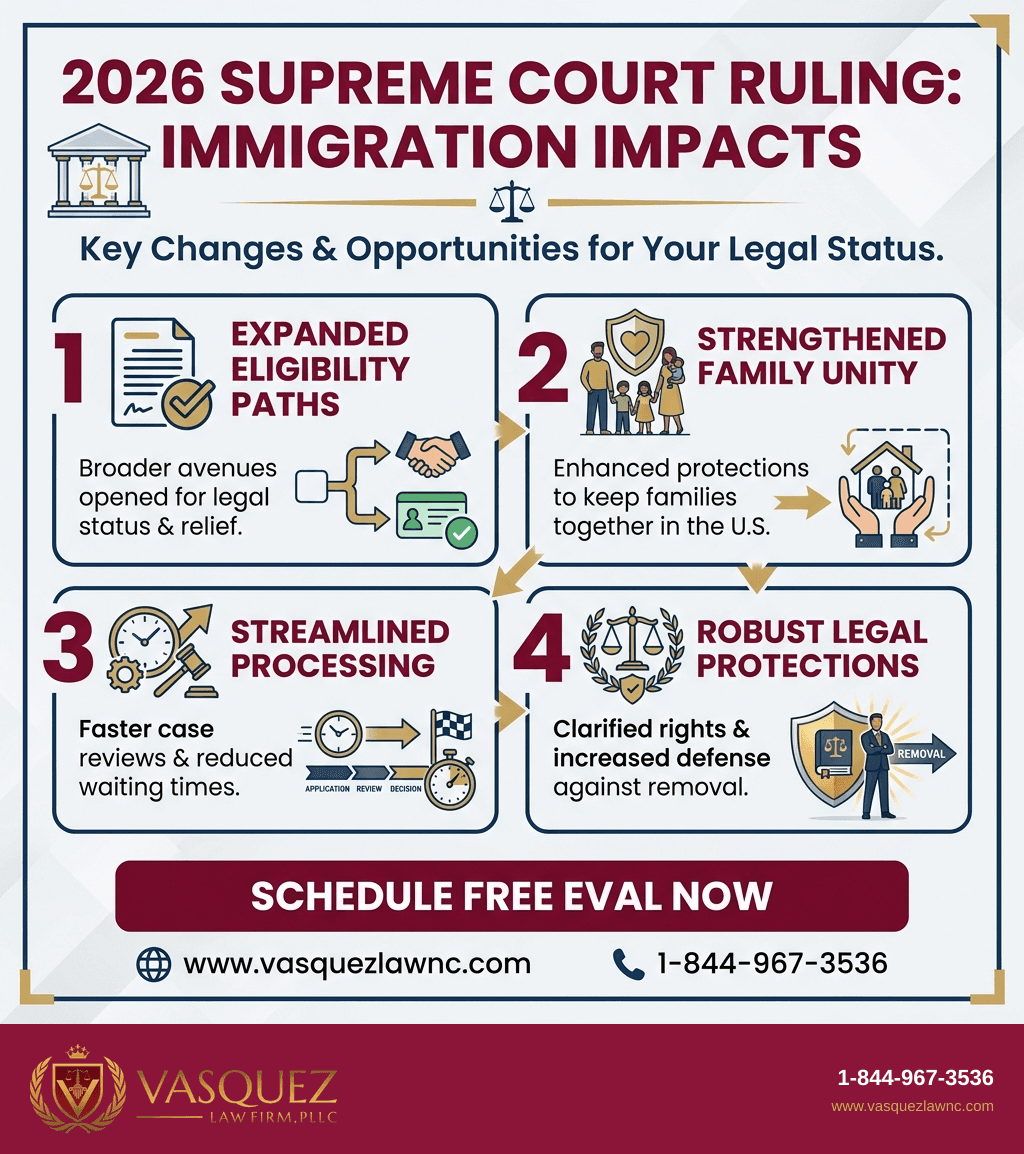
The Supreme Court immigration ruling in 2026 makes immigration judges' roles clearer. It also keeps protections like birthright citizenship, which means anyone born in the U.S. is a citizen. The ruling changes enforcement rules, deportation steps for green card holders, and court hearings across the country, including Raleigh and Orlando. Immigrants should act fast to stay informed and get legal help.
- Clarifies immigration judge roles and how they are chosen
- Supports birthright citizenship under the 14th Amendment (which says all born in the U.S. are citizens)
- Confirms some green card holders still face deportation risks
- Affects how immigration courts work nationwide
- Means quick legal advice is very important for immigrant families in NC and FL
Understanding the Supreme Court Immigration Ruling
On June 2026, the U.S. Supreme Court made a major decision about immigration. It explained how immigration judges are chosen and what powers they have. The Court also talked about immigration enforcement rules, especially limits on government choices and fair procedures for immigrants facing removal (which means being forced to leave the country).
This ruling came after years of legal questions about whether immigration judges are independent and if some federal agencies went too far in deporting lawful residents. The decision keeps protections like birthright citizenship under the 14th Amendment. But it also sets stricter rules for removal cases, especially for green card holders accused of crimes that can lead to deportation.
For Dreamers (young immigrants protected under DACA) and immigrant families in Raleigh, NC, and Orlando, FL, the ruling means clearer rules that may reduce unfair decisions. But it also keeps strong enforcement of immigration laws. It changes how immigration judges in federal courts hold hearings and make decisions, which affects case results.
Under 8 U.S.C. § 1227, lawful permanent residents (LPRs, also called green card holders) can be removed for serious crimes. The Supreme Courts 2026 ruling explains the fair procedures immigrants must get during removal cases. Immigration judges must now follow stricter rules to make sure the process is fair. These rules are in the USCIS Policy Manual and 8 C.F.R. regulations.
Also, birthright citizenship stays the same. It is protected under the 14th Amendment and court decisions. The ruling makes clear that immigration enforcement cannot take away constitutional citizenship rights.
Learn more about our immigration legal services to see how this ruling may affect your case.
Key Steps to Take After the Ruling
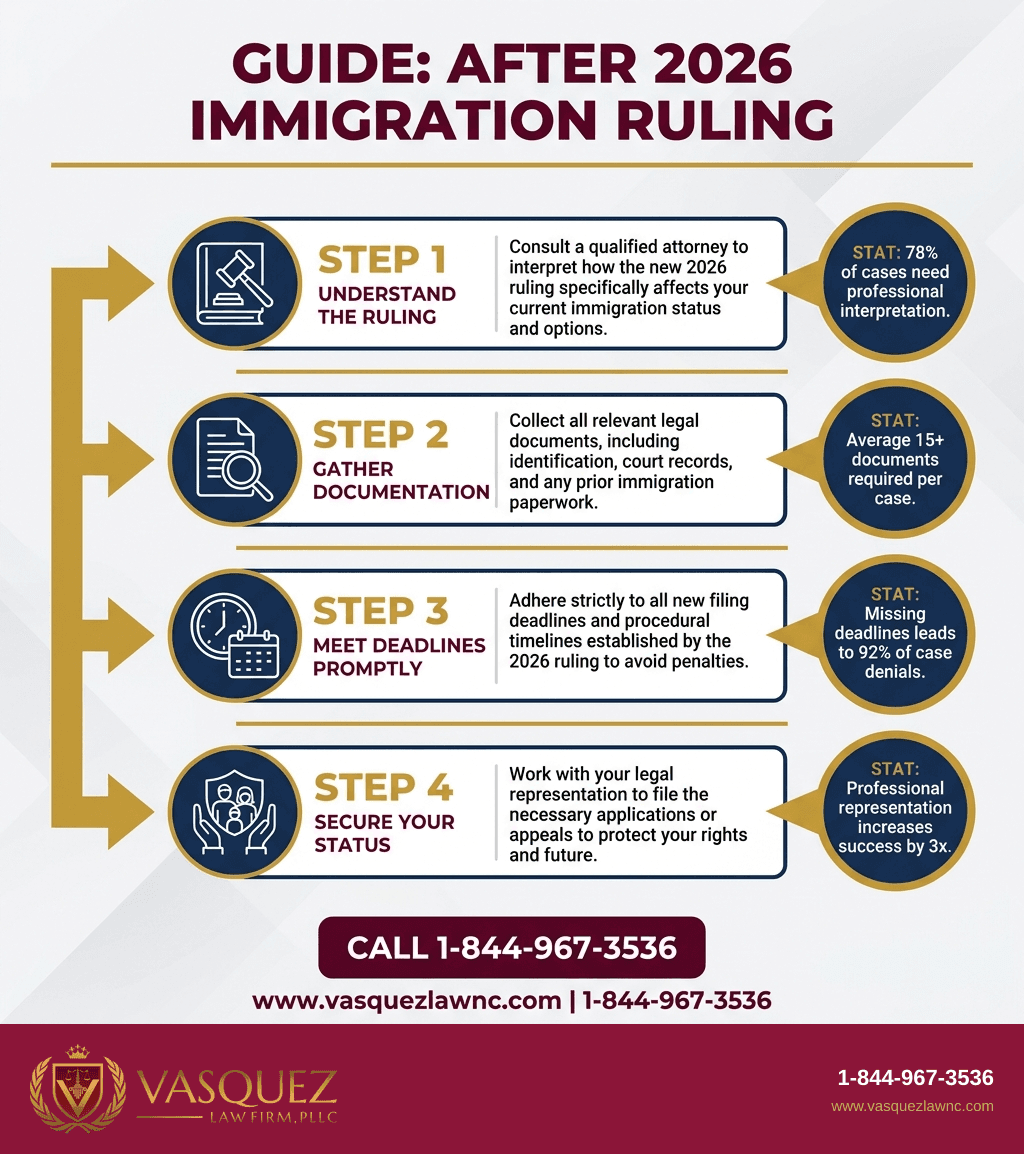
After the Supreme Court immigration ruling in 2026, people with immigration issues in Raleigh or Orlando should act quickly. Here are steps to follow:
- Stay informed: Regularly check trusted immigration news like the USCIS website and legal updates.
- Review immigration status: Check your visa, green card, or DACA status to make sure it is current and valid.
- Document communications: Keep detailed records of any notices or messages from ICE or immigration courts.
- Consult an immigration attorney: Get legal advice early to understand how the ruling affects your case and to prepare for hearings.
- Prepare evidence: Gather documents that prove your residence, work history, family ties, or eligibility for legal relief.
- Attend all hearings: Immigration judge hearings now require strict attendance; missing a hearing can lead to removal orders.
For professional help, contact our immigration attorneys in Raleigh and Orlando.
Documents and Evidence Checklist
To handle immigration court after the Supreme Court ruling, make sure you have these documents ready:
- Green card or visa papers
- Marriage or birth certificates to prove family relationships
- Work records and tax returns
- Proof of living continuously in the U.S.
- Any past immigration applications or letters from USCIS
- Criminal records or clearance papers, if needed
- Affidavits (written statements) or letters supporting your character and community ties
Having accurate and organized papers helps your attorney build a strong defense. Contact us to get help with your case.
Timeline and What to Expect
The Supreme Court immigration ruling sets clearer timelines for immigration hearings. Usually, your case goes like this:
- Initial notice: You get a Notice to Appear (NTA) which starts your removal case.
- Master calendar hearing: Happens within weeks or months to handle procedural issues.
- Individual hearing: Happens months after the master hearing to look at evidence and arguments.
- Decision: The immigration judge makes a ruling based on the evidence, which may take weeks or months.
- Appeal: If you disagree, you can appeal to the Board of Immigration Appeals (BIA) within 30 days.
In 2026, courts focus more on fair process and try to reduce delays. But you must be ready. USCIS processing times for forms like I-821D (DACA) can take 14 to 22 months, so start early. See USCIS Processing Times for official updates.
Costs and Fees You Should Know
Immigration cases have many fees that affect your total cost. In 2026, common fees include:
- USCIS filing fees, from $50 to over $1,200 depending on the form
- Attorney fees, which vary by case difficulty and location
- Costs for getting certified documents or translations
- Possible bond payments if you are detained during your case
- Filing fees for appeals or motions in immigration court or BIA
Getting legal advice early helps you know costs and avoid surprises. Contact Vasquez Law Firm to talk about your case.
Common Mistakes to Avoid
- Missing hearings: Always go to court dates to avoid automatic removal orders.
- Ignoring notices: Open and respond to official letters and messages.
- Failing to gather evidence: Prepare all needed documents before your hearing.
- Delaying attorney contact: Early legal help stops mistakes in procedure.
- Giving wrong information: Be honest and accurate on forms and interviews.
- Missing deadlines: Appeals and motions must be filed on time.
- Relying on wrong information: Use official government sites and trusted lawyers for advice.
If you remember only one thing: Talk to an experienced immigration lawyer right after you get any notice or legal action.
NC, FL, and Nationwide Notes
North Carolina Notes
In Raleigh and all North Carolina, immigration enforcement follows federal law. Local ICE offices work with federal agents on enforcement. Immigrants here can get strong help from community legal groups. Vasquez Law Firms Raleigh office knows how to handle cases affected by this Supreme Court ruling.
Florida Notes
Immigrants in Orlando, FL, face the same federal rules. Florida has many immigration courts where the new procedural rules apply. Our Orlando team offers bilingual help and online consultations to assist with complex cases affected by this decision.
Nationwide Concepts
The Supreme Courts ruling sets a rule for the whole country. Immigration judges everywhere must follow the clearer procedural rules. Enforcement priorities may differ, but due process rights protected by the Supreme Court stay the same.
When to Call a Lawyer Now
- If you get a Notice to Appear in immigration court
- After ICE or other immigration agents contact you
- If you face a removal order or deportation case
- If you are unsure about your immigration status or if you can get relief
- If you have a criminal record affecting your immigration case
- When you get any official immigration papers or court notices
- If you are a DACA recipient needing to renew
- If your birthright citizenship rights are questioned
- If you want to apply for status adjustment or citizenship
- To get help with appeals after an immigration judge decision
About Vasquez Law Firm
At Vasquez Law Firm, we mix care with strong representation. Our motto "Yo Peleo" (I Fight) shows our promise to stand up for your rights.
- Bilingual Support: Se Habla Español Spanish-speaking lawyers and staff available
- Service Areas: North Carolina, Florida, and immigration help nationwide
- Experience: Over 30 years helping clients with complex legal matters
- Results: Thousands of successful cases in many practice areas
Attorney Trust and Experience
William J. Vásquez joined the North Carolina State Bar in 2011. He is also admitted to the U.S. Courts of Appeals for the 4th, 5th, 6th, and 11th Circuits. Florida cases at the firm are handled by Florida Bar lawyer Alekssandra Lopez. The firm has given focused legal help since 2011, paying close attention to each clients case.
Don't wait to get the help you deserve. Call us now for immediate assistance.
Se Habla Español
Frequently Asked Questions
Has the Supreme Court ruled on birthright citizenship in 2026?
As of 2026, the Supreme Court has upheld birthright citizenship as guaranteed by the 14th Amendment. The ruling clarified enforcement procedures but confirmed this constitutional protection for all children born in the U.S.
Is ICE deporting people with green cards after the Supreme Court ruling?
Yes, ICE continues to deport green card holders found removable for certain grounds like serious crimes. The ruling clarifies due process but does not eliminate deportation risks for specific offenses.
Did the Supreme Court order the return of any deported individual recently?
The 2026 Supreme Court ruling did not mandate returns of deported individuals but refined procedural and enforcement standards applicable in removal cases.
What does the Supreme Court's 2026 ruling say about immigration judges?
The decision confirms immigration judges federal oversight and clarifies appointment processes to protect due process rights, affecting how removal hearings are conducted.
How can immigrants in Raleigh and Orlando protect themselves under the new ruling?
They should stay current on their immigration status, document all immigration communications, and immediately seek legal help from experienced Raleigh or Orlando attorneys.
What recent changes in immigration enforcement should NC residents know?
Enforcement in NC now adheres to stricter standards with a focus on criminal grounds for removal and procedural fairness per the Supreme Court ruling.
Does this ruling affect DACA recipients and Dreamers?
The ruling reaffirms procedural protections but does not change DACA. Renewal applicants should anticipate processing delays and seek legal advice.
Where can I find official updates about immigration case processing times?
Visit the USCIS Processing Times site at https://egov.uscis.gov/processing-times/ for real-time updates on forms like I-821D.
Sources and References
- U.S. Citizenship and Immigration Services
- Executive Office for Immigration Review
- Legal Information Institute
Take the first step toward justice today. Our team is standing by to help.
Start Your Free Evaluation Now
Call us: 1-844-967-3536
Se Habla Español - Estamos aqu para ayudarle.


William Vasquez
Founder & CEO, Vasquez Law Firm, PLLC
William Vasquez is the founder and CEO of Vasquez Law Firm, PLLC, a results-driven firm specializing in immigration, criminal defense, personal injury, and workers' compensation. A U.S. Air Force veteran and recipient of the Joint Service Achievement Medal, William is dedicated to fiercely fighting for his clients' rights.
Related Legal Services
Need legal help? Learn more about our immigration legal services, or contact us for a free evaluation.
You can also visit North Carolina immigration lawyers for more information.