North Carolina Workers Compensation: How It Works in 2026
Learn how North Carolina workers compensation works in 2026 and protect your rights. Get clarity on filing claims and benefits. Contact Vasquez Law for help.
Published on June 12, 2026
Hurt on the job?
Free review of your workers' comp claim.
Free & confidential · Se habla espanol · 24/7
Have questions? Talk to an attorney - free evaluation.
Call 1-844-967-3536Hurt on the Job? Claim What You Are Owed
A review of your workers' comp claim - we handle the fight.
North Carolina Workers Compensation: How It Works in 2026
If you've been injured on the job in Raleigh or anywhere in North Carolina, understanding workers compensation is essential. North Carolina workers compensation laws protect employees by providing medical care and lost wage benefits for work-related injuries. However, the claims process can be complex, and not all injuries are covered. This guide explains how North Carolina workers compensation works in 2026, including what qualifies as a work injury, how to file a claim, what benefits you may receive, and common mistakes to avoid when dealing with your claim.
Need help with your case? Our experienced attorneys are ready to fight for you. Se Habla Español.
Or call us now: 1-844-967-3536
Quick Answer
North Carolina workers compensation provides medical care and wage benefits to employees hurt on the job. Injuries must be work-related and reported promptly. Claims go through the NC Industrial Commission for benefits and dispute resolution.
- Covers medical treatment and lost wages
- Must report injuries to employer quickly
- Claims managed by NC Industrial Commission (NCIC)
- Not all injuries qualify—proof of work cause required
- Legal help can improve claim outcomes
How North Carolina Workers Compensation Works
Every year in North Carolina, thousands of workers report injuries sustained while performing their job duties. Workers compensation is a no-fault insurance system designed to provide benefits regardless of who caused the injury. In 2026, the system still requires the injury to arise out of and in the course of employment for coverage.
The North Carolina Industrial Commission (NCIC) administers the workers compensation system, handling claims, disputes, and ensuring compliance with state rules. Employers carry workers compensation insurance or self-insure to cover employee injuries. When a qualifying injury occurs, the employee is entitled to medical treatment, temporary or permanent disability benefits, and certain rehabilitation services.
Not all injuries are covered. For example, injuries sustained during an employee’s voluntary intoxication or violating safety rules may be excluded. Conditions must be medical verified and linked to workplace activity. The injury reporting timeline is tight — typically six days to notify the employer and then the employer must officially report the claim to the NCIC within 10 days.
Our workers compensation services include helping injured workers navigate this complex process for faster results.
Key Terms
- Compensable injury: Injury or illness caused by work activity that qualifies for benefits under N.C. Gen. Stat. § 97-2.
- Temporary Total Disability (TTD): Wage replacement when you cannot work temporarily.
- Permanent Partial Disability (PPD): Benefits for lasting impairment affecting earning capacity.
- Medical benefits: Coverage for doctor visits, tests, surgery, and rehabilitation.
How Claims Are Processed
After an injury, the employer files a claim with the NCIC. The insurance company reviews medical records and can approve benefits or dispute the claim. If disputed, the injured worker can request a hearing before an NCIC deputy commissioner. Hearings decide benefit eligibility and amounts. Appeals can go further to the full Commission or state court.
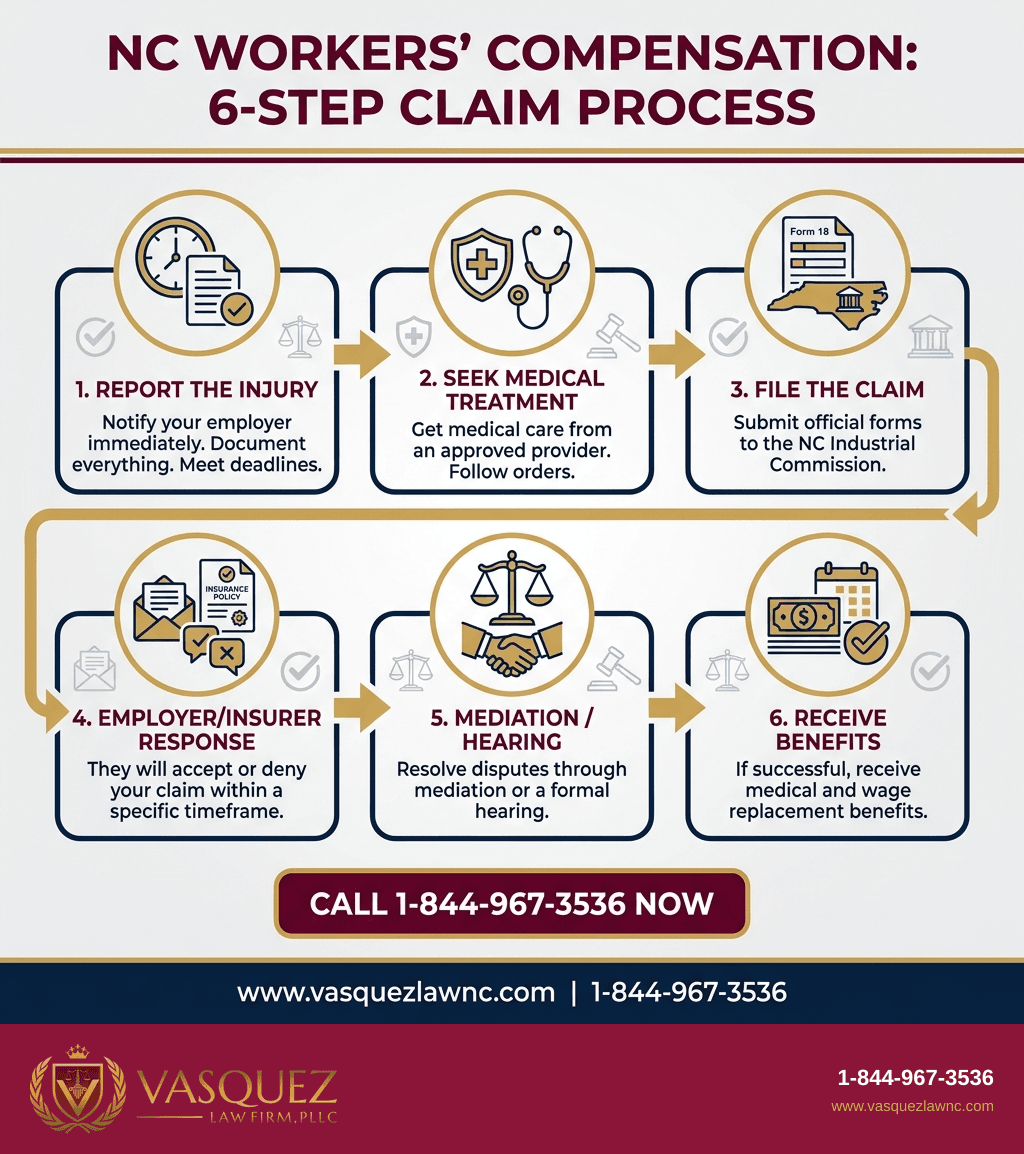
Step-by-Step: Filing Your Workers Compensation Claim
Filing a workers compensation claim in Raleigh, NC involves several clear steps and deadlines. Missing steps may delay or deny benefits.
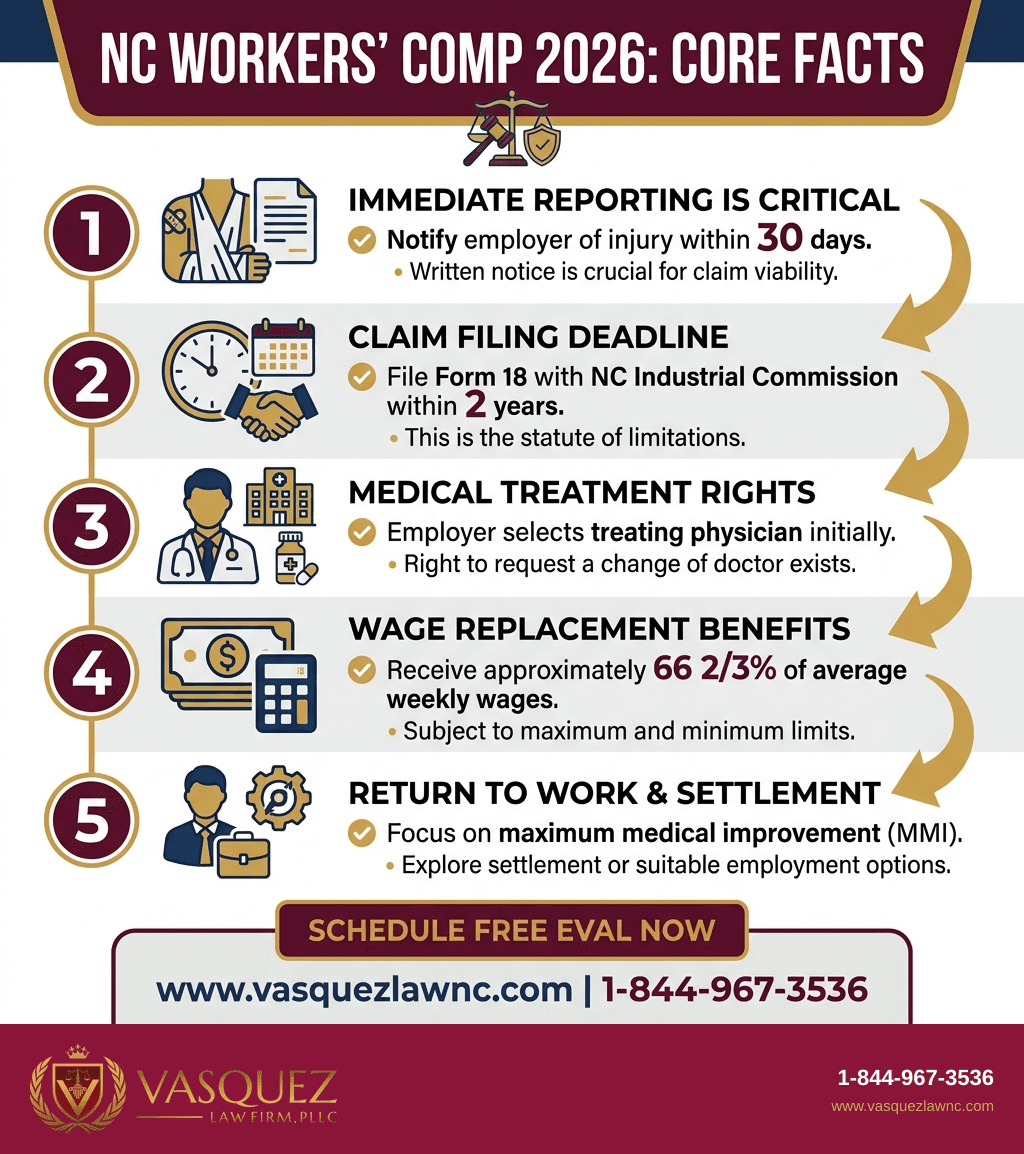
- Report the Injury Immediately: Tell your supervisor or employer about the accident within six days. This is required under N.C. Gen. Stat. § 97-22.
- Seek Medical Care: Get prompt medical treatment. Use the doctor authorized or approved by the employer’s insurance carrier if required.
- Employer Reports the Claim: The employer or their insurer must file the claim with the NCIC within 10 days of notice.
- Keep Records: Maintain copies of injury reports, medical bills, and correspondence.
- Respond to Requests: Answer questions or requests from the insurance adjuster promptly.
- Request Hearing if Denied: If your claim is denied, file a Form 33 with the NCIC within two years to start hearing proceedings.
- Attend All Hearings: Present your evidence and witness testimony to support your claim.
Our Attorney Vasquez has 15 years of experience guiding workers through each of these steps to protect their rights and get the fullest benefits allowed.
Common Injuries Covered Under North Carolina Workers Compensation
North Carolina workers compensation covers a variety of injuries if they occur during work. Some common covered injuries are:
- Herniated discs or hernias caused by lifting or strain on the job
- Sprains, strains, and fractures resulting from workplace accidents
- Cumulative trauma disorders like carpal tunnel and plantar fasciitis from repetitive motion
- Bursitis caused by repeated pressure or motion on joints
- Burns, lacerations, and cuts sustained in hazardous work environments
- Occupational diseases connected to exposure to chemicals or harmful substances
For example, plantar fasciitis can be compensable if your work requires long hours standing on hard surfaces. Hernias commonly arise in professions involving heavy lifting. Each injury type requires medical proof linking it directly to your employment.
Not Covered Injuries
Some injuries are not covered under workers compensation, including those due to intoxication, injuries while commuting, or injuries caused by intentional misconduct.
Mistakes to Avoid When Filing Your Workers Compensation Claim
- Delayed Injury Reporting: Waiting too long to report your injury to your employer can lead to claim denial. Always report immediately after injury.
- Ignoring Medical Treatment: Failing to get medical care or follow prescribed treatment plans risks losing benefits.
- Incomplete or Incorrect Forms: Errors on paperwork can cause delays or denials—double-check all submissions.
- Not Keeping Documentation: Losing records of medical reports, bills, or notes weakens your case.
- Discussing Claim Details Publicly: Avoid posting on social media or discussing your claim details openly, as insurance adjusters monitor for inconsistencies.
- Not Consulting an Attorney: Workers compensation laws have strict procedures. An attorney can help avoid pitfalls and maximize your benefits.
If you only remember one thing: Report your injury immediately and seek medical care under workers compensation rules.
When to Contact a North Carolina Workers Compensation Lawyer
Contacting a lawyer early can protect your rights. Consider calling an experienced attorney if you experience any of these:
- Your claim is denied or disputed by the insurance company.
- You have not received wage replacement payments within the expected timeframe.
- You suffer permanent disability and need help with compensation.
- Your employer or insurer refuses to authorize necessary medical treatment.
- You need help gathering evidence or preparing for an NCIC hearing.
- You received a settlement offer but are unsure if it is fair.
- You suspect employer retaliation after filing a claim.
- You want to ensure proper benefits after leaving your job due to injury.
When you contact Vasquez Law Firm, you get dedicated legal guidance focused on North Carolina workers compensation rules and procedures.
Frequently Asked Questions
How does workers' compensation work in North Carolina?
Workers compensation protects employees injured on the job in North Carolina by covering medical costs and lost wages. The injured employee must report the injury quickly. Claims are processed by the NC Industrial Commission, which determines benefit eligibility. This no-fault system means benefits are available regardless of fault but within specific rules.
Can a hernia be covered under workers' compensation?
Yes, hernias caused or aggravated by your work activities may be covered. Proof that the injury happened on the job, such as through heavy lifting or sudden strain, is required to qualify for benefits under North Carolina law.
Is plantar fasciitis a work-related injury?
Plantar fasciitis can qualify if your job duties, like prolonged standing or repetitive motions, cause or worsen it. Medical evidence linking the injury to your work makes your workers compensation claim stronger.
Is bursitis covered under workers compensation?
Bursitis may be covered if the condition results from repetitive workplace activities or pressure on certain joints. Proper documentation and timely reporting help establish eligibility.
How do I file a workers compensation claim in North Carolina?
First, report your injury to your employer immediately. Then, your employer must file the claim with the NC Industrial Commission. Make sure to keep records and seek proper medical care. If denied, you can request a hearing to challenge the decision.
What benefits does workers compensation cover?
Benefits include medical treatment, wage replacement for lost earnings, permanent disability payments if injured permanently, vocational rehab, and death benefits if applicable. The exact benefits depend on injury type and claim approval.
What is the North Carolina Industrial Commission (NCIC)?
The NCIC is the state agency overseeing workers compensation claims. It processes claims, resolves disputes, and hears appeals. Their decisions have legal authority over workers compensation in North Carolina.
Can I choose my own doctor for workers compensation treatment?
The employer or insurer generally controls the choice of doctors initially. Changes can be requested in some cases. Understanding these rules is vital to ensuring you get proper treatment under the law.
Sources and References
- North Carolina Industrial Commission
- Occupational Safety and Health Administration
- U.S. Department of Labor
Take the first step toward justice today. Our team is standing by to help.
Start Your Free Evaluation Now
Call us: 1-844-967-3536
Se Habla Español - Estamos aquí para ayudarle.

William Vasquez
Founder & CEO, Vasquez Law Firm, PLLC
William Vasquez is the founder and CEO of Vasquez Law Firm, PLLC, a results-driven firm specializing in immigration, criminal defense, personal injury, and workers' compensation. A U.S. Air Force veteran and recipient of the Joint Service Achievement Medal, William is dedicated to fiercely fighting for his clients' rights.
Related Legal Services
Need legal help? Learn more about how our work injury attorneys can help, or contact us for a free evaluation.
You can also visit our North Carolina workers comp practice for more information.