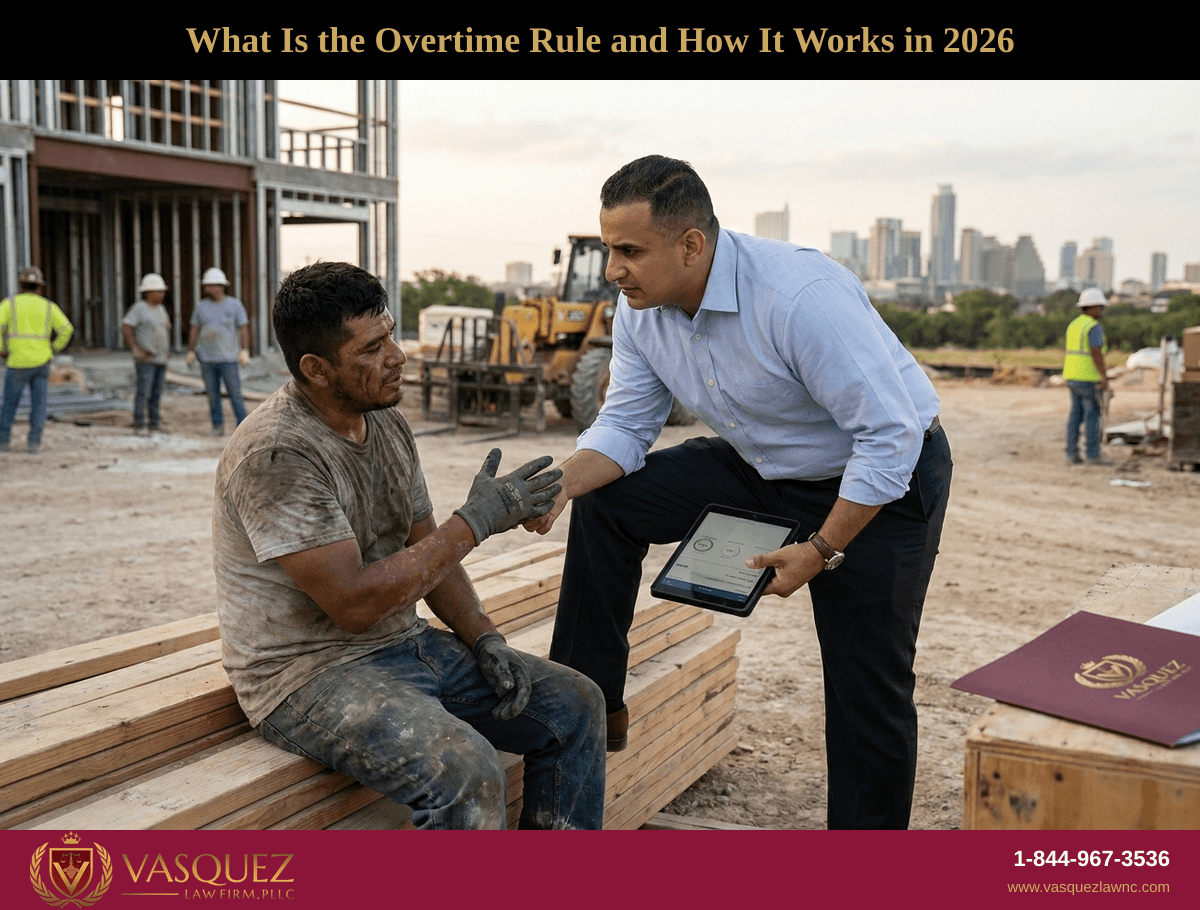
What Is the Overtime Rule and How It Works in 2026
What is the overtime rule in 2026? Learn how changes affect pay and workers’ rights in NC and FL. Contact Vasquez Law for a free consultation.
Vasquez Law Firm
Published on May 14, 2026

Have questions? Talk to an attorney — free evaluation.
Call 1-844-967-3536What Is the Overtime Rule and How It Works in 2026
The overtime rule determines when employees must be paid extra for working beyond certain hours. In 2026, new overtime rules impact workers in North Carolina and Florida. These rules define who qualifies for overtime pay and the number of hours worked before it applies. Understanding the overtime rule helps protect your rights and ensures you receive fair compensation for your labor. This guide explains the latest changes, key definitions, and what steps workers should take if they believe they are owed overtime pay.
Need help with your case? Our experienced attorneys are ready to fight for you. Se Habla Español.
Need legal help?
Free 15-minute consultation. We handle immigration, traffic, family, criminal, and personal injury matters in NC and FL.
Or call us now: 1-844-967-3536
Quick Answer
The overtime rule requires most employers to pay extra for hours worked beyond 40 per week. In 2026, updated salary thresholds broaden eligibility for overtime pay in North Carolina and Florida. Some salaried workers remain exempt under certain criteria.
- New thresholds raise salary limits for overtime pay
- Exemptions apply for some executives and professionals
- Federal law governs most overtime rules with state variations
- North Carolina and Florida generally follow federal standards
- Disputes can be addressed with legal support and state agencies
Understanding the Overtime Rule in 2026
Imagine you work 50 hours in a week but only get paid for 40. The overtime rule is designed to prevent this by requiring employers to pay you extra for hours worked beyond the standard workweek, which is usually 40 hours. In 2026, the Department of Labor has revised the overtime rule to increase the salary threshold for eligibility. This means more salaried employees in Charlotte and across North Carolina and Florida may now qualify for overtime pay than before.
The overtime rule is part of the Fair Labor Standards Act (FLSA), codified at 29 U.S.C. § 207. It requires covered employers to pay eligible employees one and a half times their regular rate for hours worked over 40 in a workweek. The Department of Labor's regulations at 29 C.F.R. Parts 541 and 778 provide detailed definitions and exemptions.
Who Qualifies for Overtime Pay?
Generally, non-exempt employees are entitled to overtime pay. These include most hourly workers and many salaried employees earning below the salary threshold. The updated 2026 salary threshold increased from approximately $684 per week to $832 per week (over $43,000 annually). Salaried employees making less than the threshold and who do not meet specific duties tests must receive overtime pay.
Exemptions Under the Overtime Rule
Exemptions apply to certain executive, administrative, and professional employees who meet strict salary and job duties criteria, including managing a team or performing specialized work. For example, managers who supervise at least two full-time employees and have hiring or firing authority often qualify for exemption. As of 2026, the salary and duties tests for exemptions have some updates, which can affect many workers.
Pay Period and Hours Calculations
Overtime pay is calculated based on hours worked in a seven-day workweek, not daily hours, under federal law. While some states have daily overtime rules, North Carolina follows federal standards which require overtime only for hours worked beyond 40 in a week. Florida does not have additional daily overtime mandates.
Different rules apply to industries like healthcare, transportation, and federal government workers. The Department of Labor website provides updated guidance specific to 2026 (dol.gov).
Step-by-Step: What to Do If You Suspect Overtime Violations
- Track Your Hours: Keep a detailed daily and weekly log of your start and finish times, including breaks and any overtime hours.
- Gather Pay Records: Collect pay stubs, contracts, and any written communication about your salary and overtime policies.
- Review Exempt Status: Check if your job duties and salary meet exemption criteria under 29 C.F.R. § 541.100.
- Contact Your Employer: Raise concerns directly with your employer’s HR or payroll department to clarify pay issues.
- Consult an Attorney: Speak with a workers compensation or labor law attorney in Charlotte for guidance tailored to North Carolina or Florida laws.
- File a Claim: If necessary, file a complaint with the U.S. Department of Labor Wage and Hour Division or the North Carolina Industrial Commission.
- Prepare for Potential Litigation: If claims are not resolved administratively, legal action may be required to recover unpaid overtime.
Don't wait to get the help you deserve. Call us now for immediate assistance.
Se Habla Español

Documents or Evidence Checklist for Overtime Claims
- Time sheets or records showing hours worked
- Pay stubs indicating salary and deductions
- Employment contracts or offer letters
- Employee handbook or written overtime policies
- Email or text messages about overtime work
- Witness statements from coworkers, if available
- Job descriptions detailing duties and responsibilities
Timeline: What to Expect With Overtime Disputes
- Week 1-2: Gather evidence and document hours.
- Week 3-4: Contact employer and attempt resolution.
- Month 2-3: File complaint with labor agency if unresolved.
- Month 3-6: Agency investigation and response.
- Month 6-12+: Possible lawsuit or settlement negotiations.
Costs and Fees: Factors Affecting Overtime Claims
- Attorney Fees: Many workers compensation lawyers use contingency fees, reducing upfront costs.
- Case Complexity: More complicated claims requiring extensive investigation may have higher costs.
- Duration: Longer disputes can increase legal expenses but may also increase potential recovery.
- Filing Fees: Some state courts or agencies charge filing fees, which vary by jurisdiction.
- Retainers: Some attorneys may require retainers, but many offer free consultations and evaluations.
Common Mistakes and How to Avoid Them
- Not Documenting Hours: Keep accurate time records to support your claim.
- Ignoring the Salary Threshold: Know the 2026 salary limits for exemptions.
- Assuming Daily Overtime Applies: Understand federal vs state rules regarding daily hours.
- Delaying Legal Advice: Consult with an attorney early to protect deadlines.
- Accepting Verbal Promises: Always get agreements in writing.
- Missing Statute of Limitations: File claims promptly; deadlines vary by state.
- Failing to Appeal Denials: Use appeal processes if initial claims are denied.
If you only remember one thing: Keep detailed work and pay records and get legal advice promptly to protect your overtime rights.
North Carolina and Florida Overtime Rules
North Carolina Notes
North Carolina generally follows federal Fair Labor Standards Act standards for overtime. The state does not require daily overtime pay over eight hours but does mandate overtime after 40 hours per week. The North Carolina Industrial Commission oversees wage and hour disputes involving overtime and workers’ compensation claims related to workplace injuries or disputes affecting pay. Workers facing overtime denial in Charlotte can seek support from local attorneys skilled in state-specific rules (ICNC.gov).
Florida Notes
Florida also adheres to federal overtime standards, with no additional daily overtime requirements. Employees working in Florida who believe they have been denied overtime pay can file complaints with the U.S. Department of Labor Wage and Hour Division. Legal assistance is especially helpful for understanding complex exemptions and salary thresholds in Florida workplaces.
Nationwide Concepts (General Only, Rules Vary)
While the FLSA sets federal overtime standards, states like California, New York, and others have more protective overtime laws, including daily pay requirements. In North Carolina and Florida, federal rules mostly apply, but workers should confirm local laws and consult attorneys about any jurisdictional nuances.
When to Call a Lawyer Now
- Your employer refuses to pay overtime despite working over 40 hours.
- You suspect your job is misclassified as exempt incorrectly.
- Your paycheck doesn’t reflect your actual hours worked.
- You face retaliation or termination after questioning overtime pay.
- You need help understanding complex salary threshold rules.
- You want to file a claim with the Industrial Commission or DOL.
- You need help appealing a denied wage or overtime claim.
- You want to protect your rights in a workplace dispute involving pay.
About Vasquez Law Firm
At Vasquez Law Firm, we combine compassion with aggressive representation. Our motto "Yo Peleo®" (I Fight) reflects our commitment to standing up for your rights.
- Bilingual Support: Se Habla Español — Spanish-speaking attorneys and staff available
- Service Areas: North Carolina, Florida, and nationwide immigration services
- Experience: Over 30 years helping clients navigate complex legal matters
- Results: Thousands of successful cases across multiple practice areas
Attorney Trust and Experience
William J. Vásquez is admitted to the North Carolina State Bar (2011) and to the U.S. Courts of Appeals for the 4th, 5th, and 11th Circuits. Florida-jurisdiction matters at the firm are handled by Florida Bar attorney Harold Estrada-Rodriguez (FL Bar No. 1041171). The firm has provided dedicated legal representation since 2011, with personalized attention to each client's case.
Don't wait to get the help you deserve. Call us now for immediate assistance.
Se Habla Español
Frequently Asked Questions
What is the new overtime rule in 2026?
In 2026, the Department of Labor updated the overtime rule by increasing the salary threshold for eligibility. This means that more salaried employees earning under $832 per week in North Carolina and Florida are entitled to overtime pay if they work over 40 hours weekly.
Does working over 8 hours a day require overtime pay?
Federal law requires overtime pay only for hours worked over 40 in a week, not daily hours over eight. North Carolina and Florida follow this federal rule, so daily overtime is not mandatory unless state laws change.
Who is exempt from overtime pay?
Exempt employees include executives, administrators, and professionals who meet specific salary and duty criteria under 29 C.F.R. § 541.100. These workers typically manage others or perform specialized tasks and earn above the salary threshold.
What changes to the overtime rules occurred in 2025 and 2026?
The major changes involve raising the salary threshold, rolling back some previous expansions, but keeping overall protections for salaried workers. These amendments impact many workers’ eligibility for overtime pay starting in 2026.
How do the overtime rules apply to NFL players?
NFL players and many professional athletes are exempt from the Fair Labor Standards Act overtime provisions. The 2026 overtime rules mainly affect non-exempt workers in standard employment sectors.
Am I Eligible for Workers' Comp?
3 quick questions to check your eligibility
Question 1 / 3
Where were you injured?
Keep Reading

What evidence is needed to prove an overtime claim?
Evidence includes time records, pay stubs, employment agreements, and any communication regarding hours or pay. Witnesses or coworkers statements can also help establish unpaid overtime claims.
Can I file a claim if my employer refuses to pay overtime?
Yes, affected workers in NC and FL can file complaints with state or federal agencies or pursue lawsuits. Consulting a workers’ compensation attorney can help you understand options and deadlines.
How long does it take to resolve an overtime dispute?
Resolution times vary widely, from several months to over a year depending on case complexity and legal processes. Early legal assistance can speed settlement or claim approval.
Sources and References
- U.S. Department of Labor
- North Carolina Industrial Commission
- Occupational Safety and Health Administration
Take the first step toward justice today. Our team is standing by to help.
Start Your Free Evaluation Now
Call us: 1-844-967-3536
Se Habla Español - Estamos aquí para ayudarle.
If you need legal assistance, learn more about get workers comp legal help today, or call us at 1-844-967-3536 for a free evaluation.
Vasquez Law Firm
Legal Team
Our experienced attorneys at Vasquez Law Firm have been serving clients in North Carolina and Florida since 2011, with 70+ years of combined attorney experience. We specialize in immigration, personal injury, criminal defense, workers compensation, and family law.
Related Legal Services
Need legal help? Learn more about get workers comp legal help today, or contact us for a free evaluation.
You can also visit North Carolina workers compensation firm for more information.