Immigration-Related Crimes: What They Mean for You in 2026
Learn about immigration-related crimes and their impact in 2026. Protect your rights with expert help from Vasquez Law. Contact us for a free evaluation.
Published on June 24, 2026
Talk to an immigration attorney
Free call. A clear plan for your case.
Free & confidential · Se habla espanol · 24/7

Have questions? Talk to an attorney - free evaluation.
Call 1-844-967-3536Worried how the latest immigration news affects you?
Schedule a confidential case review with an immigration attorney - know exactly where you stand.
USCIS Case Status
Check your USCIS case status
Enter your receipt number and get the official status. Free, no registration.
Immigration-Related Crimes: What They Mean for You in 2026
In 2026, understanding immigration-related crimes is essential for those navigating immigration law in Raleigh, NC, and Orlando, FL. Immigration offenses can range from unlawful entry to serious felonies, each with serious consequences including deportation or imprisonment. This article offers a detailed primer on immigration-related crimes and what they mean for residents, including practical guidance from the Vasquez Law Firm experienced immigration attorneys. Knowing your rights and the legal nuances in your state can make all the difference when facing related criminal charges or immigration enforcement.
Need help with your case? Our experienced attorneys are ready to fight for you. Se Habla Español.
Or call us now: 1-844-967-3536
Quick Answer
Immigration-related crimes include offenses like illegal entry, illegal reentry after deportation, visa fraud, and document falsification. Such crimes can lead to deportation, imprisonment, or denial of immigration benefits. The severity ranges from misdemeanors to serious felonies. Facing these charges requires prompt legal help to understand the immigration consequences and defenses.
- Includes illegal entry and reentry offenses
- Penalties vary from fines to imprisonment
- Can result in removal (deportation)
- Some offenses classified as serious felonies
- Legal defenses vary by case specifics
- Critical to consult experienced immigration attorneys
Understanding Immigration-Related Crimes
Last week, the District of Arizona charged 323 individuals with immigration-related criminal offenses, highlighting the seriousness of these crimes nationwide. While that enforcement occurred in Arizona, residents in Raleigh, NC, and Orlando, FL should understand the federal laws governing immigration-related crimes and their implications locally.
Immigration-related crimes cover a broad range of offenses. The most common include unlawful entry into the U.S. (8 U.S.C. § 1325), illegal reentry after deportation (8 U.S.C. § 1326), visa fraud, and document falsification. Many of these offenses fall under the Immigration and Nationality Act (INA), particularly INA §§ 237 and 275.
Some immigration offenses are misdemeanors, such as first-time illegal entry, but illegal reentry after removal is a felony carrying severe penalties. Serious felonies related to immigration often trigger mandatory deportation under INA § 237(a)(2). Understanding these distinctions matters because they affect the defendant's risk of removal and eligibility for relief.
Each crime's legal classification affects both criminal penalties and immigration consequences. For example, reentry after removal can result in prison time up to 20 years, especially if the defendant has prior aggravated felony convictions. The U.S. Code recognizes these offenses as obstacles to lawful immigration status adjustment or admission.
Effective defense requires knowledge of both criminal law and immigration regulations. Consult our immigration services to understand your options.
Different Offense Levels and Consequences
Immigration offenses have varying levels of severity impacting sentencing and immigration status. For illegal entry, typically a misdemeanor under 8 U.S.C. § 1325, penalties may include fines and short-term detention. However, illegal reentry after deportation (8 U.S.C. § 1326) is a felony with harsher punishments.
The law assigns higher offense levels to repeated violations or if the criminal act involves fraud or violence. This affects not only criminal court outcomes but immigration records, often resulting in a higher offense level assessment for immigration authorities. This factor also influences bond eligibility and removal proceedings.
Role of Federal and Local Agencies
Federal agencies such as Immigration and Customs Enforcement (ICE) and the U.S. Attorney’s Office prosecute these crimes nationwide. The Executive Office for Immigration Review (EOIR) handles immigration court related removal proceedings. Local law enforcement may collaborate, but the federal government leads prosecutions.
In Raleigh, NC, and Orlando, FL, coordination between local and federal entities affects the intensity and timing of enforcement. While enforcement approaches can differ, federal law remains universally applicable throughout the United States.
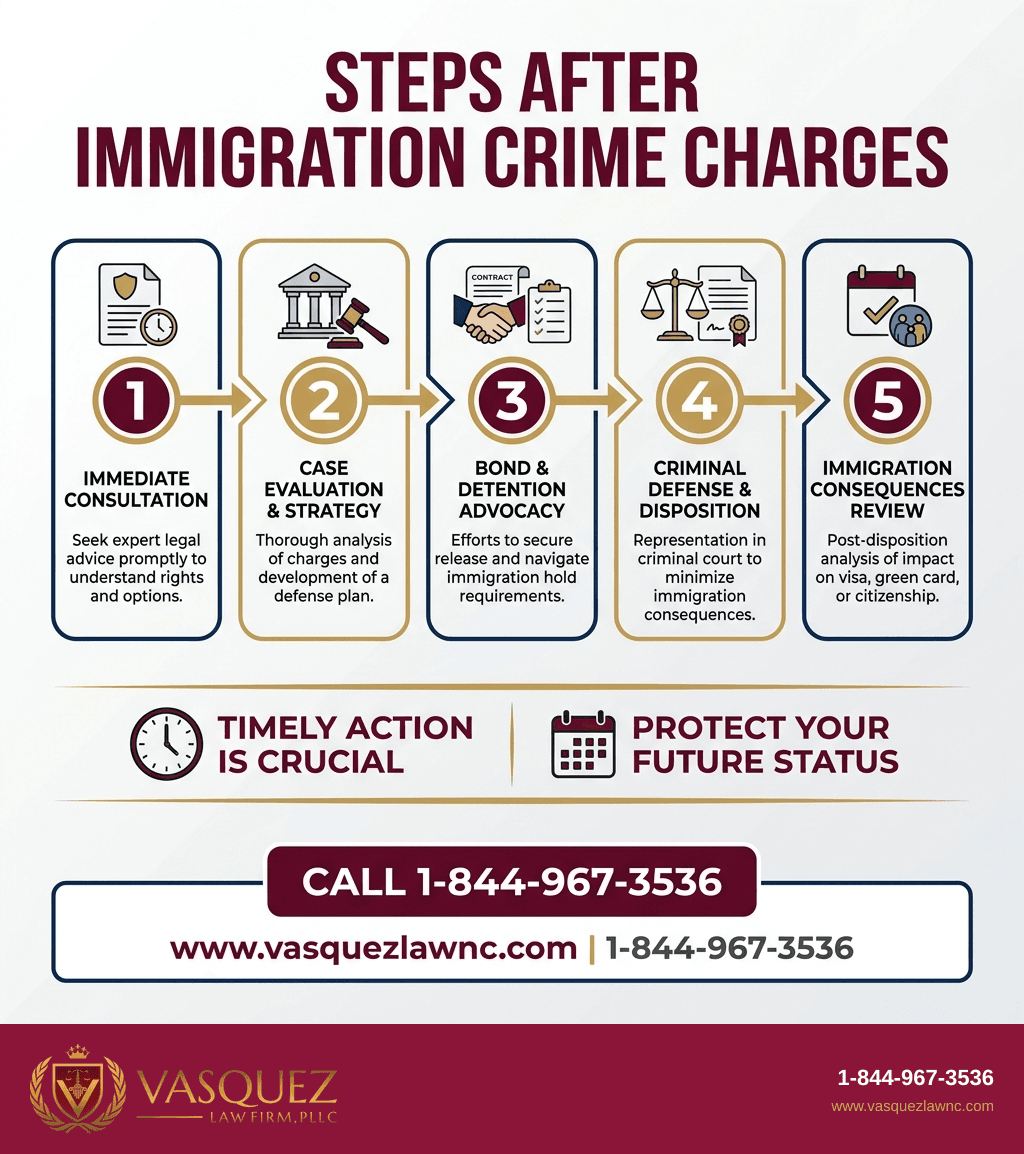
Key Steps to Take After Being Charged
Being charged with an immigration-related crime can be alarming. Immediate action is critical to protect your rights and immigration status. Follow these key steps if you face such charges.
- Seek Legal Representation: Contact an experienced immigration attorney in Raleigh or Orlando as soon as possible to evaluate your situation and build a defense.
- Understand the Charges: Clarify which immigration offense you are charged with and the potential consequences, including criminal penalties and immigration impacts.
- Prepare Documentation: Gather documents proving your immigration status, family ties, and any relief you may qualify for such as asylum or cancellation of removal.
- Avoid Self-Incrimination: Exercise your right to remain silent and avoid statements that could harm your case until with legal counsel.
- Attend All Court Appearances: Missing hearings may result in deportation orders and loss of defense opportunities.
- Consider Bond and Detention Options: Your attorney can request bond hearings to secure your release pending case outcome.
Initial Contact with Your Attorney
Your attorney will review the charges, collect evidence, and identify potential defenses. They will also advise on immigration relief options available based on your circumstances. Early involvement increases the chances of favorable outcomes.
Cooperating with Authorities
While cooperation may help, it is best done under legal advice. Uninformed cooperation or admissions may worsen immigration consequences. Always consult your lawyer before speaking to ICE or federal prosecutors.
Common Mistakes to Avoid in Immigration Crimes
- Not Hiring an Experienced Attorney: Unrepresented defendants may unknowingly waive defenses and face harsher penalties. Fix: Secure immigration legal counsel immediately.
- Pleading Guilty Without Understanding Consequences: Guilty pleas can trigger removal and bar certain immigration benefits. Fix: Discuss all implications with your attorney.
- Missing Court Dates: Failure to appear can lead to deportation orders in absentia. Fix: Always attend scheduled hearings or reschedule in advance.
- Disclosing False Information: Fraudulent documents or false statements can add criminal charges. Fix: Be truthful and only provide documents as directed by counsel.
- Ignoring Immigration Consequences: Many do not realize some crimes have grave effect on immigration status. Fix: Ask your lawyer about all immigration risks when charged.
- Delaying Legal Help: Waiting too long to hire a lawyer reduces defense options. Fix: Contact attorneys as soon as possible.
- Discussing Case on Social Media: Such posts can be used against you in court. Fix: Avoid discussing your case publicly.
If you only remember one thing: Immediate expert legal advice is vital for all immigration-related crime charges.
Timeline and What to Expect in the Legal Process
The timeline for immigration-related criminal cases depends on the charge, jurisdiction, and court schedules. Below is a typical timeline:
- Arrest and Booking: Initial detention and processing by law enforcement.
- Initial Court Appearance: Within 48 hours (or as soon as feasible) to address charges and bail.
- Pretrial Proceedings: Negotiations, motions, and possibly plea discussions over weeks or months.
- Trial or Plea: Either resolution via plea agreement or trial hearing.
- Immigration Court Proceedings: Depending on conviction or charges, removal proceedings commence within EOIR.
- Appeals or Motions: Legal challenges filed after decisions, potentially extending process.
Adjustment, relief, or removal outcomes influence whether the defendant remains in the U.S. Detailed timelines can vary. USCIS processing times for adjustment-related benefits typically range from 6 to 22 months depending on the form and backlog (USCIS Processing Times).
Costs and Fees: What Impacts the Price of Legal Help
Several factors affect legal costs for immigration-related crime defense including:
- Complexity of the Case: Felony charges or multiple offenses increase time and resources needed.
- Jurisdiction and Court Fees: Raleigh, NC, and Orlando, FL courts may have varying filing fees and timelines.
- Attorney Experience: More experienced immigration attorneys typically charge higher fees but offer better results.
- Additional Proceedings: Immigration court defenses or appeals add charges.
- Urgency: Emergency consultations or expedited work may increase costs.
At Vasquez Law Firm, we offer transparent fee structures and free initial consultations to discuss your case and options.
NC, FL, and Nationwide Notes
North Carolina Notes
Federal immigration law governs immigration-related crimes throughout North Carolina, including Raleigh. Federal prosecutors handle charges, while state cooperation varies. Local law enforcement may assist ICE but primary legal proceedings happen in federal courts or immigration courts located within the state. North Carolina defense attorneys work closely with federal counsel and immigration experts.
Florida Notes
In Orlando, FL, federal immigration enforcement is robust. Cases involving immigration-related crimes are prosecuted federally. State and local authorities often cooperate with ICE. Defendants have access to local immigration attorneys who understand Florida’s enforcement environment and provide bilingual support.
Nationwide Concepts
Immigration-related crimes are federal offenses under U.S. law. Their prosecution and consequences are consistent nationwide, though enforcement intensity and resources vary. Immigration offenses fall under statutes such as 8 U.S.C. § 1325 for unlawful entry and 8 U.S.C. § 1326 for illegal reentry, with deportation grounds outlined in INA § 237(a)(2).
When to Call a Lawyer Now
- If you have been arrested or detained by ICE or federal authorities.
- Upon receiving a summons or charge for an immigration-related crime.
- If you face allegations of illegal reentry after deportation.
- If you are unsure how your criminal case may affect your immigration status.
- If you have prior criminal convictions combined with immigration charges.
- If you want to apply for relief like cancellation of removal or asylum.
- Before attending any immigration-related court hearing or interview.
- If you are a DACA recipient facing criminal accusations affecting renewal.
- If you have concerns about immigration consequences from plea deals.
- Anytime you are unsure about your rights or legal options.
About Vasquez Law Firm
At Vasquez Law Firm, we combine compassion with aggressive representation. Our motto "Yo Peleo®" (I Fight) reflects our commitment to standing up for your rights.
- Bilingual Support: Se Habla Español — Spanish-speaking attorneys and staff available
- Service Areas: North Carolina, Florida, and nationwide immigration services
- Experience: Over 30 years helping clients navigate complex legal matters
- Results: Thousands of successful cases across multiple practice areas
Attorney Trust and Experience
William J. Vásquez is admitted to the North Carolina State Bar (2011) and to the U.S. Courts of Appeals for the 4th, 5th, 6th, and 11th Circuits. Florida-jurisdiction matters at the firm are handled by Florida Bar attorney Alekssandra Lopez. The firm has provided dedicated legal representation since 2011, with personalized attention to each client's case.
Don't wait to get the help you deserve. Call us now for immediate assistance.
Se Habla Español
Frequently Asked Questions
What counts as an immigration-related crime?
Immigration-related crimes include offenses such as illegal entry, illegal reentry after deportation, visa fraud, and document falsification. They range from misdemeanors to serious felonies. Each crime can impact your immigration status with potential deportation or denial of benefits.
Can a conviction for an immigration offense lead to deportation?
Yes, convictions for immigration offenses often lead to removal proceedings. Aggravated felonies and crimes of moral turpitude, listed under INA §§ 237(a)(2) and 101(a)(43), usually result in mandatory deportation barring relief options.
What is the penalty for illegal reentry after deportation?
Illegal reentry after removal is a federal felony (8 U.S.C. § 1326), punishable by imprisonment up to 20 years depending on prior offenses and circumstances of the case.
How can I defend against immigration criminal charges?
Defense strategies include challenging the legality of the stop or search, disputing unlawful presence allegations, or arguing lack of required elements. Legal counsel is essential to evaluate your case and possible defenses.
Do immigration-related crimes affect immigration benefits applications?
Yes, charges or convictions can delay or deny benefits such as visas, adjustment of status, or DACA. USCIS reviews criminal history closely under 8 U.S.C. § 1255 and 8 C.F.R. § 245.1.
Are immigration-related crimes handled differently in NC and FL?
While federal law applies nationwide, local enforcement and cooperation vary. Raleigh, NC, and Orlando, FL have distinct local practices, but all prosecutions occur in federal court.
What are the risks of pleading guilty to an immigration offense?
A guilty plea can lead to deportation and bar relief. Always consult an attorney before accepting any plea agreements to understand the full consequences.
Where can I find official processing times for related immigration cases?
USCIS publishes processing times for forms like I-485 and I-821D online at their official site: USCIS Processing Times. Checking these helps manage expectations.
Sources and References
- U.S. Citizenship and Immigration Services
- Executive Office for Immigration Review
- Legal Information Institute
Take the first step toward justice today. Our team is standing by to help.
Start Your Free Evaluation Now
Call us: 1-844-967-3536
Se Habla Español - Estamos aquí para ayudarle.


William Vasquez
Founder & CEO, Vasquez Law Firm, PLLC
William Vasquez is the founder and CEO of Vasquez Law Firm, PLLC, a results-driven firm specializing in immigration, criminal defense, personal injury, and workers' compensation. A U.S. Air Force veteran and recipient of the Joint Service Achievement Medal, William is dedicated to fiercely fighting for his clients' rights.
Related Legal Services
Need legal help? Learn more about our immigration law practice, or contact us for a free evaluation.
You can also visit immigration lawyers serving all of North Carolina for more information.