How to Protect Your Rights During ICE Arrests in Tallahassee in 2026
Facing ICE arrests in Tallahassee? Understand your rights and how to protect yourself in 2026. Contact Vasquez Law Firm for a free consultation today. Se Habla Español.
Published on February 27, 2026
Talk to an immigration attorney
Free call. A clear plan for your case.
Free & confidential · Se habla espanol · 24/7

Have questions? Talk to an attorney - free evaluation.
Call 1-844-967-3536Worried how the latest immigration news affects you?
Schedule a confidential case review with an immigration attorney - know exactly where you stand.
USCIS Case Status
Check your USCIS case status
Enter your receipt number and get the official status. Free, no registration.
How to Protect Your Rights During ICE Arrests in Tallahassee in 2026
Understanding your rights and what to do if you or a loved one faces ICE arrests in Tallahassee is crucial. Immigration enforcement actions, including arrests by Immigration and Customs Enforcement (ICE), can be sudden and frightening, leaving individuals and families feeling confused and vulnerable. This comprehensive guide provides essential information on what to expect during an ICE encounter in Tallahassee or anywhere in Florida, your legal rights, and why immediate legal representation is vital. Updated for 2026, we aim to equip you with the knowledge to navigate these complex situations effectively. Knowing the proper steps can significantly impact the outcome of your immigration case.
Need help with your case? Our experienced attorneys are ready to fight for you. Se Habla Español.
Schedule Your Free Case Evaluation
Or call us now: 1-844-967-3536
Quick Answer
If you encounter ICE in Tallahassee or anywhere in Florida, remember your Fifth Amendment rights. You have the right to remain silent, refuse searches without a warrant, and speak with an attorney. Do not sign anything without legal counsel. Immediately seek legal representation from an immigration attorney to protect your interests.
- Do not open your door to ICE without a warrant.
- Remain silent and state your desire to speak with a lawyer.
- Do not sign any documents without legal review.
- Carry a "Know Your Rights" card with attorney contact information.
- Document everything possible, including agent names and badge numbers.
- Inform family members of your situation and legal counsel.
Understanding ICE Enforcement in Tallahassee and Florida
Immigration and Customs Enforcement (ICE) conducts various operations across Florida, including targeted arrests, workplace raids, and enforcement at courthouses. These actions can affect individuals suspected of immigration violations, including those with expired visas, undocumented status, or prior deportation orders. Understanding the nature of these operations is the first step in preparing for potential encounters.
In 2026, ICE continues to prioritize individuals deemed a threat to public safety, national security, or border security. However, arrests can also occur during routine traffic stops or other interactions with local law enforcement if immigration status is questioned. The collaboration between local law enforcement and ICE, often through programs like 287(g) agreements, can lead to increased ICE arrests in Tallahassee and other Florida communities.
It's important to recognize that while some operations are highly visible, many arrests happen discreetly. The key is to be prepared regardless of the specific circumstances. Knowing your rights can empower you during a stressful situation and prevent actions that could harm your immigration case.
Types of ICE Operations and Their Impact
ICE conducts several types of enforcement activities. Targeted arrests involve specific individuals based on intelligence, often at their homes or workplaces. Workplace raids, while less common than in previous decades, still occur and can lead to numerous arrests. Finally, ICE agents may also be present at courthouses, making arrests of individuals attending court for other matters. Each scenario presents unique challenges and requires specific responses.
For example, a recent report highlighted that local law enforcement in Tallahassee has picked up several individuals for ICE so far this year, indicating ongoing collaboration. This means that even minor infractions can potentially lead to immigration detention. The impact of these operations extends beyond the individual, affecting families and communities across Florida.
Your Rights During an ICE Encounter: A Critical Overview
Knowing your constitutional rights is your strongest defense during an encounter with ICE. The Fourth Amendment protects against unreasonable searches and seizures, while the Fifth Amendment grants the right to remain silent and due process. These rights apply to everyone in the U.S., regardless of immigration status.
If ICE agents come to your home, they generally need a warrant signed by a judge to enter. A warrant for arrest (Form I-200) or a warrant for administrative removal (Form I-205) is not sufficient for entry unless signed by a judicial officer. Always ask agents to show you a warrant through the closed door or window. If they do not have a judicial warrant, you are not required to open your door.
Should ICE agents enter your home or stop you in public, you have the right to remain silent. You are not obligated to answer questions about your immigration status, birthplace, or how you entered the U.S. Politely state, "I wish to remain silent and speak with my attorney." This right is crucial because anything you say can be used against you in immigration proceedings.
Remember, you also have the right to refuse to sign any documents presented by ICE. Signing documents without understanding their implications can waive critical rights or lead to voluntary departure, which can have severe consequences for future immigration relief. Always insist on speaking with an attorney before signing anything. Your ability to assert these rights can profoundly influence the outcome of your case involving ICE detention.
The Importance of a Judicial Warrant
A key distinction lies between an administrative warrant (Form I-200 or I-205), issued by an ICE officer, and a judicial warrant, issued by a court judge. ICE administrative warrants do not grant agents the authority to enter your home without your consent. Only a judicial warrant, based on probable cause and signed by a judge, permits forced entry. Always verify the type of warrant presented. 8 U.S.C. § 1357 outlines the powers of immigration officers.
Step-by-Step: What to Do During an ICE Arrest
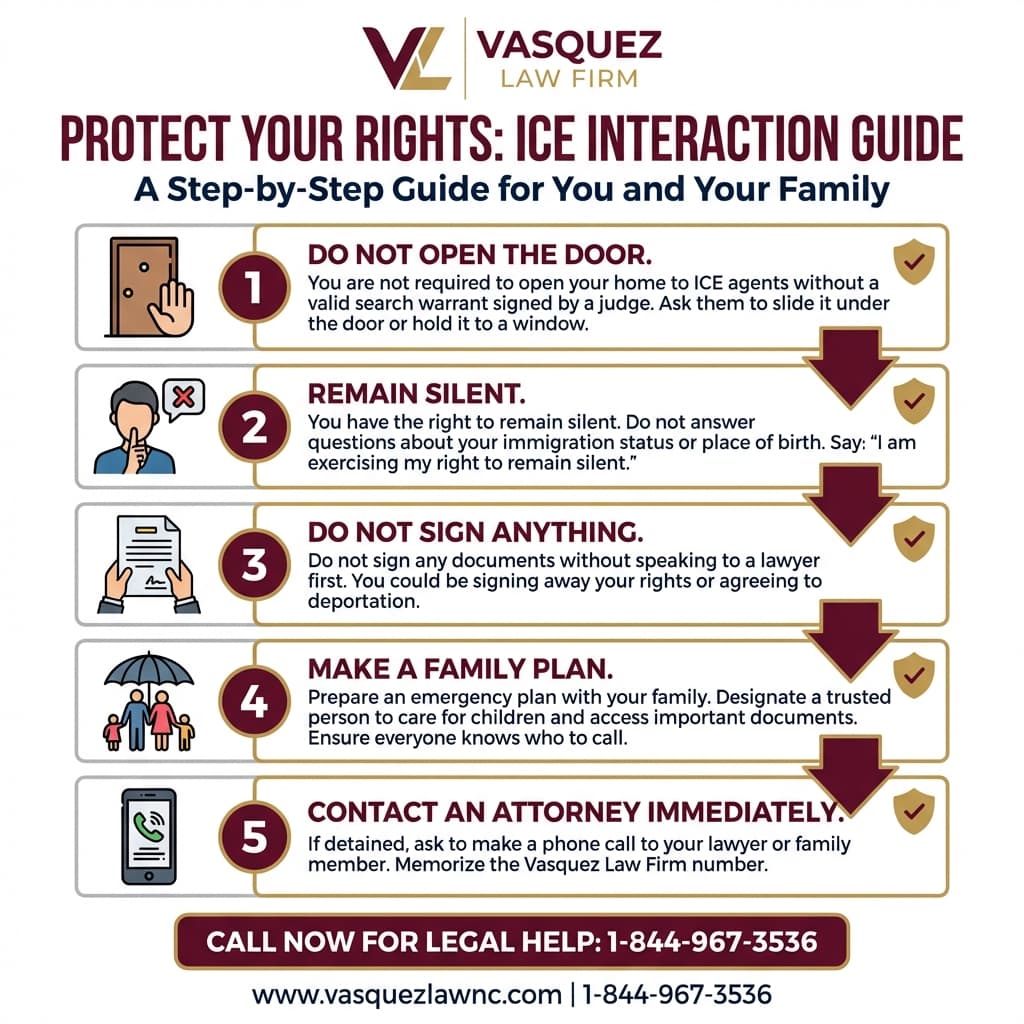
Facing an ICE arrest in Tallahassee can be overwhelming, but having a clear plan can make a significant difference. Here’s a step-by-step guide on how to respond and protect your rights:
- Remain Calm and Silent: Your first priority is to stay calm. Do not resist arrest, but clearly state, "I wish to remain silent and speak with my attorney." You are not required to answer questions about your immigration status, nationality, or how you entered the country.
- Do Not Open Your Door Without a Judicial Warrant: If ICE agents are at your home, ask them to slide any warrant under the door or hold it up to a window. If they do not have a judicial warrant signed by a judge, you are not required to open your door. An administrative warrant (Form I-200 or I-205) is not sufficient for entry without consent.
- Do Not Lie or Present False Documents: Providing false information or forged documents can lead to additional criminal charges and severely complicate your immigration case.
- Do Not Sign Anything: Never sign any document presented by ICE without first consulting with an attorney. Signing documents, especially those related to voluntary departure, can waive your rights to a hearing and lead to immediate deportation.
- Request to Speak with an Attorney: Repeatedly state your right to an attorney. ICE agents are required to provide you with a list of free legal service providers if you are detained, but you can also request to call your own attorney.
- Document Everything (If Possible): If it is safe to do so, try to remember or write down details: the agents' badge numbers, names, vehicle descriptions, and the time and location of the encounter. If witnesses are present, ask them to document what happened.
- Contact an Immigration Attorney Immediately: As soon as you or a family member can, contact an experienced immigration lawyer. Early intervention by an attorney can be critical in challenging detention, seeking bond, and exploring all available relief options. Vasquez Law Firm is ready to assist.
Documents and Information to Prepare for Immigration Cases
Preparing essential documents and information in advance can significantly aid your legal team if you or a family member is arrested by ICE. Having these items readily accessible can expedite the legal process and ensure your attorney has all necessary details.
- Personal Identification: Passports, birth certificates, national ID cards from your home country.
- Immigration Documents: Visa copies, I-94 records, Green Card (Form I-551), EAD (Employment Authorization Document), notices from USCIS or immigration court.
- Contact Information: Names and phone numbers of family members, friends, and your immigration attorney. Keep this information separate from your wallet, perhaps on a "Know Your Rights" card.
- Proof of Residence: Utility bills, lease agreements, property deeds showing your address in Tallahassee or other Florida cities.
- Employment Records: Pay stubs, employment verification letters.
- Family Ties: Birth certificates of U.S. citizen children or spouses, marriage certificates.
- Medical Records: Information on any serious medical conditions or medications.
- Financial Records: Bank statements, tax returns.
- Criminal Records (if applicable): Any court dispositions, police reports, or records of prior arrests.
- "Know Your Rights" Card: A small card stating your right to remain silent and speak with an attorney, along with your attorney's contact information.
Timeline: What to Expect After an ICE Arrest
The period following an ICE arrest can be confusing and stressful. While every case is unique, here’s a general timeline of what you might expect:
- Immediately After Arrest: You will likely be transported to an ICE processing center or a local detention facility. Agents will collect your personal information and potentially ask questions. This is when asserting your right to remain silent and requesting an attorney is most critical.
- Within 24-72 Hours: You may undergo initial processing, including fingerprinting and background checks. ICE will determine if there is a basis for your detention. If you are eligible for bond, an immigration judge or ICE officer may set a bond amount.
- Initial Hearing (Master Calendar Hearing): If detained, you will typically appear before an immigration judge for a Master Calendar Hearing. This initial appearance is usually within a few weeks to a few months, depending on the court's schedule. During this hearing, the judge will confirm your identity, explain the charges against you, and set future hearing dates. This is a crucial stage where an attorney can formally enter an appearance and begin advocating on your behalf.
- Individual Hearing (Merits Hearing): If you contest your removal, an Individual Hearing will be scheduled. This is where evidence is presented, witnesses may testify, and the judge makes a final decision on your case. This hearing can take several months to over a year to occur.
- Appeals: If the immigration judge rules against you, your attorney can file an appeal with the Board of Immigration Appeals (BIA). This process can add several months to a year or more to your case.
- Release or Deportation: Depending on the outcome of your hearings and appeals, you may be released from detention, granted immigration relief, or ordered removed (deported) from the U.S.
Throughout this timeline, having an experienced attorney from Vasquez Law Firm advocating for you can significantly impact the process and outcome. We handle cases across North Carolina, Florida, and nationwide.
Costs and Fees: What Impacts the Price of Legal Representation
The cost of legal representation for ICE arrest cases can vary widely depending on several factors. It's important to discuss fees transparently with your attorney during your initial consultation. Investing in legal counsel is often critical for navigating the complexities of immigration law and protecting your future.
- Case Complexity: Simple cases, such as bond hearings for individuals with clear relief options, may be less expensive than complex cases involving criminal history, multiple appeals, or asylum claims.
- Detention Location: Representing clients in remote detention centers may incur additional travel costs for attorneys.
- Type of Relief Sought: The specific immigration relief you are seeking (e.g., cancellation of removal, adjustment of status, asylum) will influence the amount of legal work required and thus the fees.
- Court Fees: Beyond attorney fees, there are often government filing fees for various applications and appeals, such as bond motions or applications for relief.
- Expert Witness Fees: In some cases, particularly asylum or complex criminal-immigration matters, expert witnesses may be needed, adding to the overall cost.
At Vasquez Law Firm, we strive to provide clear and upfront information about our fee structures. We understand the financial strain these situations can cause and work with clients to find suitable arrangements. We believe everyone deserves access to quality legal representation.
Common Mistakes and How to Avoid Them During ICE Encounters
During a stressful encounter with ICE, it's easy to make mistakes that can jeopardize your immigration case. Avoiding these common pitfalls is vital for protecting your rights and improving your chances of a positive outcome.
- Opening the Door Without a Judicial Warrant: This is one of the most significant errors. Always ask to see a judicial warrant before opening your door. If they only have an administrative warrant, you can keep your door closed.
- Answering Questions About Immigration Status: You have the right to remain silent. Do not answer questions about where you were born, how you entered the U.S., or your immigration status.
- Signing Documents Without Legal Review: Never sign anything from ICE, especially documents related to voluntary departure or waivers of rights, without consulting an attorney.
- Providing False Information: Lying to an immigration officer or presenting false documents can lead to criminal charges and severe immigration consequences.
- Resisting Arrest: While you have rights, physically resisting arrest can lead to additional criminal charges and complicate your situation. Remain calm and assert your rights verbally.
- Not Carrying "Know Your Rights" Information: Having a card with your attorney's contact information and a brief statement of your rights can be invaluable.
- Failing to Inform Family: Ensure a trusted family member or friend knows what to do and who to call if you are arrested.
- Delaying Legal Counsel: The sooner an attorney is involved, the better. Delays can limit your options and reduce the effectiveness of your defense.
- Assuming You Have No Options: Many people believe they have no recourse after an ICE arrest. An experienced attorney can often identify forms of relief or defense you didn't know existed.
If you only remember one thing: Always assert your right to remain silent and your right to an attorney. Do not open your door to ICE without a judicial warrant, and never sign anything without legal counsel.
NC, FL, and Nationwide Immigration Notes
Immigration law is primarily federal, meaning the laws and regulations set by the U.S. government apply nationwide. However, the practical application and local enforcement can vary significantly from state to state and even city to city. Vasquez Law Firm provides comprehensive immigration services across North Carolina, Florida, and throughout the United States, understanding these nuances.
North Carolina Immigration Enforcement
In North Carolina, counties and local law enforcement agencies may have varying levels of cooperation with ICE. Some counties participate in 287(g) agreements, which deputize local officers to perform certain immigration enforcement functions. This can lead to individuals being held for ICE after local arrests, even for minor offenses. Awareness of local policies in areas like Raleigh and Charlotte is crucial for immigrants living in the state.
Florida Immigration Enforcement
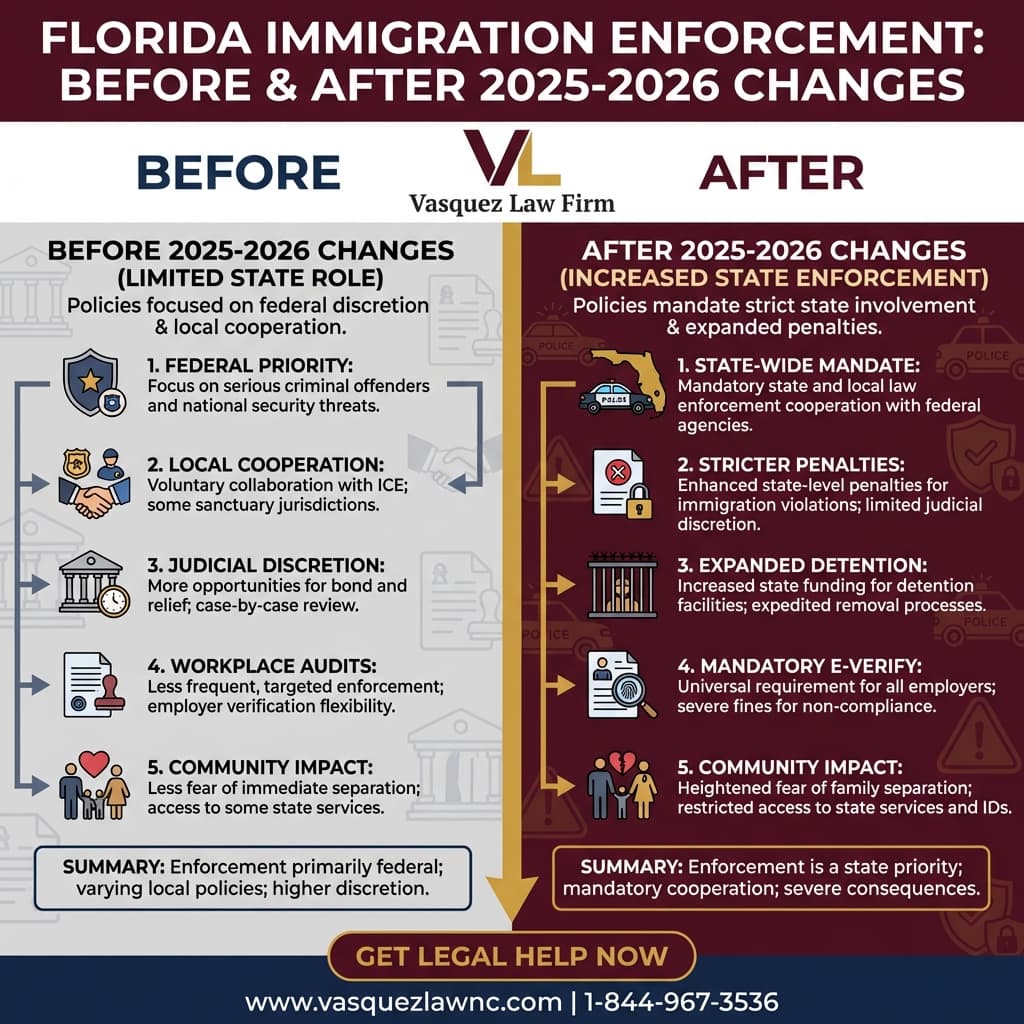
Florida has seen significant immigration enforcement activity, including ICE raids in Tampa and other major cities. State laws and policies, such as those related to sanctuary cities (or the lack thereof), can influence how ICE operates. Tallahassee, as the state capital, often sees enforcement related to broader state initiatives. It's essential for residents and visitors in Florida to be particularly vigilant and informed about their rights due to the state's active enforcement posture.
Nationwide Immigration Concepts (General Only, Rules Vary)
While specific state-level cooperation with ICE may differ, the core federal immigration laws, as enforced by USCIS and the Executive Office for Immigration Review (EOIR), remain consistent nationwide. This includes laws pertaining to visas, green cards, citizenship, deportation, and asylum. Any individual, regardless of their location in the U.S., is subject to federal immigration enforcement. The right to legal counsel and due process under federal law is universal, but access to resources and local legal aid can vary. For example, understanding US immigration law changes in 2026 is critical for anyone nationwide.
When to Call a Lawyer Now: Urgent Triggers for Legal Help
Time is often of the essence in immigration cases, especially when dealing with ICE arrests. Knowing when to seek immediate legal counsel can be the difference between detention and release, or even deportation and the opportunity to remain in the U.S. Do not delay if any of these situations apply to you or a loved one:
- An ICE Arrest Has Occurred: If you or someone you know has been arrested by ICE, contact an attorney immediately. Early intervention is critical.
- ICE Agents Are at Your Home or Workplace: Even if no arrest has been made, having legal counsel can guide you on how to interact with agents and protect your rights.
- You Receive a Notice to Appear (NTA): An NTA is the start of removal proceedings. You need an attorney to represent you in immigration court.
- You or a Loved One Is in Immigration Detention: An attorney can help determine eligibility for bond and fight for release.
- You Have a Prior Deportation Order: Re-entering the U.S. after deportation carries severe penalties, and immediate legal advice is essential.
- You Have a Criminal History: Criminal convictions, even minor ones, can have significant immigration consequences. An attorney can assess the impact.
- You Are Asked to Sign Any ICE Document: Never sign anything without a lawyer's review.
- You Fear Persecution in Your Home Country: If you believe you qualify for asylum or other humanitarian relief, a lawyer can help you pursue it.
- You are a Victim of a Crime and Fear Reporting Due to Status: You might be eligible for a U visa or T visa, and a lawyer can assist.
About Vasquez Law Firm
At Vasquez Law Firm, we combine compassion with aggressive representation. Our motto "Yo Peleo" (I Fight) reflects our commitment to standing up for your rights. We understand the unique challenges faced by immigrant communities in North Carolina, Florida, and nationwide, and we are dedicated to providing zealous advocacy.
- Bilingual Support: Se Habla Español - our team is fully bilingual, ensuring clear communication and understanding.
- Service Areas: We proudly serve clients across North Carolina and Florida, and handle federal immigration cases throughout the United States.
- Experience: With over 15 years of dedicated legal experience, we have a proven track record of guiding clients through complex legal matters.
- Results: We are committed to achieving the best possible outcomes, fighting tirelessly for our clients' futures.
Attorney Trust and Experience
Attorney Vasquez holds a Juris Doctor degree and is admitted to practice in the North Carolina State Bar. With over 15 years of dedicated legal experience, he has built a reputation for providing personalized attention and achieving favorable outcomes for his clients. He understands the profound impact immigration issues have on individuals and families, and approaches each case with empathy and unwavering determination. His commitment to justice makes Vasquez Law Firm a trusted advocate for those facing swift deportations or other challenging immigration scenarios.
Don't face your legal challenges alone. Our team is here to help you every step of the way.
Call today: 1-844-967-3536 | Se Habla Español
Frequently Asked Questions
Was there an ICE raid in Tallahassee, Florida recently?
While specific "raids" may not always be widely publicized, ICE conducts ongoing enforcement actions in Tallahassee and across Florida. News reports in 2026 confirm local law enforcement has picked up individuals for ICE. It's crucial for residents to remain vigilant and informed about their rights, as enforcement activities are a regular occurrence, often targeting specific individuals rather than large-scale public operations. Always be prepared for an encounter.
Where can I find information about ICE arrests?
Information on ICE arrests is not always publicly available in real-time due to privacy concerns. However, you can often find general statistics on ICE's official website. For information about a specific detained individual, you can use the ICE Detainee Locator online tool. Local news outlets sometimes report on significant enforcement actions, but this is not a comprehensive source for all arrests. An attorney can also help inquire about detained individuals.
Can I sue ICE for detaining me if I am a U.S. citizen?
If you are a U.S. citizen and were unlawfully detained by ICE, you may have grounds to sue for wrongful detention and civil rights violations. Such cases are complex and require strong legal evidence of citizenship and unlawful detainment. It is absolutely critical to contact a civil rights attorney or an immigration attorney experienced in federal litigation immediately if you believe this has happened to you. Timelines for filing such claims are strict.
Which state has the most ICE arrests?
Historically, states with large immigrant populations and border regions tend to have higher numbers of ICE arrests. Texas, California, Arizona, and Florida frequently rank among the states with the most ICE enforcement actions. However, these numbers fluctuate based on enforcement priorities, border policies, and local cooperation levels. It's important to note that enforcement is dynamic and can shift focus to different regions at any time. Consult ICE's official reports for current data.
What happens if I refuse to answer questions from ICE?
You have the Fifth Amendment right to remain silent during an encounter with ICE. If you choose not to answer questions, you should clearly state, "I wish to remain silent and speak with my attorney." Refusing to answer questions cannot be used as evidence against you in court. However, ICE agents may still detain you if they have probable cause to believe you are an undocumented immigrant. This right is fundamental to protecting yourself.
Do I have to open my door if ICE is outside my home?
No, you are not required to open your door to ICE agents unless they present a judicial warrant signed by a judge. An administrative warrant (Form I-200 or I-205) is not sufficient for forced entry into your home. Always ask agents to slide the warrant under the door or hold it up to a window so you can inspect it. If they don't have a judicial warrant, you can keep your door closed and do not need to let them in.
What is a 287(g) agreement and how does it affect ICE arrests in Tallahassee?
A 287(g) agreement is a program where ICE partners with state and local law enforcement agencies, deputizing local officers to perform certain immigration enforcement functions. While Tallahassee itself may not have a direct 287(g) agreement, surrounding counties or state agencies might. Such agreements can lead to increased ICE arrests as local police can identify and detain individuals for immigration violations, even during routine stops, impacting communities like Raleigh and other Florida cities.
Can an attorney help me if I am already detained by ICE?
Yes, absolutely. An attorney can be instrumental if you are already detained. They can visit you in detention, explain your rights, assess your eligibility for bond, and represent you in immigration court. Early legal intervention can significantly improve your chances of release and successful defense against deportation. Contacting an attorney as soon as possible after detention is crucial to begin preparing your case and exploring all available legal avenues.
What is the difference between an administrative warrant and a judicial warrant?
An administrative warrant (Form I-200 or I-205) is issued by an ICE officer and authorizes the arrest and detention of an individual believed to be in violation of immigration law. A judicial warrant, however, is issued by a federal judge based on probable cause and specifically authorizes entry into a private residence. The key difference is that a judicial warrant is required for forced entry into a home, while an administrative warrant is not. Understanding this distinction is vital for protecting your Fourth Amendment rights.
What should I do if I witness an ICE arrest?
If you witness an ICE arrest, you have the right to observe and document the event, as long as you do not interfere with law enforcement activities. You can take photos or videos from a safe distance, but do not physically intervene. Try to note details like the agents' vehicles, badge numbers, and any statements made. If possible, offer assistance by helping the arrested individual's family contact an immigration attorney. Your documentation can be valuable evidence.
Sources and References
- U.S. Citizenship and Immigration Services (USCIS)
- Executive Office for Immigration Review (EOIR)
- 8 U.S. Code § 1357 - Powers of immigration officers and employees
Ready to take the next step? Contact Vasquez Law Firm today for a free, confidential consultation. We're committed to fighting for your rights and achieving the best possible outcome for your case.
Start Your Free Case Evaluation Now
Call us: 1-844-967-3536
Se Habla Español - Estamos aquí para ayudarle.


William Vasquez
Founder & CEO, Vasquez Law Firm, PLLC
William Vasquez is the founder and CEO of Vasquez Law Firm, PLLC, a results-driven firm specializing in immigration, criminal defense, personal injury, and workers' compensation. A U.S. Air Force veteran and recipient of the Joint Service Achievement Medal, William is dedicated to fiercely fighting for his clients' rights.
Related Legal Services
Need legal help? Learn more about experienced immigration attorneys in Charlotte, or contact us for a free evaluation.
You can also visit NC immigration legal help for more information.