How Immigrants Can Fight Back Against Swift Deportations in 2026
Understand swift deportations and your rights in 2026. Learn how to protect yourself and your family. Contact Vasquez Law for a free consultation today.
Published on February 26, 2026
Talk to an immigration attorney
Free call. A clear plan for your case.
Free & confidential · Se habla espanol · 24/7

Have questions? Talk to an attorney - free evaluation.
Call 1-844-967-3536Check your case status now
Look up your immigration case below, then talk to an attorney about what it means — free.
Questions about your result?
Talk to an attorney about your case — free, no obligation.
How Immigrants Can Fight Back Against Swift Deportations in 2026
The threat of swift deportations can be a terrifying reality for many immigrants and their families in North Carolina, Florida, and across the United States. Understanding the procedures, your rights, and how to effectively challenge a deportation order is absolutely essential in 2026. These expedited processes, often without a full hearing, can drastically impact an individual's future, making immediate legal counsel critical. At Vasquez Law Firm, we are committed to providing aggressive and compassionate representation to help you navigate these complex immigration challenges. We believe in fighting for every client's right to due process.
Need help with your case? Our experienced attorneys are ready to fight for you. Se Habla Español.
Schedule Your Free Case Evaluation
Or call us now: 1-844-967-3536
Quick Answer: Understanding Swift Deportations
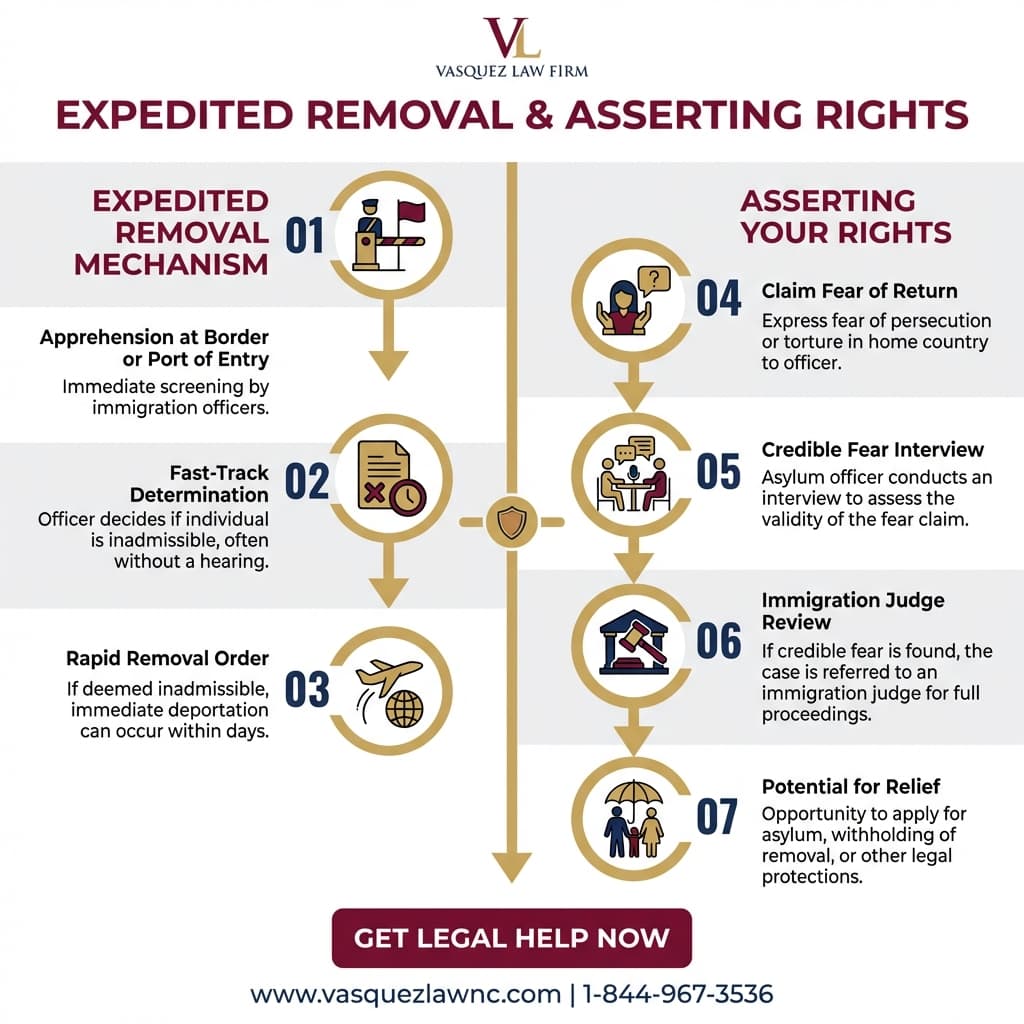
Swift deportations, also known as expedited removal, refer to the process by which certain non-citizens can be removed from the U.S. without a hearing before an immigration judge. This process is typically applied to individuals deemed inadmissible, often those apprehended near the border or who cannot prove they have been continuously present in the U.S. for at least two years. It's a critical area of immigration law where legal representation is paramount to protect your rights.
- Expedited removal bypasses immigration court.
- Applies to certain inadmissible non-citizens.
- Often used at U.S. borders or ports of entry.
- Requires immediate action to challenge the order.
- Legal counsel is vital to assert your rights and seek relief.
What Are Swift Deportations (Expedited Removal)?
Swift deportations, officially termed expedited removal, are a streamlined process used by immigration authorities to quickly remove certain non-citizens from the United States. Unlike standard deportation proceedings, which involve hearings before an immigration judge, expedited removal typically occurs without judicial review. This means individuals subject to swift deportations have very limited opportunities to present their case or seek relief, making the process incredibly challenging and often frightening.
The authority for expedited removal stems from Section 235(b)(1) of the Immigration and Nationality Act (INA). This provision allows immigration officers to remove non-citizens who are deemed inadmissible at a port of entry or who have not been physically present in the U.S. for a continuous two-year period following their admission. The scope of expedited removal has expanded over the years, impacting a broader range of individuals, including those apprehended deep within the U.S. interior, depending on policy changes and presidential administrations.
For individuals facing swift deportations, understanding the specific grounds for removal and the narrow avenues for appeal or relief is crucial. These grounds often include lack of proper entry documents, misrepresentation, or certain criminal convictions. The speed and lack of judicial oversight in these cases highlight the importance of immediate legal intervention. An experienced immigration attorney can assess your situation, identify potential defenses, and work to halt or challenge the expedited removal order, protecting your right to due process.
History and Expansion of Expedited Removal
The concept of expedited removal was introduced as part of the Illegal Immigration Reform and Immigrant Responsibility Act (IIRAIRA) of 1996. Initially, it was primarily intended for individuals apprehended at ports of entry who possessed fraudulent documents or no documents at all. However, subsequent policy directives have significantly expanded its geographic reach and application.
For example, in recent years, various administrations have sought to apply expedited removal to individuals apprehended anywhere in the U.S. who cannot prove continuous presence for two years, rather than just those at the border. These expansions have been met with legal challenges, as seen in the Reuters report about a US judge rejecting a Trump policy allowing swift deportations to alternate countries. Such legal battles underscore the dynamic nature of immigration law and the constant need for vigilance and strong legal advocacy.
The changing landscape means that what constitutes 'swift' and 'expedited' can vary depending on the political climate and judicial rulings. Immigrants, particularly Dreamers and those without clear status, must stay informed and seek legal counsel immediately if they believe they are at risk. The potential for rapid removal without a court hearing makes proactive legal planning and swift response absolutely critical.
Who Is At Risk of Swift Deportations?
Not all non-citizens are subject to expedited removal. The law specifically targets certain categories of individuals, primarily those who are deemed inadmissible under U.S. immigration law. This often includes individuals attempting to enter the U.S. without proper documentation, those who have committed certain types of fraud or misrepresentation to gain entry, or those with specific criminal histories.
A primary group at risk are those apprehended at or near U.S. borders or ports of entry without valid visas or other required travel documents. These individuals can be quickly processed and removed without appearing before an immigration judge. Another significant group includes non-citizens who cannot establish that they have been continuously present in the U.S. for at least two years immediately prior to their apprehension. This broad definition can capture many individuals who have overstayed their visas or entered without inspection.
Even individuals who have been in the U.S. for some time but lack formal status can be vulnerable, especially if they are encountered by immigration enforcement outside of a port of entry and cannot provide sufficient proof of long-term residence. The lack of a clear paper trail of continuous presence makes them susceptible to expedited removal. It is crucial for anyone in these situations to understand their rights and to seek legal assistance promptly, particularly in diverse communities like Orlando, where immigration concerns are prevalent. Vasquez Law Firm understands these risks and stands ready to assist.
Common Scenarios Leading to Expedited Removal
Several situations can trigger swift deportations. One common scenario involves individuals arriving at an airport or land border crossing with falsified documents or no documents at all. U.S. Customs and Border Protection (CBP) officers have the authority to issue expedited removal orders in these instances. Another scenario is when an individual admits to an immigration officer that they have misrepresented facts to gain entry or obtain an immigration benefit.
Additionally, non-citizens encountered by ICE (Immigration and Customs Enforcement) within 100 miles of a U.S. land border, who cannot prove lawful presence for at least 14 days, may also be placed in expedited removal. The geographic expansion of expedited removal in 2019, though challenged, aimed to apply it nationwide to individuals unable to prove two years of continuous physical presence. This policy, while facing legal hurdles, highlights the ever-present risk for many. Understanding these triggers is key to avoiding or challenging swift deportations.
Your Rights During Swift Deportations and How to Assert Them
Even in expedited removal proceedings, non-citizens have certain fundamental rights. Knowing and asserting these rights can be the difference between remaining in the U.S. and swift deportation. The most critical right is the right to express a fear of persecution or torture if returned to your home country. If you express such a fear, the immigration officer must refer you to an asylum officer for a credible fear interview. This referral temporarily halts the expedited removal process and allows you to present your case for asylum or other protection.
You also have the right to consult with an attorney. While this right may be limited in terms of timing and access, it is crucial to assert it immediately. An attorney can advise you on your options, help prepare you for interviews, and advocate on your behalf. You have the right to remain silent and not answer questions beyond identifying yourself. Providing unnecessary information can inadvertently harm your case. Furthermore, you have the right to review the documents presented against you, though this can be challenging in detention settings.
It's important to remember that immigration officers are not required to inform you of all your rights, making it your responsibility to know and assert them. This is particularly true if you are detained. Remaining calm, clearly stating your fear of return, and requesting an attorney are vital first steps. Attorney Vasquez and our team at Vasquez Law Firm are experienced in protecting these rights for individuals facing swift deportations in North Carolina, Florida, and nationwide.
The Credible Fear Interview Process
If you express a fear of persecution or torture, you will be referred for a credible fear interview with an asylum officer. This interview is a crucial step to avoid swift deportations. The asylum officer will determine if there is a "significant possibility" that you could establish eligibility for asylum or protection under the Convention Against Torture. If you pass this interview, your case will then be referred to an immigration judge for a full hearing, where you can formally apply for asylum.
Preparing for a credible fear interview is paramount. You should be ready to articulate why you fear returning to your home country, providing details about past persecution or threats, and explaining why you believe your government cannot protect you. While an attorney cannot be present in the interview room, they can help you prepare thoroughly beforehand, ensuring you understand the questions and can present your story effectively. This preparation can significantly increase your chances of a positive outcome.
Challenging Swift Deportations: Legal Strategies
Challenging swift deportations requires immediate and strategic legal action. One of the most common strategies is to assert a fear of persecution or torture, leading to a credible fear interview and potentially a full asylum hearing. This effectively moves the case out of the expedited removal process and into the more formal immigration court system, where more protections and opportunities for relief exist.
Another strategy involves demonstrating that you are not, in fact, subject to expedited removal. This could mean proving continuous physical presence in the U.S. for at least two years, or arguing that you are a lawful permanent resident or U.S. citizen, which would make expedited removal inapplicable. Evidence such as utility bills, employment records, school records, and tax returns can be critical in establishing continuous presence. It's important to gather and present this documentation quickly.
In some cases, it may be possible to seek a waiver of inadmissibility, although these are generally difficult to obtain in the expedited removal context. Additionally, legal challenges to the expedited removal order itself, through federal court litigation, can sometimes halt the process. As seen in recent cases where federal judges have ruled against expanded expedited removal policies, judicial oversight can play a role. However, these are complex legal maneuvers best undertaken with the guidance of an experienced immigration attorney. For comprehensive assistance, consider contacting Vasquez Law Firm for a free immigration consultation.
Judicial Review and Challenges to Policy
While expedited removal bypasses initial judicial review, federal courts can still hear challenges to the policies and implementation of expedited removal. These challenges often come in the form of class-action lawsuits or individual petitions for habeas corpus, arguing that the government has exceeded its authority or violated due process rights. A notable example involved a federal judge ruling against a Trump administration policy seeking to expand swift deportations to alternate countries, which was reported by Reuters. These cases highlight the ongoing legal battle over the scope and legality of expedited removal.
Such judicial interventions, though rare and often lengthy, can provide crucial relief for individuals and even lead to policy changes. However, direct access to judicial review for individuals in expedited removal is highly limited. This makes the initial stages, particularly asserting a credible fear, even more critical as it's often the only pathway to a judge. An attorney can advise on the feasibility and strategy for such high-level challenges.
Common Mistakes to Avoid During Swift Deportations
Navigating swift deportations is fraught with peril, and certain mistakes can severely jeopardize your case. Avoiding these pitfalls is crucial for protecting your rights and maximizing your chances of a positive outcome. Here are some common mistakes and how to prevent them:
- Not expressing fear of return: Many individuals, out of fear or confusion, fail to explicitly state their fear of persecution or torture if returned to their home country. This is the single most important right to assert.
- Signing documents without understanding: Never sign any document presented by an immigration officer if you do not fully understand its contents or implications. Request an interpreter and an attorney before signing anything.
- Lying or providing inconsistent information: Any false statements or inconsistencies can be used against you and severely damage your credibility. Always be truthful, but remember you have the right to remain silent on certain questions.
- Failing to assert your right to an attorney: Even if access is limited, always request to speak with an attorney. An attorney can advise you on your rights and help you navigate the process.
- Not providing proof of continuous presence: If you've been in the U.S. for two years or more, failing to present evidence of continuous physical presence can lead to expedited removal. Gather documents like utility bills, leases, school records, and pay stubs.
- Ignoring prior immigration violations: Believing that past issues won't resurface is a mistake. Prior deportations, visa overstays, or criminal history will complicate your case and require specific legal strategies.
- Delaying legal help: Time is of the essence in swift deportation cases. Waiting to seek legal counsel can close off potential avenues for relief. Contact an attorney immediately upon apprehension.
If you only remember one thing: Always express a fear of returning to your home country and immediately request to speak with an attorney. These two actions are your strongest defenses against swift deportations.
NC, FL, and Nationwide Immigration Notes
Immigration law, including swift deportations, operates under a federal framework, meaning the core laws and regulations originate from the U.S. government. However, the practical application and impact of these laws can vary regionally, including in North Carolina and Florida, due to local enforcement priorities and judicial circuits.
North Carolina Considerations
In North Carolina, immigration enforcement, particularly by ICE, is active. Individuals in cities like Charlotte, Raleigh, and Durham may encounter enforcement actions that could lead to swift deportations. North Carolina is under the jurisdiction of the Fourth Circuit Court of Appeals, which interprets federal immigration laws. Understanding local enforcement trends and having access to legal representation familiar with the specific dynamics in North Carolina is critical. Vasquez Law Firm proudly serves clients across North Carolina, offering expert immigration defense.
Florida Considerations
Florida, with its extensive coastline and large immigrant population, particularly in areas like Orlando and Miami, is a focal point for federal immigration enforcement. CBP operations at ports of entry, airports, and along the coast mean a high potential for expedited removal. Florida falls under the Eleventh Circuit Court of Appeals. The state's unique demographics and geography often lead to a high volume of immigration cases, making experienced legal counsel, such as Vasquez Law Firm, indispensable for those facing swift deportations.
Nationwide Federal Framework
Across the entire United States, the legal framework for swift deportations is defined by federal statutes like the INA and regulations from agencies like USCIS and ICE. While enforcement priorities may shift with administrations, the fundamental process of expedited removal remains consistent. This means that an individual's rights and the legal strategies available are largely the same, regardless of the state. However, the availability of legal resources, local court backlogs, and community support networks can differ significantly, highlighting the importance of a nationwide perspective in immigration defense. Our firm offers nationwide immigration services, ensuring consistent, high-quality representation wherever you are.
When to Call an Immigration Lawyer Now
The urgency of swift deportations cannot be overstated. Waiting to seek legal counsel can severely limit your options and jeopardize your ability to remain in the U.S. You should call an immigration lawyer immediately if any of the following situations apply to you or a loved one:
- You or a family member has been detained by ICE or CBP.
- You have been issued a Notice to Appear (NTA) or an expedited removal order.
- You fear persecution or torture if returned to your home country.
- You are asked to sign any immigration-related documents.
- You are questioned by immigration officers about your status or entry.
- You have a prior deportation order or immigration violation on your record.
- You are a non-citizen without legal status and are concerned about enforcement actions.
- You are a lawful permanent resident or citizen but are mistakenly targeted for removal.
- You need to gather evidence of continuous physical presence in the U.S.
- You have a credible fear interview scheduled and need preparation.
About Vasquez Law Firm
At Vasquez Law Firm, we combine compassion with aggressive representation. Our motto "Yo Peleo" (I Fight) reflects our unwavering commitment to standing up for your rights and vigorously defending your interests. We understand the profound impact that immigration challenges, especially the threat of swift deportations, can have on individuals and families. That's why we bring over 15 years of dedicated legal experience to every case, fighting tirelessly for the best possible outcomes.
- Bilingual Support: Se Habla Español - our team is fully bilingual, ensuring clear communication and understanding throughout your legal journey.
- Service Areas: We proudly serve clients across North Carolina and Florida, and provide comprehensive immigration services nationwide.
- Experience: With over 15 years of focused experience, Attorney Vasquez has a proven track record in complex immigration matters, personal injury, workers' compensation, and criminal defense.
- Results: Our firm is dedicated to achieving favorable results, having successfully guided thousands of clients through challenging legal processes.
Attorney Trust and Experience
Attorney Vasquez holds a Juris Doctor degree and is admitted to practice in both the North Carolina State Bar and Florida Bar. His extensive experience, particularly in immigration law, makes him a trusted advocate for individuals facing the most daunting legal challenges. He is known for his personalized approach, ensuring each client receives the attention and strategic counsel they deserve. When you choose Vasquez Law Firm, you choose a legal partner who will fight relentlessly for your future.
Don't face your legal challenges alone. Our team is here to help you every step of the way.
Call today: 1-844-967-3536 | Se Habla Español
Frequently Asked Questions About Swift Deportations
What's the difference between expedited removal and standard deportation?
Expedited removal, or swift deportation, allows immigration officers to remove certain non-citizens without a hearing before an immigration judge. Standard deportation requires a formal hearing in immigration court, offering more opportunities for defense and legal relief. The key distinction is the absence of judicial review in expedited removal, making it a much faster process.
Can U.S. citizens be subjected to swift deportations?
No, U.S. citizens cannot be legally subjected to swift deportations or any form of deportation. Citizenship grants full protection from removal. However, mistakes can happen, and a U.S. citizen might be mistakenly identified as a non-citizen. If this occurs, it's crucial to immediately assert your citizenship and contact an attorney to rectify the error swiftly.
What is a credible fear interview?
A credible fear interview is a crucial step for individuals facing expedited removal who express a fear of persecution or torture if returned to their home country. An asylum officer conducts this interview to determine if there's a "significant possibility" you could qualify for asylum. Passing this interview moves your case to immigration court, halting swift deportation.
What documents prove continuous physical presence in the U.S.?
To prove continuous physical presence for two years or more, you can use various documents. These include utility bills, rental agreements or property deeds, employment records, pay stubs, tax returns, school records, medical records, and bank statements. The more evidence you can provide, the stronger your claim against expedited removal.
How quickly can a swift deportation occur?
Swift deportations can occur very rapidly, sometimes within hours or days of apprehension. Because they bypass immigration court, there are fewer procedural steps and delays. This speed underscores why immediate legal intervention is absolutely critical to challenge the process or assert rights, such as requesting a credible fear interview.
What if I don't speak English during detention?
If you don't speak English, you have the right to an interpreter during any interactions with immigration officials. It's vital to request one immediately. Do not try to communicate in a language you're not proficient in, as misunderstandings can have severe consequences. Ensure the interpreter is accurate and you fully understand all questions and statements.
Can I appeal an expedited removal order?
Appealing an expedited removal order directly is extremely difficult, as the process is designed to bypass judicial review. The primary way to challenge it is by expressing a fear of persecution, which leads to a credible fear interview and potentially a referral to an immigration judge. Federal court challenges to the policy itself are also possible but complex.
What is the role of an immigration lawyer in swift deportation cases?
An immigration lawyer plays a critical role in swift deportation cases by advising on rights, preparing for interviews, identifying potential relief, and challenging orders. They can help assert a credible fear claim, gather evidence of continuous presence, and navigate complex legal procedures. Their immediate intervention can significantly alter the outcome of an expedited removal case.
Are there any recent changes to swift deportation policies in 2026?
Immigration policies are dynamic. As of 2026, there are ongoing legal challenges and policy debates regarding the scope and application of swift deportations. Recent judicial rulings have pushed back against expansions, but enforcement remains a priority. Staying informed through reliable sources and legal counsel is essential to understand any new developments impacting expedited removal.
What if I am a Dreamer or DACA recipient facing swift deportation?
Dreamers and DACA recipients, while having certain protections, can still face swift deportations under specific circumstances, especially if their DACA status has lapsed or if they have certain criminal convictions. It's imperative for DACA recipients to consult an attorney immediately if detained or issued an order, as their situation requires specialized legal defense strategies.
Sources and References
- U.S. Citizenship and Immigration Services (USCIS)
- Executive Office for Immigration Review (EOIR)
- 8 U.S.C. § 1235 - Inspection and Examination
Ready to take the next step? Contact Vasquez Law Firm today for a free, confidential consultation. We're committed to fighting for your rights and achieving the best possible outcome for your case.
Start Your Free Case Evaluation Now
Call us: 1-844-967-3536
Se Habla Español - Estamos aquí para ayudarle.


William Vasquez
Founder & CEO, Vasquez Law Firm, PLLC
William Vasquez is the founder and CEO of Vasquez Law Firm, PLLC, a results-driven firm specializing in immigration, criminal defense, personal injury, and workers' compensation. A U.S. Air Force veteran and recipient of the Joint Service Achievement Medal, William is dedicated to fiercely fighting for his clients' rights.
Related Legal Services
Need legal help? Learn more about immigration lawyers in North Carolina, or contact us for a free evaluation.
You can also visit statewide immigration legal services for more information.