What the Law Protects for Naturalized Citizens in 2026
Understand your naturalized citizen rights and responsibilities in 2026. Discover voting, travel, and family reunification benefits. Contact Vasquez Law for a free consultation today.
Published on February 25, 2026
Talk to an immigration attorney
Free call. A clear plan for your case.
Free & confidential · Se habla espanol · 24/7
Have questions? Talk to an attorney - free evaluation.
Call 1-844-967-3536Free Tool
Check Your USCIS Case Status Now
Enter your receipt number - get the official USCIS status in English or Spanish. No registration.
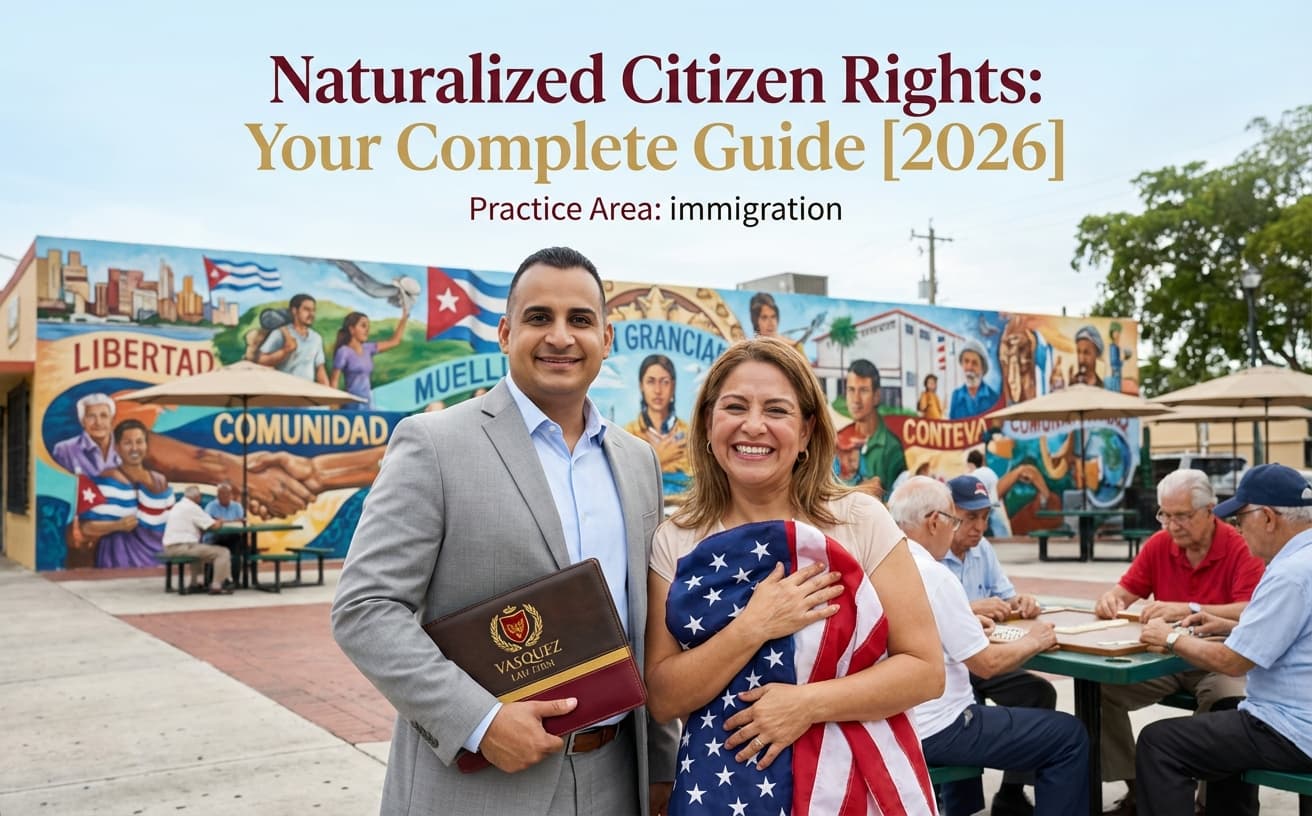
What the Law Protects for Naturalized Citizens in 2026
Becoming a naturalized citizen in the United States is a profound achievement, granting you a full spectrum of naturalized citizen rights and responsibilities. These rights are largely identical to those of native-born citizens, opening doors to greater civic participation, enhanced protections, and expanded opportunities. Understanding these rights, from voting and holding public office to sponsoring family members and traveling freely, is crucial for every new citizen. This comprehensive guide, updated for 2026, aims to clarify what it means to be a U.S. citizen through naturalization and how Vasquez Law Firm can help you navigate any related legal challenges.
Need help with your immigration case? Our experienced attorneys are ready to fight for you. Se Habla Español.
Schedule Your Free Case Evaluation
Or call us now: 1-844-967-3536
Quick Answer
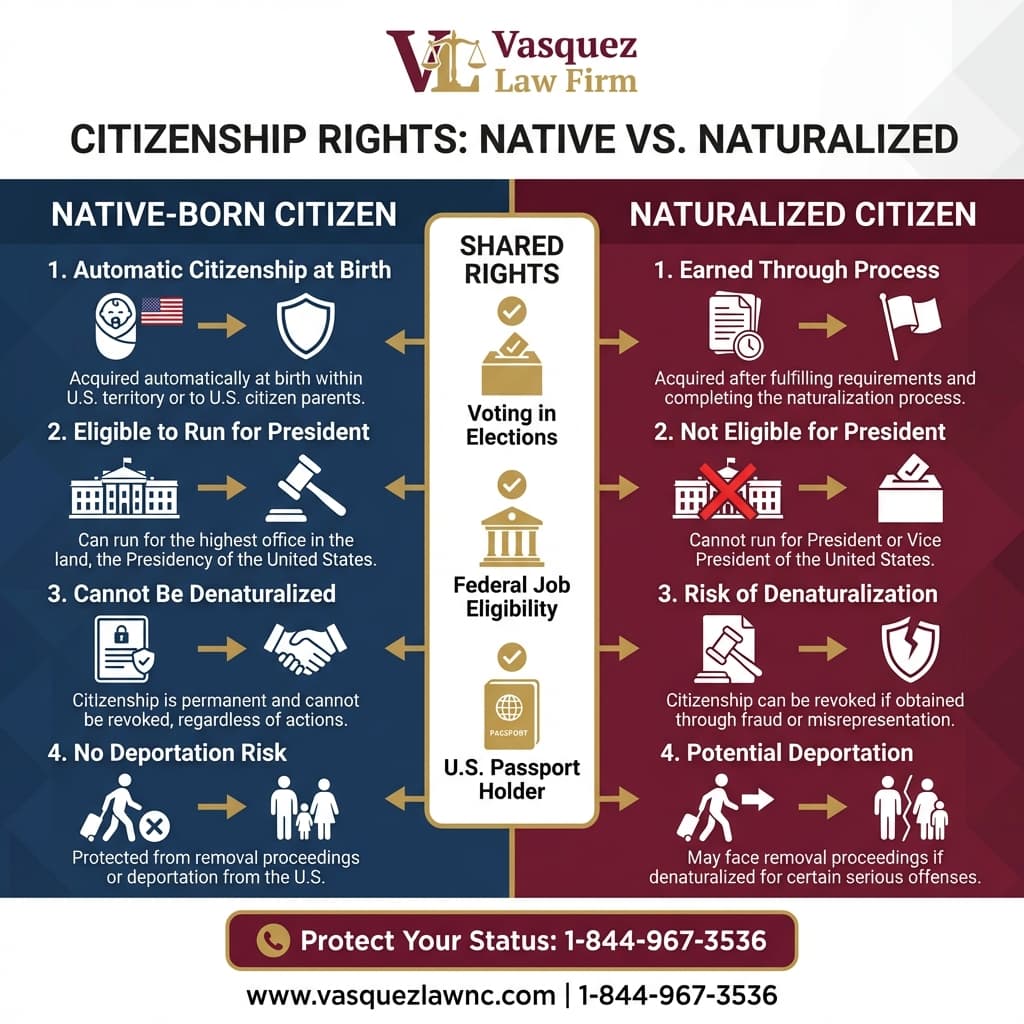
Naturalized citizen rights are nearly identical to those of native-born citizens, granting full participation in U.S. society. This includes the right to vote, hold most federal and state offices, obtain a U.S. passport, and sponsor family members for immigration. The primary difference is the inability to become President or Vice President.
- Right to vote in all elections.
- Ability to run for most public offices.
- Protection from deportation.
- Access to U.S. passports and international travel.
- Opportunity to sponsor close relatives for immigration.
- Full access to federal benefits and programs.
Understanding Your Naturalized Citizen Rights in 2026
Naturalization is the process by which a foreign citizen or national becomes a citizen of the United States. Once naturalized, your status is almost indistinguishable from someone born in the U.S. This means you gain all the fundamental rights and freedoms guaranteed by the U.S. Constitution, along with specific privileges that enhance your life and security.
The journey to becoming a naturalized citizen can be complex, often requiring years of meeting specific residency, moral character, and language requirements. However, the benefits of achieving this status are immense, providing stability and a full sense of belonging. Vasquez Law Firm understands the importance of these rights and helps individuals in North Carolina, Florida, and nationwide navigate the path to citizenship.
As of 2026, the core naturalized citizen rights remain robust, offering comprehensive protection and opportunities. These rights ensure that you can fully integrate into American society, participate in its democratic processes, and benefit from its legal and social structures. It is essential for every naturalized citizen to be aware of these fundamental entitlements.
Key Distinctions from Native-Born Citizens
While naturalized citizens enjoy nearly all the same rights as native-born citizens, there are two primary constitutional distinctions. The most well-known is that naturalized citizens cannot serve as President or Vice President of the United States, a requirement stipulated in Article II, Section 1 of the U.S. Constitution. This specific limitation is a historical artifact, a unique exception to the otherwise equal standing of all citizens.
Another, less commonly discussed, distinction involves the process of losing citizenship. While a native-born citizen can only lose their citizenship through voluntary renunciation, a naturalized citizen can, in very rare and specific circumstances, have their citizenship revoked if it was obtained through fraud or misrepresentation. This process, known as denaturalization, is exceedingly rare and typically involves serious criminal conduct or deliberate deception during the naturalization process. It is a complex legal battle and not a common occurrence.
The Fundamental Rights and Privileges of U.S. Citizenship
Upon taking the Oath of Allegiance, naturalized citizens acquire a comprehensive set of rights that significantly improve their quality of life and legal standing. These rights are not just symbolic; they have practical implications for daily life, career opportunities, and family planning. Knowing these privileges can empower you to exercise them fully and confidently.
- Right to Vote: This is arguably one of the most powerful naturalized citizen rights. You can vote in all federal, state, and local elections, directly influencing the political landscape and the future of your community.
- Ability to Run for Public Office: While the presidency is excluded, naturalized citizens can run for and hold most other elected positions, including U.S. Senator, U.S. Representative, state governor, and local council member.
- Protection from Deportation: One of the most significant benefits is the permanent protection from deportation, a constant concern for many non-citizens. As a citizen, you cannot be deported from the U.S.
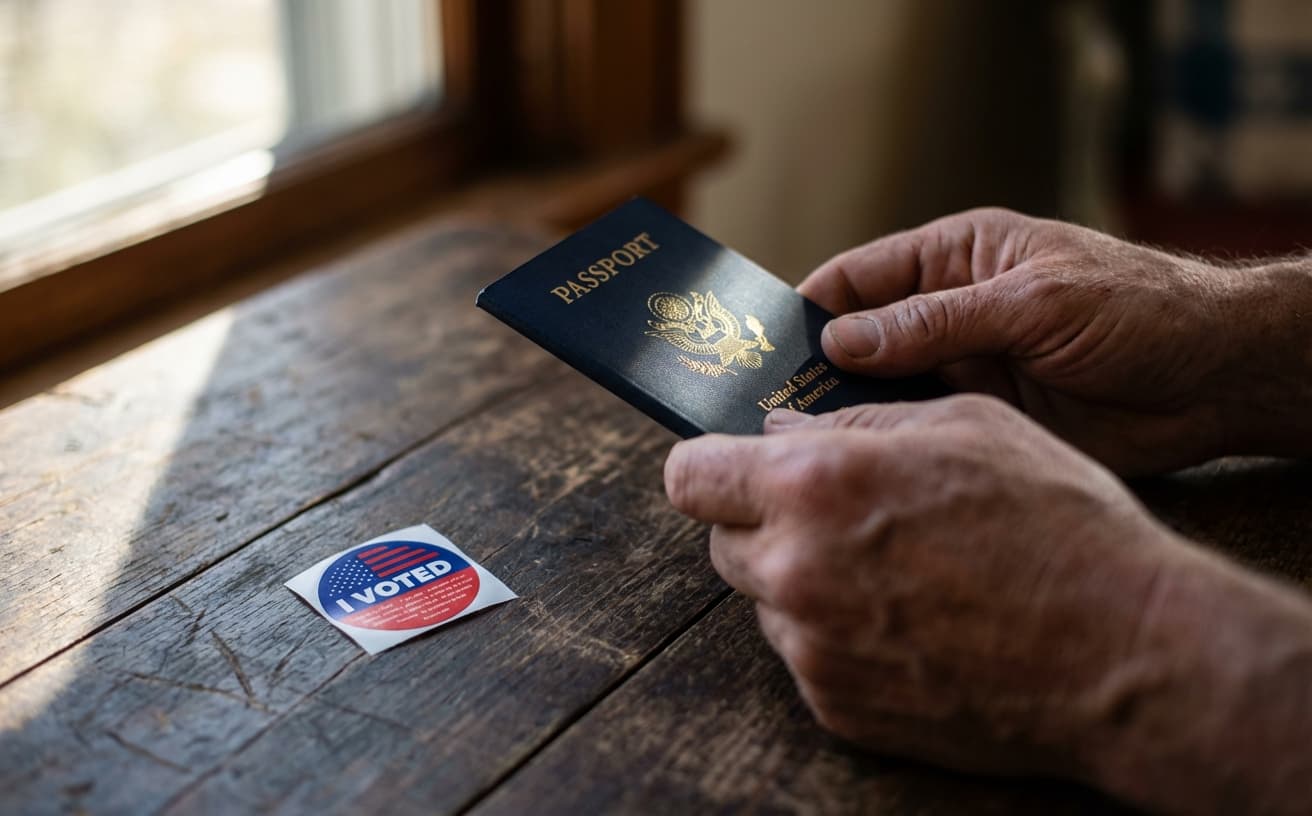
- Obtain a U.S. Passport: This allows for easier international travel and provides consular protection from the U.S. government when abroad.
- Sponsor Family Members: Citizens have a higher priority and fewer restrictions when petitioning for relatives to immigrate to the U.S., including parents, spouses, children, and siblings. This is a crucial aspect of family reunification.
- Access to Federal Jobs: Many federal government jobs require U.S. citizenship, opening up a wider range of employment opportunities.
- Federal Benefits: Citizens are eligible for a full range of federal benefits, including Social Security, Medicare, and other assistance programs, provided they meet other eligibility criteria.
- Jury Service: Citizens have the right and responsibility to serve on a jury, participating directly in the justice system.
These rights collectively provide a level of security, opportunity, and participation that is unparalleled for non-citizens. Vasquez Law Firm is dedicated to helping individuals in Raleigh and across North Carolina understand and achieve these vital naturalized citizen rights.
Responsibilities That Come with Citizenship
Citizenship is a two-way street; along with rights, it entails important responsibilities that contribute to the functioning and well-being of the nation. These obligations are not merely legal requirements but civic duties that uphold the democratic principles of the United States. Embracing these responsibilities is a hallmark of good citizenship.
Understanding and fulfilling these duties is just as important as knowing your naturalized citizen rights. They ensure that the democratic system functions effectively and that society remains just and orderly. Vasquez Law Firm emphasizes the importance of civic engagement and legal compliance for all citizens.
- Obeying the Law: All citizens are bound to follow federal, state, and local laws.
- Paying Taxes: Citizens contribute to public services and infrastructure through taxation.
- Serving on a Jury: As mentioned, this is both a right and a responsibility, essential for a fair justice system.
- Defending the Country: Male citizens between 18 and 26 are required to register with the Selective Service. While not a military draft, it is a legal requirement.
- Voting: While a right, it is also considered a civic responsibility to participate in the democratic process.
- Participating in Your Community: Engaging in local government, volunteering, or staying informed about public issues helps strengthen society.
These responsibilities reinforce the idea that citizenship is an active role, not just a passive status. Fulfilling them helps maintain the freedoms and opportunities that all naturalized citizens enjoy.
Protecting Your Naturalized Citizen Status: Common Mistakes to Avoid
Once you achieve naturalized citizenship, it is generally permanent and secure. However, understanding potential pitfalls can help ensure you maintain your status without issues. While denaturalization is rare, it is crucial to avoid any actions that could jeopardize your hard-earned citizenship. Being informed about these rare but serious risks is part of exercising your naturalized citizen rights responsibly.
- Providing False Information During Naturalization: If it is discovered that you intentionally misrepresented facts or committed fraud during your naturalization application, your citizenship could be revoked. Always be truthful in all immigration proceedings.
- Committing Certain Serious Crimes: While citizenship generally protects against deportation, committing certain severe crimes, especially those involving national security, could theoretically lead to denaturalization if directly linked to fraudulent naturalization. This is an extreme scenario.
- Renouncing U.S. Citizenship: Voluntarily giving up your U.S. citizenship, typically by formally declaring allegiance to another country or by taking an oath of renunciation, will obviously end your U.S. citizen status.
- Failing to Understand Dual Citizenship Implications: While the U.S. generally permits dual citizenship, some countries do not. Be aware of the laws of any other country you claim citizenship with, as it might impact your ability to travel or exercise rights there.
If you only remember one thing: Always be truthful and comply with U.S. laws to protect your naturalized citizen rights. If you have any concerns about your citizenship status, contact an experienced immigration attorney immediately.
The 14th Amendment and Naturalized Citizenship
The 14th Amendment to the U.S. Constitution is foundational to understanding naturalized citizen rights. Adopted in 1868, it famously states in its first sentence: "All persons born or naturalized in the United States and subject to the jurisdiction thereof, are citizens of the United States and of the State wherein they reside." This critical clause, known as the Citizenship Clause, firmly establishes that naturalized citizens hold the same legal status as those born in the U.S.
This amendment was revolutionary, primarily intended to grant citizenship to formerly enslaved people, but its language broadly applies to all who become citizens through naturalization. It ensures that once you are naturalized, you are a full and equal citizen, entitled to all the privileges and immunities of citizenship, and subject to due process and equal protection under the law. This constitutional backing provides a powerful layer of protection for naturalized citizen rights, making them fundamentally secure. For more information on constitutional protections, you can refer to legal resources like Cornell Law School's Legal Information Institute. The 14th Amendment ensures equality for all citizens, regardless of how they obtained their citizenship.
North Carolina, Florida, and Nationwide Immigration Services
Immigration law, including naturalization and naturalized citizen rights, is primarily federal. This means the laws and procedures established by agencies like U.S. Citizenship and Immigration Services (USCIS) apply uniformly across the entire United States. Whether you apply for naturalization in Raleigh, North Carolina, Miami, Florida, or anywhere else, the core eligibility requirements and the rights you gain upon naturalization are the same.
While the federal framework governs naturalized citizen rights, local factors can influence the application process. For example, processing times might vary slightly between USCIS field offices, and the availability of legal aid or community resources can differ by state. Vasquez Law Firm proudly serves clients throughout North Carolina and Florida, offering expert guidance on federal immigration matters.
North Carolina Notes
In North Carolina, many aspiring citizens reside in cities like Raleigh, Charlotte, and Durham. USCIS has field offices and application support centers in the state that process naturalization applications and conduct interviews. While state laws do not directly affect federal naturalization requirements, understanding local resources and legal support can be beneficial. Our Raleigh office frequently assists clients with their naturalization applications, ensuring they meet all federal criteria and are prepared for their interviews. We help clients understand how their naturalized citizen rights will impact their lives in the Tar Heel State.
Florida Notes
Florida, with its large immigrant population, also sees a significant number of naturalization applications. Major cities like Miami, Orlando, and Tampa have USCIS facilities. The process for naturalization is identical to North Carolina, but the volume of applications can sometimes affect local processing times. Vasquez Law Firm's presence in Florida allows us to provide dedicated support to clients seeking to become naturalized citizens, helping them secure their naturalized citizen rights in the Sunshine State. We understand the specific needs of the diverse communities across Florida.
Nationwide Concepts
The principles of naturalized citizen rights are enshrined in federal law (Title 8 of the U.S. Code, particularly the Immigration and Nationality Act). This means that whether you are in California, New York, or Texas, the fundamental rights and responsibilities of a naturalized citizen are consistent. Vasquez Law Firm leverages this federal consistency to provide comprehensive immigration services nationwide, ensuring all clients receive expert advice regardless of their location within the U.S. We guide individuals through the naturalization process, helping them achieve the full scope of naturalized citizen rights.
Don't face your legal challenges alone. Our team is here to help you every step of the way.
Call today: 1-844-967-3536 | Se Habla Español
When to Call a Lawyer Now About Naturalized Citizen Rights
While the naturalization process aims to be straightforward for eligible applicants, various situations can arise where legal counsel becomes essential. An experienced immigration attorney can provide invaluable guidance, prevent errors, and represent your interests effectively. Knowing when to seek professional help can save you time, stress, and potential complications, ensuring your naturalized citizen rights are secured.
- Complex Eligibility Issues: If you have a criminal record, spent significant time outside the U.S., or have other factors that might affect your "good moral character" requirement.
- Previous Denials or Delays: If your naturalization application has been denied in the past or is experiencing unusual delays.
- Uncertainty About Documentation: If you are unsure which documents to submit or how to properly complete forms like Form N-400.
- Fear of Interview: If you are anxious about the naturalization interview, particularly regarding English language or civics test requirements, or if you have a complex case.
- Potential Denaturalization Proceedings: In the rare event you receive a notice of intent to revoke citizenship, immediate legal action is critical.
- Family Sponsorship Questions: If you need to understand the nuances of sponsoring family members after naturalization.
- Changes in Immigration Law: If you are concerned about new policies or changes in immigration law that could impact your application or status.
- Seeking Clarity on Rights and Responsibilities: If you want a thorough understanding of your naturalized citizen rights and obligations beyond general information.
Vasquez Law Firm offers comprehensive support for naturalization cases across North Carolina and Florida. Our team is committed to ensuring you understand and obtain all the naturalized citizen rights you deserve.
About Vasquez Law Firm
At Vasquez Law Firm, we combine compassion with aggressive representation. Our motto "Yo Peleo" (I Fight) reflects our commitment to standing up for your rights. We understand the profound impact immigration matters have on individuals and families, and we are dedicated to providing personalized, effective legal solutions.
- Bilingual Support: Se Habla Español - our team is fully bilingual, ensuring clear communication and understanding.
- Service Areas: We proudly offer immigration services nationwide, with a strong presence in North Carolina and Florida.
- Experience: With over 15 years of dedicated legal experience, we have successfully guided countless clients through complex legal processes.
- Results: Our firm has a proven track record of achieving favorable outcomes across various practice areas, always prioritizing our clients' best interests.
Attorney Trust and Experience
Attorney Vasquez holds a Juris Doctor degree and is admitted to practice in both the North Carolina State Bar and Florida Bar. With over 15 years of dedicated legal experience, he has built a reputation for providing personalized attention and achieving favorable outcomes for his clients. His commitment to justice and his deep understanding of immigration law make him a trusted advocate for naturalized citizens and aspiring citizens alike. Our team is ready to help you secure your naturalized citizen rights.
Frequently Asked Questions
What can naturalized citizens not do?
The primary restriction for naturalized citizens is that they cannot serve as President or Vice President of the United States. This is a constitutional requirement. Beyond this, naturalized citizens have virtually all the same rights and responsibilities as native-born citizens, including voting, holding most other public offices, and full protection under U.S. law. All other naturalized citizen rights are essentially equal.
Does a naturalized citizen have the same rights as a native citizen?
Yes, almost entirely. The 14th Amendment's Citizenship Clause ensures that "All persons born or naturalized in the United States... are citizens." This means naturalized citizens enjoy the same constitutional rights, protections, and privileges as native-born citizens, with the sole exception of eligibility for the presidency or vice presidency. This equality includes voting, travel, and federal benefits, reinforcing the strength of naturalized citizen rights.
What are the 5 requirements to become a U.S. citizen?
Generally, the five core requirements for naturalization are: 1) Be at least 18 years old; 2) Be a lawful permanent resident (Green Card holder) for at least 5 years (or 3 years if married to a U.S. citizen); 3) Demonstrate continuous residence and physical presence in the U.S.; 4) Show good moral character; and 5) Pass English and civics tests. Meeting these criteria is key to obtaining naturalized citizen rights.
What does the 14th Amendment say about naturalized citizenship?
The 14th Amendment's Citizenship Clause (Section 1) explicitly states: "All persons born or naturalized in the United States and subject to the jurisdiction thereof, are citizens of the United States and of the State wherein they reside." This constitutional provision is critical because it legally establishes that naturalized citizens have the same citizenship status and rights as those born in the U.S., guaranteeing their naturalized citizen rights.
What are the obligations of a U.S. citizen?
U.S. citizens have several important obligations, including obeying federal, state, and local laws, paying taxes, serving on juries when called, and defending the country if required (e.g., Selective Service registration for males). While voting is a right, it is also widely considered a civic responsibility. These responsibilities balance the naturalized citizen rights you gain.
Can a naturalized citizen lose their citizenship?
In very rare and specific circumstances, a naturalized citizen can lose their citizenship through a process called denaturalization. This typically occurs only if citizenship was obtained through fraud or willful misrepresentation of material facts during the naturalization process. It is a complex legal proceeding, and it is not common, generally not affecting validly obtained naturalized citizen rights.
What documents prove naturalized citizenship?
The primary document proving naturalized citizenship is the Certificate of Naturalization (Form N-550 or N-570), which you receive after taking the Oath of Allegiance. A U.S. passport is also definitive proof of citizenship. These documents are essential for exercising your naturalized citizen rights, such as voting or traveling internationally.
Can naturalized citizens vote?
Absolutely. The right to vote is one of the most fundamental naturalized citizen rights. Once you become a U.S. citizen through naturalization, you are eligible to register and vote in all federal, state, and local elections, provided you meet other standard voter registration requirements (such as age and residency). This allows full participation in the democratic process.
Can a naturalized citizen sponsor family for Green Cards?
Yes, naturalized citizens have significant advantages in sponsoring family members for Green Cards. They can petition for a wider range of relatives, including spouses, unmarried children (under 21 and over 21), married children of any age, and parents and siblings. This ability to facilitate family reunification is a powerful aspect of naturalized citizen rights.
How long does the naturalization process take in 2026?
The naturalization process timeline can vary significantly based on the USCIS field office jurisdiction, the complexity of the case, and current processing backlogs. As of 2026, it generally ranges from 8 to 18 months from the time of filing Form N-400 to taking the Oath of Allegiance. An attorney can help monitor your case and address delays to secure your naturalized citizen rights efficiently.
Sources and References
- U.S. Citizenship and Immigration Services (USCIS) - Citizenship
- Executive Office for Immigration Review (EOIR)
- Cornell Law School - 14th Amendment
Need immigration help? Our immigration attorneys can review your case.
Ready to take the next step? Contact Vasquez Law Firm today for a free, confidential consultation. We're committed to fighting for your rights and achieving the best possible outcome for your case.
Start Your Free Case Evaluation Now
Call us: 1-844-967-3536
Se Habla Español - Estamos aquí para ayudarle.
William Vasquez
Founder & CEO, Vasquez Law Firm, PLLC
William Vasquez is the founder and CEO of Vasquez Law Firm, PLLC, a results-driven firm specializing in immigration, criminal defense, personal injury, and workers' compensation. A U.S. Air Force veteran and recipient of the Joint Service Achievement Medal, William is dedicated to fiercely fighting for his clients' rights.
Related Legal Services
Need legal help? Learn more about immigration case consultation, or contact us for a free evaluation.
You can also visit immigration attorneys across North Carolina for more information.