How H-1B Specialty Occupation Requirements Work in 2026
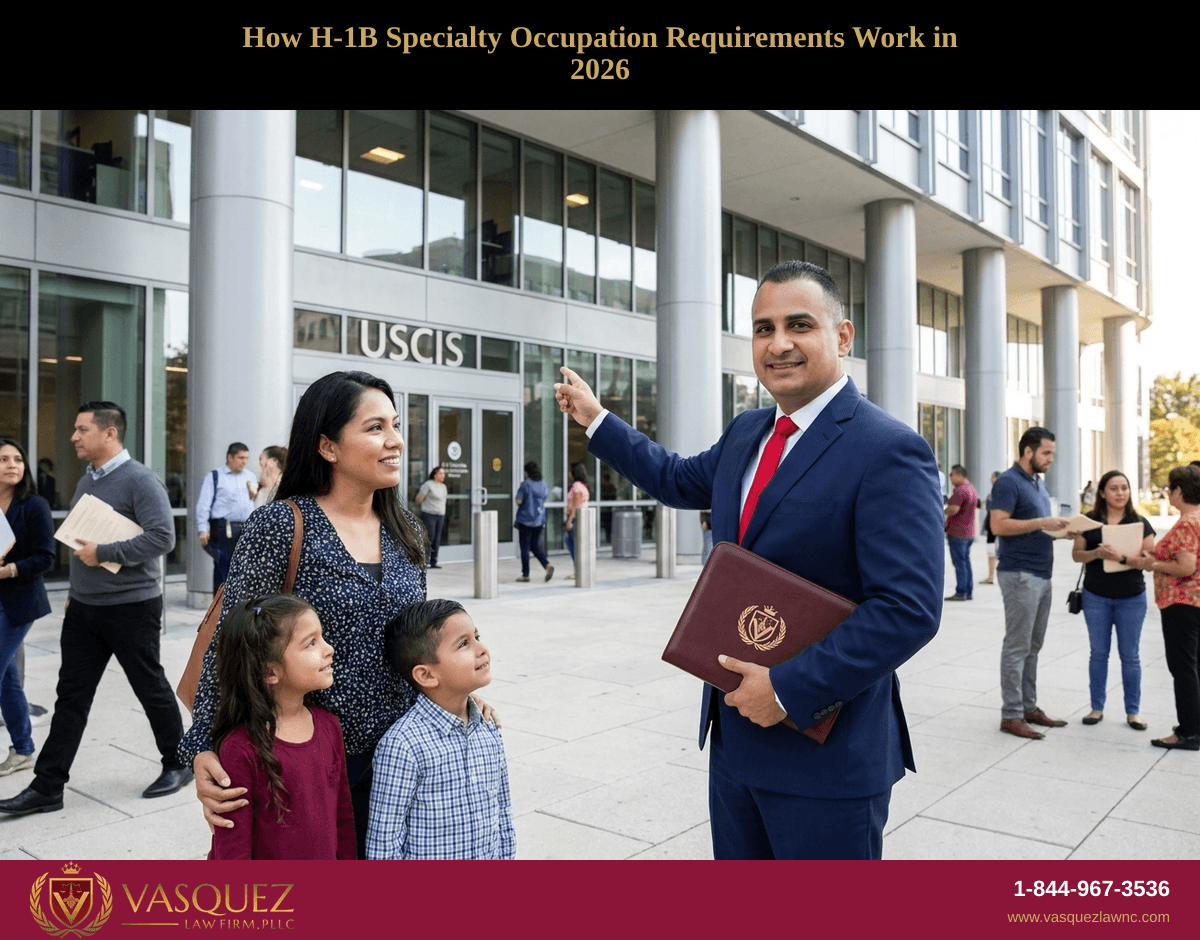
H-1B specialty occupation requirements are critical for foreign workers seeking employment in the United States in 2026. This article explains the eligibility criteria, consular processing, and filing procedures for applicants in Raleigh, NC and Orlando, FL. Understanding these requirements helps prospective H-1B workers navigate USCIS rules and consular interviews effectively.
Published on September 21, 2026
Talk to an immigration attorney
Free call. A clear plan for your case.
Free & confidential · Se habla espanol · 24/7
Have questions? Talk to an attorney - free evaluation.
Call 1-844-967-3536Worried how the latest immigration news affects you?
Schedule a confidential case review with an immigration attorney - know exactly where you stand.
USCIS Case Status
Check your USCIS case status
Enter your receipt number and get the official status. Free, no registration.
This article provides general legal information, not individualized legal advice. Reading does not create an attorney-client relationship. For advice specific to your situation, contact Vasquez Law Firm.
What are the H-1B specialty occupation requirements for 2026 applicants?
Need a Work Visa or Permit?
H-1B, TN, L-1, and more. We help workers and employers navigate the visa process.
The H-1B specialty occupation requirements for 2026 applicants include having a job offer in a qualifying specialty occupation, possessing at least a bachelor's degree or its equivalent in a related field, and meeting the USCIS criteria for specialty occupation status. Employers must file a petition on behalf of the worker, demonstrating the job’s complexity and the worker’s qualifications.
The H-1B visa is designed for foreign workers in specialty occupations that require theoretical and practical application of highly specialized knowledge. Common fields include IT, engineering, medicine, and finance. The applicant must hold a degree or equivalent experience related to the offered position. The employer must submit Form I-129, Petition for a Nonimmigrant Worker, along with evidence that the position qualifies as a specialty occupation.
USCIS evaluates whether the job requires a bachelor’s degree or higher as a minimum entry requirement. This includes reviewing the employer’s job description, industry standards, and whether similar positions typically require such education. The applicant’s credentials must match the job requirements. If the applicant’s degree is from a foreign institution, an evaluation may be necessary to confirm equivalency to a U.S. bachelor’s degree.
Additionally, the employer must comply with wage requirements, paying the prevailing wage for the occupation and geographic area. This protects U.S. workers and ensures fair compensation. Employers must also attest that hiring the H-1B worker will not adversely affect working conditions of similarly employed U.S. workers.
In 2026, these requirements remain consistent with prior years but with updated wage levels and procedural clarifications. The USCIS website and official regulations provide detailed guidance on specialty occupation criteria and documentation.
Who is affected by the 2026 H-1B specialty occupation and consular processing rules?
The 2026 H-1B specialty occupation and consular processing rules affect foreign nationals seeking to work temporarily in the U.S. in specialty occupations, employers sponsoring such workers, and applicants undergoing consular visa processing outside the United States. This includes residents of Raleigh, NC and Orlando, FL who are applying through local employers or consulates.
Applicants currently outside the U.S. must generally complete consular processing at a U.S. embassy or consulate before entering the country. Those already in the U.S. on another visa may apply for a change of status or adjustment of status if eligible. Employers in Raleigh, NC and Orlando, FL who hire H-1B workers must comply with the updated filing and wage requirements.
According to USCIS data, thousands of H-1B petitions are filed annually nationwide, with a significant portion from technology and healthcare sectors prevalent in North Carolina’s Research Triangle and Orlando’s growing tech industry. Many applicants from these regions rely on consular processing due to their location abroad at the time of application.
The rules also impact immigration attorneys and human resources professionals who manage H-1B petitions and advise clients on compliance. The consular processing steps, including interviews and document submission, are critical for applicants outside the U.S. to secure their visas and begin employment legally.
Applicants must be aware that consular processing timelines and requirements can vary by country and consulate, affecting how quickly they can start work in the U.S. The USCIS guidance emphasizes the importance of timely and accurate petition filing to avoid delays.
What does the law say about H-1B specialty occupation and consular processing?
The legal foundation for H-1B specialty occupation visas is found in the Immigration and Nationality Act (INA), specifically 8 U.S.C. § 1184(c), which defines the requirements and procedures for nonimmigrant workers. The law requires that the position qualify as a specialty occupation and that the employer file a petition with USCIS.
Consular processing is governed by regulations under the Department of State and USCIS, including visa issuance procedures codified at 22 CFR § 41. Applicants outside the U.S. must apply for a visa at a U.S. consulate after USCIS approves the petition.
"Many aliens want to come to the United States to work. This page provides a summary of employment-based nonimmigrant and immigrant visa classifications and other categories of aliens who are eligible for employment authorization. Each classification provides a link to more detailed information on its requirements." (Source: USCIS, https://www.uscis.gov/working-in-the-united-states)
The INA requires that the employer attest to paying the prevailing wage and that the employment will not negatively impact U.S. workers. The law also sets numerical limits on H-1B visas issued annually, which can affect the timing and availability of visas for 2026 applicants.
Applicants seeking adjustment of status within the U.S. must comply with 8 U.S.C. § 1255, which governs eligibility for lawful permanent resident status. This statute allows certain H-1B workers to apply for green cards, provided they meet eligibility criteria and maintain valid status.
"If you are in the United States in a lawful nonimmigrant status that does not provide employment authorization, you generally may apply for: A change of status to a nonimmigrant classification that provides employment authorization; or An adjustment of status to become a lawful permanent resident." (Source: USCIS, https://www.uscis.gov/working-in-the-united-states)
The regulations at 8 CFR § 274a.12 list the classes of aliens authorized to work, including H-1B visa holders. Compliance with these laws ensures lawful employment and avoids removal or denial of re-entry under 8 U.S.C. § 1227.
What should you do to apply for an H-1B visa and complete consular processing in 2026?
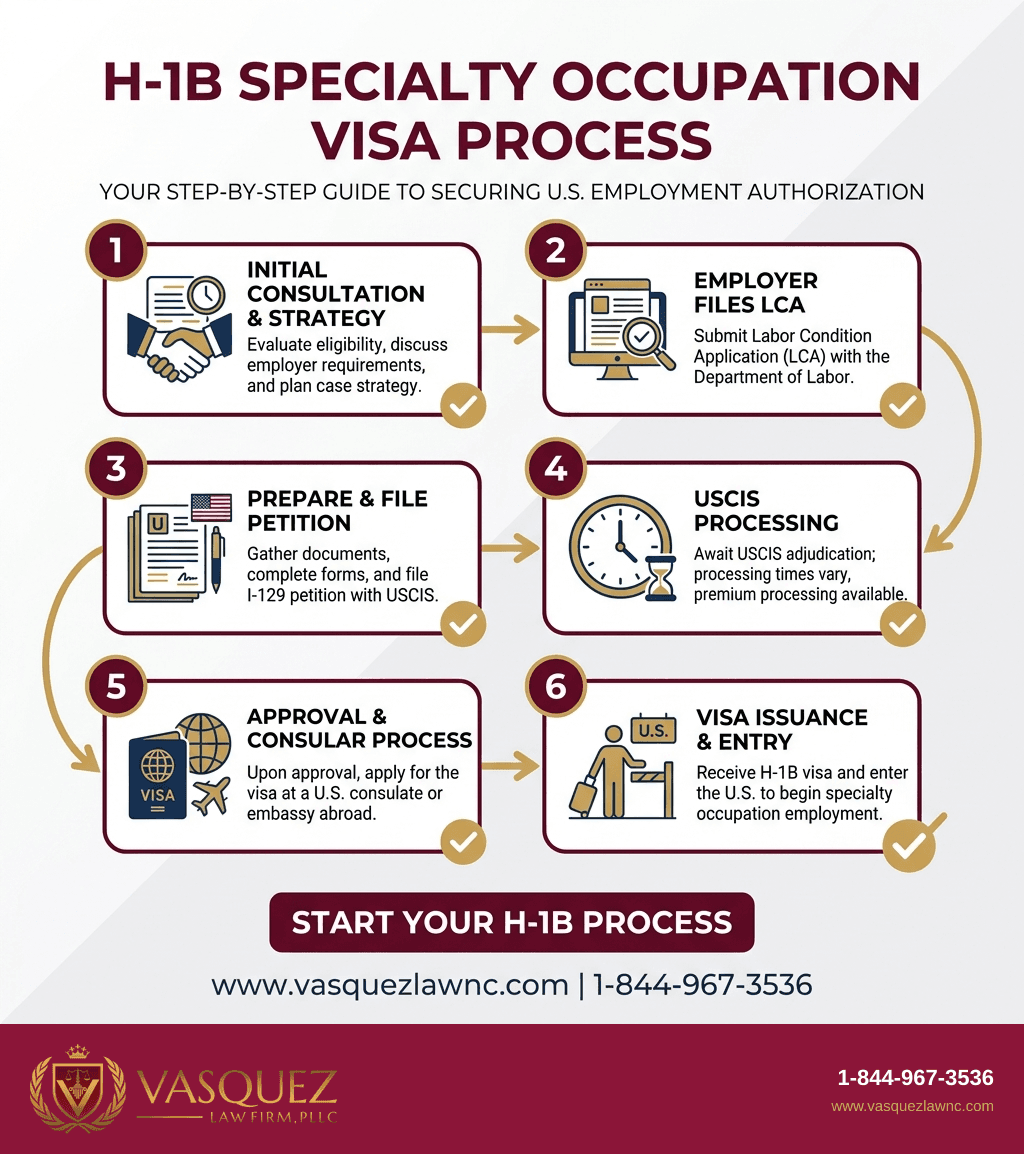
To apply for an H-1B visa and complete consular processing in 2026, start by securing a job offer from a U.S. employer willing to sponsor you. The employer must file Form I-129 with USCIS, including evidence that the position qualifies as a specialty occupation and that you meet the educational and professional requirements.
At our Raleigh, NC and Orlando, FL offices, we typically see applicants struggle with gathering proper credential evaluations and timely filing. Many miss the importance of submitting a complete petition with all supporting documents, which can delay approval or cause denials.
Once USCIS approves the petition, if you are outside the U.S., you must apply for an H-1B visa at a U.S. consulate. This involves scheduling a visa interview, submitting Form DS-160, paying fees, and providing biometric data. Prepare for the interview by bringing all documents, including the USCIS approval notice, job offer letter, educational credentials, and proof of ties to your home country.
If you are already in the U.S. on a different visa, you may apply for a change of status or adjustment of status, depending on eligibility. Filing Form I-765 for employment authorization may also be necessary if you want to work while your application is pending.
Here is a summary table of key steps and timelines for H-1B applicants in 2026:
| Step | Description | Typical Timeline |
|---|---|---|
| Job Offer & Employer Petition | Employer files Form I-129 with USCIS | 1-3 months processing |
| USCIS Approval | Receive Form I-797 approval notice | Varies by service center |
| Consular Visa Application | Apply for visa at U.S. consulate | 1-2 months |
| Visa Interview | Attend consular interview with documents | Scheduled by consulate |
| Entry to U.S. | Present visa and admission at port of entry | Upon visa issuance |
Uno. Confirm your job qualifies as a specialty occupation and gather all educational and professional documents. Dos. Have your employer file a complete and accurate petition with USCIS. Tres. If outside the U.S., prepare for consular processing by scheduling your visa interview and collecting required documents.
Careful preparation and compliance with USCIS and consular requirements increase your chances of a smooth H-1B visa process. For residents of Raleigh, NC and Orlando, FL, local consulates and USCIS offices provide resources and support for applicants.
What happens next after filing an H-1B petition and consular processing application?
After filing an H-1B petition, USCIS reviews the application for completeness and eligibility. If approved, the applicant outside the U.S. proceeds with consular processing by applying for the visa and attending an interview. If the petition is denied, the employer may appeal or file a new petition.
Consular officers evaluate the visa application, conduct background checks, and interview the applicant to determine eligibility. Approval results in visa issuance, allowing lawful entry to the U.S. to begin employment. Denial may occur for failure to meet requirements or security concerns.
USCIS notes that "you must comply with all conditions of your employment authorization and the terms of your admission to this country. If you violate any of the conditions, you could be removed from or denied re-entry into the United States." This highlights the importance of maintaining lawful status after entry.
"You must comply with all conditions of your employment authorization and the terms of your admission to this country. If you violate any of the conditions, you could be removed from or denied re-entry into the United States." (Source: USCIS, https://www.uscis.gov/working-in-the-united-states)
What's Your Immigration Situation?
Answer 3 questions - we'll tell you your options
Question 1 / 3
What best describes your situation?
Keep Reading
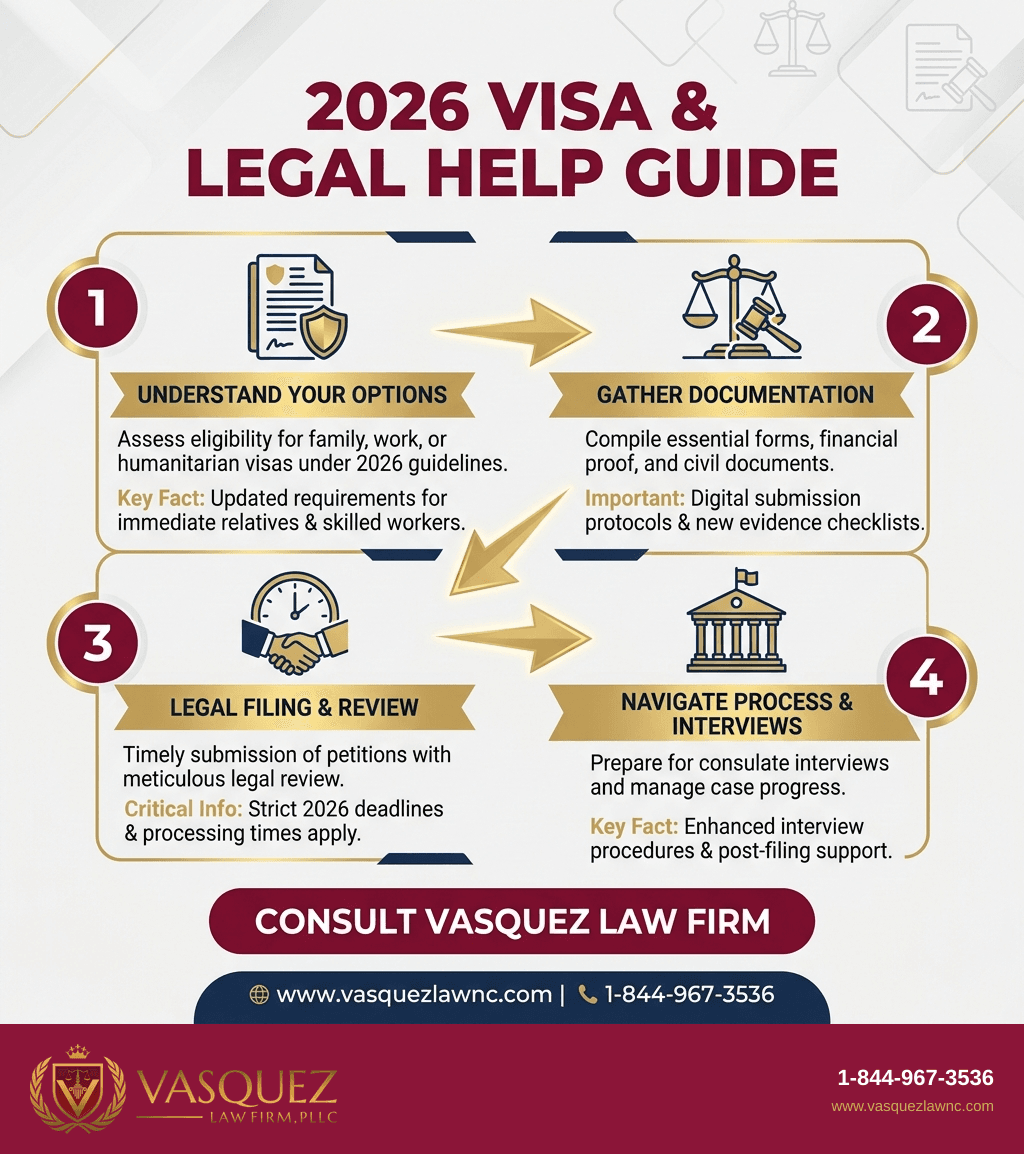
Applicants who change employers or job positions must file amended petitions to maintain compliance. Extensions of stay require timely filings before current status expires. Failure to maintain status can result in removal proceedings under 8 U.S.C. § 1227.
In Raleigh, NC and Orlando, FL, employers and applicants should monitor USCIS processing times and consular appointment availability to plan accordingly. Legal counsel can assist with navigating complex procedural steps and responding to Requests for Evidence (RFEs) or denials.
Frequently Asked Questions about H-1B Specialty Occupation and Consular Processing
What is a specialty occupation under the H-1B visa?
A specialty occupation is a job that requires theoretical and practical application of specialized knowledge, typically needing at least a bachelor’s degree or equivalent. Examples include engineers, IT professionals, doctors, and accountants. USCIS evaluates the job duties and educational requirements to determine specialty occupation status.
Can I apply for an H-1B visa without a U.S. employer?
No. The H-1B visa requires a U.S. employer to file a petition on your behalf. Self-petitioning is not allowed except in very limited cases like extraordinary ability, which do not apply to H-1B. The employer must demonstrate the job qualifies as a specialty occupation and that you meet the qualifications.
What is consular processing for an H-1B visa?
Consular processing is the procedure where applicants outside the U.S. apply for an H-1B visa at a U.S. embassy or consulate. After USCIS approves the petition, the applicant submits visa forms, attends an interview, and receives the visa to enter the U.S. legally for employment.
Can I change status to H-1B if I am already in the U.S.?
Yes. If you are in the U.S. on a nonimmigrant visa without employment authorization, you may apply for a change of status to H-1B. Your employer must file the petition with USCIS, and you must maintain lawful status while the application is pending.
What happens if my H-1B petition is denied?
If your petition is denied, you may appeal or file a new petition if eligible. Denial reasons include failure to prove specialty occupation status or insufficient evidence of qualifications. Consult an immigration attorney to evaluate options and next steps.
This article provides general legal information, not individualized legal advice. Reading does not create an attorney-client relationship. For advice specific to your situation, contact Vasquez Law Firm.
Reviewed by William Vasquez, Founder & CEO, Vasquez Law Firm, PLLC.
If you need legal assistance, learn more about learn about our immigration practice, or call us at 1-844-967-3536 for a free evaluation.
Related Topics

William Vasquez
Founder & CEO, Vasquez Law Firm, PLLC
William Vasquez is the founder and CEO of Vasquez Law Firm, PLLC, a results-driven firm specializing in immigration, criminal defense, personal injury, and workers' compensation. A U.S. Air Force veteran and recipient of the Joint Service Achievement Medal, William is dedicated to fiercely fighting for his clients' rights.
Related Legal Services
Need legal help? Learn more about learn about our immigration practice, or contact us for a free evaluation.
You can also visit NC immigration legal help for more information.