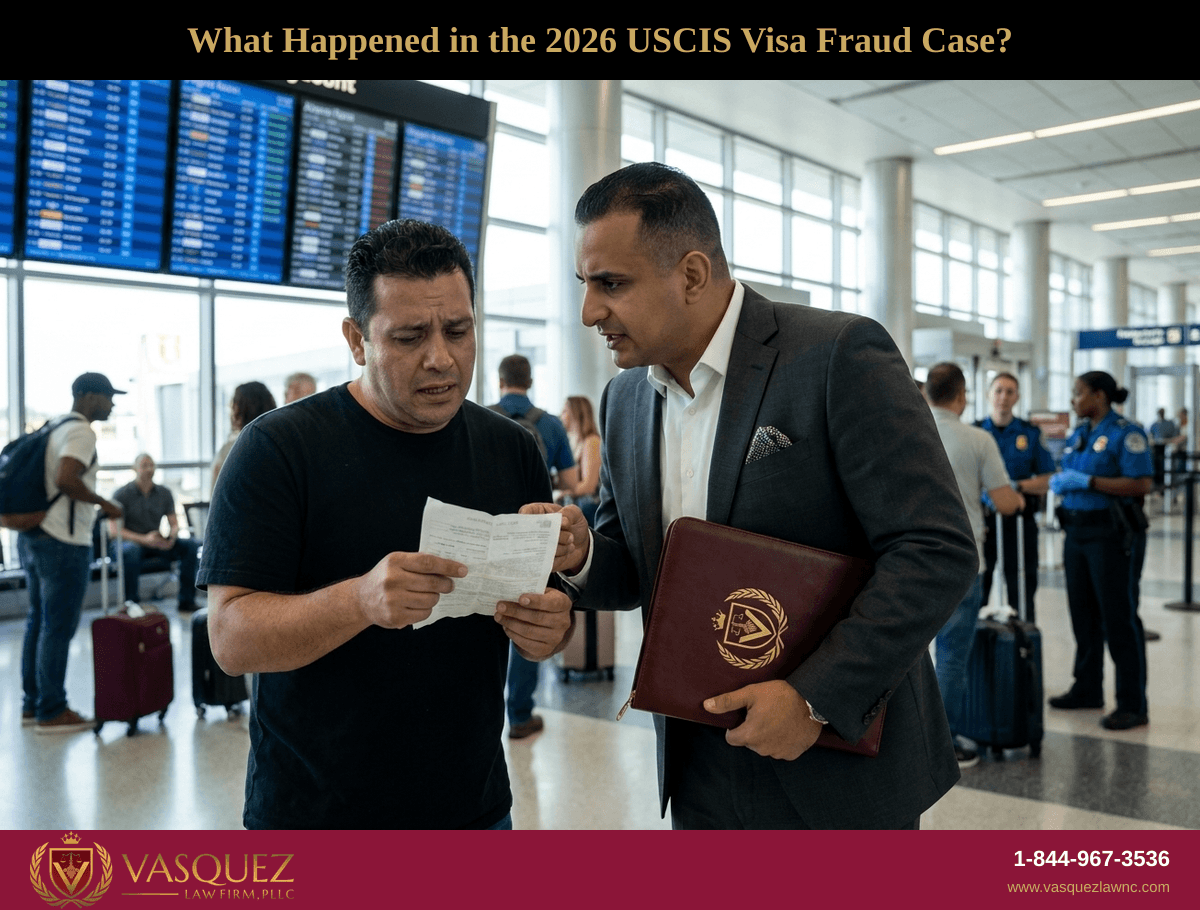
What Happened in the 2026 USCIS Visa Fraud Case?
The USCIS visa fraud case in 2026 involved defendants who created a sham marriage to fraudulently obtain a green card. This article explains the case details, who is affected, and legal steps for those concerned about immigration fraud in Raleigh, NC and Orlando, FL.
Published on July 4, 2026
Have questions? Talk to an attorney - free evaluation.
Call 1-844-967-3536Free Tool
Check Your USCIS Case Status Now
Enter your receipt number - get the official USCIS status in English or Spanish. No registration.
This article provides general legal information, not individualized legal advice. Reading does not create an attorney-client relationship. For advice specific to your situation, contact Vasquez Law Firm.
What happened in the 2026 USCIS visa fraud case?
Ready to Apply for a Green Card?
Family-based, employment-based, or other paths — we guide you through every step.
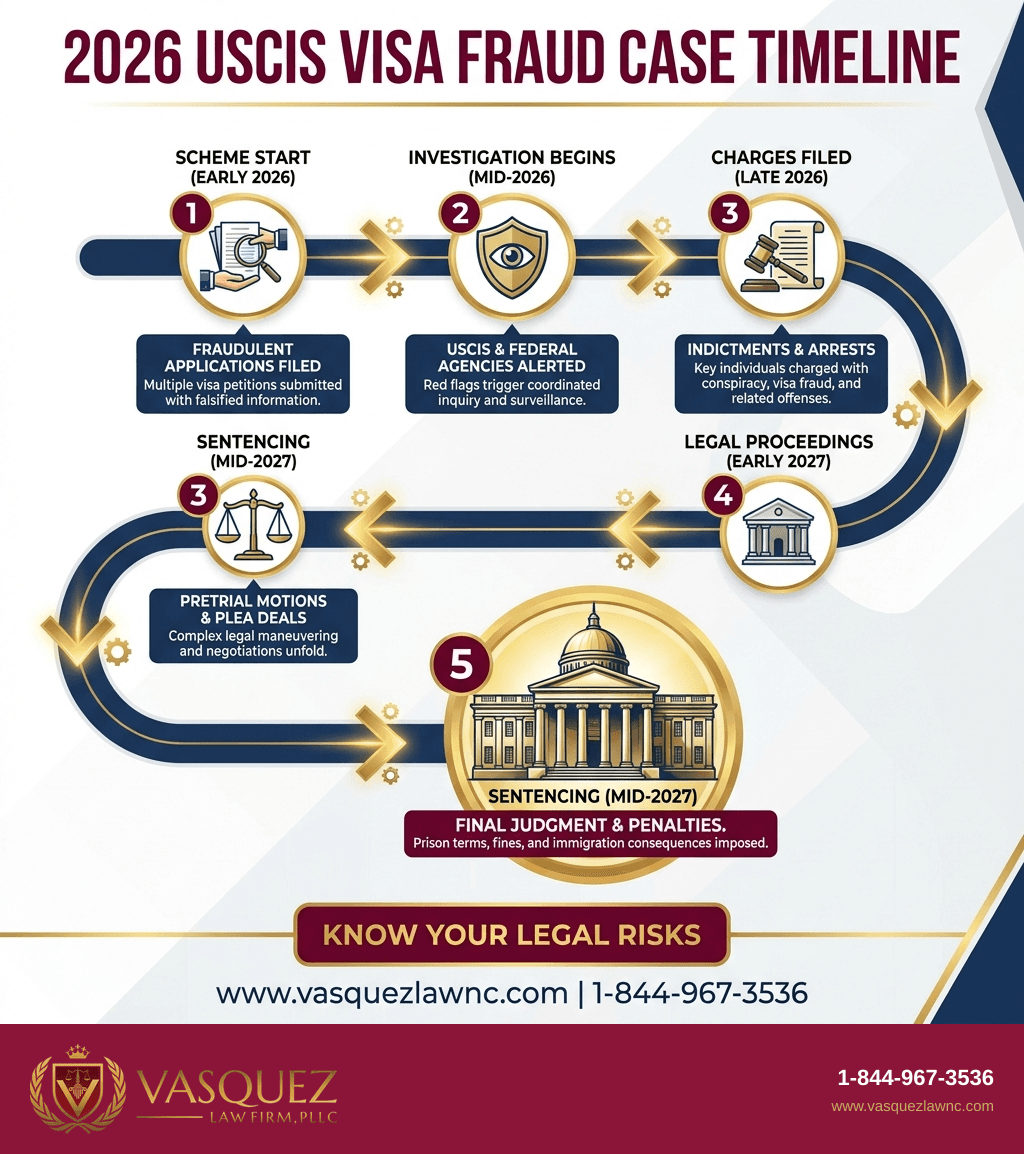
The 2026 USCIS visa fraud case involved two defendants who created a fake marriage to fraudulently obtain lawful permanent residence in the United States. Jung Hoon Song and Bonnie Jo C. Quichocho were sentenced after pleading guilty to visa fraud and conspiracy charges. The scheme spanned from January 2008 to May 2022 and involved false statements to immigration authorities about their marital residence.
The defendants married on December 24, 2011, and filed immigration forms including Form I-130, Petition for Alien Relative, and Form G-325A, Biographic Information, with USCIS. They falsely claimed to live together in Guam to obtain a conditional green card for Song. Later, they jointly filed Form I-751 to remove the conditions on Song's permanent resident status, again misrepresenting their living situation. The defendants never lived together before or after marriage and divorced in 2018.
Song was sentenced to one year probation, a $500 fine, a $100 special assessment fee, and potential deportation proceedings. Quichocho received six months probation and similar fines. USCIS played a vital role in uncovering the fraud through its Fraud Detection and National Security Directorate, cooperating with Homeland Security Investigations and the U.S. attorney’s office in Guam.
This case highlights USCIS’s commitment to combating marriage fraud and protecting the integrity of the immigration system. As stated by USCIS spokesman Zach Kahler, "USCIS will relentlessly pursue marriage fraud to protect the lawful immigration process." (Source: USCIS, uscis.gov)
For residents of Raleigh, NC and Orlando, FL, this case serves as a reminder of the serious legal consequences of immigration fraud and the importance of truthful immigration applications.
Who is affected by the USCIS visa fraud case and how?
The USCIS visa fraud case primarily affects individuals who apply for immigration benefits through marriage-based petitions. It also impacts immigration authorities, employers, and communities in Raleigh, NC and Orlando, FL where many rely on lawful immigration processes.
Applicants who submit fraudulent marriage petitions risk criminal prosecution, fines, probation, and deportation. The defendants in this case faced these consequences after misrepresenting their marital status and residence to obtain a green card. This case underscores the risks for anyone considering or accused of sham marriage schemes.
USCIS and law enforcement agencies are affected as they must dedicate resources to detecting and prosecuting fraud. The integrity of the immigration system depends on truthful applications. Employers in Raleigh, NC and Orlando, FL also rely on accurate immigration status verification to comply with employment authorization rules under 8 CFR § 274a.12 (8 CFR § 274a.12).
Communities are affected because fraudulent immigration benefits can undermine public trust and divert resources from legitimate applicants. According to USCIS data, thousands of marriage-based green card applications are filed annually in North Carolina alone, highlighting the scale of potential impact.
In Raleigh, NC and Orlando, FL, where our offices are located, immigration fraud investigations have increased, reflecting national trends. The consequences of fraud extend beyond legal penalties to affect families, employers, and local communities.
What does the law say about sham marriages and visa fraud?
Federal immigration law prohibits marriage fraud and visa fraud as serious offenses. Under the Immigration and Nationality Act (INA), marriage entered into for the sole purpose of obtaining immigration benefits is illegal. The law requires that marriages be bona fide, meaning genuine and entered in good faith.
The defendants’ actions violated multiple provisions, including those governing conditional permanent residence under 8 U.S.C. § 1186a (8 U.S.C. § 1186a). This statute sets conditions on green cards obtained through marriage and requires joint petitions to remove conditions, which must be truthful.
Additionally, visa fraud is punishable under federal law, including criminal charges for making false statements to immigration authorities. The defendants pled guilty to visa fraud and conspiracy to commit illegal entry by false representation, reflecting these legal standards.
"The defendants misrepresented in these documents that they resided together in Guam... They made the false statements to obtain immigration benefits for Song." (Source: USCIS, https://www.uscis.gov/newsroom/news-releases/defendants-sentenced-in-visa-fraud-and-conspiracy-case)
Other relevant laws include adjustment of status provisions under 8 U.S.C. § 1255 (8 U.S.C. § 1255), which govern how noncitizens apply for lawful permanent residence while in the U.S. Fraudulent applications under these statutes can lead to denial, removal proceedings, and criminal penalties.
USCIS regulations at 8 CFR § 245.1 also specify eligibility criteria and grounds for denial based on fraud or misrepresentation. The legal framework aims to deter and punish sham marriages to maintain immigration system integrity.
What should you do if you are concerned about visa fraud or sham marriage allegations?
If you are concerned about visa fraud or sham marriage allegations, it is crucial to act promptly and seek experienced legal advice. USCIS and law enforcement take such allegations seriously, and penalties can include fines, probation, deportation, and criminal charges.
At our Raleigh, NC and Orlando, FL offices, we typically see that the most common mistake applicants make is failing to provide sufficient evidence of a bona fide marriage when filing petitions. Honest documentation and truthful statements are essential to avoid suspicion.
Here are key steps to consider if facing visa fraud concerns:
- Consult an immigration attorney immediately to understand your rights and options.
- Gather evidence proving the legitimacy of your marriage, such as joint financial records, photos, affidavits from friends and family, and shared residence documents.
- Respond carefully to any USCIS or law enforcement inquiries; do not provide false information.
- File truthful petitions and avoid any misrepresentations on forms like Form I-130 or Form I-751.
- Report suspected fraud using the USCIS Tip Form if you believe someone is committing immigration benefit fraud.
Below is a table summarizing common immigration forms involved in marriage-based petitions and their purposes:
| Form | Purpose | Typical Filing Time |
|---|---|---|
| Form I-130 | Petition for Alien Relative to establish relationship | Upon marriage or relationship establishment |
| Form I-485 | Application to Adjust Status to Permanent Resident | After I-130 approval or concurrently |
| Form I-751 | Petition to Remove Conditions on Residence | Within 90 days before 2-year green card expires |
For residents of Raleigh, NC and Orlando, FL, working with an attorney experienced in immigration fraud cases is vital. Our attorneys help clients prepare strong evidence and navigate USCIS procedures to protect their rights.
Remember, honesty is the best policy. Filing truthful petitions and cooperating with USCIS investigations can prevent serious consequences.
What happens next after a visa fraud conviction like this case?
After a visa fraud conviction, the defendants may face probation, fines, and deportation proceedings. Immigration authorities may initiate removal actions based on the fraud conviction, as occurred with Jung Hoon Song, who was ordered to report for potential deportation.
The case prosecuted by the U.S. attorney’s office in Guam demonstrates the coordinated efforts of USCIS, Homeland Security Investigations, and law enforcement partners to investigate and prosecute immigration fraud. This cooperation will continue to protect the immigration system.
USCIS will maintain vigilance in detecting and deterring marriage fraud. As the agency stated,
"USCIS will relentlessly pursue marriage fraud to protect the lawful immigration process." (Source: USCIS, https://www.uscis.gov/newsroom/news-releases/defendants-sentenced-in-visa-fraud-and-conspiracy-case)
What's Your Immigration Situation?
Answer 3 questions - we'll tell you your options
Question 1 / 3
What best describes your situation?
Keep Reading
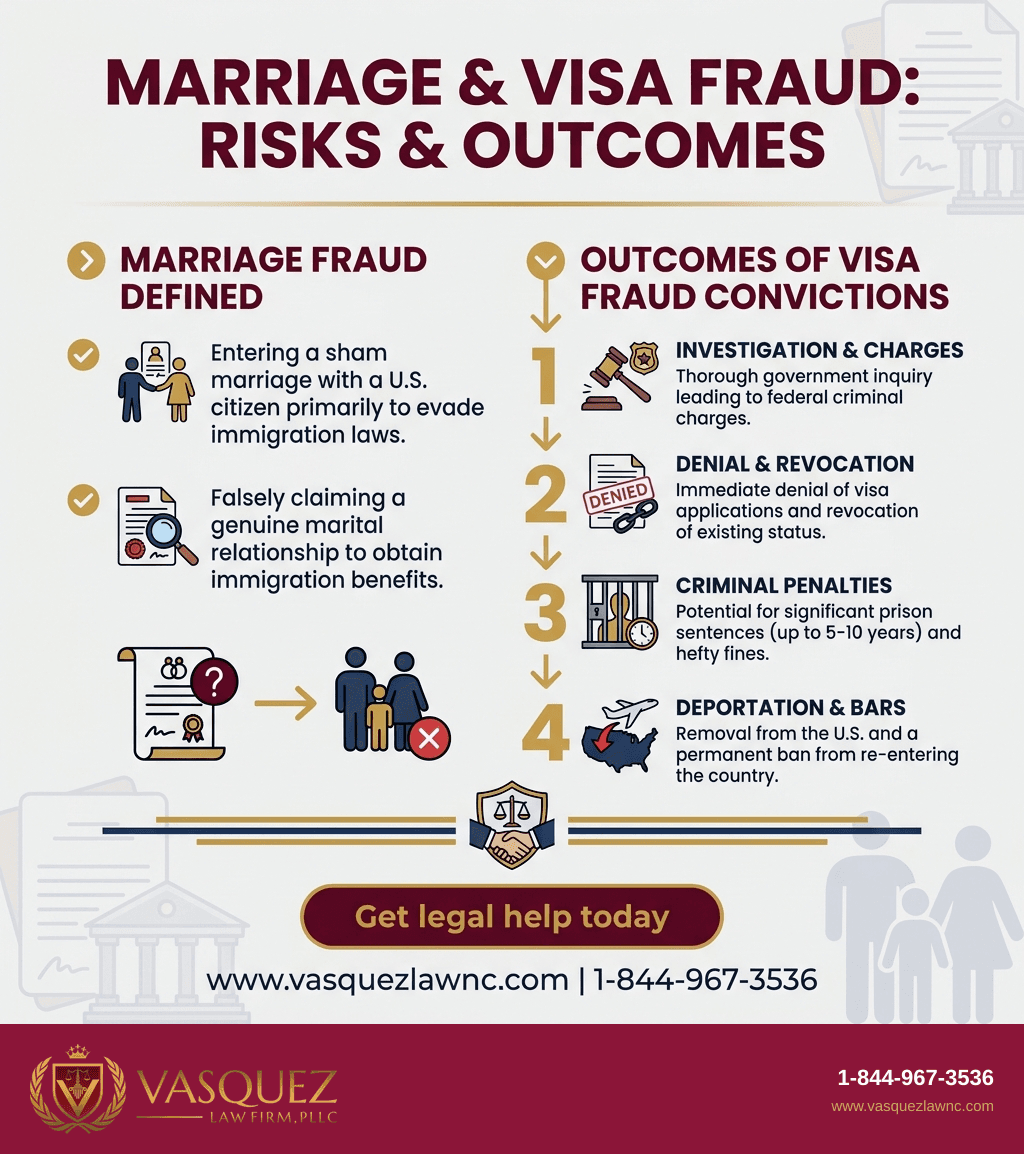
Applicants found guilty of fraud should expect immigration benefits to be revoked and removal proceedings to commence. For others, USCIS may increase scrutiny of marriage-based petitions and require more evidence to prove bona fide relationships.
For residents of Raleigh, NC and Orlando, FL, staying informed about USCIS policies and working with qualified immigration attorneys can help avoid pitfalls and protect immigration status.
Frequently Asked Questions about USCIS Visa Fraud Cases
What is considered marriage fraud by USCIS?
Marriage fraud occurs when a couple enters into a marriage solely to obtain immigration benefits, without intending to live as a genuine married couple. USCIS requires marriages to be bona fide and may investigate suspicious cases.
What are the penalties for visa fraud?
Penalties can include fines, probation, criminal charges, denial of immigration benefits, and deportation. The 2026 case resulted in probation and fines for the defendants, along with potential removal proceedings.
How can I prove my marriage is genuine to USCIS?
Provide evidence such as joint leases, bank accounts, insurance policies, photos, affidavits from family and friends, and shared financial responsibilities to demonstrate a bona fide marriage.
Can USCIS revoke my green card if marriage fraud is discovered later?
Yes, if USCIS finds that the marriage was fraudulent, it can revoke permanent resident status and initiate removal proceedings, even years after the green card was issued.
How do I report suspected immigration fraud?
You can report suspected fraud using the USCIS Tip Form available on their website. Reporting helps protect the integrity of the immigration system.
This article provides general legal information, not individualized legal advice. Reading does not create an attorney-client relationship. For advice specific to your situation, contact Vasquez Law Firm.
Reviewed by William Vasquez, Founder & CEO, Vasquez Law Firm, PLLC.
If you need legal assistance, learn more about get immigration legal help today, or call us at 1-844-967-3536 for a free evaluation.
Related Topics

William Vasquez
Founder & CEO, Vasquez Law Firm, PLLC
William Vasquez is the founder and CEO of Vasquez Law Firm, PLLC, a results-driven firm specializing in immigration, criminal defense, personal injury, and workers' compensation. A U.S. Air Force veteran and recipient of the Joint Service Achievement Medal, William is dedicated to fiercely fighting for his clients' rights.
Related Legal Services
Need legal help? Learn more about get immigration legal help today, or contact us for a free evaluation.
You can also visit North Carolina immigration lawyers for more information.