What an Armed Career Criminal Means for Your Case in 2026
Wondering what qualifies as an armed career criminal? Learn about 18 U.S.C. 924(e) sentencing guidelines and how it affects your case. Free consult.
Published on August 8, 2026
Protect your record and your freedom
Free, confidential review. 24/7.
Free & confidential · Se habla espanol · 24/7

Have questions? Talk to an attorney - free evaluation.
Call 1-844-967-3536Protect Your Record and Your Freedom
A confidential case review - available 24/7 for emergencies.
What an Armed Career Criminal Means for Your Case in 2026
If you are accused of being an armed career criminal, the legal consequences in 2026 can be very serious. This is because of federal sentencing increases under 18 U.S.C. 924(e). This law raises penalties for people with past felony convictions involving violent crimes or firearms. Understanding how the Armed Career Criminal Act applies in Smithfield, NC, can help you prepare a defense and know your options. Vasquez Law Firm’s criminal defense team in Smithfield gives clear guidance about the career offender penalty and what to expect during sentencing.
Need help with your case? Our experienced attorneys are ready to fight for you. Se Habla Español.
Or call us now: 1-844-967-3536
Quick Answer
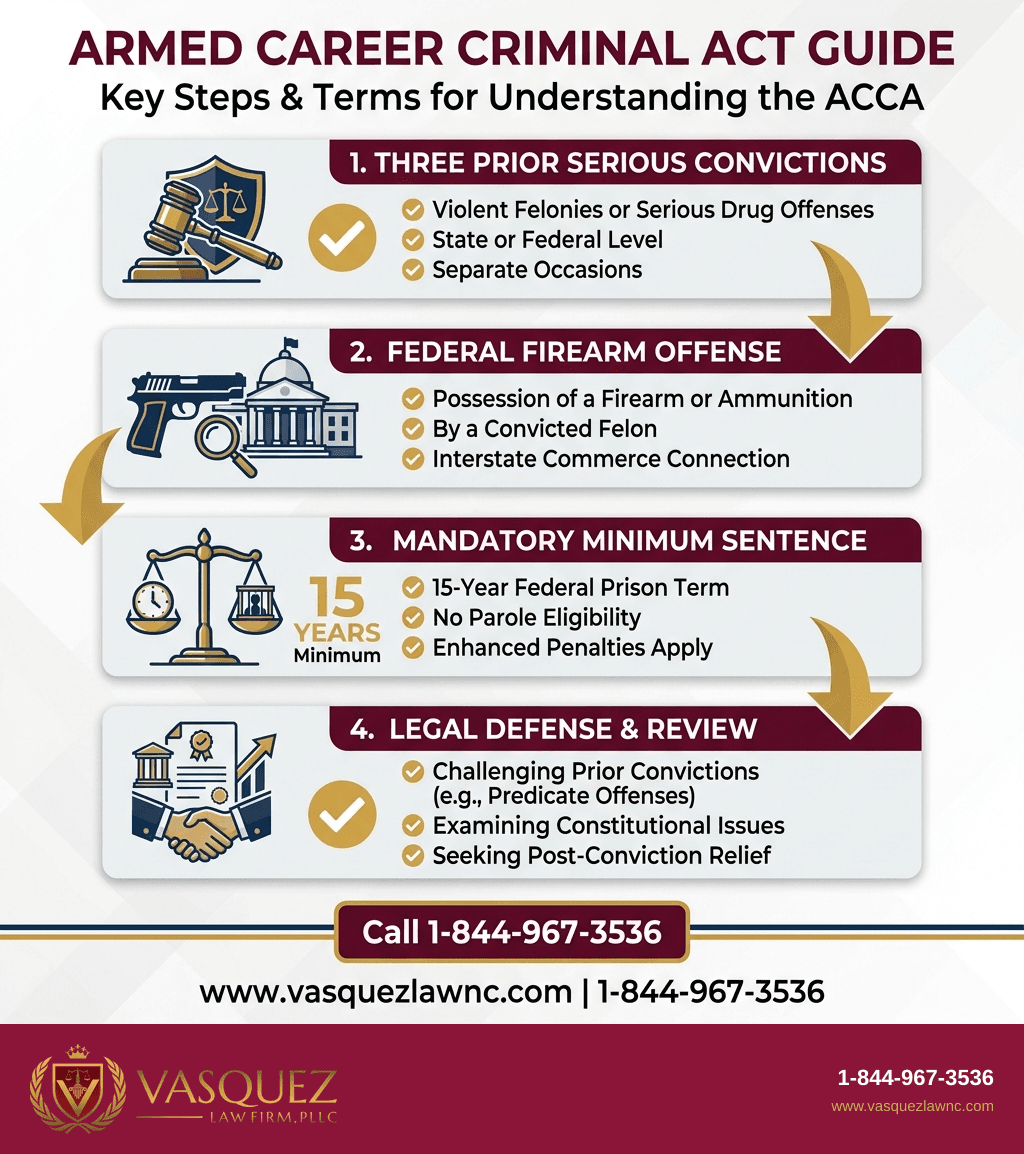
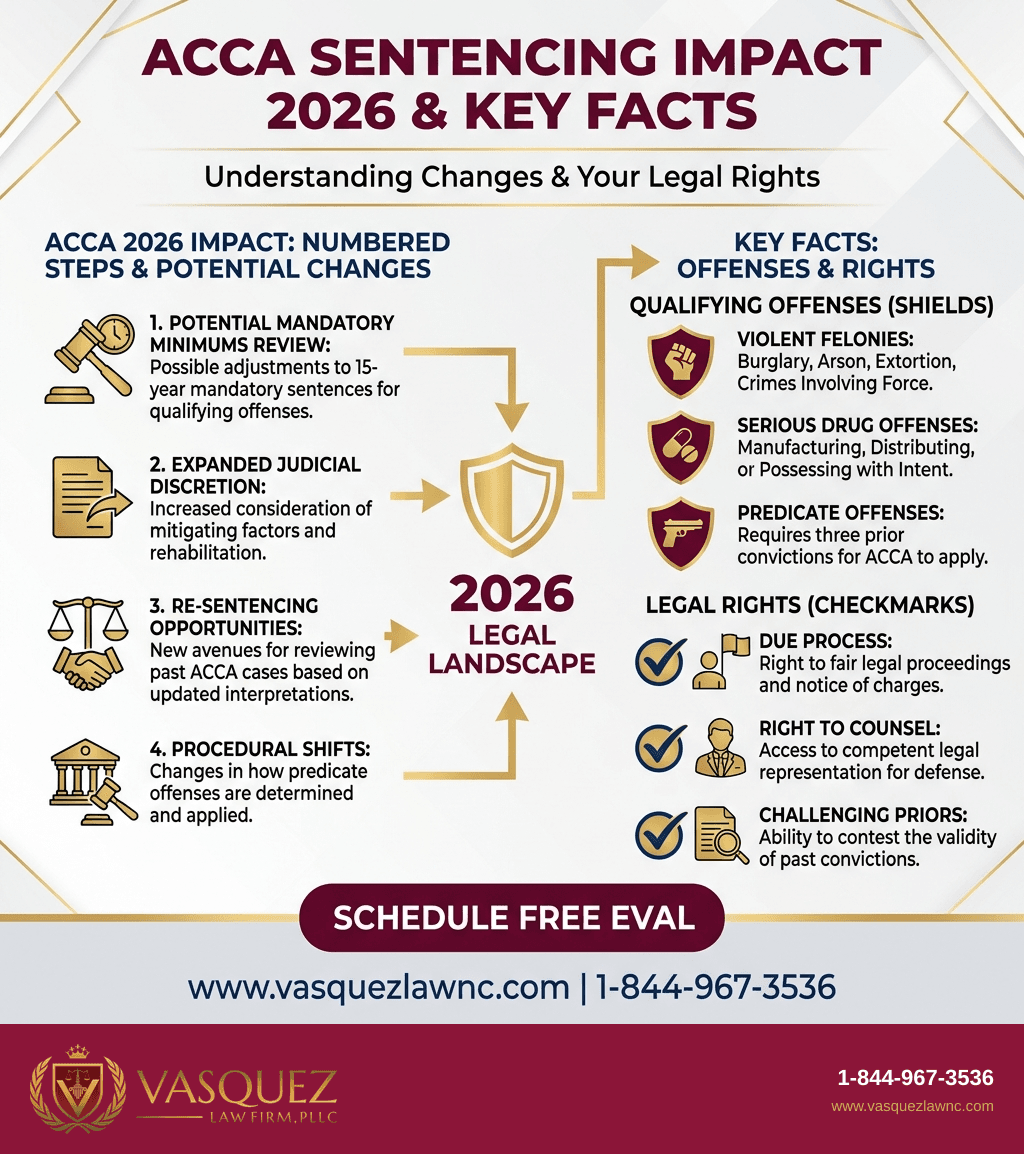
In 2026, an armed career criminal faces required longer federal sentences under 18 U.S.C. 924(e) if they have three or more past violent felony convictions or serious drug crimes. This means longer prison terms, usually at least 15 years, affecting cases in Smithfield, NC.
- Applies at the federal level, using past felony convictions
- Leads to required minimum prison sentences
- Covers violent felonies and serious drug crimes
- Raises penalties for firearm-related offenses
- Needs careful legal defense in Smithfield
Understanding the Armed Career Criminal Act
The Armed Career Criminal Act (ACCA), found at 18 U.S.C. 924(e), increases penalties for people convicted of certain firearm crimes who also have a history of serious felonies. This law requires longer prison terms for anyone who illegally has a firearm and has three past convictions for violent felonies or serious drug crimes. This law applies across the country, including cases in Smithfield, North Carolina.
The purpose of the ACCA is to focus on defendants who repeatedly commit serious crimes and are a higher risk to public safety. For example, a person convicted of illegal gun possession after multiple past burglaries or drug trafficking convictions may get a minimum 15-year federal sentence under this law.
To understand how this law applies, courts carefully review a defendant's criminal history. They look at federal sentencing rules and details of each past conviction to decide if the ACCA applies and increases the sentence.
Our criminal defense services in Smithfield include checking if you qualify under the ACCA and protecting your rights during sentencing.
Key Terms in the ACCA
- Violent felony: A crime that uses or threatens force against another person. Examples include burglary, arson, and assaults.
- Serious drug offenses: Convictions under federal or state laws involving large amounts or intent to sell illegal drugs.
- Mandatory minimum: The shortest sentence a judge can give if the ACCA applies, usually 15 years in prison.
What Qualifies as a Career Offender?
Not everyone with a criminal record counts as an armed career criminal under federal law. To meet the ACCA’s definition, a defendant must have at least three past convictions that are violent felonies or serious drug crimes. These past convictions create the reason for a career offender penalty during sentencing.
Examples of qualifying felonies include burglary of a building, robbery, arson, and serious drug trafficking crimes. Minor theft or nonviolent misdemeanors usually do not qualify. Each past conviction must be checked to make sure it meets the legal standard.
In Smithfield, we see cases where clients do not realize they qualify because of past convictions that trigger the ACCA penalties. Our legal team reviews court records and sentencing papers to challenge wrong classifications or make sure the law is followed correctly.
How Prior Convictions Qualify
- Must be punishable by jail time of more than one year
- Must fit ACCA’s definitions of violent felony or serious drug offense
- Felonies under state law, like North Carolina burglary, often qualify
- Nonviolent crimes usually do not qualify unless they involve guns or violence
Career Offender Guidelines
The United States Sentencing Commission sets rules that judges use to decide sentences for career offenders. These rules balance the defendant’s criminal history, how serious the crime is, and other factors. The ACCA works with these rules to add penalties for repeat offenders.
Under these rules, a career offender can face many years or decades in prison. This is much longer than sentences for first-time offenders. This shows why having an experienced defense is very important during sentencing.
How Sentencing Guidelines Apply
The federal sentencing guidelines give a system to figure out prison time based on the crime and criminal history. The Armed Career Criminal Act changes normal calculations by requiring minimum sentences when it applies.
If the ACCA applies, a defendant sentenced in Smithfield federal court faces at least 15 years in prison, no matter what other factors say. Judges must look at past qualifying convictions and details of the current crime.
Sentencing hearings include arguments from both the prosecution and defense about whether the ACCA applies and possible challenges to the penalty. Challenges may involve disagreements about facts of past convictions or legal meanings.
- The ACCA requires a minimum 15-year prison sentence under 18 U.S.C. 924(e)
- Sentencing guidelines add calculations for more time
- Penalties may increase supervised release periods
Learn how federal sentencing works and why having an experienced attorney matters.
Example Scenario
A man with past convictions for armed robbery and drug trafficking is caught with an illegal firearm in Smithfield, NC. Under federal law, he qualifies as an armed career criminal and faces a minimum 15-year sentence. This is much harsher than a first-time firearms offender would get.
Common Mistakes in Armed Career Criminal Cases
Armed career criminal cases are complicated, and mistakes can happen at many steps. Here are common mistakes defendants make and how to avoid them:
- Overlooking prior convictions — Not realizing your criminal record triggers career offender status. Always tell your attorney your full history.
- Failing to challenge convictions — Accepting past convictions without question can raise your sentence. Some may be invalid or against the Constitution.
- Ignoring federal jurisdiction — Some defendants wrongly think state charges won’t affect federal sentencing increases.
- Missing deadlines for appeals — Timely appeals are very important if you think the ACCA was applied wrong.
- Poor legal representation — The complexity needs a skilled defense team who knows the ACCA and federal rules.
If you remember only one thing: Early checking of your criminal history and getting expert defense can stop automatic harsh sentencing as an armed career criminal.
What to Expect: Timeline and Process
The timeline for an armed career criminal case starts with arrest and can last through long sentencing and appeals.
- Arrest and arraignment: Charges are filed, and the first court appearance happens within days.
- Pretrial motions and discovery: This takes weeks or months while evidence and past records are checked.
- Plea negotiations or trial: The defendant may plead guilty or go to trial.
- Sentencing hearing: The judge applies the ACCA if it fits to decide the punishment.
- Appeal phase: Possible if there were legal errors or wrong use of the ACCA.
These steps can take many months or longer depending on how complex the case is and court schedules. Our Smithfield lawyers guide clients through each step to protect their rights well.
When to Call a Criminal Defense Lawyer
Getting legal help early is very important if you face federal charges involving guns and a criminal history. Call a criminal defense lawyer in Smithfield right away if you:
- Are charged with illegal gun possession
- Have several past felony convictions
- Face charges that raise your status to armed career criminal
- Get a federal indictment mentioning 18 U.S.C. 924(e)
- Want to look at plea deals or other options
- Need help understanding sentencing rules
Attorney Vasquez has experience defending clients against armed career criminal charges. Contact our office for a free case evaluation.
About Vasquez Law Firm
At Vasquez Law Firm in Smithfield, North Carolina, we mix care with strong representation. Our motto "Yo Peleo®" (I Fight) shows our promise to stand up for your rights.
- Bilingual Support: Se Habla Español — Spanish-speaking lawyers and staff are available
- Service Areas: We focus on criminal defense in Smithfield and nearby North Carolina counties
- Experience: Over 15 years defending armed career criminal and complex federal cases
- Results: Thousands of successful cases with personal attention
Attorney Trust and Experience
William J. Vasquez, JD, is licensed by the North Carolina State Bar and has expert knowledge of federal gun laws and sentencing. Since 2011, Vasquez Law Firm has given focused legal help to clients facing serious charges.
Don't wait to get the help you need. Call us now for quick assistance.
Se Habla Español
Frequently Asked Questions
What qualifies you as a career criminal under the law?
Under the Armed Career Criminal Act (18 U.S.C. 924(e)), a career criminal has at least three past convictions for violent felonies or serious drug crimes, which cause sentencing increases. These past arrests raise penalties for illegal gun possession. It is very important to review your criminal history with a skilled attorney.
What is the Armed Career Criminal guideline?
This guideline sets federal required sentencing increases that impose at least 15 years for defendants with past violent or drug felony convictions who illegally have firearms. It affects how judges give penalties during sentencing in federal courts.
Is armed criminal action always a felony?
Yes, armed criminal action is treated as a felony in both North Carolina and federal courts. Committing a crime while armed makes the offense more serious and raises penalties a lot, often leading to long prison terms.
How does a career offender enhancement affect sentencing?
The enhancement raises penalties when a defendant has past qualifying felonies, leading to required longer prison terms that replace usual sentencing calculations. Federal law 18 U.S.C. 924(e) requires minimum 15-year sentences.
Can nonviolent felonies count toward armed career criminal status?
Usually, no. The law targets violent felonies and serious drug crimes. Some burglary-type crimes may count if they involve possible violence, but nonviolent felonies usually do not cause the increase.
What role does prior conviction documentation play?
Courts need official records of past convictions to apply the Armed Career Criminal Act increases. Disputing or checking these records is often key to a strong defense.
Does the Armed Career Criminal Act apply in North Carolina state courts?
The ACCA is federal law but uses past state convictions, including those from North Carolina, to decide if defendants get higher federal sentences. State convictions directly affect federal sentencing decisions.
Can an armed career criminal charge be appealed?
Yes. Appeals can be based on mistakes in applying the ACCA or errors in including past convictions. Skilled lawyers can find appealable issues in your case.
Sources and References
- U.S. Citizenship and Immigration Services
- Executive Office for Immigration Review
- Legal Information Institute
Take the first step toward justice today. Our team is ready to help.
Start Your Free Evaluation Now
Call us: 1-844-967-3536
Se Habla Español - We are here to help you.


William Vasquez
Founder & CEO, Vasquez Law Firm, PLLC
William Vasquez is the founder and CEO of Vasquez Law Firm, PLLC, a results-driven firm specializing in immigration, criminal defense, personal injury, and workers' compensation. A U.S. Air Force veteran and recipient of the Joint Service Achievement Medal, William is dedicated to fiercely fighting for his clients' rights.
Related Legal Services
Need legal help? Learn more about how our defense attorneys can help, or contact us for a free evaluation.
You can also visit our North Carolina defense practice for more information.