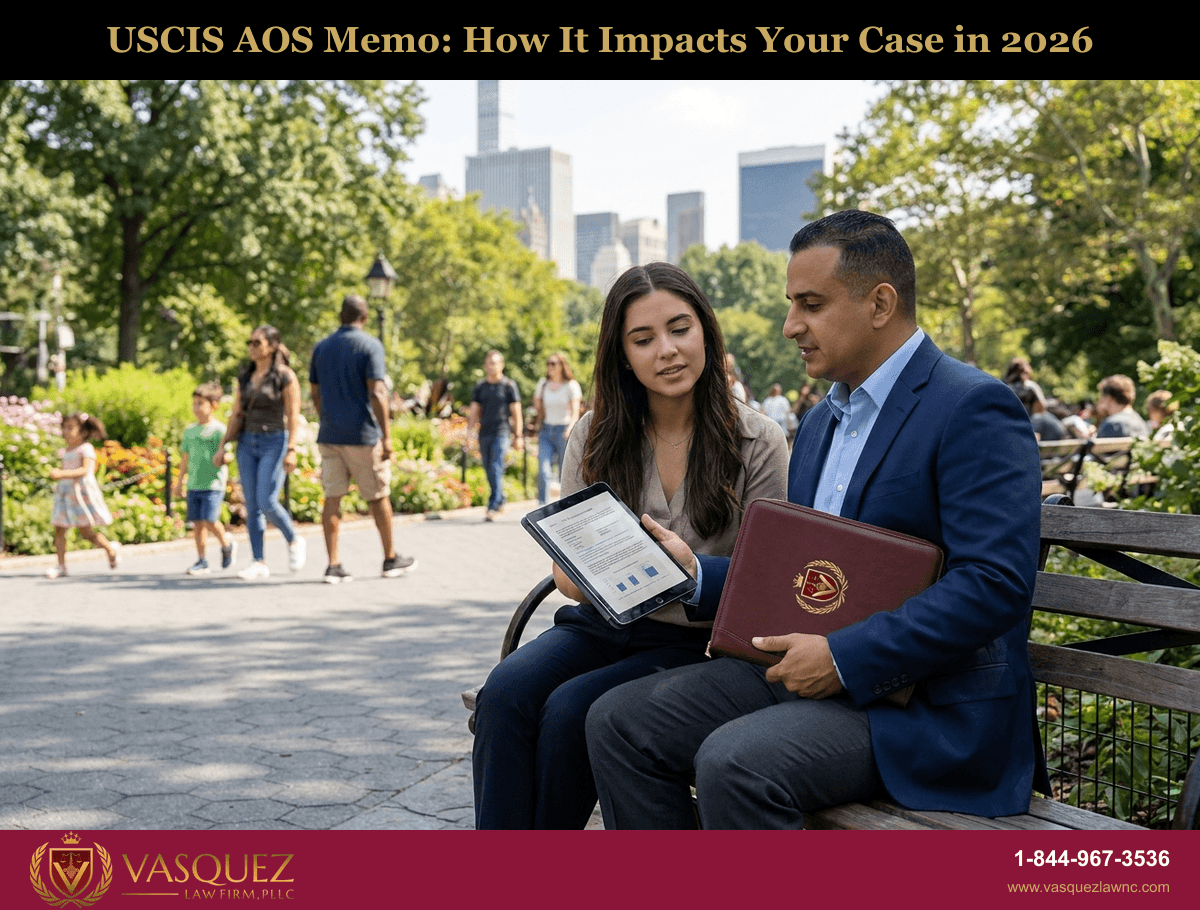
USCIS AOS Memo: How It Impacts Your Case in 2026
Learn how the USCIS AOS Memo affects green card applications in 2026. Understand the latest policy and get a free evaluation from Vasquez Law.
Published on June 25, 2026· Updated June 25, 2026
Talk to an immigration attorney
Free call. A clear plan for your case.
Free & confidential · Se habla espanol · 24/7
Have questions? Talk to an attorney - free evaluation.
Call 1-844-967-3536Free Tool
Check Your USCIS Case Status Now
Enter your receipt number - get the official USCIS status in English or Spanish. No registration.
USCIS AOS Memo: How It Impacts Your Case in 2026
The USCIS AOS Memo issued in 2026 gives new instructions on adjustment of status applications. Adjustment of status means applying to change your immigration status to become a lawful permanent resident (green card holder) while staying in the U.S. This memo may affect foreign nationals in Orlando and Raleigh. It explains who can apply, which cases get priority, and what proof you must give. Our clear explanation helps you understand these changes and get ready to apply for your green card.
Need help with your case? Our experienced attorneys are ready to fight for you. Se Habla Español.
Or call us now: 1-844-967-3536
Quick Answer
The USCIS AOS Memo of 2026 updates the rules for adjustment of status applications. It explains who can apply and what proof is needed. It affects green card applicants in Orlando and Raleigh by giving priority to some cases and asking for more documents.
- New rules on which cases get processed first
- Stricter rules on submitting proof
- Clear instructions for employers and foreign workers
- Possible changes in how long approval takes
- Important for people filling out Form I-485
Understanding the USCIS AOS Memo
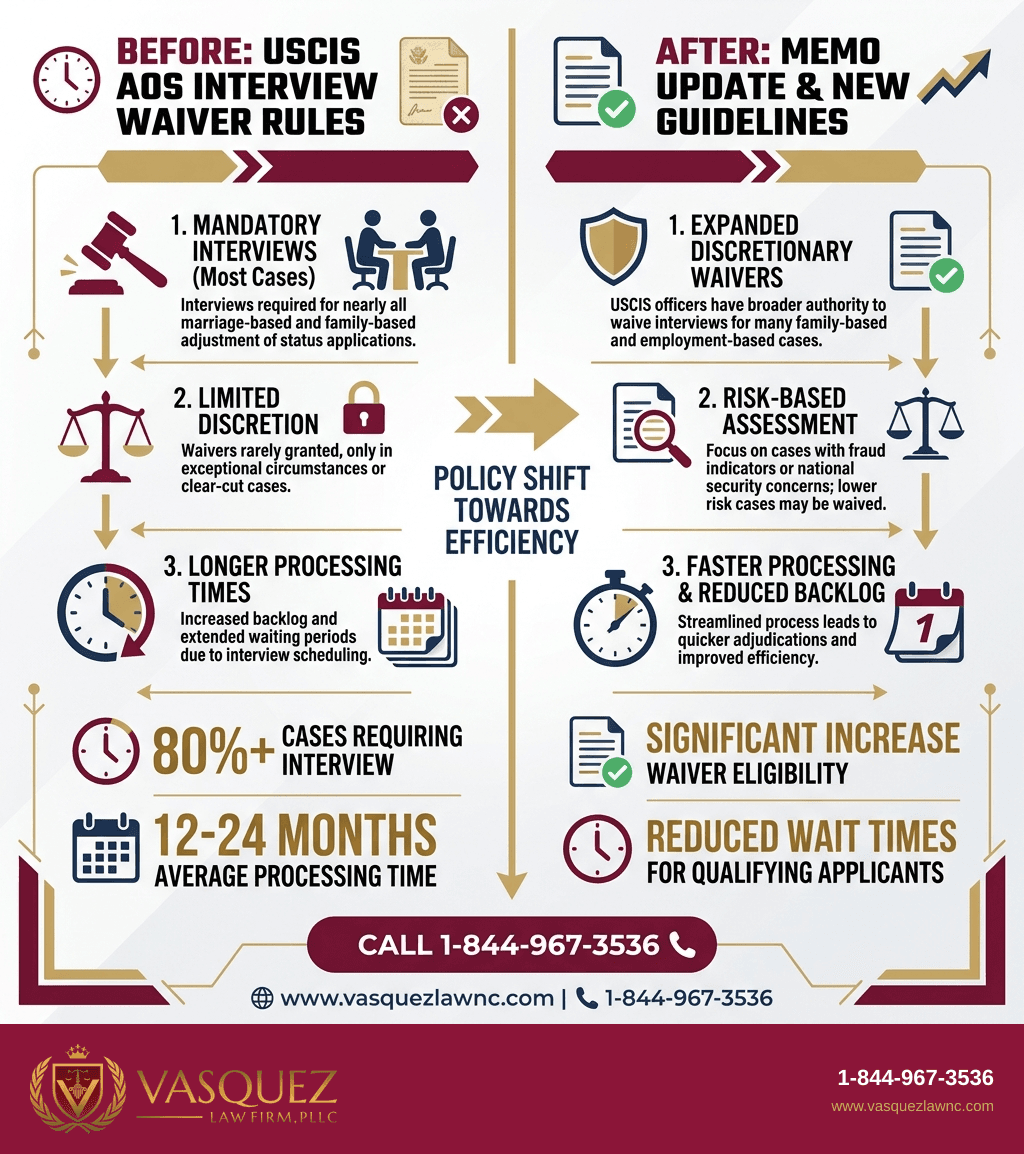
In early 2026, U.S. Citizenship and Immigration Services (USCIS) issued a new policy memo. This memo explains the adjustment of status (AOS) process under federal immigration law. Adjustment of status means applying to change your immigration status to lawful permanent resident (LPR) while inside the U.S.
Adjustment of Status is a process under 8 U.S.C. §1255. It lets some people in the U.S. apply for a green card without leaving the country. The USCIS AOS Memo tries to balance law enforcement goals with fairness to applicants in Orlando and Raleigh, NC. Many foreign nationals live in these cities.
This memo clears up confusion from earlier memos. It gives consistent instructions to USCIS officers at service centers across the country. It explains how to check if someone can enter the U.S. legally, keep lawful status, and prove eligibility under rules in 8 C.F.R. §245.1.
The Policy: What It Includes
- Eligibility Verification: The memo requires stricter checks of legal entry and status. Applicants must clearly prove they were admitted legally.
- Evidence Requirements: Applicants must submit more types of documents. This includes proof of employment and updated background checks.
- Processing Priorities: USCIS sorts cases based on risk and public safety. This affects how long your case may take.
Background and Purpose
The memo answers past lawsuits and calls for clear USCIS rules. It replaces older guidance that was sometimes unclear or applied differently. Now, applicants filing Form I-485, Application to Register Permanent Residence or Adjust Status, face clearer but tougher standards.
If you apply in Orlando, FL or Raleigh, NC, watch for these changes. They affect your first application and any Requests for Evidence (RFEs) from USCIS.
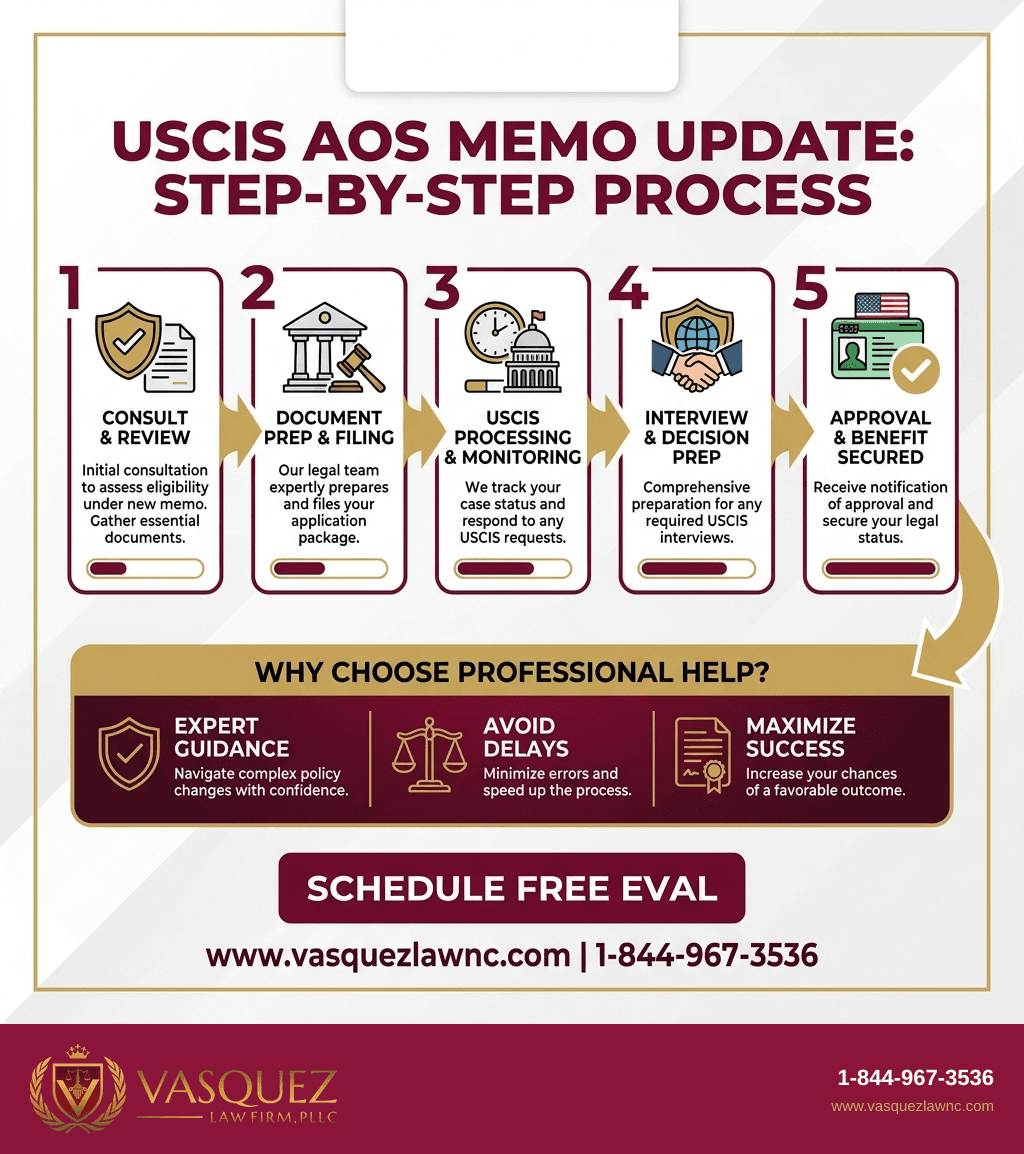
Key Steps to Take After the Memo
Because the USCIS AOS Memo changes some rules and procedures, applicants must prepare differently. Our immigration lawyers in Orlando and Raleigh suggest these important steps to improve your chances under the new policy.
Step 1: Review Eligibility Thoroughly
Make sure you meet all the requirements for adjustment. This includes legal entry and continuous residence in the U.S. Your proof must be complete and well-organized to pass USCIS checks.
Step 2: Gather Detailed Documentation
Collect all necessary proof. This includes I-94 arrival records, letters from employers, pay stubs, tax returns, and other papers showing your status and eligibility. USCIS now expects more detailed proof.
Step 3: File Form I-485 Correctly
Fill out the application carefully. Include all extra forms and fees. Check everything for accuracy and completeness to avoid delays or denials.
Step 4: Monitor USCIS Processing Updates
Check the USCIS processing times page (https://egov.uscis.gov/processing-times/) to know how long your local service center takes.
Step 5: Respond Promptly to Requests for Evidence
If USCIS asks for more proof (RFE), reply quickly with the documents they want. Ignoring or delaying your response can cause your case to be denied.
Immigration rules and USCIS policies change often. Getting regular legal advice from experts in Orlando and Raleigh helps keep your case on track.
For personal help, contact our immigration attorneys at Vasquez Law Firm.
Common Mistakes to Avoid with Your Application
- Incomplete Evidence: Sending too little proof of legal entry or status can cause RFEs or denials. Always check that your documents meet memo rules.
- Missing Deadlines: Waiting too long to answer USCIS letters often leads to denial. Set reminders and act fast.
- Incorrect Form Filing: Mistakes on Form I-485 or missing required forms slow processing or cause denials.
- Unawareness of Policy Changes: Using old rules or ignoring the memo can hurt your application.
- Ignoring Employment Documentation: The new memo often requires proof of employment. Missing this can hurt employment-based green card cases.
- Failure to Maintain Status: Gaps or unauthorized work before applying may make you ineligible under the new memo.
- Not Consulting an Attorney: USCIS rules are complex. Expert advice helps you apply the best way.
If you remember only one thing: provide all required proof and answer USCIS requests quickly to protect your application under the 2026 USCIS AOS Memo.
Timeline and What to Expect with Processing
Processing times for adjustment of status applications vary. They have generally gotten a bit longer because of the memo's new rules. USCIS data shows Form I-485 processing takes about 8 to 14 months in 2026, depending on the service center.
- Initial Review: 30-60 days after you file to check if your application is complete
- Biometrics Appointment: Usually set within 6-8 weeks after filing
- Request for Evidence: If USCIS needs more documents, they send an RFE. This adds 60-90 days to processing.
- USCIS Interview: In-person interviews usually happen 6-12 months after filing
- Final Decision: Usually made within 1-2 months after the interview
These times vary in Orlando and Raleigh depending on local USCIS office workloads.
Check USCIS processing times often to set realistic expectations.
NC, FL, and Nationwide Notes
North Carolina Notes
In Raleigh, NC, USCIS applies the 2026 memo to set processing priorities. The immigrant community is growing there. Applicants should expect more requests for employment-related proof, especially for family-based and work-based green cards.
Florida Notes
In Orlando, FL, USCIS offices get many adjustment applications. The new memo requires both foreign workers and employers to keep strict proof of legal presence and follow immigration rules.
Nationwide Concepts
Across the U.S., the memo makes adjustment rules standard. It stresses clear proof of legal entry, no unauthorized work, and supporting documents as required by 8 U.S.C. §1255 and 8 C.F.R. §245.1.
Knowing these rules is important wherever you apply. But local offices may process cases at different speeds.
When to Call a Lawyer Now
- If you got a request for evidence that mentions the new memo rules
- If you are not sure if you qualify under the new criteria
- If USCIS recently denied your application after the memo came out
- If you need help collecting and organizing proof that meets memo rules
- If you want to know how the memo affects work-based applications
- If your case has complicated legal or immigration history
- If you want to look for other immigration options because denial risks are higher
- If you want help filing in Orlando or Raleigh USCIS offices
About Vasquez Law Firm
At Vasquez Law Firm, we combine care with strong representation. Our motto "Yo Peleo®" (I Fight) shows how we stand up for your rights.
- Bilingual Support: Se Habla Español - Spanish-speaking lawyers and staff available
- Service Areas: North Carolina, Florida, and immigration help nationwide
- Experience: Over 30 years helping clients with complex legal issues
- Results: Thousands of successful cases in many practice areas
Attorney Trust and Experience
William J. Vásquez is licensed to practice law in North Carolina since 2011. He is also admitted to the U.S. Courts of Appeals for the 4th, 5th, 6th, and 11th Circuits. For Florida cases, the firm uses Florida Bar attorney Alekssandra Lopez. The firm has given focused legal help since 2011, paying close attention to each client.
Don't wait to get the help you deserve. Call us now for immediate assistance.
Se Habla Español
Frequently Asked Questions
What is the USCIS AOS Memo?
The USCIS AOS Memo is a 2026 policy document that clarifies rules for adjustment of status applications, including eligibility and evidence requirements. It guides USCIS officers in Orlando, Raleigh, and nationwide on updated standards.
How does the USCIS AOS Memo affect my green card application?
This memo prioritizes certain cases and demands more evidence, potentially affecting processing times and approval chances. Applicants must carefully comply with new requirements to avoid delays.
What evidence does the new USCIS green card memo require?
Applicants should provide clear proof of lawful entry, employment authorization, and continuous legal status, including detailed documents like pay stubs and tax returns to meet the updated standards.
Has USCIS issued clarifications to the AOS Memo?
Yes, to address confusion and ensure consistent application, USCIS has released clarifications guiding applicants and officers on how to interpret the memoe280 9s policies.
Can the USCIS new memo 2026 increase denial rates for AOS?
Stricter criteria and evidence demands could lead to more denials if applicants are unprepared. Understanding memo requirements and legal guidance help reduce that risk.
Where can I find official USCIS processing times for AOS?
Visit https://egov.uscis.gov/processing-times/ and select Form I-485 for the latest wait time estimates by service center.
Are there any lawsuits challenging the USCIS AOS Memo?
Yes, litigation exists challenging aspects of the memo, but current USCIS procedures remain in effect until any court decision changes them.
How can I prepare for the changes in USCIS AOS policy in Orlando and Raleigh?
Consulting an experienced immigration attorney to review your case and prepare comprehensive evidence is essential in light of the 2026 USCIS AOS Memo changes.
Sources and References
- U.S. Citizenship and Immigration Services
- Executive Office for Immigration Review
- Legal Information Institute
Take the first step toward justice today. Our team is standing by to help.
Start Your Free Evaluation Now
Call us: 1-844-967-3536
Se Habla Español - Estamos aquí para ayudarle.
If you need legal assistance, learn more about our immigration law practice, or call us at 1-844-967-3536 for a free evaluation.
William Vasquez
Founder & CEO, Vasquez Law Firm, PLLC
William Vasquez is the founder and CEO of Vasquez Law Firm, PLLC, a results-driven firm specializing in immigration, criminal defense, personal injury, and workers' compensation. A U.S. Air Force veteran and recipient of the Joint Service Achievement Medal, William is dedicated to fiercely fighting for his clients' rights.
Related Legal Services
Need legal help? Learn more about speak with an immigration lawyer, or contact us for a free evaluation.
You can also visit North Carolina immigration law firm for more information.