How TPS Works: What Immigrants Should Know in 2026
Learn how TPS works in 2026 and the latest TPS extension news. Protect your status with help from Vasquez Law. Contact our Orlando office for help.
Published on July 7, 2026
Talk to an immigration attorney
Free call. A clear plan for your case.
Free & confidential · Se habla espanol · 24/7
Have questions? Talk to an attorney - free evaluation.
Call 1-844-967-3536Worried how the latest immigration news affects you?
Schedule a confidential case review with an immigration attorney - know exactly where you stand.
How TPS Works: What Immigrants Should Know in 2026
Temporary Protected Status (TPS) gives important protection to many immigrants in the USA, including those in Orlando, FL and Raleigh, NC. In 2026, TPS still helps people from certain countries avoid deportation. These countries face problems like war, natural disasters, or other serious issues. Knowing how to apply for TPS, the latest TPS news, and what the 2026 TPS extension means can help immigrants protect their rights and plan ahead. This article explains the benefits, timelines, and common mistakes, with helpful advice from Vasquez Law Firm immigration lawyers.
Need help with your case? Our experienced lawyers are ready to fight for you. Se Habla Español.
Or call us now: 1-844-967-3536
Quick Answer
Temporary Protected Status (TPS) lets people from certain countries stay temporarily in the U.S. without fear of deportation. It also lets them work and travel. TPS is extended or ended based on conditions in the designated countries. To apply for TPS, you must file Form I-821 with USCIS and meet strict rules.
- TPS protects you from deportation temporarily
- It allows you to get a work permit in the U.S.
- You must apply using Form I-821
- Extensions depend on conditions in your country
- TPS does not directly lead to permanent residency
Understanding Temporary Protected Status
Imagine you can stay in the United States without fear of deportation even if your visa or entry status has expired. That is what Temporary Protected Status (TPS) offers. TPS is a humanitarian program created by federal law (8 U.S.C. a7 1254a). It helps immigrants from countries where it is unsafe to return because of serious problems.
Countries get TPS designation if they face war, natural disasters, epidemics, or other serious situations. In 2026, countries like Haiti, El Salvador, Honduras, Nepal, and Venezuela have TPS because of ongoing problems.
TPS protects eligible immigrants by stopping deportation temporarily and allowing work permits. But TPS is not a way to get permanent legal status. It is temporary and the U.S. government reviews and extends it based on conditions in the home country.
Our immigration services in Orlando and Raleigh help clients understand TPS eligibility and keep their status by renewing and extending it.
Legal Framework and Criteria
TPS designation is allowed by the Secretary of the Department of Homeland Security following rules set by law. To qualify, applicants must:
- Be a national (person from) a designated TPS country or meet similar residency rules.
- Have lived continuously in the U.S. since a certain date.
- Pass security and background checks.
- Not have disqualifying criminal records or immigration violations.
Once a country is designated, TPS holders can apply for work authorization by filing Form I-765. They may also apply for travel permission called Advance Parole.
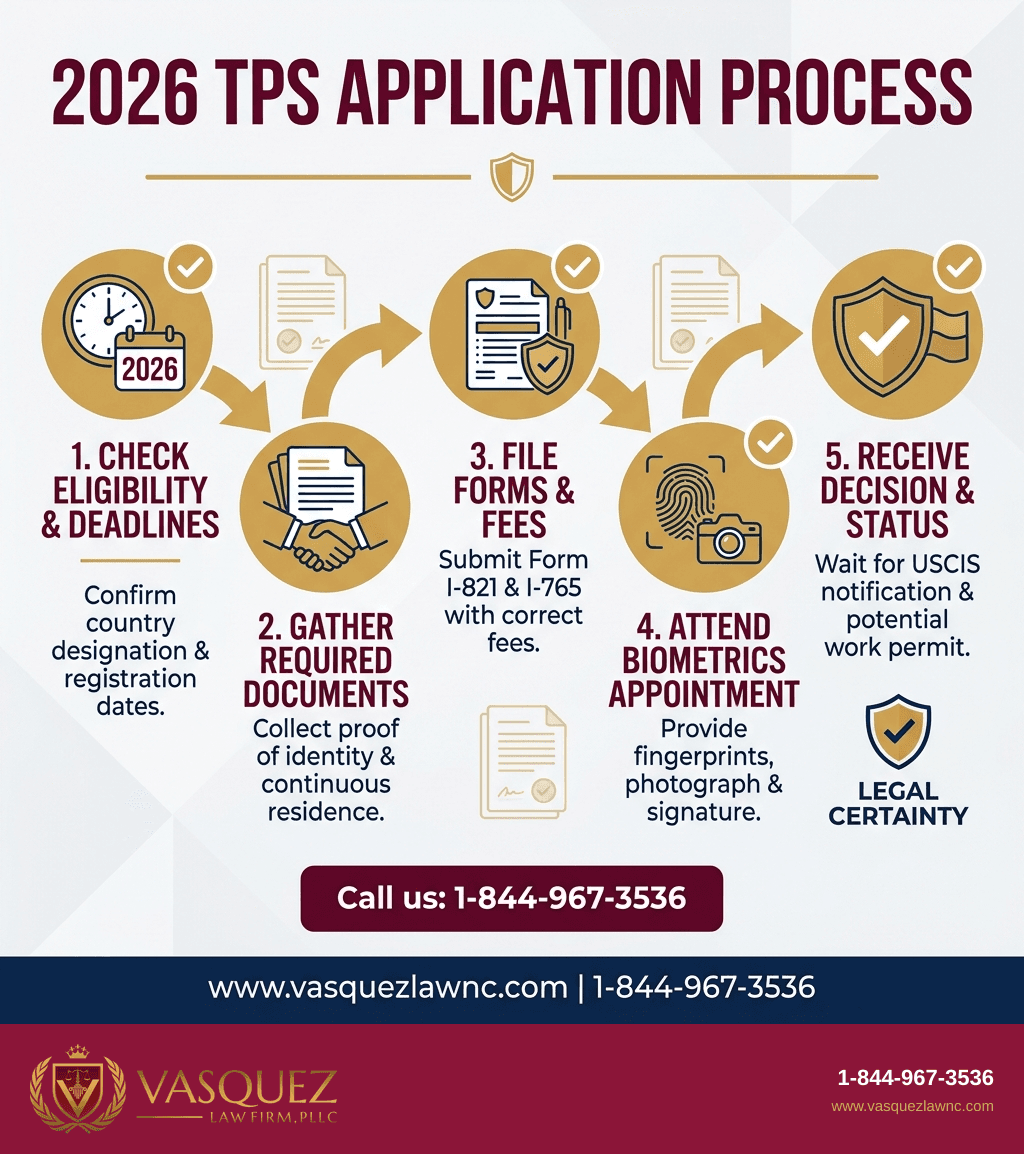
Steps to Apply for TPS in 2026
Applying for TPS needs careful attention to timing, documents, and eligibility. In 2026, following USCIS rules gives you the best chance to be approved.
Step 1: Check Eligibility and Designation Status
Look at the list of TPS countries on the USCIS website. Make sure your country has TPS now and check your eligibility date.
Step 2: Prepare Documentation
Collect proof of your nationality like a passport or birth certificate. Also get evidence that you have lived continuously in the U.S. Gather identity documents and police or court records if needed.
Step 3: Complete Form I-821
Fill out Form I-821, Application for Temporary Protected Status. Send it with your supporting documents and the filing fee or a request to waive the fee.
Step 4: Apply for Work Authorization
File Form I-765 at the same time or after TPS approval to get an Employment Authorization Document (EAD). This permit lets you work legally in the U.S. while TPS is active.
Step 5: Attend Biometrics Appointment
USCIS will set an appointment to take your fingerprints and photos for background checks. This step is required to process your TPS application.
Step 6: Await USCIS Decision & Renewals
Processing times vary. In 2026, I-821 TPS applications usually take 6 to 14 months (source: USCIS Processing Times). Watch for extension dates and file renewals on time to keep your status.
Common Mistakes in TPS Applications
- Missing Deadlines: Not sending your initial or renewal applications during open registration causes denial. Always check USCIS announcements for deadlines.
- Incomplete Forms: Mistakes or missing information on Form I-821 cause delays or rejection. Check all details before sending.
- Insufficient Evidence: Not having enough proof of continuous residence or nationality can make your application invalid.
- Wrong Fees: Paying the wrong fees or missing fee waiver requests can cause denial. Check fees on the USCIS website.
- Unauthorized Travel: Leaving the U.S. without Advance Parole may end your TPS protection.
- Criminal Records: Not telling about or properly handling disqualifying convictions can cause TPS denial or deportation.
- Ignoring Renewal Notices: You must file renewal applications on time or you lose TPS protection.
If you remember only one thing: filing on time and accurately with a knowledgeable lawyer greatly improves your chances of TPS approval.
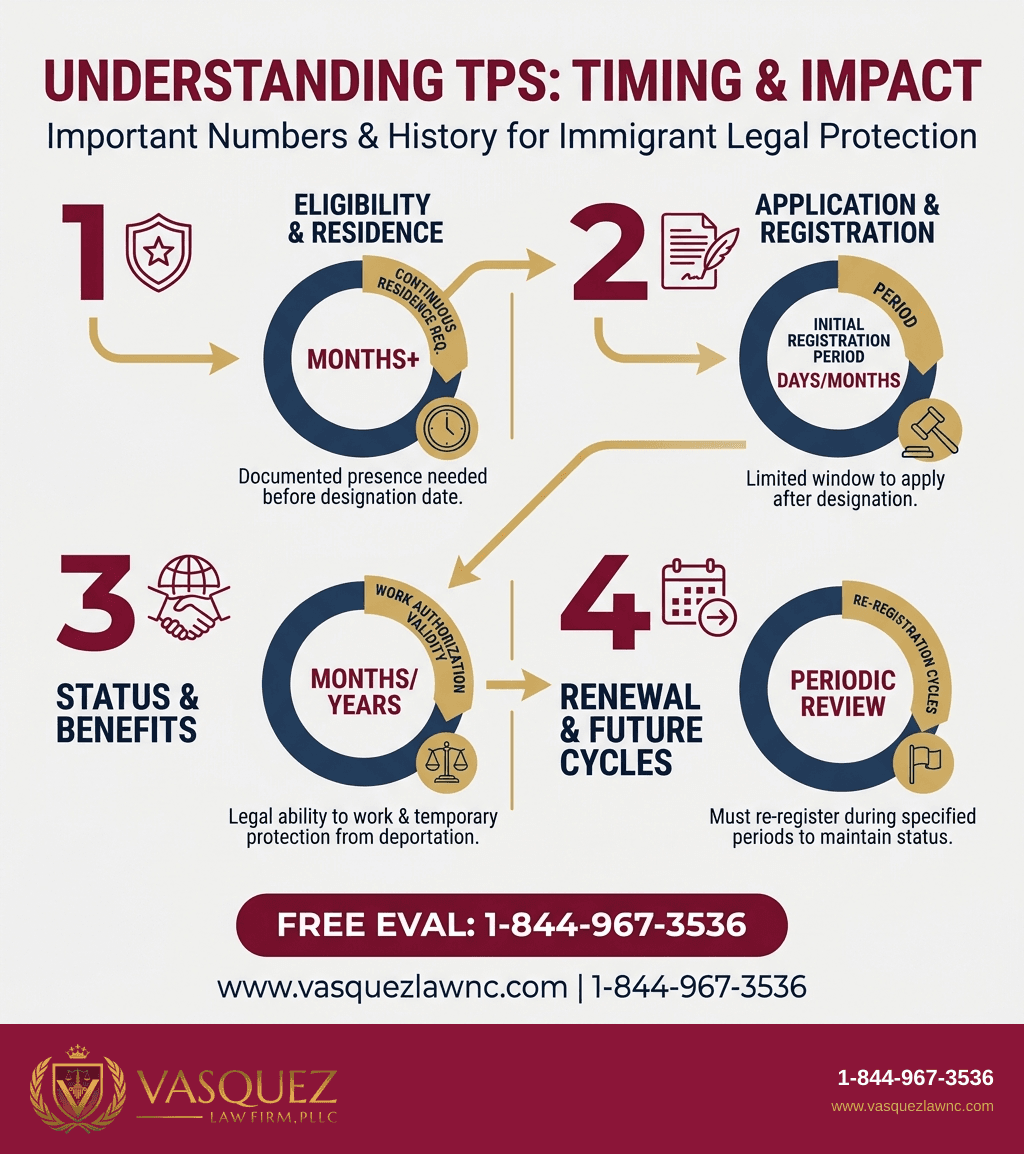
Timeline and What to Expect
- 0-3 Months: Gather and prepare your TPS application documents.
- 3-6 Months: File Form I-821 and Form I-765 for work authorization. USCIS processes initial filings.
- 6-12 Months: Attend biometrics appointment. USCIS reviews and approves or asks for more evidence.
- 12-14 Months: Get approval notice; receive EAD if requested. Check USCIS Processing Times often.
- Annually: Watch for TPS extension announcements and file renewals on time.
Benefits and Limitations of TPS
Benefits
- Protection from deportation while TPS is valid
- Work authorization with Employment Authorization Document
- Ability to apply for travel permits (Advance Parole)
- Some state benefits depend on TPS status
Limitations
- TPS is temporary and can be extended or ended
- No direct way to get permanent residency or citizenship
- Does not give eligibility for some federal benefits beyond work authorization
- People with certain criminal records cannot get TPS
TPS in North Carolina and Florida
North Carolina Notes
Many TPS holders living in Raleigh and across North Carolina use TPS to keep legal status and work permits. Local immigration services and legal help assist with TPS renewals, applications, and related benefits. TPS holders should stay updated on state rules about work and driver's licenses.
Florida Notes
In Orlando and all over Florida, TPS is important protection for immigrants from Haiti, Venezuela, and other designated countries. Florida has many TPS holders who need legal help with renewals, work permits, and travel permission. Local lawyers guide applicants on following state and federal rules.
Nationwide Concepts
TPS is a federal program, so USCIS rules apply everywhere in the U.S. But processing times and local enforcement may differ by area. TPS holders across the country should get legal advice to avoid problems like late filings or travel without permission. Watching TPS news is important to stay informed about changes or extensions.
When to Call an Immigration Lawyer
- If your TPS application was denied or rejected
- If you got a Notice to Appear for deportation
- If you plan to travel abroad and need Advance Parole
- If your TPS countrye28099s designation changes
- If you have criminal charges or convictions
- If you miss a TPS renewal deadline
- If you have trouble proving continuous residence
- If you want to explore other immigration options besides TPS
- If USCIS asks for more evidence or sends notices
- If you want to prepare for possible TPS ending or changes
About Vasquez Law Firm
At Vasquez Law Firm, we mix care with strong representation. Our motto "Yo Peleoae" (I Fight) shows our promise to stand up for your rights.
- Bilingual Support: Se Habla Espaf1ol e28094 Spanish-speaking lawyers and staff available
- Service Areas: North Carolina, Florida, and immigration services across the U.S.
- Experience: Over 30 years helping clients with complex legal issues
- Results: Thousands of successful cases in many practice areas
Attorney Trust and Experience
William J. Ve1squez, JD, is licensed to practice law in North Carolina and Florida. He has 15 years of experience in immigration law helping TPS applicants and other cases in Raleigh, NC, and Orlando, FL. Our team offers legal plans made for each cliente28099s unique needs.
Don't wait to get the help you need. Call us now for quick assistance. Se Habla Espaf1ol.
Frequently Asked Questions
What does TPS stand for?
TPS means Temporary Protected Status. It grants temporary legal protection to immigrants from countries facing serious problems like war or natural disaster. TPS holders cannot be deported while their status is valid.
Is TPS extended to 2026?
Yes, many TPS designations were extended into 2026 due to ongoing challenges in affected countries. Extensions allow eligible individuals to maintain status and work authorization with timely renewal applications.
Can someone with TPS be deported?
While TPS protects against removal based on country conditions, TPS holders can be deported for serious criminal activity or immigration violations. TPS is not a permanent legal status.
Is Trump cancelling TPS?
The Trump administration tried to terminate TPS for certain countries, but courts blocked those attempts. As of 2026, TPS protections remain active unless new changes occur.
What are the benefits of Temporary Protected Status?
TPS provides deportation protection, work authorization, and travel options with Advance Parole. It does not grant permanent residency or citizenship directly.
How do I apply for TPS?
File Form I-821 with USCIS along with supporting documents and fees. Also apply for a work permit (Form I-765) if desired. Applications must be filed during open registration periods.
Which countries currently have TPS designation?
As of 2026, countries including Haiti, El Salvador, Honduras, Nepal, and Venezuela are designated for TPS. Check USCIS regularly for updates.
Can TPS holders travel outside the U.S.?
TPS holders can apply for Advance Parole to travel internationally and re-enter without losing TPS. Applying before travel and consulting attorneys is crucial to avoid reentry issues.
Sources and References
- U.S. Citizenship and Immigration Services
- Executive Office for Immigration Review
- Legal Information Institute
Take the first step toward justice today. Our team is ready to help. Se Habla Espaf1ol.
Start Your Free Evaluation Now
Call us: 1-844-967-3536
Se Habla Espaf1ol - Estamos aqued para ayudarle.


William Vasquez
Founder & CEO, Vasquez Law Firm, PLLC
William Vasquez is the founder and CEO of Vasquez Law Firm, PLLC, a results-driven firm specializing in immigration, criminal defense, personal injury, and workers' compensation. A U.S. Air Force veteran and recipient of the Joint Service Achievement Medal, William is dedicated to fiercely fighting for his clients' rights.
Related Legal Services
Need legal help? Learn more about immigration case consultation, or contact us for a free evaluation.
You can also visit NC immigration legal help for more information.