Requirements to Be an Immigration Lawyer in 2026 Explained
Wondering about the requirements to be an immigration lawyer in 2026? Learn what degrees, years, and skills are needed. Contact Vasquez Law for help.
Published on September 4, 2026
Talk to an immigration attorney
Free call. A clear plan for your case.
Free & confidential · Se habla espanol · 24/7
Have questions? Talk to an attorney - free evaluation.
Call 1-844-967-3536Worried how the latest immigration news affects you?
Schedule a confidential case review with an immigration attorney - know exactly where you stand.
Requirements to Be an Immigration Lawyer in 2026 Explained
Many people in Raleigh, NC, and Orlando, FL, want to become immigration lawyers. They want to help families and businesses understand the complex U.S. immigration laws. Knowing the requirements to be an immigration lawyer in 2026 is very important for anyone who wants this job. This includes the education needed, getting a license, practical skills, and knowing federal law. Whether you want to know how long it takes or what salary to expect, this guide gives you key details to get ready for a successful career as an immigration lawyer.
Need help with your case? Our experienced attorneys are ready to fight for you. Se Habla Español.
Or call us now: 1-844-967-3536
Quick Answer
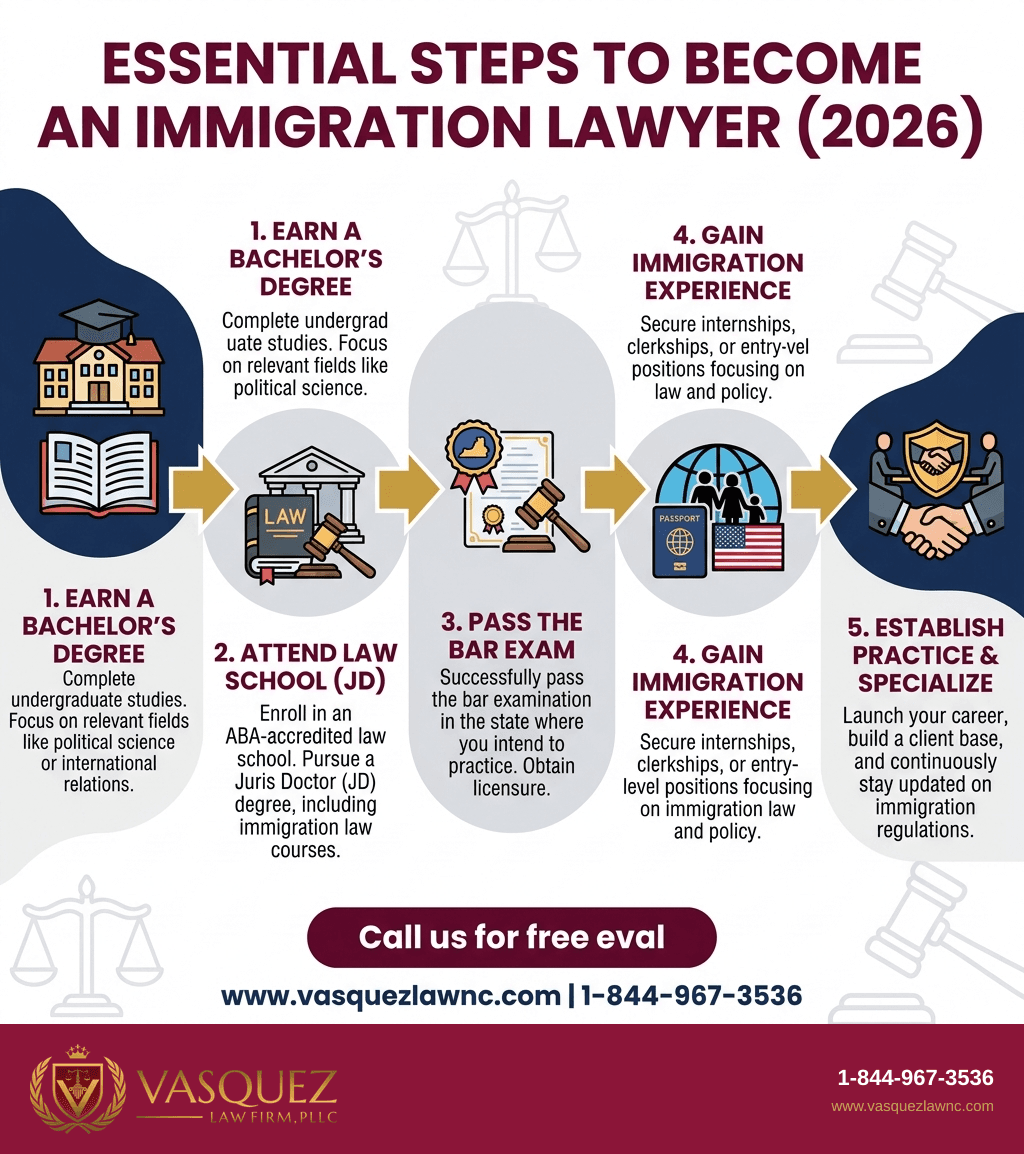
To become an immigration lawyer in 2026, you usually need a bachelor's degree, a Juris Doctor (JD) degree, pass the state bar exam, and have special knowledge of immigration laws. It usually takes about seven years. This includes undergraduate and law school education, plus time to prepare for the bar exam.
- Finish an undergraduate degree
- Get a JD from an accredited law school
- Pass the bar exam in your state
- Get immigration law experience through internships or clerkships
- Learn federal immigration laws well
Understanding the Requirements to Be an Immigration Lawyer
Imagine someone in Raleigh who wants to start a career defending immigrant rights. The requirements to be an immigration lawyer include both education and practical qualifications. First, you must get a bachelor's degree in any subject. Common subjects include political science, international relations, or pre-law. This gives you a good base for law school where you will learn special legal skills.
Next, you must attend a law school approved by the American Bar Association (ABA) to get a Juris Doctor (JD) degree. In law school, taking immigration law classes, clinics, or externships helps you gain expertise. After law school, you must pass the state bar exam where you want to work. For example, if you want to work in Raleigh, NC, or Orlando, FL, you must pass the North Carolina or Florida bar exam.
Besides education, experience is very important. You learn immigration law by working in internships at immigration law firms, government offices, or nonprofit groups. This hands-on work helps you understand how U.S. Citizenship and Immigration Services (USCIS) works and how immigration courts operate. In 2026, immigration law is controlled by the federal government. So, knowing federal laws, rules, and policies is very important. Important laws include the Immigration and Nationality Act (INA) found under 8 U.S.C., which controls legal immigration, deportation, and becoming a citizen. Rules found under 8 Code of Federal Regulations (C.F.R.) also affect daily work.
Finally, an immigration lawyer must follow ethical rules and keep learning new legal information to stay current. This area of law changes often, so lawyers must keep up with new laws, rules, and policy updates from agencies like USCIS and EOIR (Executive Office for Immigration Review).
To learn more about our immigration legal services and how we help clients in Raleigh and Orlando, visit our immigration practice page.
What Degree Is Needed to Be an Immigration Lawyer?
The main degree needed is a Juris Doctor (JD). You get this after finishing a bachelor's degree. This degree lets you take the bar exam. You can also get special certificates or an LLM degree in immigration law. These are optional but help you learn more deeply.
How Hard Is It to Become an Immigration Lawyer?
Passing the bar exam is usually the hardest part. Immigration law is complex because it changes often and is controlled by the federal government. To succeed, you must study hard and keep learning about new laws and policies.
Immigration Lawyer Salary Overview
According to the U.S. Bureau of Labor Statistics, the middle salary for immigration lawyers in 2026 is between $70,000 and $120,000. This depends on experience and location. Lawyers in cities like Raleigh and Orlando may earn more because of higher demand.
Step-by-Step Process to Become an Immigration Lawyer
- Earn a Bachelor's Degree: Usually takes 4 years, often in liberal arts or social sciences.
- Pass the LSAT Exam: The Law School Admission Test is needed to get into law school.
- Complete Law School: 3 years at an ABA-approved law school to get a JD.
- Focus on Immigration Law Courses: Take classes and clinics to get practical experience.
- Pass the State Bar Exam: Needed in North Carolina and Florida to practice law.
- Gain Practical Experience: Do internships or clerkships at immigration law firms or public interest groups.
- Keep Learning: Attend continuing legal education (CLE) to stay updated on immigration law changes.
At every step, networking with immigration lawyers and professional groups can help you find opportunities.
Recommended Internships and Fellowships
- USCIS internships
- Legal Aid immigration clinics
- Nonprofit immigrant advocacy groups
Bar Exam Preparation Tips
Plan early and take bar review courses, especially on federal law parts. This helps improve your chances because the exam is hard.
Documents and Evidence to Support Your Legal Education
When you prepare to become an immigration lawyer, keep your school and work documents safe. Examples include:
- Official transcripts from college and law school
- Law degree certificate (Juris Doctor diploma)
- LSAT score reports
- Bar exam application and passing results
- Letters confirming internships or fellowships
- Certificates for immigration law specialization or continuing legal education (CLE)
- Resume showing your immigration law experience
You will need these documents when applying for jobs or more certifications.
How to Organize Your Legal Documentation
Keep both digital and paper copies safe and easy to get. Use secure cloud storage with backups. Watch for expiration dates on certificates that need renewal.
Why Documentation Matters Beyond Career Start
Legal documents may be asked for by clients or during professional license checks in North Carolina or Florida.
Timeline: Expectations for Becoming Licensed
- Bachelor’s Degree: 4 years
- Law School (JD): 3 years
- Bar Exam Prep & Passing: 3-6 months after graduation
- Immigration Law Internships: Varies, often 6 or more months during law school
- Total Typical Time: About 7 to 8 years
The timeline can change if you study part-time or find different internship chances. Some people finish faster by taking summer classes or studying more hours for the bar exam.
USCIS processing times do not affect licensing but do affect clients’ immigration applications. See current USCIS processing times at USCIS processing times.
Costs and Fees Associated with Becoming an Immigration Lawyer
Becoming an immigration lawyer costs money. You should plan for these expenses:
- Undergraduate Tuition: Varies a lot; public universities in North Carolina cost about $9,000 to $22,000 per year for residents.
- Law School Tuition: About $25,000 to $60,000 per year depending on the school.
- LSAT Exam Fees: Around $200 including study materials.
- Bar Exam Fees: Usually $300 to $500, plus costs for prep courses.
- Licensing and Registration: State bar fees vary from about $100 to $400.
- Continuing Legal Education: Yearly costs for CLE courses to keep your license active.
Financial aid, scholarships, and paid internships may help lower these costs.
Common Mistakes and How to Avoid Them
- Not Studying Federal Immigration Law Enough: Fix: Take special immigration law classes and attend seminars.
- Ignoring Practical Experience: Fix: Get internships at immigration law firms or agencies early.
- Failing to Prepare Well for the Bar Exam: Fix: Join good bar prep courses, especially for your state’s rules.
- Skipping Continuing Education After Licensing: Fix: Plan to attend CLEs regularly, especially for immigration law updates.
- Applying for Bar in the Wrong State: Fix: Choose the state bar exam based on your career plans (for example, NC or FL for Vasquez Law clients).
- Poor Document Organization: Fix: Keep all your education and legal papers organized and easy to find.
- Not Using Virtual Consultations for Business Immigration: Fix: Learn about remote practice areas like H-1B visas with virtual help from firms like Vasquez Law.
If you remember only one thing: Becoming an immigration lawyer needs hard study, real experience, and ongoing learning about federal immigration rules.
Jurisdiction Notes: Raleigh, NC and Orlando, FL
North Carolina Notes
Immigration law is controlled by the federal government, but lawyers working in Raleigh must pass the North Carolina bar exam. The NC State Bar requires tests on ethics specific to the state and membership registration. Vasquez Law Firm’s Raleigh office offers experienced immigration legal help focused on federal law for clients living in North Carolina.
Florida Notes
Lawyers in Orlando, FL, must pass the Florida Bar to practice law there. Vasquez Law Firm provides immigration services in Orlando with bilingual help. Florida immigration lawyers often work with diverse immigrant communities and federal courts.
Nationwide Immigration Law Context
Because immigration law is federal, the requirements to become an immigration lawyer are mostly the same across states. But state bar exams and local immigration court rules differ. Vasquez Law Firm offers business immigration legal consultations virtually across the country using Zoom.
When to Call a Lawyer Now
- If you or a family member faces immigration court or deportation
- When filing complex family or business immigration applications
- For questions about visas, green cards, or citizenship eligibility
- If you are an immigrant with work authorization problems
- After getting a USCIS notice that they may deny your case
- When updating or renewing DACA or TPS status
- If accused of breaking immigration laws or facing removal orders
- Before traveling internationally with pending immigration applications
- If you need help understanding changes in immigration policies
- For appeals or motions after immigration benefits are denied
About Vasquez Law Firm
At Vasquez Law Firm, we mix care with strong representation. Our motto "Yo Peleo®" (I Fight) shows our promise to stand up for your rights.
- Bilingual Support: Se Habla Español — Spanish-speaking lawyers and staff available
- Service Areas: North Carolina, plus Florida and nationwide for immigration
- Experience: Over 30 years helping clients with complex legal issues
- Results: Thousands of successful cases in many practice areas
Attorney Trust and Experience
William J. Vásquez is licensed by the North Carolina State Bar (2011) and the U.S. Courts of Appeals for the 4th, 5th, and 11th Circuits. The firm has offered dedicated legal help since 2011, giving personal attention to each client’s case.
Don't wait to get the help you need. Call us now for fast assistance.
Se Habla Español
Frequently Asked Questions
How long does it take to become an immigration lawyer?
The typical path takes about seven years—four years to complete a bachelor's degree plus three years of law school. After that, you must pass the state bar exam. Actual time may vary depending on full-time or part-time study and internship opportunities.
What educational degree is required to become an immigration lawyer?
A Juris Doctor (JD) degree from an accredited law school is required. This follows completion of an undergraduate degree. Some attorneys may also pursue an LLM in immigration law for specialized knowledge, but this is optional.
How hard is it to pass the bar exam in North Carolina or Florida?
Passing the bar requires focused study and understanding of state-specific laws. It is challenging because it covers multiple legal topics, but numerous review programs exist. The bar exam is a major hurdle for all lawyers, regardless of specialization.
What salary can an immigration lawyer expect in the USA?
Immigration lawyers earn between $70,000 and $120,000 annually on average. Salaries vary by location, law firm size, and experience level. Urban centers like Raleigh and Orlando tend to offer competitive salaries.
Can anyone practice immigration law in any US state after passing the bar?
Immigration law is federally regulated, but you must be licensed in a state to represent clients in immigration courts or agencies. Many immigration matters are handled nationwide, but only licensed lawyers in that state may provide legal representation in person.
Is experience with USCIS processes important for immigration lawyers?
Yes. USCIS governs most immigration benefits, so practical knowledge of USCIS forms, procedures, and processing times is essential. Familiarity speeds case handling and reduces errors in complex filings.
Do immigration lawyers need to take continuing education?
Yes. Most state bars require ongoing continuing legal education (CLE) to ensure attorneys stay up-to-date with changes in immigration law and regulations. This is critical due to frequent policy updates.
Are there any online or virtual opportunities for becoming an immigration lawyer?
While educational programs often require in-person attendance, many law schools now offer hybrid or online courses. Firms like Vasquez Law offer virtual consultations, especially for business immigration cases, which expands geographic reach for new lawyers.
Sources and References
- U.S. Citizenship and Immigration Services
- Executive Office for Immigration Review
- Legal Information Institute
Take the first step toward justice today. Our team is standing by to help.
Start Your Free Evaluation Now
Call us: 1-844-967-3536
Se Habla Español - Estamos aquí para ayudarle.


William Vasquez
Founder & CEO, Vasquez Law Firm, PLLC
William Vasquez is the founder and CEO of Vasquez Law Firm, PLLC, a results-driven firm specializing in immigration, criminal defense, personal injury, and workers' compensation. A U.S. Air Force veteran and recipient of the Joint Service Achievement Medal, William is dedicated to fiercely fighting for his clients' rights.
Related Legal Services
Need legal help? Learn more about how our immigration attorneys can help, or contact us for a free evaluation.
You can also visit immigration lawyers serving all of North Carolina for more information.