What Happens When You Lie on a Citizenship Application in 2026?
Lying on a citizenship application is a serious crime that can result in criminal charges and loss of citizenship. In 2026, USCIS and the Department of Justice are aggressively prosecuting cases where applicants conceal criminal history. This article explains the recent indictment of a naturalized citizen for fraud, who is affected, the relevant laws, and what applicants should do to avoid serious consequences.
Published on September 3, 2026
Talk to an immigration attorney
Free call. A clear plan for your case.
Free & confidential · Se habla espanol · 24/7

Have questions? Talk to an attorney - free evaluation.
Call 1-844-967-3536Free Tool
Check Your USCIS Case Status Now
Enter your receipt number - get the official USCIS status in English or Spanish. No registration.
This article gives general legal information. It is not personal legal advice. Reading this does not create an attorney-client relationship. For advice about your own case, contact Vasquez Law Firm.
What happened in the latest case of lying on a citizenship application in 2026?
Worried your citizenship will be questioned?
Recent enforcement makes documentation more important than ever. 15-min call to see what proof you need.
Lying on a citizenship application is still a serious federal crime. A recent case shows this clearly. In 2026, a naturalized U.S. citizen was charged with naturalization fraud. Naturalization fraud means lying or hiding important facts to get citizenship. This person hid felony sexual assault crimes when applying for citizenship. This case shows the government is working hard to find and punish people who get citizenship by lying.
On September 2, 2026, Kevin Jesus King went to court. He was charged with lying about past crimes to get U.S. citizenship. The U.S. Attorney's Office for the District of Nevada said King committed sexual assaults in July 2017 and March 2018. But he did not tell about these crimes on his Form N-400, Application for Naturalization, which he sent in January 2018. In a sworn interview with USCIS in June 2018, King again said he did not commit these crimes. Eleven days later, he was given citizenship through naturalization.
The charges say King hid his criminal past on purpose to get citizenship illegally. He pleaded guilty in state court in 2024 to the sexual assaults. But he now faces federal charges for naturalization fraud. This crime can lead to up to 10 years in prison. His jury trial will happen in November 2026.
USCIS Director Joseph B. Edlow said this kind of fraud is very serious. He said, "Lying on a citizenship application is a serious crime. Under the Trump administration, if you cheat to get U.S. citizenship, expect the consequences." The Department of Justice is working with USCIS to cancel citizenship and prosecute people who get citizenship illegally.
This case was reported by USCIS on their official website on September 3, 2026. It shows the government wants to keep the naturalization process honest (USCIS News Release, 09/03/2026).
Who is affected by charges of lying on a citizenship application?
People who apply for naturalization and do not tell the truth about their criminal history or give false information risk criminal charges and losing their citizenship. This includes lawful permanent residents who commit crimes and then try to hide them when applying for citizenship.
In North Carolina, a state with many immigrants, many lawful permanent residents apply for citizenship every year. Those who have committed felonies or serious crimes and do not report them on Form N-400 risk being investigated by USCIS and facing criminal charges. Orlando, FL, where our Florida office is, also has many naturalization applicants who face similar risks.
USCIS data shows thousands of naturalization applications are filed each year across the country. Most applicants tell the truth. But cases like Kevin Jesus King's 2026 indictment show the government watches for fraud. The Department of Justice and USCIS work together to investigate suspicious applications, especially those hiding violent or fraudulent crimes.
Applicants who lie on their citizenship forms risk criminal punishment and losing citizenship if caught after becoming citizens. The government can start denaturalization, which means canceling citizenship. This can lead to removal from the United States.
These consequences affect people all over the country, including in Raleigh, NC and Orlando, FL. The legal and personal problems show why honesty is very important in the naturalization process.
What does the law say about lying on a citizenship application?
The law does not allow giving false information or hiding important facts on naturalization applications. Federal law says naturalization fraud can lead to up to 10 years in prison. The law is found at 18 U.S.C. A7 1425. It makes it a crime to knowingly get naturalization illegally.
Applicants must truthfully report any criminal history on Form N-400. Not doing so is fraud. USCIS officers ask questions under oath to check if the information is true. If a person lies during the interview or on the application, they can face criminal charges and lose citizenship.
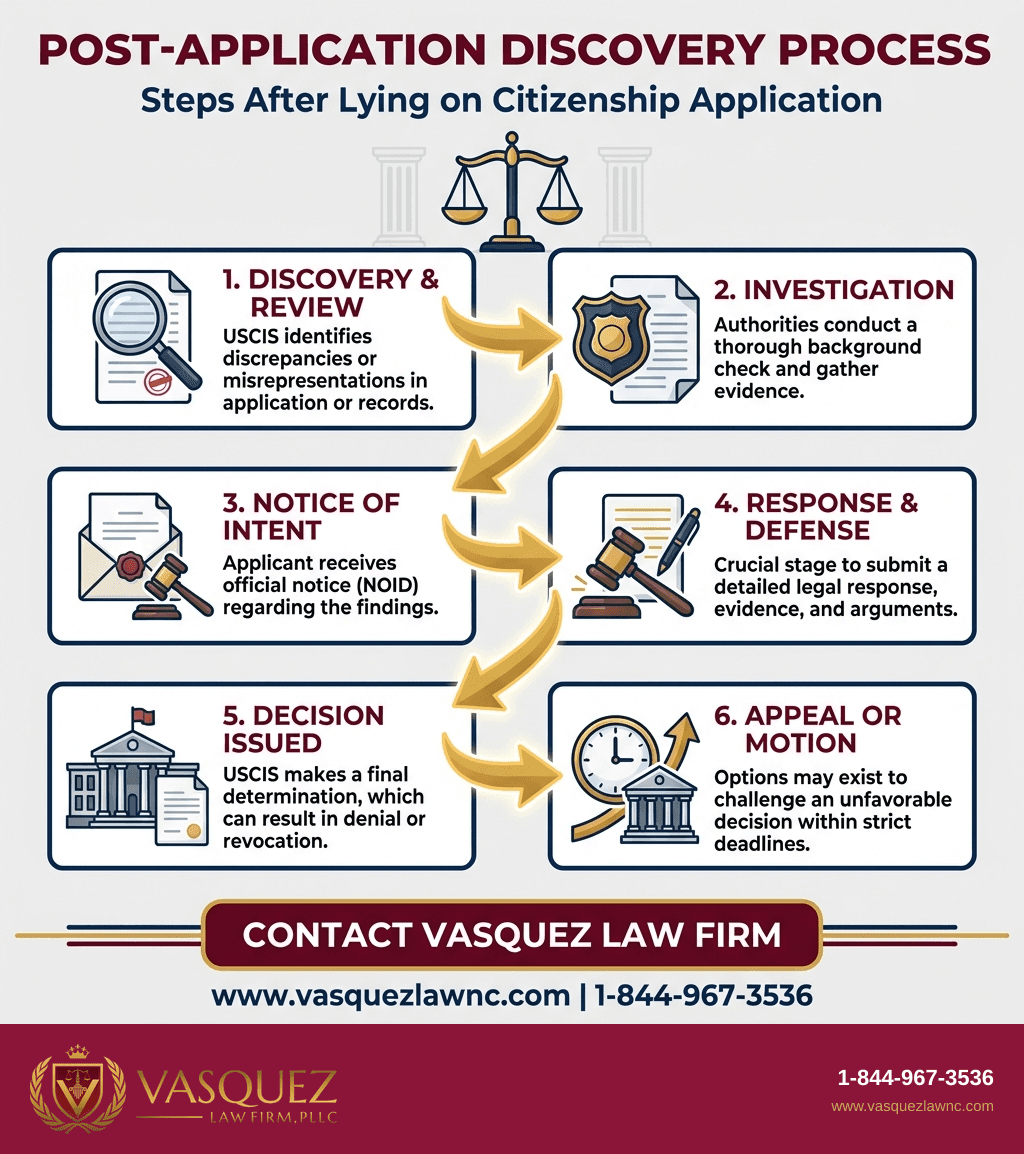
Also, the Immigration and Nationality Act (INA) sets rules for removal and denial of naturalization because of criminal behavior. For example, 8 U.S.C. A7 1227 lists crimes that can lead to deportation. 8 U.S.C. A7 1255 covers rules about changing status and eligibility for naturalization.
"Lying on a citizenship application is a serious crime. Under the Trump administration, if you cheat to get U.S. citizenship, expect the consequences," said USCIS Director Joseph B. Edlow. (Source: USCIS, https://www.uscis.gov/newsroom/news-releases/naturalized-us-citizen-indicted-for-lying-to-obtain-us-citizenship-after-committing-felonies)
The USCIS Policy Manual explains that hiding criminal history during naturalization can lead to losing citizenship. The naturalization oath requires applicants to promise loyalty and truthfulness. Fraud breaks that promise.
The Department of Justice prosecutes naturalization fraud cases. They often work with USCIS investigations. The government must prove beyond a reasonable doubt that the applicant knowingly lied or hid facts to get citizenship.
What should I do if I am worried about lying on my citizenship application?
If you think you made mistakes or left out information on your naturalization application, get legal advice quickly. Our Raleigh, NC and Orlando, FL offices often help clients worried about past criminal records or missing information. Getting advice early can help fix problems before they become criminal charges.
Here are steps to take if you worry about lying on your citizenship application:
- Check your Form N-400 and all documents carefully to make sure they are correct.
- Talk to an experienced immigration lawyer to understand your situation and risks.
- Be honest about any past criminal history in future immigration matters.
- Do not try to hide or change information in any immigration application or interview.
- If USCIS or law enforcement contacts you about your application, get a lawyer right away.
Many cases we see in Raleigh, NC and Orlando, FL involve clients who did not know they had to tell everything. Some did not know certain crimes had to be reported. The most common mistake is denying or downplaying past crimes. This can cause serious problems, including charges of naturalization fraud.
Knowing the legal rules and being honest with USCIS is very important. If you have concerns, do not wait to get help. A lawyer can help you prepare correct applications and represent you if there is an investigation.
What happens next after an indictment for lying on a citizenship application?
After an indictment for naturalization fraud, the person faces criminal prosecution. This may include a jury trial. If found guilty, the person can go to prison for up to 10 years. The government may also start denaturalization to cancel citizenship.
In the 2026 case, the jury trial is set for November 3, 2026. An indictment is only an accusation. The person is innocent until proven guilty beyond a reasonable doubt. The Department of Justice handles these cases in federal court.
USCIS keeps investigating suspected immigration fraud. They work closely with the Department of Justice to hold offenders responsible. The agency asks the public to report suspected fraud through official ways.
"When individuals lie about a violent or fraudulent criminal history to secure the privileges of American citizenship, they violate federal law and disrespect the millions of immigrants who follow the legal process correctly. We will aggressively investigate and prosecute those who use deceit to obtain these sacred rights." (Source: USCIS, https://www.uscis.gov/newsroom/news-releases/naturalized-us-citizen-indicted-for-lying-to-obtain-us-citizenship-after-committing-felonies)
Denaturalization can cause loss of citizenship and possible deportation under 8 U.S.C. A7 1227. This legal process can take a long time and is complicated. Skilled legal help is needed.
What's Your Immigration Situation?
Answer 3 questions - we'll tell you your options
Question 1 / 3
What best describes your situation?
Keep Reading
Frequently Asked Questions about lying on a citizenship application
What is naturalization fraud?
Naturalization fraud happens when a person knowingly gives false information or hides important facts on their citizenship application or during the naturalization process. It is a federal crime. It can lead to prison and loss of citizenship.
Can USCIS revoke citizenship if I lied on my application?
Yes. USCIS can start denaturalization if it finds out citizenship was gotten by fraud, including lying about criminal history. This can cause loss of citizenship and possible removal from the U.S.
What should I do if I realize I made a mistake on my citizenship application?
You should talk to an immigration lawyer right away. Fixing mistakes and being honest in future dealings with USCIS can lower risks. Do not try to hide or change information.
How does USCIS investigate suspected fraud?
USCIS looks at applications, holds interviews, and may work with law enforcement and the Department of Justice to check suspicious cases. They also accept tips from the public about immigration fraud.
What penalties can I face for lying on a citizenship application?
Penalties include criminal charges with up to 10 years in prison, losing citizenship, and deportation. The government treats naturalization fraud very seriously to protect the immigration system.
This article gives general legal information. It is not personal legal advice. Reading this does not create an attorney-client relationship. For advice about your own case, contact Vasquez Law Firm.
Reviewed by William Vasquez, Founder & CEO, Vasquez Law Firm, PLLC.
If you need legal help, learn more about our immigration legal services, or call us at 1-844-967-3536 for a free evaluation.
Related Topics

William Vasquez
Founder & CEO, Vasquez Law Firm, PLLC
William Vasquez is the founder and CEO of Vasquez Law Firm, PLLC, a results-driven firm specializing in immigration, criminal defense, personal injury, and workers' compensation. A U.S. Air Force veteran and recipient of the Joint Service Achievement Medal, William is dedicated to fiercely fighting for his clients' rights.
Related Legal Services
Need legal help? Learn more about our immigration legal services, or contact us for a free evaluation.
You can also visit our North Carolina immigration practice for more information.