How to File a Workers Comp Claim for Psychological Injury in 2026
Understand psychological injury workers' comp claims in North Carolina for 2026. Learn how to file, what's covered, and protect your rights. Contact Vasquez Law for a free consultation.
Published on March 5, 2026
Hurt on the job?
Free review of your workers' comp claim.
Free & confidential · Se habla espanol · 24/7
Have questions? Talk to an attorney - free evaluation.
Call 1-844-967-3536Hurt on the Job? Claim What You Are Owed
A review of your workers' comp claim - we handle the fight.
How to File a Workers Comp Claim for Psychological Injury in 2026
Navigating a workers' compensation claim can be complex, especially when dealing with a psychological injury. In North Carolina, workers' comp laws are specific about what mental health conditions qualify for benefits. If you've suffered emotional distress, anxiety, depression, or PTSD due to a workplace incident or sustained a physical injury that then led to psychological trauma, understanding your rights and the claims process is crucial. This guide provides essential information for 2026, helping you understand how to pursue a psychological injury workers' comp claim and what to expect.
Need help with your psychological injury workers' comp case? Our experienced attorneys are ready to fight for you. Se Habla Español.
Schedule Your Free Case Evaluation
Or call us now: 1-844-967-3536
Quick Answer
In North Carolina, a psychological injury may be covered by workers' compensation if it's directly caused by an unusual or extraordinary workplace event, or if it stems from a compensable physical injury. Proving the direct causal link is key. Benefits can include medical treatment, lost wages, and disability payments.
- Psychological injuries must be directly related to an accident or incident at work.
- Mental-mental claims (no physical injury) are harder to prove in NC.
- Medical evidence and expert testimony are crucial for success.
- Timely reporting to your employer is a mandatory first step.
Understanding Psychological Injury Workers' Comp in NC
When you think of workers' compensation, physical injuries like broken bones or back strain often come to mind. However, the impact of a workplace incident can extend far beyond the physical, leading to severe psychological injury. These mental health conditions can be just as debilitating, affecting your ability to work and live a normal life. In North Carolina, the laws surrounding psychological injury workers' comp claims are specific and often require a robust legal strategy.
A psychological injury can manifest in various forms, including post-traumatic stress disorder (PTSD), severe anxiety, depression, or even a phobia, all stemming from a work-related event. The challenge often lies in establishing the direct causal link between the workplace and the mental health condition. Unlike a visible physical injury, psychological trauma can be more difficult to objectively measure and prove, making strong medical evidence and expert testimony absolutely essential for a successful workers' comp claim.
Types of Compensable Psychological Injuries
North Carolina law generally recognizes two main categories for psychological injury workers' comp claims:
- Physical-Mental Injuries: This is when a psychological condition develops as a direct consequence of a compensable physical injury. For example, if you suffer a severe burn injury at work and then develop PTSD or depression due to the pain, disfigurement, or trauma associated with that physical injury, it may be covered. This is the more common and generally easier type of psychological injury claim to prove under NC workers' comp law.
- Mental-Mental Injuries: These claims involve a psychological injury that arises without any accompanying physical injury. For instance, if you witness a traumatic event at work, such as a fatal accident involving a coworker, and subsequently develop PTSD or severe anxiety, this would be a mental-mental claim. These claims are significantly more challenging to win in North Carolina, requiring proof of an "unusual and extraordinary work-related event" that directly caused the psychological harm.
Understanding this distinction is critical for anyone considering a psychological injury workers' comp claim in North Carolina. The legal requirements and evidentiary burdens differ substantially between these two types of cases. Consulting with an attorney from Vasquez Law Firm can help you determine the viability of your claim and guide you through the specific challenges involved.
Proving a Psychological Injury Workers' Comp Claim
Successfully proving a psychological injury workers' comp claim in North Carolina demands meticulous documentation and compelling evidence. The North Carolina Industrial Commission (NCIC), which oversees workers' compensation cases, requires clear proof that your mental health condition is directly linked to your employment. This isn't always straightforward, especially for mental-mental claims where the connection isn't as obvious as a physical injury.
The burden of proof rests on the injured worker. You must demonstrate that your psychological injury arose out of and in the course of your employment. This means showing that your job duties or a specific workplace incident was the primary cause of your condition. For physical-mental claims, you'll need to establish the physical injury first, and then show how the psychological condition directly resulted from it.
Essential Evidence for Your Claim
To support your psychological injury workers' comp case, you will need:
- Medical Records: Comprehensive documentation from psychiatrists, psychologists, therapists, and other mental health professionals is paramount. These records should detail your diagnosis, treatment plan, prognosis, and, most importantly, the clear causal link between your work and your psychological condition.
- Expert Testimony: Often, expert medical testimony from a qualified mental health professional is required. This expert can explain the nature of your psychological injury, how it relates to your work, and its impact on your ability to function.
- Witness Statements: If a specific incident caused your injury, statements from coworkers or supervisors who witnessed the event can be invaluable.
- Employer Records: Any internal reports of the incident, safety logs, or other relevant documents from your employer can also support your claim.
- Personal Accounts: Your detailed account of the events, symptoms, and how your life has been affected is also a critical piece of the puzzle.
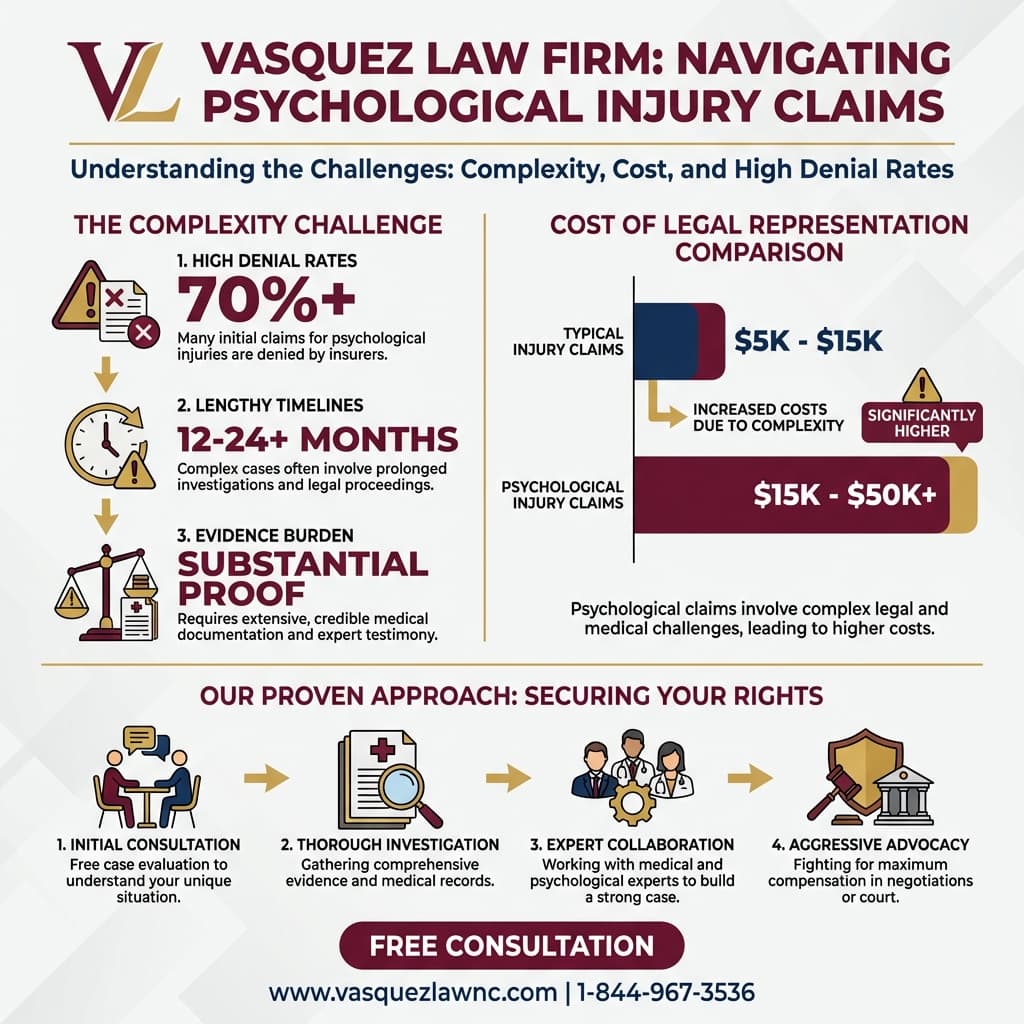
Without strong medical evidence and a clear narrative, it can be extremely difficult to overcome the skepticism that often surrounds psychological injury claims. Insurance companies frequently dispute these claims, arguing that the condition is pre-existing or not work-related. This is why having an experienced workers' compensation attorney on your side is so important to navigate these complexities.
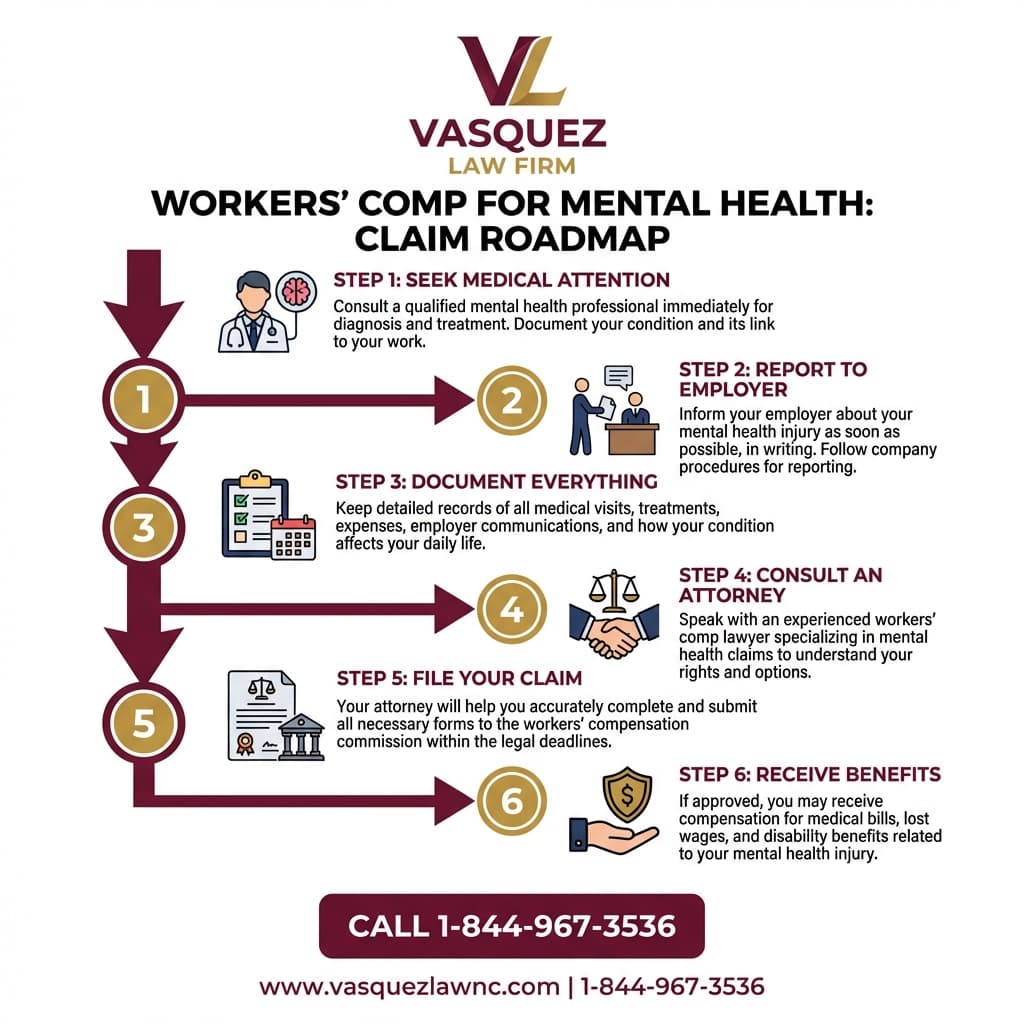
Step-by-Step: Filing a Psychological Injury Workers' Comp Claim in NC
Filing a psychological injury workers' comp claim in North Carolina involves several critical steps that must be followed precisely. Missing a deadline or failing to submit proper documentation can jeopardize your ability to receive benefits. As of 2026, the process remains largely consistent, emphasizing timely action and thorough record-keeping.
- Report the Injury Immediately: Notify your employer in writing as soon as possible, but no later than 30 days from the date of the incident or diagnosis of your psychological injury. Include details about how and when the injury occurred, and that you believe it's work-related. Failure to report promptly can result in denial of your claim.
- Seek Medical Attention: Get evaluated by a mental health professional who can diagnose your condition and establish the link to your work. Ensure all medical records clearly state the work-related cause.
- File Form 18 (Notice of Accident): Complete and file Form 18, "Notice of Accident to Employer and Claim of Employee, Representative, or Dependent," with the North Carolina Industrial Commission (NCIC). This officially starts your claim and must be done within two years of the injury. You can find this form on the NC Industrial Commission website.
- Cooperate with Investigation: Your employer's insurance company will likely investigate your claim. Be truthful and consistent in all statements, but remember that anything you say can be used against you. It's advisable to consult with an attorney before providing detailed statements.
- Gather Evidence: Collect all relevant medical records, therapy notes, witness statements, and any other documentation that supports your claim. This is where the causal link between your work and your psychological injury must be clearly demonstrated.
- Attend Hearings/Mediations: If your claim is disputed, you may need to attend hearings or mediation sessions with the NCIC. An attorney can represent you and present your case effectively.
Each step is crucial, and the complexities of a psychological injury workers' comp claim often necessitate legal guidance. Vasquez Law Firm has extensive experience helping clients in Charlotte and across North Carolina navigate these challenging waters.
Compensation and Settlements for Psychological Injuries
If your psychological injury workers' comp claim is approved in North Carolina, you may be entitled to several types of benefits. The goal of workers' compensation is to help you recover and return to work, or to provide financial support if you are unable to do so. The specific compensation for a psychological injury can vary greatly depending on the severity of the condition, the length of recovery, and the impact on your earning capacity.
Common types of benefits include:
- Medical Treatment: This covers all necessary and reasonable medical expenses related to your psychological injury, including therapy, medication, psychiatric evaluations, and counseling.
- Temporary Disability Benefits: If your psychological injury prevents you from working for a period, you may receive temporary total disability (TTD) benefits, which typically amount to two-thirds of your average weekly wage, subject to state maximums.
- Permanent Partial Disability (PPD): If your psychological injury results in a permanent impairment, you might receive PPD benefits. This is often determined by a medical professional who assigns an impairment rating.
- Vocational Rehabilitation: In some cases, if you cannot return to your previous job due to your psychological injury, workers' compensation may cover vocational rehabilitation services to help you find suitable alternative employment.
Psychiatric Workers' Comp Settlements
Many psychological injury workers' comp cases in North Carolina are resolved through settlements rather than going to a full hearing. A settlement can be a lump sum payment that closes your claim, or it can be structured to provide ongoing benefits. The average payout for a psychological injury varies widely, as there's no fixed amount. Factors influencing settlement value include:
- The severity and permanence of the psychological injury.
- The extent of medical treatment required and future medical needs.
- Your lost wages and impact on future earning potential.
- The strength of the medical evidence linking the injury to work.
- The specific facts of your case and the legal arguments involved.
Negotiating a fair settlement requires a deep understanding of workers' compensation law and the true value of your claim. An attorney can be instrumental in calculating potential damages and advocating for your best interests, ensuring you don't accept an offer that undervalues your suffering and losses. Learn more about permanent disability in NC.
Don't face your legal challenges alone. Our team is here to help you every step of the way.
Call today: 1-844-967-3536 | Se Habla Español
Common Mistakes and How to Avoid Them
Navigating a psychological injury workers' comp claim can be fraught with pitfalls. Avoiding common mistakes is just as important as taking the right steps. These errors can significantly weaken your case and potentially lead to a denial of benefits. Be vigilant and proactive to protect your rights.
-
Delaying Reporting: Waiting too long to report your psychological injury to your employer can create doubt about its work-relatedness. Fix: Report in writing immediately, ideally within 24-48 hours, but no later than 30 days as required by North Carolina law (N.C. Gen. Stat. § 97-22).
-
Not Seeking Prompt Medical Care: A delay in seeing a mental health professional can make it harder to prove the causal link between your work and your injury. Fix: Seek immediate evaluation and treatment from a qualified psychiatrist, psychologist, or therapist and ensure they document the work-related aspects.
-
Failing to Follow Medical Advice: If you don't adhere to your prescribed treatment plan, the insurance company may argue that you are not genuinely injured or are hindering your own recovery. Fix: Attend all appointments, take all prescribed medications, and follow all therapy recommendations diligently.
-
Discussing Your Case on Social Media: Anything you post online can be used against you by the insurance company to discredit your claims of psychological distress. Fix: Avoid posting about your injury, your case, or your activities on social media. It's best to stay off social media entirely during your claim.
-
Giving Recorded Statements Without Legal Counsel: Insurance adjusters are trained to ask questions that can elicit responses detrimental to your claim. Fix: Never give a recorded statement to the insurance company without first consulting with an experienced workers' compensation attorney.
-
Underestimating the Value of Your Claim: Without understanding the full scope of your medical needs, lost wages, and potential future impact, you might accept a settlement that is far too low. Fix: Always have an attorney evaluate your claim's full value before agreeing to any settlement offer.
-
Not Filing Form 18 on Time: The Form 18 is essential for formally notifying the NCIC of your injury and claim. Missing the two-year deadline can permanently bar your claim (N.C. Gen. Stat. § 97-24). Fix: File Form 18 with the NCIC within two years of the date of injury or diagnosis.
If you only remember one thing: Always prioritize timely reporting and seeking professional medical and legal advice. These two steps are the foundation of any successful psychological injury workers' comp claim.
When to Call a Lawyer Now for Your Psychological Injury
Dealing with a psychological injury is already incredibly challenging, and navigating the complexities of workers' compensation law can add immense stress. There are specific situations where seeking legal counsel immediately can make a significant difference in the outcome of your psychological injury workers' comp claim.
- Your Claim Has Been Denied: If the insurance company has denied your claim, don't give up. An attorney can review the denial, identify the reasons, and help you file an appeal to fight for the benefits you deserve.
- You're Facing Pressure to Return to Work: If your employer or the insurance company is pressuring you to return to work before your mental health professional deems you ready, a lawyer can protect your rights and ensure your medical needs are prioritized.
- Your Benefits Have Been Reduced or Terminated: If your workers' comp benefits for your psychological injury have been cut off or reduced without explanation, an attorney can intervene to challenge this decision.
- You're Offered a Settlement: Insurance companies often offer low settlements. An attorney can evaluate the offer, negotiate on your behalf, and ensure any settlement adequately covers your current and future needs.
- You're Having Difficulty Getting Medical Treatment Approved: If the insurance company is refusing to approve necessary psychiatric care, therapy, or medication, a lawyer can advocate for your right to appropriate medical treatment.
- Your Employer is Retaliating Against You: If you believe your employer is taking adverse actions against you (e.g., demotion, harassment) because you filed a workers' comp claim, an attorney can address this illegal retaliation.
- Your Psychological Injury is Severe or Long-Term: For significant psychological injuries that require extensive treatment and impact your long-term ability to work, a lawyer can help secure maximum compensation.
- You Don't Understand the Process: Workers' comp law is complex. If you feel overwhelmed or confused by the paperwork, deadlines, or legal jargon, a lawyer can provide clarity and guidance.
The team at Vasquez Law Firm is dedicated to helping injured workers in North Carolina. We understand the unique challenges of psychological injury workers' comp cases and are ready to provide the aggressive, compassionate representation you need. Learn more about our workers' compensation services.
About Vasquez Law Firm
At Vasquez Law Firm, we combine compassion with aggressive representation. Our motto "Yo Peleo" (I Fight) reflects our commitment to standing up for your rights and ensuring justice for our clients. We understand the profound impact a workplace injury, especially a psychological one, can have on your life and livelihood. Our team is dedicated to providing personalized legal solutions and fighting tirelessly on your behalf.
- Bilingual Support: Se Habla Español - our team is fully bilingual, ensuring clear communication and understanding for all our clients.
- Service Areas: We proudly serve clients across North Carolina, including Charlotte, and handle immigration cases nationwide. For workers' compensation, our focus is exclusively on North Carolina.
- Experience: With over 15 years of dedicated legal experience, we have a proven track record of helping clients navigate complex legal matters and achieve favorable outcomes.
- Results: Our commitment to our clients is reflected in the thousands of successful cases we've handled across multiple practice areas, including workers' compensation, personal injury, and immigration.
Attorney Trust and Experience
Attorney Vasquez holds a Juris Doctor degree and is admitted to practice in both the North Carolina State Bar and Florida Bar. With over 15 years of dedicated legal experience, he has built a reputation for providing personalized attention and achieving favorable outcomes for his clients. His deep understanding of North Carolina workers' compensation law, combined with a compassionate approach, makes him a trusted advocate for those suffering from psychological injuries.
Don't face your legal challenges alone. Our team is here to help you every step of the way.
Call today: 1-844-967-3536 | Se Habla Español
Frequently Asked Questions
What is a psychological injury in workers' comp?
A psychological injury in workers' comp refers to a mental health condition like PTSD, anxiety, or depression that is directly caused by a work-related incident or a compensable physical injury sustained at work. In North Carolina, proving this direct link is critical for a successful claim, often requiring extensive medical evidence and expert testimony to establish causation.
Is anxiety covered by North Carolina workers' comp?
Anxiety can be covered by North Carolina workers' comp if it results directly from a compensable physical injury or an unusual and extraordinary work-related event. "Mental-mental" claims, where anxiety arises without a physical injury, are generally more difficult to prove, requiring clear evidence of a specific, traumatic workplace incident. Medical documentation is key.
How do I prove a psychological injury for workers' comp in NC?
To prove a psychological injury for NC workers' comp, you need strong medical evidence from mental health professionals diagnosing your condition and linking it to your work. This includes therapy notes, psychiatric evaluations, and expert testimony. Witness statements and detailed accounts of the work incident are also crucial to establish the direct causal connection.
What is the average payout for a psychological injury workers' comp claim?
There is no specific "average payout" for a psychological injury workers' comp claim, as values vary significantly based on individual circumstances. Factors like the severity of the injury, required treatment, duration of disability, and impact on earning capacity all influence the settlement amount. An attorney can help estimate your claim's potential value.
Can I get workers' comp for stress and anxiety in North Carolina?
Yes, you can potentially get workers' comp for stress and anxiety in North Carolina, but it's challenging. It must stem from a physical injury or an "unusual and extraordinary" workplace event, not just general work stress. Strong medical documentation from a mental health professional linking the stress and anxiety directly to the work incident is essential for these claims.
What benefits are available for psychiatric workers' comp settlements?
Psychiatric workers' comp settlements can include medical treatment costs (therapy, medication), temporary disability payments for lost wages, and potentially permanent partial disability benefits if there's a lasting impairment. Settlements may also cover vocational rehabilitation if you cannot return to your previous job due to the psychological injury. Each case is unique.
What is the deadline to file a psychological injury workers' comp claim in NC?
In North Carolina, you must report your psychological injury to your employer in writing within 30 days of the incident or diagnosis. You then have two years from the date of injury to file Form 18, "Notice of Accident," with the North Carolina Industrial Commission to formally initiate your psychological injury workers' comp claim. Timeliness is critical.
Do I need a lawyer for a psychological injury workers' comp case?
While not legally required, having a lawyer is highly recommended for a psychological injury workers' comp case in North Carolina. These claims are often complex and frequently disputed by insurance companies. An attorney can help gather evidence, establish causation, navigate legal deadlines, negotiate settlements, and represent your interests, significantly improving your chances of success.
What if my employer denies my psychological injury claim?
If your employer or their insurance company denies your psychological injury workers' comp claim, you have the right to appeal the decision. This typically involves requesting a hearing with the North Carolina Industrial Commission. An experienced workers' compensation attorney can guide you through the appeals process, gather additional evidence, and advocate on your behalf.
Can I claim workers' comp for emotional distress from harassment?
Claiming workers' comp for emotional distress from harassment in North Carolina is extremely difficult. General workplace harassment or bullying that does not involve a physical injury or an "unusual and extraordinary" traumatic event is typically not covered. These claims often fall outside the scope of workers' compensation, as the law focuses on specific, definable workplace accidents or injuries.
Sources and References
- North Carolina Industrial Commission (NCIC)
- N.C. Gen. Stat. § 97-22 - Notice of accident to employer
- N.C. Gen. Stat. § 97-24 - Time for filing claims
Ready to take the next step? Contact Vasquez Law Firm today for a free, confidential consultation. We're committed to fighting for your rights and achieving the best possible outcome for your case.
Start Your Free Case Evaluation Now
Call us: 1-844-967-3536
Se Habla Español - Estamos aquí para ayudarle.


William Vasquez
Founder & CEO, Vasquez Law Firm, PLLC
William Vasquez is the founder and CEO of Vasquez Law Firm, PLLC, a results-driven firm specializing in immigration, criminal defense, personal injury, and workers' compensation. A U.S. Air Force veteran and recipient of the Joint Service Achievement Medal, William is dedicated to fiercely fighting for his clients' rights.
Related Legal Services
Need legal help? Learn more about learn about workers compensation rights, or contact us for a free evaluation.
You can also visit statewide workers comp services for more information.