What You Need to Know About Permanent Disability in NC in 2026
Understanding permanent disability in North Carolina workers' comp claims. Learn your rights and how to pursue benefits. Contact Vasquez Law Firm today.
Published on March 1, 2026
Hurt on the job?
Free review of your workers' comp claim.
Free & confidential · Se habla espanol · 24/7

Have questions? Talk to an attorney - free evaluation.
Call 1-844-967-3536Hurt on the Job? Claim What You Are Owed
A review of your workers' comp claim - we handle the fight.
What You Need to Know About Permanent Disability in NC in 2026
Suffering a workplace injury can be life-altering, especially if it leads to a permanent disability. In North Carolina, understanding your rights and the workers' compensation system is crucial to securing the benefits you deserve. This comprehensive guide, updated for 2026, will walk you through what constitutes permanent disability, how it's determined, and the steps you need to take to protect your future. Don't navigate this complex process alone; Vasquez Law Firm is here to fight for you.
Need help with your permanent disability claim? Our experienced attorneys are ready to fight for you. Se Habla Español.
Schedule Your Free Case Evaluation
Or call us now: 1-844-967-3536
Quick Answer
In North Carolina, permanent disability refers to a lasting physical or mental impairment resulting from a workplace injury that impacts your ability to work. It's determined after you reach Maximum Medical Improvement (MMI). Benefits can include permanent partial disability (PPD) for impairment ratings or permanent total disability (PTD) if you cannot return to any gainful employment. Seeking legal counsel is vital for these complex claims.
- Permanent disability is a lasting impairment from a work injury.
- It's assessed after Maximum Medical Improvement (MMI).
- Benefits include PPD for impairment and PTD for total inability to work.
- North Carolina Industrial Commission oversees these claims.
- An attorney can help maximize your compensation.
Understanding Permanent Disability in NC Workers' Comp
When a workplace injury or illness leaves you with a lasting impairment, it may be classified as a permanent disability. This isn't just about pain; it's about how your injury affects your ability to earn a living. In North Carolina, the workers' compensation system aims to provide benefits that help you cope with these long-term consequences, ensuring you receive fair compensation for your diminished capacity.
The journey to a permanent disability determination begins after you've undergone treatment and your doctors agree you've reached Maximum Medical Improvement (MMI). MMI means your condition is stable and unlikely to improve further with additional medical treatment. At this point, your physician will assess the extent of your impairment and assign an impairment rating, which is a percentage reflecting the loss of use of a body part or system.
It's important to understand that not all permanent impairments lead to the same type or level of benefits. The specific type of permanent disability you're awarded will depend on the severity of your condition and its impact on your vocational abilities. This distinction is critical, as it directly influences the amount and duration of compensation you may receive. Navigating these classifications requires a thorough understanding of North Carolina workers' compensation law.
The North Carolina Industrial Commission (NCIC) is the state agency responsible for administering workers' compensation laws and resolving disputes. All claims for permanent disability benefits must go through their established processes. This can involve hearings, medical evaluations, and negotiations with the employer's insurance carrier. Having an experienced attorney from Vasquez Law Firm by your side can significantly improve your chances of a favorable outcome.
Types of Permanent Disability Benefits
In North Carolina, permanent disability benefits primarily fall into two categories: Permanent Partial Disability (PPD) and Permanent Total Disability (PTD). PPD benefits are awarded when an injured worker has a permanent impairment but can still return to some form of work, even if it's a lighter duty or a different job. These benefits are typically based on a statutory schedule of compensation for specific body parts, or on a functional impairment rating.
Permanent Total Disability (PTD) is reserved for the most severe cases where an injury prevents an individual from returning to any gainful employment. This is a high bar to meet and often requires extensive medical documentation and vocational assessments. PTD benefits are typically paid for life or until the worker reaches retirement age, depending on the specific circumstances and settlement agreements. Understanding which category applies to your situation is crucial.
Determining Your Permanent Disability Rating in 2026
The process of determining your permanent disability rating in North Carolina is a critical step in your workers' compensation claim. Once you've reached Maximum Medical Improvement (MMI), your treating physician will assess your condition and assign an impairment rating. This rating is typically expressed as a percentage of the loss of use of a specific body part or of the whole person, following guidelines established by the American Medical Association (AMA) Guides to the Evaluation of Permanent Impairment, often the 5th or 6th Edition.
This impairment rating forms the basis for Permanent Partial Disability (PPD) benefits. For scheduled body parts, such as an arm or leg, North Carolina law provides a specific number of weeks of compensation for each percentage of impairment. For example, if you have a 10% impairment to your arm, you would receive 10% of the statutory number of weeks for an arm injury. It's vital that this rating accurately reflects your true condition, as it directly impacts your compensation.
However, the impairment rating is not the only factor. Your ability to return to your previous job or any other suitable employment also plays a significant role. If your impairment prevents you from performing your pre-injury job, or even a modified version, you may be entitled to additional benefits beyond the impairment rating. This is where vocational rehabilitation and job search efforts become important, especially for those seeking PTD.
Insurance companies often challenge impairment ratings or argue that an injured worker can perform some type of work. This is why having an experienced workers' compensation attorney is invaluable. An attorney can review your medical records, consult with independent medical examiners if necessary, and advocate for an accurate and fair rating that truly reflects your permanent disability. Vasquez Law Firm has a proven track record of fighting for clients' rights in these complex situations.
Challenging an Impairment Rating
If you disagree with your doctor's impairment rating, you have the right to seek a second opinion. This is a crucial step, as a lower rating can significantly reduce your benefits. Your attorney can help arrange for an independent medical examination (IME) with a physician who specializes in your type of injury. The findings from this IME can be used to challenge the initial rating and negotiate for higher compensation with the insurance carrier.
The North Carolina Industrial Commission (NCIC) provides a formal process for disputing impairment ratings and other aspects of a workers' compensation claim. This can involve mediation, hearings, and presenting evidence from medical experts. Building a strong case requires comprehensive medical documentation and skilled legal representation. Vasquez Law Firm understands the nuances of the NCIC's procedures and can guide you through every stage.
Benefits for Permanent Disability in North Carolina
Securing benefits for permanent disability in North Carolina workers' compensation cases involves different types of compensation designed to address the long-term impact of your injury. The primary forms of benefits include Permanent Partial Disability (PPD) and Permanent Total Disability (PTD), each with its own calculation methods and eligibility criteria. Understanding these can help you anticipate what to expect and ensure you receive your full entitlement.
PPD benefits are paid for a specific number of weeks, determined by the percentage of impairment to a scheduled body part (e.g., an arm, leg, hand, foot, or eye) or to the back/neck. The weekly compensation rate is typically two-thirds of your average weekly wage at the time of injury, subject to state maximums. For unscheduled body parts or whole-person impairment, the calculation can be more complex and may involve considering your loss of earning capacity. This calculation is governed by N.C. Gen. Stat. § 97-31.
If you are deemed to have a Permanent Total Disability (PTD), you may receive weekly benefits for the remainder of your life, or until you reach retirement age, provided you continue to meet the strict eligibility requirements. PTD benefits are also calculated at two-thirds of your average weekly wage, up to the state maximum. Qualification for PTD often requires proving that you are unable to return to any form of gainful employment, even with vocational rehabilitation efforts.
Beyond weekly wage benefits, workers' compensation also covers medical expenses related to your permanent disability. This includes ongoing treatment, medications, physical therapy, and any necessary medical equipment. It's crucial to ensure that all authorized medical care is covered, as these costs can accumulate significantly over time. Your attorney can help ensure these benefits are properly administered and that you don't face unexpected out-of-pocket expenses.
Additionally, in some cases, a permanent disability settlement may be reached, which involves a lump-sum payment instead of weekly benefits. This can provide financial stability, but it's a decision that requires careful consideration, as it means giving up future rights to weekly payments and potentially future medical care. Vasquez Law Firm can advise you on whether a lump-sum settlement is in your best interest and negotiate favorable terms on your behalf.
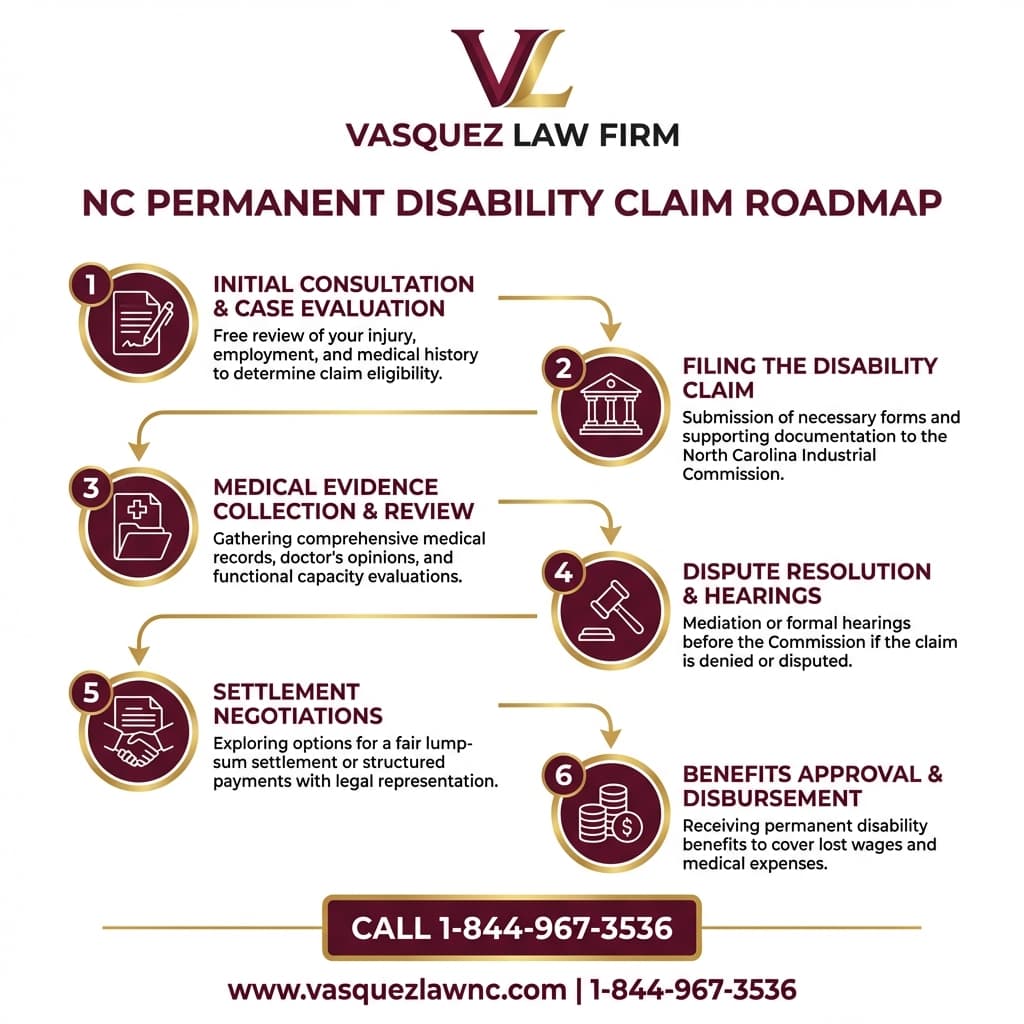
Steps to Secure Permanent Disability Benefits in 2026
Securing permanent disability benefits in North Carolina workers' compensation involves several critical steps. Following these steps carefully can significantly impact the success of your claim and ensure you receive the compensation you deserve. The process can be lengthy and challenging, but with proper guidance, you can navigate it effectively.
- Report Your Injury Promptly: Always report your workplace injury to your employer immediately, ideally in writing. North Carolina law requires reporting within 30 days, but sooner is always better. Delaying can jeopardize your claim.
- Seek Medical Attention: Get immediate medical care for your injury. Follow all doctor's orders, attend all appointments, and keep detailed records of your treatment. Consistent medical documentation is crucial for proving your permanent disability.
- File a Claim with the NC Industrial Commission: Complete and file Form 18 (Notice of Accident to Employer and Claim of Employee) or Form 18B (Notice of Accident to Employer and Claim of Employee for Occupational Disease) with the NCIC. This formally initiates your workers' compensation claim.
- Reach Maximum Medical Improvement (MMI): Continue treatment until your doctor determines you have reached MMI. At this point, your condition is stable, and further improvement is not expected.
- Obtain an Impairment Rating: Your treating physician will assess your permanent impairment and assign a rating, typically a percentage. This rating is a key factor in calculating Permanent Partial Disability (PPD) benefits.
- Negotiate with the Insurance Carrier: Based on your impairment rating and other factors, the insurance company will likely make an offer for PPD benefits. This is a critical stage for negotiation, as initial offers may be low.
- Consider a Second Medical Opinion: If you believe your impairment rating is too low, or if the insurance company disputes it, your attorney can help you seek an independent medical examination (IME) to get a second opinion.
- Attend Hearings or Mediation: If an agreement cannot be reached, your case may proceed to mediation or a formal hearing before the NCIC. Your attorney will represent you, present evidence, and argue your case.
- Explore Vocational Rehabilitation: If your permanent disability prevents you from returning to your pre-injury job, vocational rehabilitation services may be offered to help you find suitable alternative employment.
- Finalize Settlement or Award: Once an agreement is reached or a decision is made by the NCIC, your benefits will be finalized either through a formal award or a lump-sum settlement.
Common Mistakes and How to Avoid Them
Navigating a permanent disability claim in North Carolina workers' compensation can be fraught with pitfalls. Avoiding common mistakes is just as important as taking the right steps. These errors can significantly delay your claim, reduce your benefits, or even lead to a denial. Be proactive and informed to protect your rights.
- Delaying Injury Reporting: Failing to report your injury to your employer within the statutory 30-day window can lead to your claim being denied. Always report it immediately and in writing.
- Not Seeking Prompt Medical Attention: Delaying medical care or failing to follow your doctor's treatment plan can make it difficult to prove your injury's work-relatedness and the extent of your permanent disability.
- Missing Filing Deadlines: The NC Industrial Commission has strict deadlines for filing claims and other documents. Missing these can result in your claim being barred permanently.
- Providing Recorded Statements Without Counsel: Insurance adjusters may ask for recorded statements. Anything you say can be used against you. Always consult with an attorney before giving a statement.
- Failing to Disclose Pre-Existing Conditions: While a pre-existing condition doesn't automatically bar your claim, failing to disclose it can harm your credibility. Be honest with your doctors and attorney.
- Returning to Work Too Soon or Against Medical Advice: Going back to work before your doctor clears you, or performing duties beyond your restrictions, can suggest your injury isn't as severe as claimed.
- Settling Too Early Without Legal Advice: Accepting an initial settlement offer without understanding its full implications can mean you waive rights to future medical care or additional benefits.
- Not Documenting Everything: Keep detailed records of all medical appointments, mileage, lost wages, communications with your employer and the insurance company. Documentation is key evidence.
- Underestimating Your Impairment: Don't downplay your symptoms or limitations to your doctor or the insurance company. Be honest and thorough about how your injury affects your daily life and work.
- Failing to Seek Legal Representation: The workers' compensation system is complex. Trying to navigate it alone against experienced insurance adjusters and lawyers often leads to suboptimal outcomes.
If you only remember one thing: Always prioritize medical treatment and consult with an experienced North Carolina workers' compensation attorney as early as possible to protect your rights and maximize your benefits.
North Carolina Workers' Comp Specifics for Permanent Disability
Workers' compensation laws, especially concerning permanent disability, are highly state-specific. While general principles might apply nationwide, the details of eligibility, calculation, and dispute resolution vary significantly. For those in North Carolina, understanding the specific rules and regulations of the North Carolina Industrial Commission (NCIC) is paramount. This section focuses exclusively on the nuances of permanent disability within the Tar Heel State.
North Carolina Impairment Ratings
In North Carolina, impairment ratings are typically assigned by your authorized treating physician once you reach Maximum Medical Improvement (MMI). These ratings follow guidelines, most commonly the AMA Guides to the Evaluation of Permanent Impairment. The percentage assigned directly influences the amount of Permanent Partial Disability (PPD) benefits you receive for scheduled body parts, as outlined in N.C. Gen. Stat. § 97-31. For injuries to the back or neck, or other non-scheduled body parts, a whole person impairment rating may be given, which can be more challenging to calculate and often requires an attorney's expertise.
North Carolina Permanent Total Disability Criteria
Qualifying for Permanent Total Disability (PTD) in North Carolina is stringent. The NCIC considers an injured worker to be permanently and totally disabled if they:
- Have lost both hands, both arms, both feet, both legs, both eyes, or any two thereof.
- Are paralyzed in both arms or both legs, or the trunk of the body.
- Suffer from an incurable insanity or imbecility.
- Have an injury to the brain resulting in severe, permanent, and intractable neurological or psychiatric disorder.
- Cannot earn wages in any employment, and have been unsuccessful in good faith efforts to obtain employment suitable to their capacity.
The last point, known as the 'odd-lot' doctrine, is frequently litigated. It requires proving not just that you can't do your old job, but that you can't do any job available in the open labor market. This often involves vocational experts and extensive job searches. Vasquez Law Firm has extensive experience demonstrating PTD eligibility to the NCIC.
North Carolina Settlement Options
In North Carolina, permanent disability claims often resolve through a settlement. This can be a Form 26A (Agreement for Permanent Partial Disability) for scheduled losses, or a Clincher Agreement, which is a full and final settlement of all rights under the Workers' Compensation Act. A Clincher Agreement typically involves a lump-sum payment and closes out your claim, including future medical benefits. Deciding whether to accept a Clincher Agreement is a monumental decision that should only be made after consulting with an attorney who can evaluate the full value of your claim.
When to Call a Lawyer for Your Permanent Disability Claim
The complexities of a permanent disability claim in North Carolina's workers' compensation system make legal representation almost essential. Knowing when to call a lawyer can make a significant difference in the outcome of your case. Don't wait until it's too late to get the professional guidance you need. Here are key triggers indicating it's time to contact Vasquez Law Firm:
- Your Claim is Denied: If your workers' compensation claim, or specific benefits, have been denied, you need immediate legal help to appeal the decision.
- The Insurance Company Disputes Your Impairment Rating: If the insurer tries to reduce your doctor's impairment rating or sends you to their own doctor for a lower rating.
- You're Offered a Low Settlement: If the insurance company makes an offer that seems too low, or attempts to settle your case with a lump sum that doesn't cover your future needs.
- You're Being Pressured to Return to Work: If your employer or the insurance company is pressuring you to return to work before your doctor clears you, or to duties beyond your restrictions.
- Your Employer Retaliates Against You: If you face adverse employment actions (e.g., termination, demotion) after filing a claim for permanent disability.
- You're Unable to Return to Your Old Job: If your permanent disability prevents you from performing your pre-injury job, or any suitable alternative employment.
- You Need Ongoing Medical Care: If your injury requires long-term medical treatment, prescriptions, or equipment, and the insurance company is denying coverage.
- You Don't Understand the Process: If you feel overwhelmed by paperwork, deadlines, or the legal jargon of the workers' compensation system.
- You're Considering a Clincher Agreement: Before signing any full and final settlement, you need an attorney to ensure it's fair and protects your long-term interests.
- You Believe You Qualify for Permanent Total Disability: PTD claims are complex and highly contested. You'll need strong legal advocacy to prove your inability to work.
About Vasquez Law Firm
At Vasquez Law Firm, we combine compassion with aggressive representation. Our motto "Yo Peleo" (I Fight) reflects our commitment to standing up for your rights. We understand the physical, emotional, and financial toll a permanent disability can take on individuals and families. That's why we bring over 15 years of dedicated legal experience to every case, fighting tirelessly to ensure our clients receive the justice and compensation they deserve.
- Bilingual Support: Se Habla Español - our team is fully bilingual, ensuring clear communication and understanding throughout your legal journey.
- Service Areas: Workers compensation in North Carolina; immigration nationwide, including Florida
- Experience: With over 15 years in the legal field, Attorney Vasquez has successfully handled thousands of cases, building a reputation for meticulous preparation and fierce advocacy.
- Results: Our firm is dedicated to achieving favorable outcomes, leveraging our deep legal knowledge and strategic approach to maximize our clients' compensation and protect their futures.
Attorney Trust and Experience
Attorney Vasquez holds a Juris Doctor degree and is admitted to practice in both the North Carolina State Bar and Florida Bar. With over 15 years of dedicated legal experience, he has built a reputation for providing personalized attention and achieving favorable outcomes for his clients. He understands the intricacies of workers' compensation law and is committed to guiding you through every step of your permanent disability claim with expertise and care. Don't hesitate to learn more about our team.
Don't face your legal challenges alone. Our team is here to help you every step of the way.
Call today: 1-844-967-3536 | Se Habla Español
Frequently Asked Questions
What conditions automatically qualify you for permanent disability in NC?
No specific conditions automatically qualify you for permanent disability in North Carolina. Each case is evaluated based on medical evidence, the impairment rating, and the impact on your ability to work. While severe injuries like paralysis or loss of multiple limbs often lead to PTD, a formal determination by a physician and the NC Industrial Commission is always required. It's a complex assessment process.
How is permanent disability calculated in North Carolina?
Permanent Partial Disability (PPD) is calculated based on your impairment rating (percentage of loss of use) and a statutory schedule for specific body parts, or the whole person. The weekly rate is typically two-thirds of your average weekly wage, up to a state maximum. Permanent Total Disability (PTD) provides ongoing weekly benefits, also at two-thirds of your average weekly wage, if you cannot return to any gainful employment.
What is the difference between Permanent Partial and Permanent Total Disability?
Permanent Partial Disability (PPD) means you have a lasting impairment but can still work, even if in a modified capacity. Benefits are for a fixed period based on your impairment rating. Permanent Total Disability (PTD) means your injury prevents you from performing any type of gainful employment, entitling you to ongoing weekly benefits, often for life. The criteria for PTD are much stricter.
Can I work while receiving permanent disability benefits in NC?
If you receive Permanent Partial Disability (PPD) benefits, you can often work, as these benefits compensate for your impairment, not your total inability to work. However, if you are receiving Permanent Total Disability (PTD) benefits, working would likely jeopardize your eligibility, as PTD is based on the inability to perform any gainful employment. Always consult your attorney before returning to work.
How long do permanent disability benefits last in North Carolina?
Permanent Partial Disability (PPD) benefits are paid for a specific number of weeks, determined by your impairment rating and the body part injured. Permanent Total Disability (PTD) benefits are generally paid for the remainder of your life or until you reach retirement age, provided you continue to meet eligibility requirements. The duration depends entirely on the type and severity of the permanent disability.
What if my condition worsens after receiving a permanent disability rating?
If your condition significantly worsens after receiving a permanent disability rating, you may be able to seek additional compensation or a re-evaluation of your benefits. This is often possible if your claim remains open or if you can demonstrate a substantial change in your medical condition. It's crucial to document all changes and consult an attorney immediately to explore your options.
Do I need a lawyer for a permanent disability claim in NC?
While not legally required, having a lawyer for a permanent disability claim in North Carolina is highly recommended. The process is complex, involves intricate medical and legal evaluations, and insurance companies often try to minimize payouts. An experienced attorney can advocate for your rights, negotiate fair settlements, challenge low ratings, and represent you before the NC Industrial Commission, significantly improving your outcome.
Can I receive Social Security Disability and NC Workers' Comp simultaneously?
Yes, it is possible to receive both North Carolina workers' compensation and Social Security Disability benefits concurrently. However, there are complex offset rules, known as a "workers' compensation offset," that can reduce your Social Security Disability benefits to prevent overpayment. An attorney can help you structure your workers' comp settlement to minimize this offset and maximize your total benefits.
What evidence is needed to prove permanent disability?
To prove permanent disability in North Carolina, you typically need extensive medical documentation, including physician reports, diagnostic test results (X-rays, MRIs), treatment records, and a formal impairment rating from your treating physician. Expert testimony from medical or vocational specialists may also be required. Thorough documentation of how your injury affects your daily life and work abilities is crucial.
How long does it take to get a permanent disability settlement?
The timeline for a permanent disability settlement in North Carolina varies widely depending on the complexity of your case, the severity of your injury, and whether the insurance company disputes your claim. It can take anywhere from several months to a few years, especially if the case goes to hearings before the NC Industrial Commission. An attorney can help expedite the process.
Sources and References
- North Carolina Industrial Commission (NCIC)
- North Carolina Workers' Compensation Act (N.C. Gen. Stat. § 97)
- North Carolina State Bar
Ready to take the next step? Contact Vasquez Law Firm today for a free, confidential consultation. We're committed to fighting for your rights and achieving the best possible outcome for your case.
Start Your Free Case Evaluation Now
Call us: 1-844-967-3536
Se Habla Español - Estamos aquí para ayudarle.


William Vasquez
Founder & CEO, Vasquez Law Firm, PLLC
William Vasquez is the founder and CEO of Vasquez Law Firm, PLLC, a results-driven firm specializing in immigration, criminal defense, personal injury, and workers' compensation. A U.S. Air Force veteran and recipient of the Joint Service Achievement Medal, William is dedicated to fiercely fighting for his clients' rights.
Related Legal Services
Need legal help? Learn more about workers compensation case consultation, or contact us for a free evaluation.
You can also visit workers compensation services throughout NC for more information.