What Happens If You Lose DACA Status in 2026?
Worried about losing your DACA status in 2026? Learn what it means, steps to take, and how to protect your rights. Contact Vasquez Law for help today.
Published on July 1, 2026· Updated August 6, 2026
Talk to an immigration attorney
Free call. A clear plan for your case.
Free & confidential · Se habla espanol · 24/7
Have questions? Talk to an attorney - free evaluation.
Call 1-844-967-3536Free Tool
Check Your USCIS Case Status Now
Enter your receipt number - get the official USCIS status in English or Spanish. No registration.
What Happens If You Lose DACA Status in 2026?
In 2026, many people with DACA in Orlando and Raleigh worry about what losing DACA status means for their future. This article explains important facts about losing DACA status, problems with renewing it, and choices Dreamers in North Carolina and Florida have. Learn the legal effects of losing DACA and how Vasquez Law Firm can help you with difficult immigration issues.
Need help with your case? Our experienced lawyers are ready to fight for you. Se Habla Español.
Or call us now: 1-844-967-3536
Quick Answer
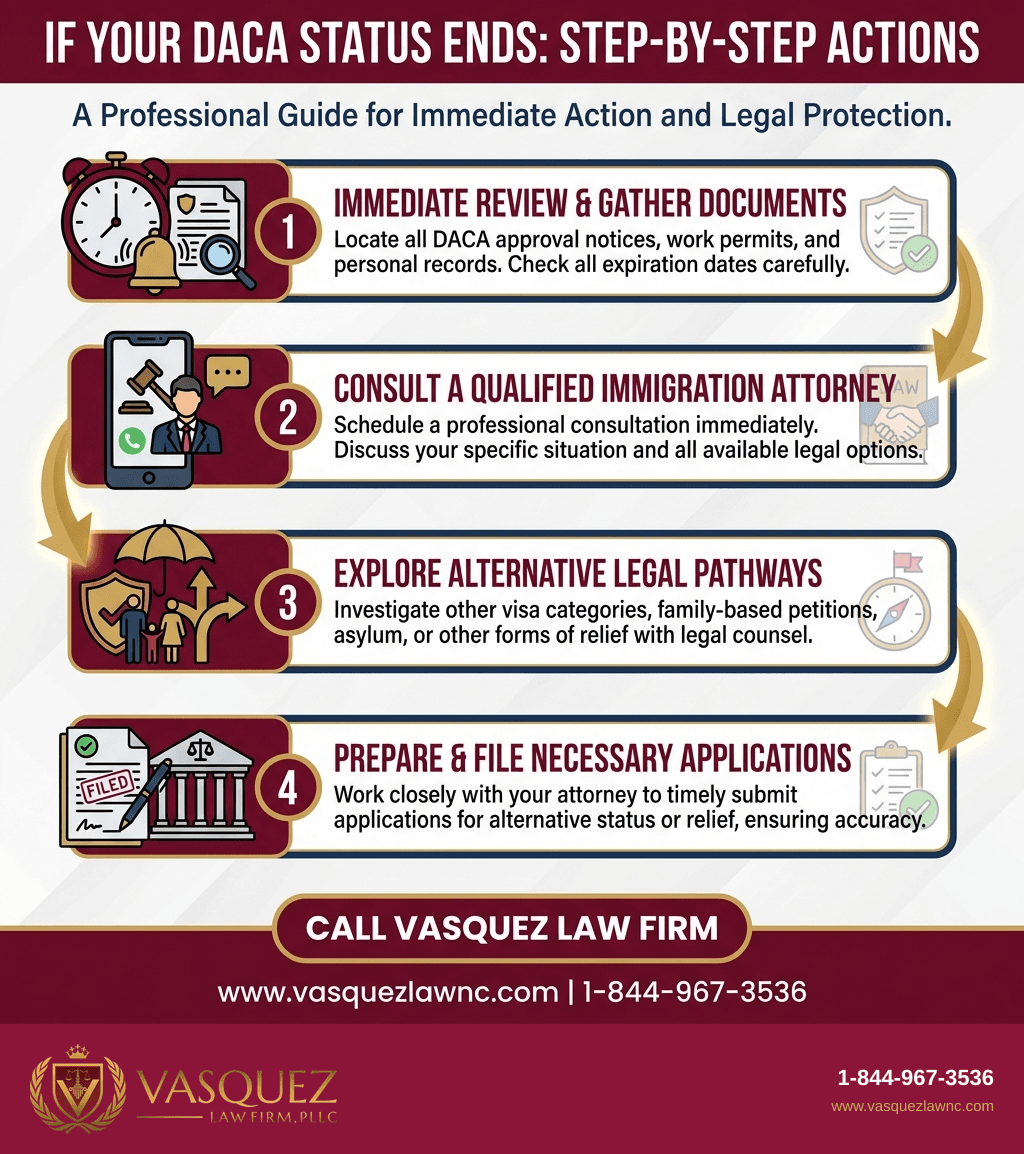
If you lose your DACA status, you lose your permission to work and protection from deportation. You should act fast by contacting an immigration lawyer. Your options may include renewing DACA if you qualify, applying for other immigration help, or getting ready to defend against removal.
- DACA is temporary and can be taken away.
- Renewal needs you to file Form I-821D on time.
- Not renewing puts you at risk of deportation.
- Legal help makes it easier to handle these problems.
- Local help is available in Orlando and Raleigh.
Understanding DACA Status and Loss
Think about Carolina, a young woman living in Orlando who has had DACA since 2015. Suddenly, because of changes in immigration rules and a late renewal, her DACA status ends. What does this mean for her daily life and legal situation? DACA, or Deferred Action for Childhood Arrivals, is a federal program that gives temporary protection from deportation and work permits to certain undocumented people who came to the U.S. before age 16 and meet other rules.
When DACA status ends, the person loses protection from removal right away. They also lose the work permit that let them work legally. Because DACA is a choice by the government and temporary, USCIS can cancel it anytime, especially if people do not renew on time or no longer qualify. Knowing what happens when you lose DACA is very important for Dreamers in North Carolina and Florida.
Our immigration legal services team in Raleigh and Orlando helps clients like Carolina who face hard situations with DACA status. Staying updated with USCIS official guidance and recent DACA news 2026 is key to protecting your future.
Steps to Take if You Lose DACA Status
- Talk to an immigration lawyer right away who knows DACA cases. Timing is very important to avoid deportation.
- Check if you can renew DACA or get other immigration benefits like family-based status or humanitarian protections.
- Gather all important papers such as past approval letters, ID, and proof you lived in the U.S. continuously.
- File your DACA renewal application using Form I-821D if you qualify, and meet USCIS deadlines.
- Get ready for possible removal hearings by collecting papers and evidence that support your case or defenses.
- Do not work or travel without permission because this can make your immigration status worse.
- Keep up with changes in immigration laws and rules that might affect your status.
Contact Vasquez Law Firm for a free meeting and to start protecting your rights as soon as possible.
Important Documents for DACA Renewal
- Filled USCIS Form I-821D: The application to renew DACA.
- Proof you lived in the U.S. continuously: Leases, school records, pay stubs.
- ID documents: Passport, state ID, or birth certificate.
- Past DACA approval letters: Form I-797 approval notices.
- Proof of education or military service: High school diploma, GED, or Armed Forces records.
- Criminal records: Papers explaining any arrests or tickets (if any).
- Photos: Recent passport-style photos that meet USCIS rules.
Missing or wrong papers cause delays or denial of your application. Our legal team in Orlando helps collect and check all your papers carefully.
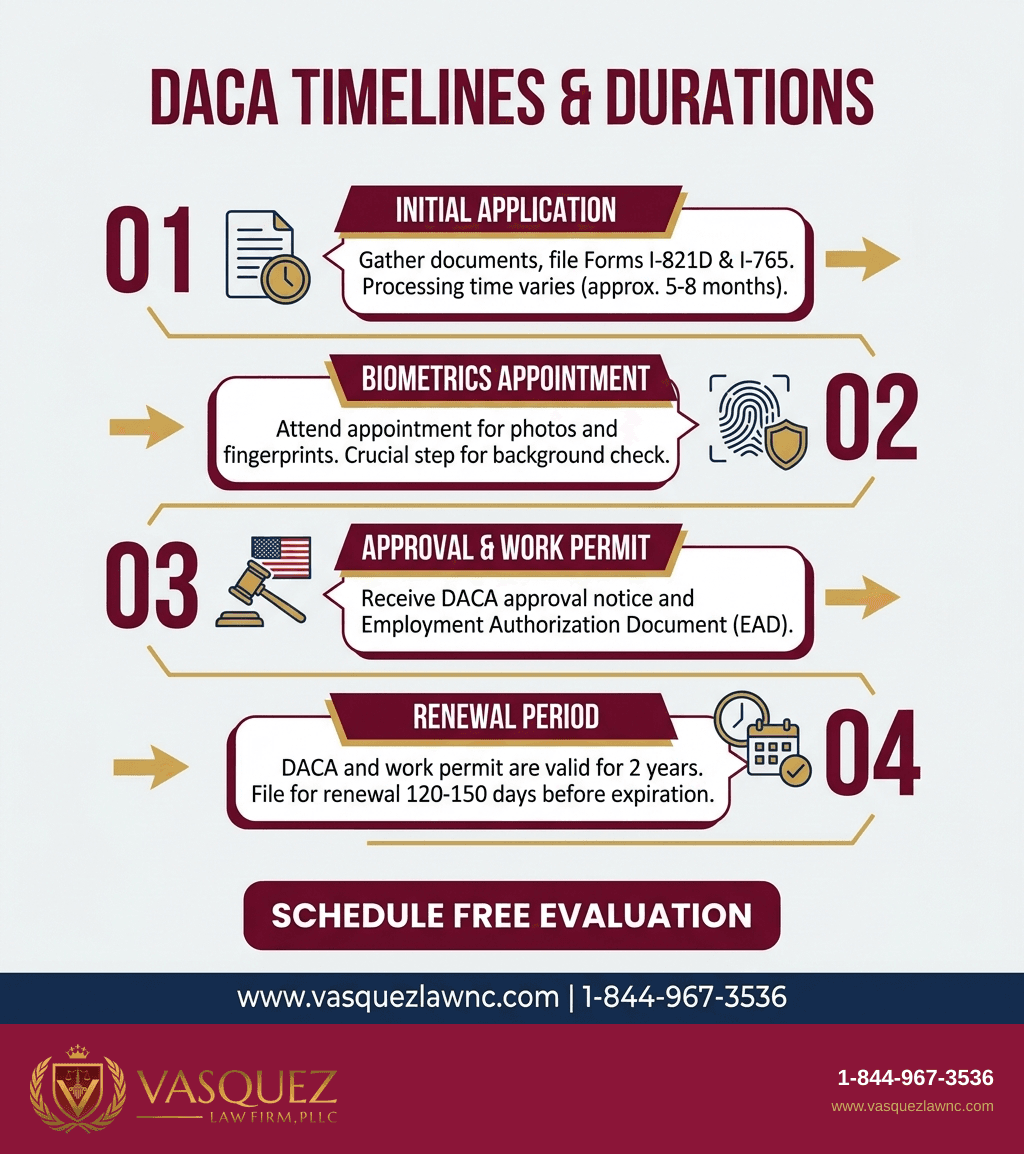
Timeline and What to Expect for Renewal
USCIS takes about 9 to 14 months to process DACA applications and renewals in 2026, according to USCIS Processing Times.
- Send your renewal application 150 to 120 days before your current DACA expires.
- USCIS sends a Notice of Action to confirm they got your application.
- You will get a fingerprint appointment in a few weeks.
- USCIS decides your case in several months depending on their workload.
- If approved, you get a new DACA for two years from your current expiration date.
- If denied, talk to a lawyer right away about your next steps.
This timeline assumes no Requests for Evidence (RFE) or delays. Having a lawyer helps you get approval on time. Vasquez Law in Raleigh and Orlando helps you through the whole renewal process.
Common Mistakes That Risk DACA Status
- Filing renewal late: Missing the 150-day window causes loss of status. Always file early.
- Incomplete or wrong forms: Mistakes on Form I-821D cause delays or denial.
- Not telling about criminal history: Hiding arrests can cause denial and block future help.
- Working or traveling without permission: Doing this risks losing your status.
- Ignoring USCIS notices: Missing appointments or ignoring RFEs leads to denial.
- Not knowing changes in eligibility: Changes in your situation may affect your eligibility and must be reported.
- Trusting informal advice or online forums (like DACA Reddit): Wrong information can hurt you.
If you remember only one thing: File renewals on time and fill forms correctly with legal help to keep your DACA status.
North Carolina and Florida Notes for DACA Holders
North Carolina Notes
In North Carolina, people with DACA can get a state driver’s license if they show proof of permission to be here. Local offices like those in Raleigh help with immigration forms. USCIS field office work affects processing times. Knowing state rules is very important. Vasquez Law Firm’s Raleigh office helps Dreamers in North Carolina learn about local resources and legal choices.
Florida Notes
In Orlando, DACA recipients can also get driver’s licenses and work permits. Because Florida has many immigrants, USCIS centers here may have more cases, which can slow processing. Vasquez Law Firm’s Orlando office offers bilingual help for DACA Dreamers facing complex immigration rules.
Nationwide Concepts
Even though DACA is a federal program, how it works can differ by USCIS district. Federal courts also affect DACA’s future through ongoing lawsuits. Immigration policies may change with new government leaders. Staying updated with official USCIS news and talking to skilled lawyers across the country is very important.
When to Call an Immigration Lawyer Now
- If your DACA status has ended or is about to expire.
- If you get a USCIS Notice of Intent to Deny or a Request for Evidence.
- After any arrest or criminal charge, even if small.
- If you face removal or deportation hearings.
- If you have trouble getting or renewing your DACA work permit.
- If you want to look at other immigration benefits besides DACA.
- If you are confused by changing DACA rules or news.
- Before traveling outside the U.S. without advance parole permission.
About Vasquez Law Firm
At Vasquez Law Firm, we mix care with strong representation. Our motto "Yo Peleo" (I Fight) shows our promise to stand up for your rights.
- Bilingual Support: Se Habla Español Spanish-speaking lawyers and staff available
- Service Areas: North Carolina, Florida, and immigration help nationwide
- Experience: Over 30 years helping clients with hard legal matters
- Results: Thousands of successful cases in many practice areas
Attorney Trust and Experience
William J. Vásquez is licensed to practice in North Carolina and the U.S. Courts of Appeals for the 4th, 5th, 6th, and 11th Circuits. Florida cases at the firm are handled by Florida Bar lawyer Alekssandra Lopez. Since 2011, Vasquez Law Firm has given focused legal help with personal attention to each client.
Don't wait to get the help you need. Call us now for quick help. Se Habla Español.
Frequently Asked Questions
What does DACA mean?
DACA stands for Deferred Action for Childhood Arrivals. It lets certain undocumented people brought to the U.S. as children get temporary protection from deportation and work permits. But it does not give permanent immigration status or a path to citizenship by itself.
Is DACA now illegal in 2026?
DACA is still valid across the country in 2026 but faces legal challenges. Courts have made different decisions. There is no permanent federal law, so the program’s future depends on ongoing lawsuits and policy changes.
Can someone with DACA be deported?
Yes, DACA does not guarantee protection. Breaking rules or criminal acts can lead to removal hearings. DACA is a choice by the government and can be canceled.
Can DACA recipients become U.S. citizens?
DACA is temporary and does not give citizenship. People with DACA can try other ways like family petitions or work-based options that lead to permanent residency and later citizenship.
What are the benefits of Deferred Action for Childhood Arrivals?
It gives protection from deportation, permission to work, and access to Social Security numbers. Some states let DACA holders get driver’s licenses.
What is the DACA renewal process?
Renewal means filing Form I-821D about 120-150 days before your DACA expires with updated papers. USCIS takes about 9 to 14 months to process renewals now.
Who is eligible for DACA?
Applicants must have come before age 16, lived continuously since June 15, 2007, be under 31 years old in 2012, and meet other rules like education or military service.
What should I do if my DACA application is denied?
Talk to an immigration lawyer right away. They can help you appeal, refile correctly, or find other immigration help.
Sources and References
- U.S. Citizenship and Immigration Services
- Executive Office for Immigration Review
- Legal Information Institute
Take the first step toward justice today. Our team is ready to help. Se Habla Español.
Start Your Free Evaluation Now
Call us: 1-844-967-3536
Se Habla Español - We are here to help you.


William Vasquez
Founder & CEO, Vasquez Law Firm, PLLC
William Vasquez is the founder and CEO of Vasquez Law Firm, PLLC, a results-driven firm specializing in immigration, criminal defense, personal injury, and workers' compensation. A U.S. Air Force veteran and recipient of the Joint Service Achievement Medal, William is dedicated to fiercely fighting for his clients' rights.
Related Legal Services
Need legal help? Learn more about speak with an immigration lawyer, or contact us for a free evaluation.
You can also visit our NC immigration team for more information.