How Immigration Processing Works in Orlando in 2026
Learn how immigration processing works in Orlando in 2026. Understand key steps, timelines, and costs. Contact Vasquez Law for a free evaluation.
Published on June 5, 2026
Talk to an immigration attorney
Free call. A clear plan for your case.
Free & confidential · Se habla espanol · 24/7
Have questions? Talk to an attorney - free evaluation.
Call 1-844-967-3536Worried how the latest immigration news affects you?
Schedule a confidential case review with an immigration attorney - know exactly where you stand.
How Immigration Processing Works in Orlando in 2026
Immigration processing presents complex challenges that affect thousands of applicants in Orlando each year. In 2026, navigating USCIS procedures requires understanding processing times, paperwork, and legal requirements to protect your rights. This article explains immigration processing clearly for residents in Orlando, NC, and FL, outlining key steps, typical timelines, costs, and common mistakes to avoid. Whether seeking family-based adjustment or other immigration benefits, knowing what to expect helps you stay informed and prepared throughout the process.
Need help with your case? Our experienced attorneys are ready to fight for you. Se Habla Español.
Or call us now: 1-844-967-3536
Quick Answer
Immigration processing involves multiple steps including application submission, biometric appointments, interviews, and final decisions by USCIS. Processing times vary by case type and USCIS workload, often ranging from several months to over a year as of 2026.
- USCIS updates processing times regularly online
- I-130 petitions for spouses commonly take 10 to 20 months
- Delays may occur due to requests for evidence or background checks
- Staying organized and responding promptly reduces processing delays
- Legal guidance improves chances of successful outcomes
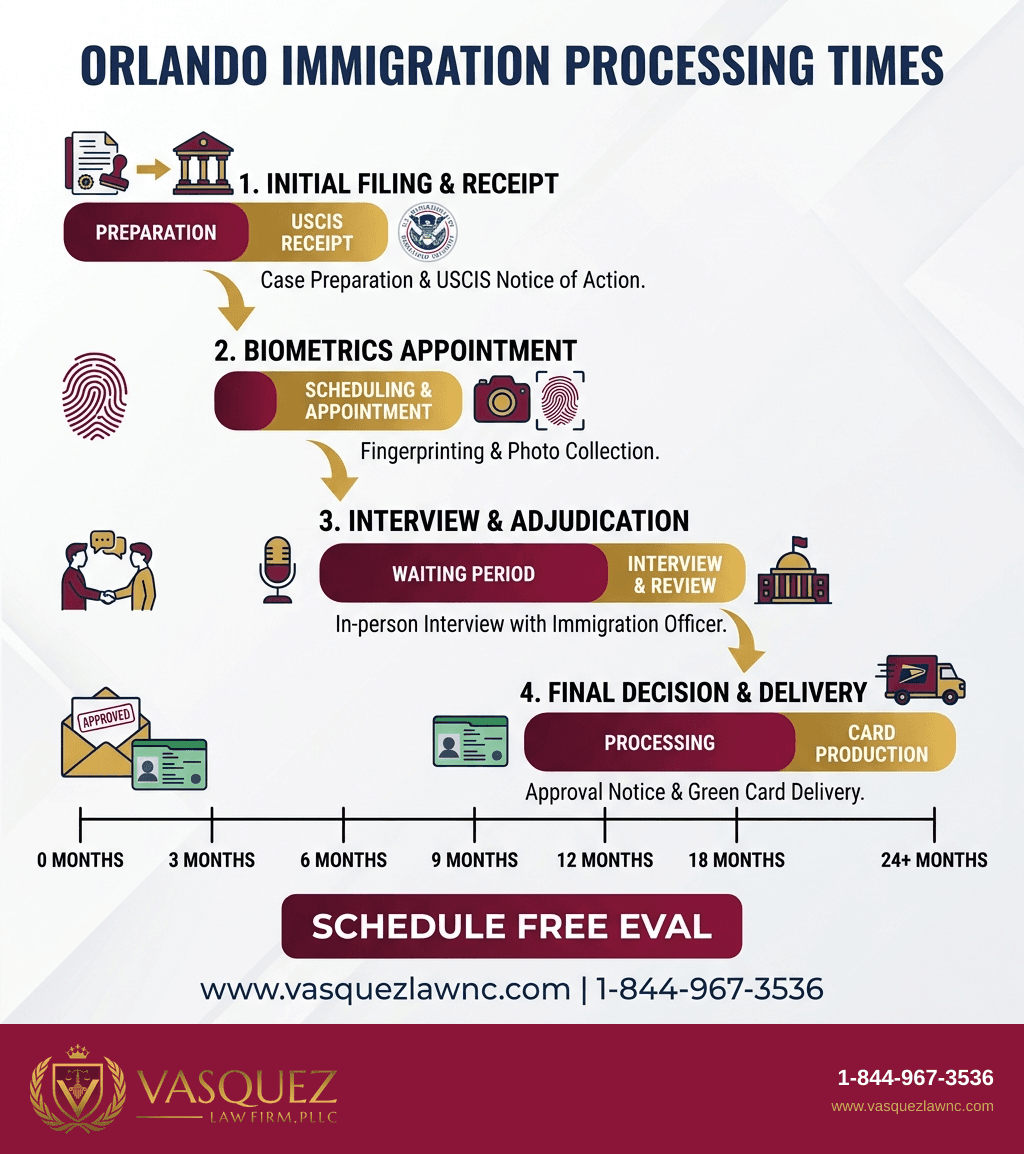
Infographic: Visual timeline of immigration processing from application to decision, highlighting key steps and estimated durations.
Understanding immigration processing
Imagine submitting your immigration petition and waiting months without clarity on progress. Immigration processing means handling forms, background checks, and interviews with the government agency in charge, USCIS. For example, family-based petitions like Form I-130 have average processing times of 10 to 20 months depending on your location and service center. In 2026, USCIS maintains updated processing times online at https://egov.uscis.gov/processing-times/.
Processing is a federal procedure governed by laws such as 8 U.S.C. § 1255 addressing adjustment of status and 8 C.F.R. § 245.1 on eligibility. It involves document review, biometric screening, and possible interviews. The process also includes inquiries by USCIS if more information is needed.
Errors or missing information can cause requests for evidence (RFE), which add months. Hence, understanding the basic immigration process helps applicants in Orlando and Raleigh plan ahead.
What agencies oversee immigration processing?
- USCIS: Handles visa petitions, adjustment of status, naturalization, and related applications.
- Immigration Courts (EOIR): Manages removal and deportation cases.
- ICE: Responsible for enforcement and detention.
Why does processing time vary?
Times vary due to factors like case type, USCIS workload, background check complexity, and pandemic-related delays. For example, I-130 processing time in 2026 fluctuates based on service centers and if additional security checks apply.
Typical forms involved
- I-130 (Petition for Alien Relative)
- I-485 (Application for Adjustment of Status)
- I-765 (Employment Authorization Document)
- I-131 (Travel Document)
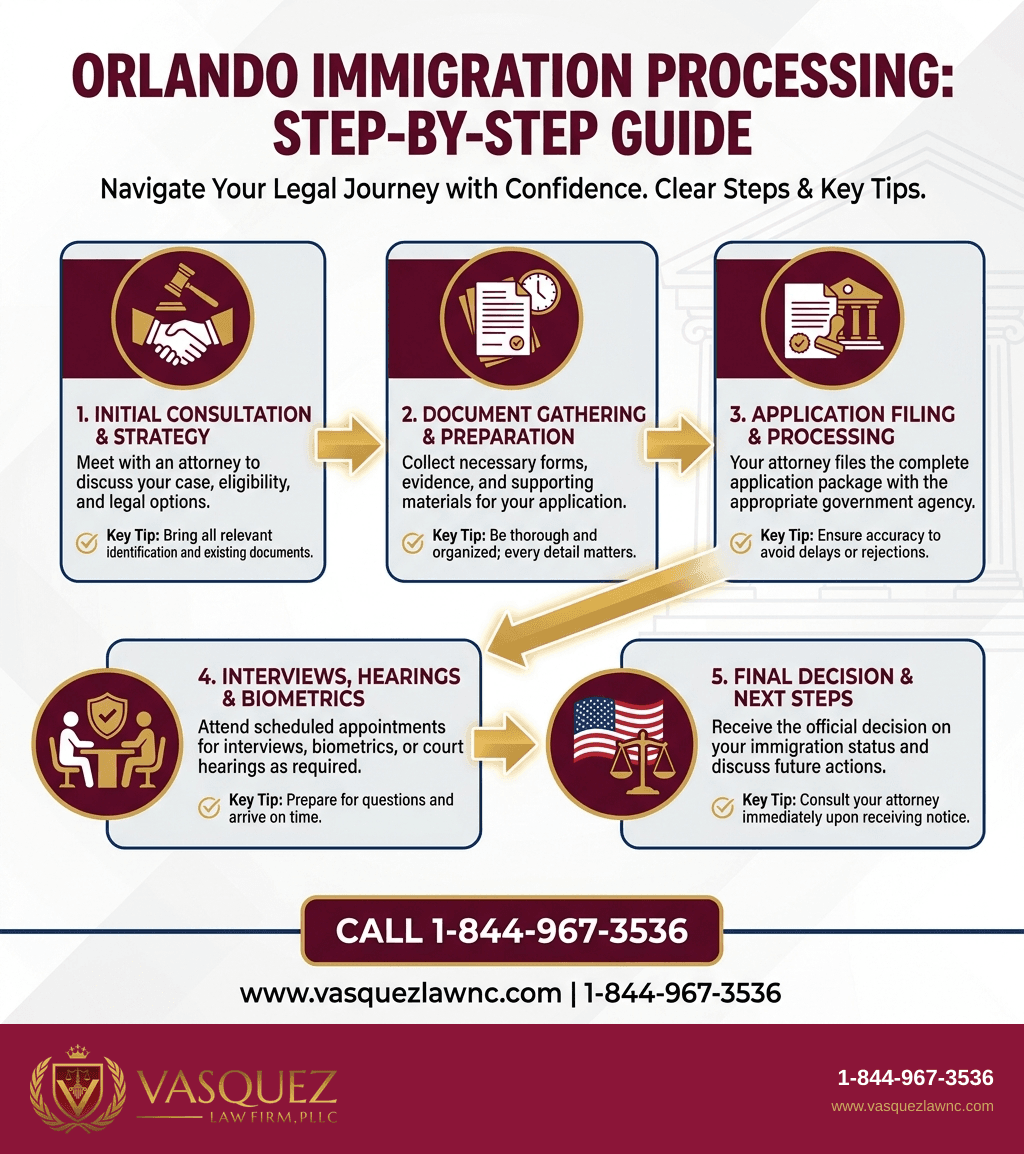
Step-by-step: What to do
- Gather required evidence such as proof of relationship, identity documents, and supporting letters.
- File the correct USCIS form with fees to the proper USCIS lockbox facility.
- Receive USCIS Receipt Notice confirming application acceptance.
- Attend biometrics appointment scheduled by USCIS for fingerprinting and photo.
- Respond promptly to any Requests for Evidence (RFE) to avoid delays.
- Prepare for a USCIS interview if required, especially for family-based petitions.
- Monitor case status online using your receipt number on the USCIS website.
- Receive decision approving, denying, or requesting additional information.
Common forms and timelines example
For a spouse petition via I-130, the typical processing time in 2026 is 10 to 20 months. If concurrently filing I-485, additional steps and waiting periods apply. DACA renewals, for instance, currently take 14 to 22 months according to USCIS data for form I-821D (source).
How to prepare
- Keep detailed personal records
- Track deadlines closely
- Consult knowledgeable immigration attorneys for complex cases
Documents or evidence checklist
- Completed USCIS forms (e.g., I-130, I-485, I-765)
- Proof of U.S. citizenship or lawful status of petitioner
- Birth certificates, marriage certificates, and other civil documents
- Passport-style photos
- Proof of bona fide relationship for family cases
- Receipts for filing fees
- Documentation supporting eligibility (e.g., medical exams, police clearances)
- Translations certified by qualified translators
Timeline: What to expect
- Receipt of application: 2-3 weeks after filing
- Biometrics appointment: Usually within 4-8 weeks
- RFE response window: Typically 30-90 days
- Interview scheduling: 6-12 months after filing, varies widely
- Final decision: 10-20 months for I-130 in 2026
- Possible appeals or motions: Additional months if case denied
Example timeline for I-130 spouse petition
In Orlando, expect initial USCIS Receipt Notice in about 3 weeks, biometrics in 6 weeks, interview within 9 to 12 months, and decision within 12 to 20 months.
USCIS inquiry processing time
Inquiring about a pending case can take USCIS several weeks to respond. Generally, case inquiry requests are processed within 15 to 45 calendar days depending on the service center workload.
Costs and fees: What impacts the price
- Filing fees vary by application type (e.g., I-130 fee is $535 as of 2026)
- Attorney fees depend on case complexity; consultation fees may vary
- Costs for supporting evidence like translations, medical exams, or biometrics appointments
- Additional filing fees for work permits and travel documents if requested
- Possible extra fees for appeals or motions if denied
Budgeting for these expenses and working with a knowledgeable attorney can reduce unexpected costs and delays.
Common mistakes and how to avoid them
- Filing incomplete forms – double-check all fields before submitting.
- Missing deadlines – set reminders for USCIS timelines and RFE responses.
- Ignoring USCIS Requests for Evidence – timely respond with complete documents.
- Failing to attend biometric appointments or interviews – always attend and inform if a reschedule is needed.
- Not keeping copies of all filings and correspondence – maintain a detailed file.
- Waiting too long to seek legal help – consult early to avoid mistakes that cause denials.
- Assuming processing times are static – track USCIS changes and updates frequently.
- Using unreliable or unverified translations – use certified translators for all foreign documents.
If you only remember one thing: Respond promptly to any USCIS communication and keep your case organized.
Infographic: Visual list of frequent errors applicants make and how to prevent them.
NC, FL, and nationwide notes
North Carolina notes
USCIS field offices in Raleigh handle interviews and biometrics appointments for applicants residing in North Carolina. State-specific documentation requirements may apply, especially for benefits tied to employment or education. Vasquez Law Firm's Raleigh office offers in-person help for immigration processing in NC.
Florida notes
In Orlando, USCIS conducts local processing steps including interviews and biometrics. Florida residents face similar federal rules but must be mindful of tighter state policies around enforcement and deportation. Vasquez Law Firm has an Orlando office to provide hands-on assistance for immigration cases in Florida.
Nationwide concepts (general only, rules vary)
Immigration laws are federal, but processing times and local USCIS offices vary by region. Nationwide, delays can arise from increased security checks and policy changes. Applicants should track their case status on the USCIS website and remain proactive regardless of location.
When to call a lawyer now
- If you receive a Request for Evidence and are unsure how to respond
- Facing removal or deportation proceedings
- If USCIS denies your petition or application
- When processing times exceed normal ranges significantly without updates
- For help with complex cases like waivers or asylum claims
- If you get summoned for an interview and want legal help preparing
- When you encounter status issues like lost or delayed employment authorization
- If you need assistance navigating USCIS inquiries or requests
About Vasquez Law Firm
At Vasquez Law Firm, we combine compassion with aggressive representation. Our motto "Yo Peleo®" (I Fight) reflects our commitment to standing up for your rights.
- Bilingual Support: Se Habla Español — Spanish-speaking attorneys and staff available
- Service Areas: North Carolina, Florida, and nationwide immigration services
- Experience: Over 30 years helping clients navigate complex legal matters
- Results: Thousands of successful cases across multiple practice areas
Attorney Trust and Experience
William J. Vásquez is admitted to the North Carolina State Bar (2011) and to the U.S. Courts of Appeals for the 4th, 5th, and 11th Circuits. Florida-jurisdiction matters at the firm are handled by Florida Bar attorney Harold Estrada-Rodriguez (FL Bar No. 1041171). The firm has provided dedicated legal representation since 2011, with personalized attention to each client's case.
Don't wait to get the help you deserve. Call us now for immediate assistance. Se Habla Español.
Frequently Asked Questions
What is the average processing time for an I-130 petition in 2026?
In 2026, the average USCIS processing time for an I-130 petition (family-based) varies between 10 and 20 months depending on the service center. You can check specific processing times on the USCIS website to stay updated on your case's expected timeline.
Can I check the status of my immigration case online?
Yes. USCIS provides an online case status tool where you can enter your receipt number to track progress. Checking frequently helps you stay informed about deadlines and any additional requests from USCIS.
What happens if USCIS requests additional evidence?
If you receive a Request for Evidence (RFE), you must respond within the specified deadline with the requested documents. Failure to respond can result in denial. Getting legal help is recommended for preparing a thorough response.
Is it normal for my immigration case to take more than a year?
Yes. Depending on the petition or application, processing can take from several months to over a year due to USCIS workload, background checks, or case complexity. Patience and careful monitoring are essential.
Does marriage to a U.S. citizen guarantee a green card?
No. While marriage to a U.S. citizen is a basis for petitioning an immigrant visa, USCIS requires proof the marriage is genuine and meets all legal standards. Background checks and interviews are part of the process.
Are people with green cards subject to deportation?
Yes, green card holders can be deported for certain criminal convictions or immigration violations under 8 U.S.C. § 1227. It is important to consult with an attorney if you face removal proceedings.
How long does it take USCIS to respond to case inquiries?
Typically, USCIS responds to case inquiries within 15 to 45 days. It is important to only file inquiries if your case has exceeded the posted processing time to avoid delays.
Can I work while my immigration application is pending?
You may be eligible for employment authorization by filing Form I-765. Approval times vary but often take 4 to 6 months. Do not start work until authorized, or you risk legal consequences.
Sources and References
- U.S. Citizenship and Immigration Services
- Executive Office for Immigration Review
- Legal Information Institute
Take the first step toward justice today. Our team is standing by to help. Se Habla Español.
Start Your Free Evaluation Now
Call us: 1-844-967-3536
Se Habla Español - Estamos aquí para ayudarle.
If you need legal assistance, learn more about our immigration law practice, or call us at 1-844-967-3536 for a free evaluation.


William Vasquez
Founder & CEO, Vasquez Law Firm, PLLC
William Vasquez is the founder and CEO of Vasquez Law Firm, PLLC, a results-driven firm specializing in immigration, criminal defense, personal injury, and workers' compensation. A U.S. Air Force veteran and recipient of the Joint Service Achievement Medal, William is dedicated to fiercely fighting for his clients' rights.
Related Legal Services
Need legal help? Learn more about our immigration law practice, or contact us for a free evaluation.
You can also visit our NC immigration team for more information.