How Legal Immigration Processing Works in Orlando in 2026
Learn how legal immigration processing works in Orlando in 2026. Understand steps and requirements. Contact Vasquez Law for a free evaluation.
Published on June 5, 2026
Talk to an immigration attorney
Free call. A clear plan for your case.
Free & confidential · Se habla espanol · 24/7
Have questions? Talk to an attorney - free evaluation.
Call 1-844-967-3536Worried how the latest immigration news affects you?
Schedule a confidential case review with an immigration attorney - know exactly where you stand.
How Legal Immigration Processing Works in Orlando in 2026
Legal immigration processing in Orlando involves multiple steps governed by current U.S. immigration laws, including forms, timelines, and requirements. Understanding this process helps aspiring immigrants and Dreamers navigate complex federal regulations confidently. Updated for 2026, this guide explains key phases, typical processing times, documentation needed, common mistakes, and when to seek legal support, with special focus on North Carolina and Orlando, Florida. Whether you seek family sponsorship, work visas, or adjustment of status, knowing how legal immigration processing works is critical to success.
Need help with your case? Our experienced attorneys are ready to fight for you. Se Habla Español.
Or call us now: 1-844-967-3536
Quick Answer
The legal immigration processing system involves filing petitions with USCIS, submitting required documents, attending biometrics and interviews, and waiting for decisions, all overseen by strict federal laws.
- Legal immigration processing follows set steps enforced federally.
- Applicants must meet USCIS immigration requirements and deadlines.
- Processing times vary from months to years depending on case type.
- Proper documentation and legal guidance reduce errors and delays.
- Recent court rulings in 2026 improve processing in Orlando and Raleigh.
Understanding Legal Immigration Processing
Imagine Maria, a Dreamer in Orlando, who wants to adjust her status to become a lawful permanent resident. She files a petition with USCIS and waits months for notification. This process exemplifies the complexities many immigrants face.
Legal immigration processing refers to a series of federal procedures regulated primarily by the Immigration and Nationality Act and enforced by U.S. Citizenship and Immigration Services (USCIS). It includes petitions, interviews, biometrics collection, and adjudications for visas, green cards, and citizenship.
As of 2026, this process is governed by current U.S. immigration laws, incorporating updates from recent judicial decisions such as the lifting of Trump-era curbs on application processing. These developments impact applicants in Orlando and across North Carolina.
Federal statutes like 8 U.S.C. § 1255 cover adjustment of status, allowing many noncitizens in the U.S. to apply for permanent residency without leaving the country, provided they satisfy eligibility requirements. Regulations at 8 C.F.R. § 245.1 detail the criteria USCIS uses to grant or deny applications.
Because immigration laws are complex and frequently changing, applicants benefit from expert advice to navigate legal requirements and USCIS procedural standards effectively. Vasquez Law Firm's immigration lawyers in Raleigh, NC and Orlando, FL, provide this guidance to ease the legal immigration process for clients.
Primary Agencies Involved
- USCIS: Handles form processing, interviews, and approvals.
- Executive Office for Immigration Review (EOIR): Oversees immigration court proceedings if removal becomes an issue.
- Immigration Customs Enforcement (ICE): Conducts investigations and enforcement.
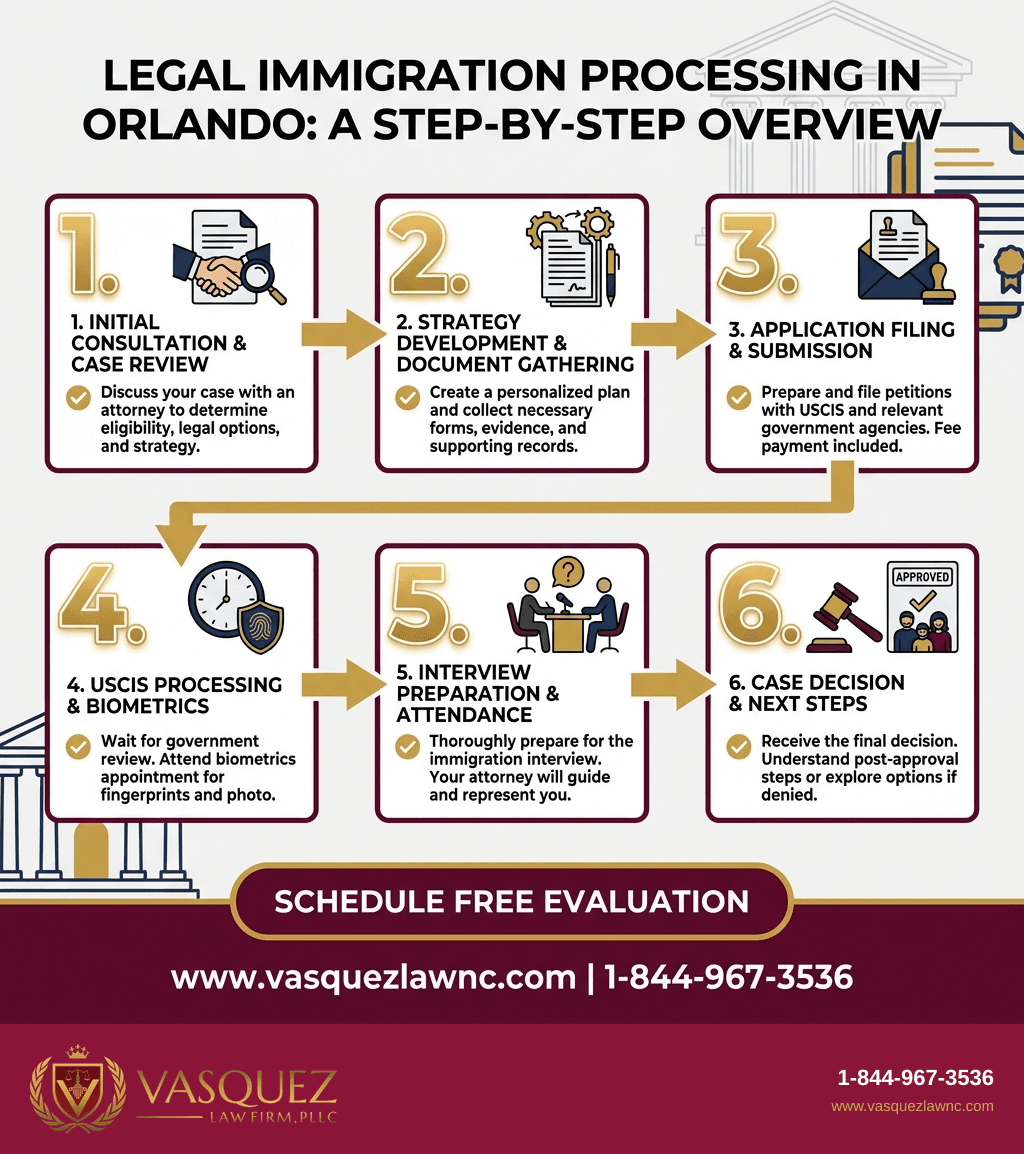
Step-by-Step Legal Immigration Process
Consider Carlos, a Florida client applying for a family-based green card. His journey illustrates the typical 12-step legal immigration process updated for 2026:
- Determine Eligibility: Understand which visa or status applies based on family, employment, or humanitarian grounds.
- File Petition: Submit forms such as I-130 (family) or I-140 (employment) with USCIS.
- Receive Receipt Notice: USCIS acknowledges application and assigns a case number.
- Submit Supporting Documents: Provide birth certificates, passports, financial affidavits, and other evidence.
- Pay Fees: Application fees vary by form and case.
- Attend Biometrics Appointment: USCIS collects fingerprints and photographs for background checks.
- Wait for Interview Notice: Appointment scheduled for applicant to appear at USCIS office.
- Interview: An immigration officer reviews the application in person.
- Receive Decision Letter: USCIS approves, denies, or issues a Request for Evidence.
- Respond to RFEs: If requested, submit additional information timely.
- Final Approval or Denial: Applicant receives permanent resident card or denial notice.
- Appeal or Motion to Reopen if Denied: Legal avenues exist to challenge unfavorable decisions.
This process can take months or longer depending on the case complexity and the current USCIS workload in Orlando or Raleigh.
LSI Keywords: legal immigration process, immigration process steps
Documents and Evidence Checklist
Visa and adjustment applications require precise documentation. Failure to supply requested evidence can delay processing. Applicants commonly need:
- Valid passport(s) from home country.
- Birth and marriage certificates certified by authorities.
- Proof of lawful entry to the U.S. (I-94 forms if applicable).
- Form-specific evidence like job offers or family relationships.
- Financial affidavits showing sufficient support to stay in the U.S.
- Medical examinations from authorized physicians.
- Photographs meeting USCIS specifications.
Gathering these documents early helps avoid delays. Vasquez Law Firm's immigration attorneys assist Orlando and North Carolina clients in preparing thorough evidence sets carefully aligned with USCIS Policy Manual standards.
LSI Keywords: U S immigration requirements, immigration laws list
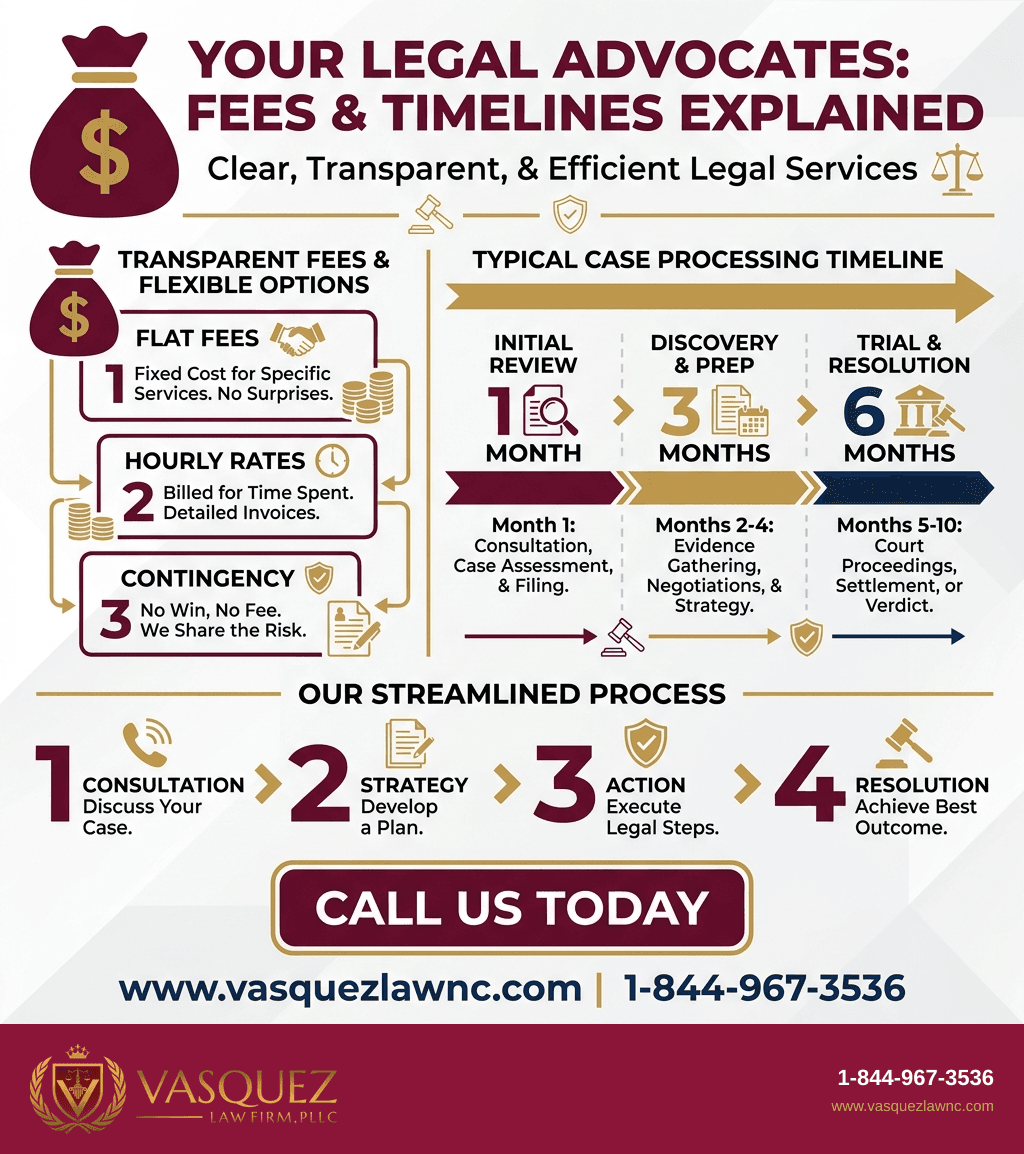
Timeline and What to Expect
USCIS processing times fluctuate by form type and location. According to the USCIS Processing Times website in 2026, here are average waits for common forms in Orlando and Raleigh:
- Form I-130 (Petition for Alien Relative): 7 to 15 months
- Form I-485 (Adjustment of Status): 8 to 14 months
- Form N-400 (Naturalization): 8 to 12 months
- Form I-765 (Employment Authorization): 2 to 6 months
Applicants should plan for some variation due to background checks or additional Requests for Evidence. Legal counsel can help predict realistic timelines and prepare accordingly.
Common Scenario Timeline: Dreamers renewing DACA status in Orlando typically wait 14 to 22 months as per Form I-821D processing trends.
LSI Keywords: immigration process take, U S immigration website
Costs and Fees for Legal Immigration
Application fees depend on the form and vary from $230 for Form I-765 (work permit) up to over $1,200 for Form I-485 (adjustment). Additional costs may arise for medical exams, document translation, and attorney fees.
- Filing Fees: Mandatory government fees paid directly to USCIS.
- Attorney Fees: Vary by case complexity; Vasquez Law Firm offers transparent pricing.
- Other Costs: Biometrics, medical exams, certification, and mailing fees.
Early consultation with a knowledgeable immigration law firm in Raleigh or Orlando helps budget accurately and avoid surprise expenses.
LSI Keywords: U S immigration laws PDF, current U S immigration laws
Common Mistakes and How to Avoid Them
- Submitting incomplete forms. Fix: Double-check all sections are complete before filing.
- Missing deadlines for responses or fee payments. Fix: Use calendar reminders and legal help.
- Providing inconsistent information across forms. Fix: Review for accuracy, consistency.
- Ignoring Requests for Evidence (RFEs). Fix: Respond promptly with all requested documents.
- Failing to disclose criminal or immigration history accurately. Fix: Be honest; consult legal counsel.
- Not including required supporting evidence. Fix: Follow USCIS checklist and get attorney review.
- Attempting DIY applications without legal guidance. Fix: Engage attorneys experienced in NC and FL immigration law.
If you only remember one thing: Proper preparation and legal help reduce costly mistakes and speed your legal immigration processing.
Legal Immigration Processing in NC and FL
North Carolina Notes
In Raleigh and throughout North Carolina, USCIS offices and immigration courts operate following federal immigration rules. Local legal assistance from Vasquez Law Firm ensures compliance with state-specific challenges, including employment verification and driver's license eligibility after status changes.
Florida (Orlando) Notes
Our Orlando office manages legal immigration cases statewide in Florida. Recent updates in processing policies following judicial rulings positively affect applicants here. Clients benefit from attorneys familiar with Florida's immigrant community and USCIS regional procedures.
Nationwide Concepts
While federal law governs immigration nationally, processing times and USCIS workload differ by region. Petitions filed from North Carolina and Florida are subject to these regional variances. Nationwide, staying current on legal reform and immigration law changes is critical.
When to Call a Lawyer Now
- If you received a Request for Evidence (RFE) or Notice of Intent to Deny (NOID).
- If your application case has been pending unusually long beyond posted processing times.
- After a denial or refusal letter from USCIS or immigration court.
- If you have a criminal record or past immigration violations potentially affecting eligibility.
- If you need help filing for complex visas or adjustment of status.
- If you're a Dreamer affected by changes to DACA policies or processing.
- If you were placed in removal (deportation) proceedings.
- Before responding to any immigration official or detention notice.
- If you require help preparing for your USCIS interview.
- When you want a clear evaluation of your best immigration options.
About Vasquez Law Firm
At Vasquez Law Firm, we combine compassion with aggressive representation. Our motto "Yo Peleo®" (I Fight) reflects our commitment to standing up for your rights.
- Bilingual Support: Se Habla Español - Spanish-speaking attorneys and staff available
- Service Areas: North Carolina, Florida, and nationwide immigration services
- Experience: Over 30 years helping clients navigate complex legal matters
- Results: Thousands of successful cases across multiple practice areas
Attorney Trust and Experience
William J. Vásquez is admitted to the North Carolina State Bar (2011) and to the U.S. Courts of Appeals for the 4th, 5th, and 11th Circuits. Florida-jurisdiction matters at the firm are handled by Florida Bar attorney Harold Estrada-Rodriguez (FL Bar No. 1041171). The firm has provided dedicated legal representation since 2011, with personalized attention to each client's case.
Don't wait to get the help you deserve. Call us now for immediate assistance.
Se Habla Español
Frequently Asked Questions
How long does the legal immigration process take?
The length depends on the type of petition and USCIS center workload. For example, I-485 applications take about 8 to 14 months as of 2026. Delays can result from backlogs, RFEs, or security checks. Planning accordingly and getting professional help reduces uncertainty.
What documents should I prepare for immigration processing?
You should have identity and relationship proofs, legal entry records, financial evidence, medical exams, and any form-specific papers like work letters or birth certificates. Accurate documents help avoid requests for more evidence and delays.
Is the legal immigration processing difficult for Dreamers?
Many find it challenging due to changing policies and strict requirements. Dreamers in Orlando rely on legal guidance to navigate renewals and adjustment processes successfully. Experienced attorneys can simplify this complexity.
How do current U.S. immigration laws affect my case?
Recent policy changes and court rulings may speed up or alter eligibility and evidence requirements. Staying updated on laws and rulings ensures your application complies with the latest standards.
What role does USCIS play in the process?
USCIS receives applications, verifies documents, conducts interviews, and grants or denies benefits such as visas and green cards. They enforce federal immigration policies consistently nationwide.
What are the most common mistakes applicants make?
Common errors include incomplete forms, missed deadlines, inconsistent info, ignoring RFEs, and lack of evidence. These mistakes cause delays or denials but can be avoided with proper preparation.
Can changes in immigration laws impact my application?
Yes, new laws or rulings can change eligibility and procedures. Continuous monitoring of legal updates and consulting knowledgeable attorneys help you adapt effectively.
Can I appeal a denied immigration application?
Many denials can be appealed, but strict deadlines apply. Legal advice is crucial to assess grounds for appeal and prepare proper filings to improve chances of success.
Sources and References
- U.S. Citizenship and Immigration Services
- Executive Office for Immigration Review
- Legal Information Institute
Take the first step toward justice today. Our team is standing by to help.
Start Your Free Evaluation Now
Call us: 1-844-967-3536
Se Habla Español - Estamos aquí para ayudarle.
If you need legal assistance, learn more about how our immigration attorneys can help, or call us at 1-844-967-3536 for a free evaluation.
William Vasquez
Founder & CEO, Vasquez Law Firm, PLLC
William Vasquez is the founder and CEO of Vasquez Law Firm, PLLC, a results-driven firm specializing in immigration, criminal defense, personal injury, and workers' compensation. A U.S. Air Force veteran and recipient of the Joint Service Achievement Medal, William is dedicated to fiercely fighting for his clients' rights.
Related Legal Services
Need legal help? Learn more about how our immigration attorneys can help, or contact us for a free evaluation.
You can also visit North Carolina immigration law firm for more information.