Immigration Benefits: How They Impact You in 2026
Understand immigration benefits in 2026, their meaning, and how USCIS rules affect you. Contact Vasquez Law for a free consultation today.
Published on July 7, 2026
Talk to an immigration attorney
Free call. A clear plan for your case.
Free & confidential · Se habla espanol · 24/7

Have questions? Talk to an attorney - free evaluation.
Call 1-844-967-3536Worried how the latest immigration news affects you?
Schedule a confidential case review with an immigration attorney - know exactly where you stand.
Immigration Benefits: How They Impact You in 2026
Immigration benefits are very important for immigrants who want to change their status, get permission to work, or reunite with family in 2026. Understanding these benefits and the laws behind them can help immigrants in Raleigh, NC, and Orlando, FL, handle the complicated immigration process. This article explains what immigration benefits mean, gives examples, shows who can get them, and covers important USCIS rules. Whether you are applying for DACA, a green card, or other immigration help, learning how these benefits work is key to protecting your rights.
Need help with your case? Our experienced attorneys are ready to fight for you. Se Habla Español.
Or call us now: 1-844-967-3536
Quick Answer
Immigration benefits are legal rights or protections given by the government. They let immigrants live, work, or study legally in the United States. These benefits include green cards, work permits, asylum, and DACA protections. To get these benefits, you must meet federal rules and carefully follow USCIS application steps. This helps you keep legal status and protect your rights.
- Benefits include green cards, work permits, and asylum.
- Who can get benefits depends on your immigration status and program.
- USCIS sets detailed rules for applying and timing.
- Knowing about benefits helps immigrants protect their rights.
- Vasquez Law Firm offers expert immigration help in Raleigh and Orlando.
Understanding Immigration Benefits Meaning
Think about Maria, an immigrant in Raleigh, NC. She wants to apply for permanent residence so she can live and work legally in the U.S. The phrase "immigration benefits" means official government permissions or legal statuses given under U.S. federal law. These benefits let immigrants get legal status, permission to work, protection from deportation (being sent out of the country), or travel rights.
Immigration benefits include different legal tools. These are adjustment of status (getting a green card), humanitarian protections like asylum or Temporary Protected Status (TPS), work permits called Employment Authorization Documents (EADs), and deferred action programs like DACA (Deferred Action for Childhood Arrivals).
The United States Citizenship and Immigration Services (USCIS) is the federal government agency that handles most immigration benefits applications. When we say "immigration benefits USCIS," we mean the official benefits USCIS gives or recognizes under federal immigration law.
It is important to know that immigration benefits are not automatic. You must meet specific eligibility rules set by federal laws and regulations. For example, 8 U.S.C. § 1255 is the law that controls adjustment of status. It explains who can become a lawful permanent resident without leaving the country.
Vasquez Law Firm helps clients in Raleigh, NC, and Orlando, FL. We explain these benefits and help you apply for the immigration relief you need. Learn more about our immigration services to protect your rights during the process.
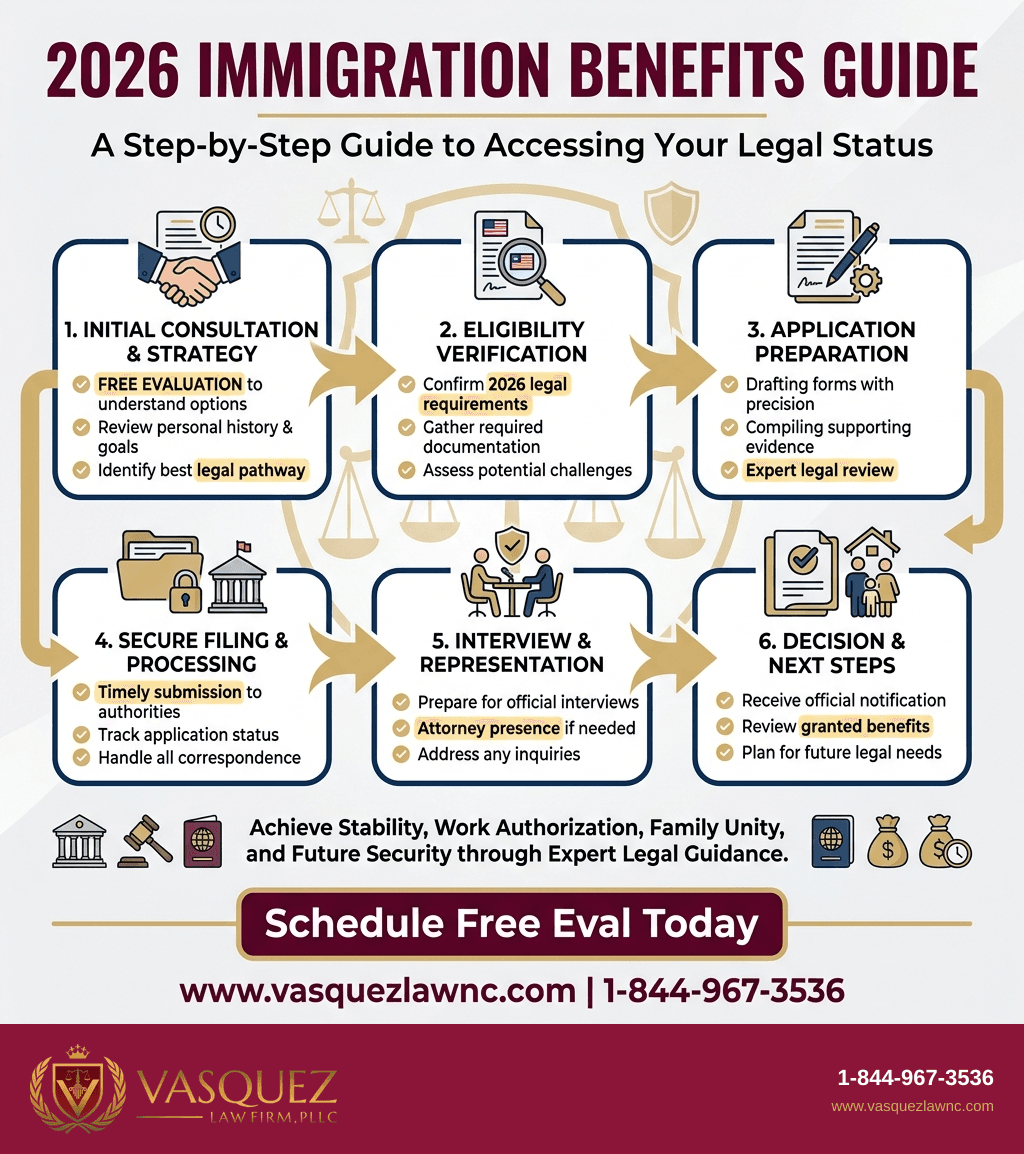
Step-by-step: How to Access Immigration Benefits
- Identify the Benefit Needed: Find out which immigration benefit fits your situation, like a green card, work permit, or asylum.
- Gather Required Documents: Collect proof of your identity, status, eligibility, and other needed evidence.
- Complete USCIS Forms: Fill out the correct USCIS forms carefully. For example, use Form I-485 for adjustment of status or Form I-821D for DACA.
- Pay Filing Fees: USCIS charges fees depending on the application type. Check current fees on the USCIS website.
- Submit Application and Evidence: Send your application to USCIS and keep copies for yourself.
- Attend Biometrics and Interviews: USCIS may ask for your fingerprints and interviews to check your information.
- Wait for USCIS Decision: Processing times vary. Check official times at USCIS Processing Times.
- Respond to Requests for Evidence (RFE): If USCIS asks for more information, reply quickly with the right documents.
- Receive Decision: If approved, get your benefit documents like a green card or work permit.
- Maintain and Renew Benefits: Renew your status or benefits on time so you don’t lose them.
Following these steps carefully can improve your chances of success. Talking to an immigration lawyer in Raleigh or Orlando can guide you and help avoid delays or denials.
Common Mistakes to Avoid With Immigration Benefits
- Incomplete Applications: Not sending all required forms or documents can cause delays or denials. Always double-check USCIS instructions.
- Missing Deadlines: Missing filing deadlines or expiration dates can make you lose eligibility.
- Using Outdated Forms: USCIS updates forms often. Using old forms can cause your application to be rejected.
- Ignoring Requests for Evidence: Not answering USCIS questions will lead to denial.
- Incorrect Fee Payments: Paying too little or too much can cause problems with your application.
- Misrepresenting Information: Giving false information can lead to removal (deportation) and other penalties.
- Not Consulting with Lawyers: Trying to handle complex immigration benefits alone may cause mistakes you can avoid.
If you remember only one thing: Always send complete, correct applications on time. Also, think about getting legal help to protect your rights and benefits.
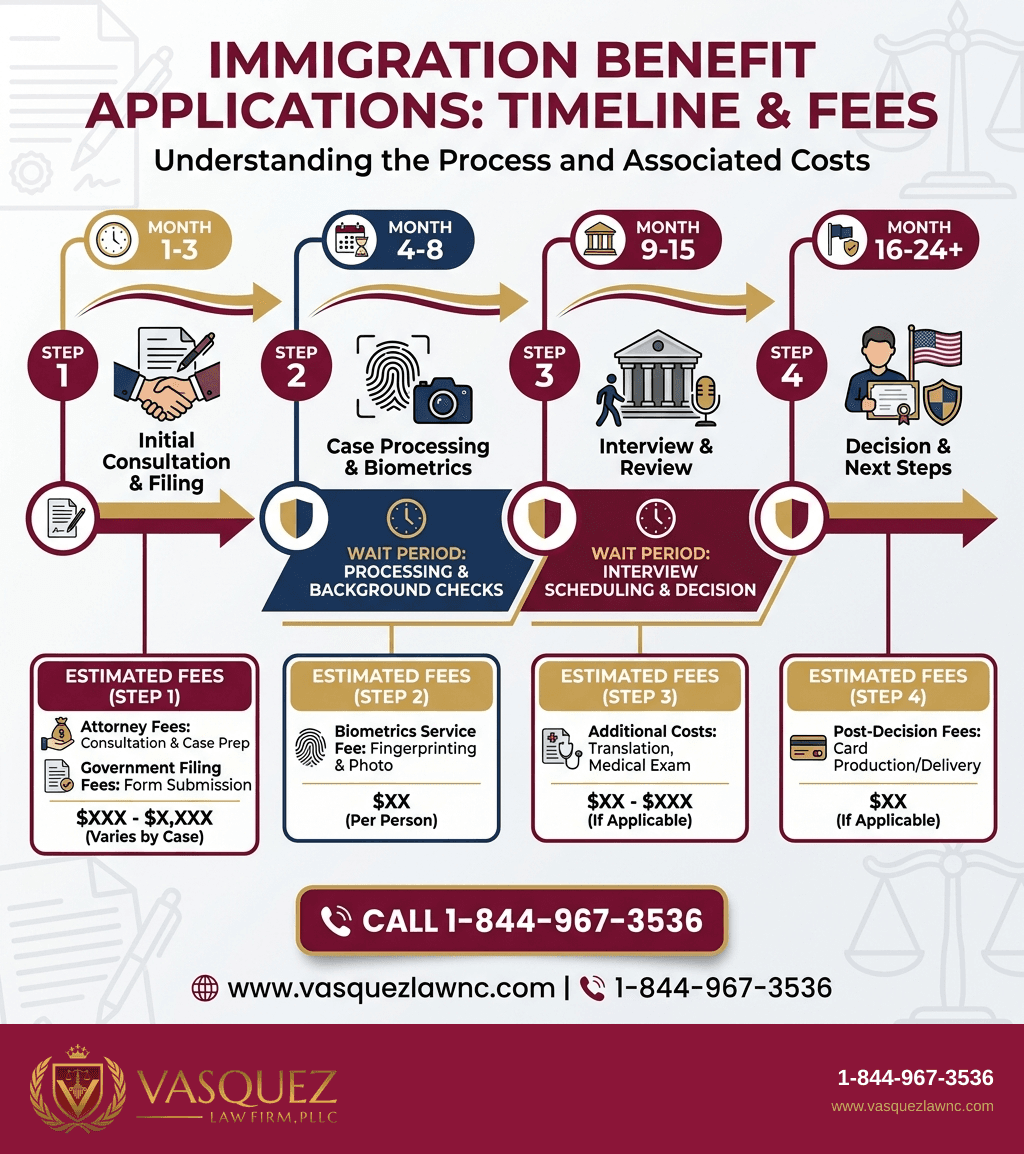
Timeline: What to Expect When Applying
- DACA Renewals (Form I-821D): USCIS estimates 14 to 22 months to process as of 2026 (USCIS Processing Times).
- Green Card Adjustment (Form I-485): Usually takes 8 to 14 months in Raleigh, NC area.
- Work Permit (EAD): Takes about 4 to 9 months for approval after filing.
- Asylum Applications: Processing times vary widely, about 6 to 10 months for first decisions.
Remember these times are averages. They can change because of USCIS workload, policy changes, or how complex your case is.
Check your case status on the official USCIS website and talk regularly with your attorney to manage your expectations.
Costs and Fees: What Impacts the Price
- Application Fees: USCIS charges fees based on the benefit type. For example, Form I-485 (green card adjustment) costs $1,140 plus biometrics fees.
- Attorney Fees: Lawyer costs vary. Vasquez Law Firm offers clear consultations and fee details.
- Documentation Costs: Getting translations, medical exams, and other papers adds to expenses.
- Premium Processing: Some visas allow faster processing if you pay extra fees.
A lawyer can help you plan your budget and avoid extra costs by filing correctly the first time.
NC, FL, and Nationwide Notes
North Carolina Notes
In Raleigh and all of North Carolina, immigration cases follow federal laws enforced by USCIS and immigration courts. Local offices offer limited services. Having a lawyer helps residents manage applications well. The Raleigh USCIS field office supports many people applying for adjustment, naturalization, and DACA every year.
Our immigration attorneys in Raleigh, NC know local USCIS and immigration court rules well.
Florida Notes
Orlando, FL, is an important center for immigration services in Florida. The Orlando USCIS field office handles adjustment of status, naturalization, and benefit renewals. State and local resources exist, but immigration benefits are controlled by federal law.
Business immigration consultations in Florida happen online via Zoom. Family and humanitarian cases can be done in person.
Nationwide Concepts
Federal immigration benefits apply across the whole country under USCIS authority. Processing times and rules are mostly the same but may differ a little by service center. Laws like INA § 240A control cancellation of removal (stopping deportation) nationwide. Investors, students, and workers follow standard visa categories no matter the state.
Knowing federal rules and working with a trusted immigration law firm gives you steady, reliable help with immigration benefits anywhere in the U.S.
When to Call a Lawyer Now
- If USCIS sends a Request for Evidence (RFE) or Notice of Intent to Deny.
- After getting a Notice to Appear in immigration court.
- If you face deportation or removal proceedings.
- If your visa or work permission is about to expire.
- If you have a complicated criminal or immigration history that affects eligibility.
- If you need help understanding USCIS forms and eligibility rules.
- Before filing any immigration application or petition.
- If you experience job discrimination or wage problems as an immigrant.
- When applying for humanitarian relief like asylum or TPS.
- If your family member’s immigration status is at risk.
About Vasquez Law Firm
At Vasquez Law Firm, we mix care with strong representation. Our motto "Yo Peleo®" (I Fight) shows our promise to stand up for your rights.
- Bilingual Support: Se Habla Español — Spanish-speaking lawyers and staff are ready to help
- Service Areas: North Carolina, Florida, and immigration services across the country
- Experience: Over 30 years helping clients with complex legal issues
- Results: Thousands of successful cases in many practice areas
Attorney Trust and Experience
William J. Vásquez is licensed by the North Carolina State Bar (2011) and the U.S. Courts of Appeals for the 4th, 5th, and 11th Circuits. Florida cases at the firm are handled by Florida Bar lawyer Harold Estrada-Rodriguez (FL Bar No. 1041171). The firm has given dedicated legal help since 2011, giving personal attention to each client’s case.
Don't wait to get the help you deserve. Call us now for immediate assistance. Se Habla Español.
Frequently Asked Questions
What are immigration benefits?
Immigration benefits are legal permissions given by the federal government that let immigrants live, work, or study legally in the U.S. Examples are green cards, work permits, asylum status, and DACA protections. You must apply for these benefits through USCIS and meet specific eligibility rules.
Who qualifies for immigration benefits in the USA?
Who qualifies depends on the benefit. It often depends on family ties, job offers, humanitarian needs, or special immigration programs. Each benefit has detailed USCIS eligibility rules to make sure only qualified people get legal status or work permission.
Do immigrants receive government money as a federal benefit?
Federal immigration benefits usually do not include direct money payments. These benefits mostly give legal status and work permission. Some immigrants may qualify for state public help programs, which are separate from federal immigration benefits.
What is an example of an immigration benefit?
A green card, or lawful permanent residence, is a common immigration benefit. It lets you live and work permanently in the U.S. Other examples are Temporary Protected Status and work permits given under DACA or employment-based visas.
What are five advantages of migration?
Migrants help grow the labor market, add cultural diversity, bring new ideas, boost the economy through spending and taxes, and reunite families. In cities like Raleigh and Orlando, immigrants support local businesses, schools, and communities.
What does USCIS consider a cons of immigration?
USCIS notes concerns like more demand on public services and job competition. But USCIS balances these with immigrants’ economic and cultural benefits. Policies change to address local effects and get the most benefits.
How does immigration create a surplus?
Immigration surplus means positive effects on the economy. This includes more productive workers and more consumer spending that outweigh costs. Studies show it helps business growth and new jobs in North Carolina and Florida.
What steps should I take to apply for immigration benefits in 2026?
Find the benefit you need, gather your documents, fill out USCIS forms carefully, and send your application with the right fee. Watch USCIS processing times and talk to a lawyer in Raleigh or Orlando to file correctly and get good help.
Sources and References
- U.S. Citizenship and Immigration Services
- Executive Office for Immigration Review
- Legal Information Institute
Take the first step toward justice today. Our team is standing by to help. Se Habla Español.
Start Your Free Evaluation Now
Call us: 1-844-967-3536
Se Habla Español - Estamos aquí para ayudarle.


William Vasquez
Founder & CEO, Vasquez Law Firm, PLLC
William Vasquez is the founder and CEO of Vasquez Law Firm, PLLC, a results-driven firm specializing in immigration, criminal defense, personal injury, and workers' compensation. A U.S. Air Force veteran and recipient of the Joint Service Achievement Medal, William is dedicated to fiercely fighting for his clients' rights.
Related Legal Services
Need legal help? Learn more about immigration lawyers in North Carolina, or contact us for a free evaluation.
You can also visit immigration legal services throughout NC for more information.