What Does the Green Card Bill Mean for Immigrants in 2026
Wondering about the Green Card Bill in 2026? Learn how the Dignity Act affects green card holders. Contact Vasquez Law for a free consultation.
Published on July 28, 2026
Have questions? Talk to an attorney - free evaluation.
Call 1-844-967-3536Free Tool
Check Your USCIS Case Status Now
Enter your receipt number - get the official USCIS status in English or Spanish. No registration.
What Does the Green Card Bill Mean for Immigrants in 2026
The green card bill, including the Dignity Act green card provisions, aims to create a new path for immigrants in 2026. This reform affects registry green cards and more, with specific impacts for immigrants in Raleigh, NC, and Orlando, FL. This article explains the latest immigration reform bill 2026 developments, how the bill works, who qualifies, and what the timeline and costs might be. If you or a loved one holds a green card or hopes to apply, understanding the new bill’s potential changes is key. Vasquez Law Firm provides expert immigration legal assistance for North Carolina and Florida residents.
Need help with your case? Our experienced attorneys are ready to fight for you. Se Habla Español.
Or call us now: 1-844-967-3536
Quick Answer
The green card bill of 2026, including the Dignity Act green card provisions, proposes an automatic path to permanent residency for qualifying immigrants who have lived continuously in the U.S. for at least seven years. It also updates the immigration registry bill by expanding eligibility criteria, affecting many green card holders in Raleigh, NC and Orlando, FL.
- Automatic green card eligibility after seven years continuous residence
- Expanded registry green card qualifying dates and conditions
- Provisions protect certain green card holders from ICE enforcement actions
- Updated USCIS processing requirements and timelines
- Legal avenues open for immigrants in NC, FL, and nationwide
Understanding the Green Card Bill and Dignity Act
The Green Card Bill, often referred to along with the "Dignity Act," is a proposed federal reform to U.S. immigration law introduced in early 2026. Its intention is to provide clearer, more accessible paths to lawful permanent resident status, especially for long-standing immigrants who meet certain residency and admissibility criteria. This bill is a significant component of the broader immigration reform bill 2026, which aims to address backlogs, update eligibility rules, and streamline processes.
The Dignity Act specifically proposes granting an automatic green card after continuous residence in the United States for seven years. This provision contrasts with traditional lengthy paperwork and undocumented status issues that many immigrants face. For applicants seeking registry green cards – which rely on continuous residence since a cutoff date – the bill updates the cutoff year to July 1, 2017, a substantial adjustment from prior law (commonly 1972).
This reform promises hope for many immigrants currently living with uncertain legal status in Raleigh, NC, and Orlando, FL. It has also raised questions about the intersection of green card eligibility with ICE enforcement, as certain protections may reduce risk of deportation for eligible holders. However, as of July 2026, the bill has not yet been fully enacted by Congress.
For deeper understanding, it's essential to consider how the bill modernizes the immigration registry concept, updating the continuous residence criteria and adding clearer rules for admissibility. This supports long-term residents seeking permanent immigration status without the ever-present fear of losing their legal rights or facing arrest due to immigration status.
For more details on the immigration registry and adjustment of status, see the U.S. Citizenship and Immigration Services website and the Legal Information Institute at Cornell Law School.
Learn more about our immigration services and how Vasquez Law Firm in Raleigh, NC, and Orlando, FL can help you understand this bill.
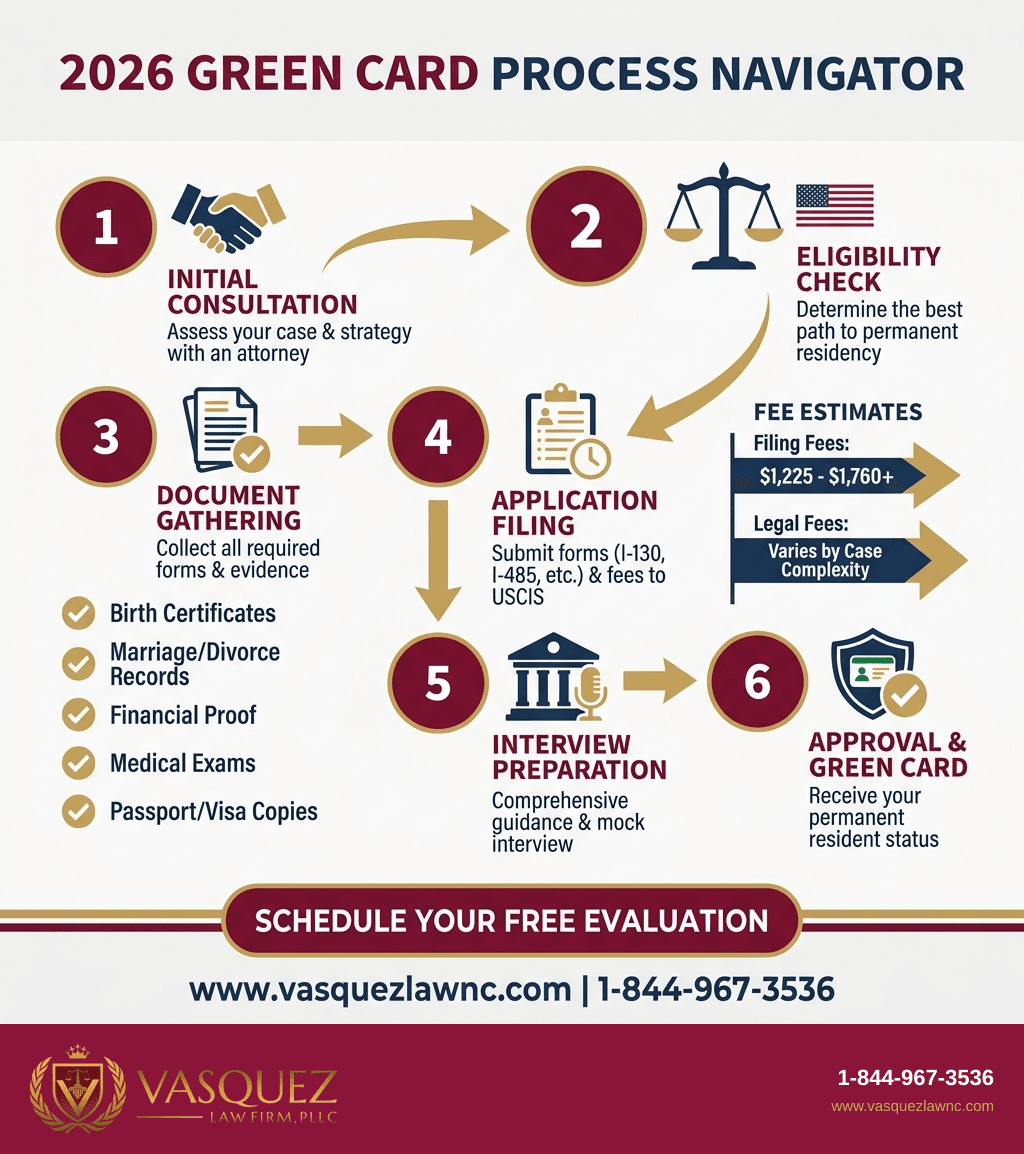
Step-by-step: How the Green Card Bill Works
- Determine Eligibility: Check if you have continuously lived in the U.S. since July 1, 2017. This means no extended absences and proof of residence is necessary.
- Gather Documentation: Collect evidence such as tax returns, pay stubs, lease agreements, and affidavits from community members to demonstrate continuous residence and good moral character.
- File Application: Submit Form I-485 (Application to Register Permanent Residence or Adjust Status) along with other required forms to USCIS.
- Biometrics Appointment: Attend biometric data collection and background checks required by USCIS.
- Interview: Some applicants may be required to attend in-person interviews at local USCIS offices like those in Raleigh, NC or Orlando, FL.
- Adjudication and Approval: USCIS reviews the application; if approved, applicants receive their green card according to the new bill's provisions.
- Legal Protections: Green card holders gain lawful status and associated employment authorization and protections from ICE removal barring serious crimes.
If you want help with the filing process, contact our office for guidance.
Documents and Evidence Needed
- Proof of continuous residence since July 1, 2017 (utility bills, rental contracts, school records)
- Forms required by USCIS (such as I-485, I-130 if family petitions are involved)
- Identification documents (passport, birth certificates)
- Criminal background records, if applicable
- Tax returns or employment records
- Affidavits from community members confirming residence and good character
- Medical examination records as required by USCIS
Timeline: What to Expect for Your Green Card Case
- Week 1-4: USCIS receives and reviews your initial application and supporting documents.
- Week 5-8: USCIS schedules biometrics appointment for fingerprinting and photographs.
- Week 9-20: Background and security checks are conducted; delays may occur depending on application complexity.
- Week 21-40: USCIS may require interviews or additional evidence requests.
- Week 41-52: Final decision expected; approved applicants receive green card in mail.
Processing times vary by applicant and form. For up-to-date estimates, check the USCIS processing times page.
Costs and Fees Associated with the Green Card Bill
- USCIS Filing Fees: Typically around $1,225, including biometrics, but fees may be reduced for certain applicants.
- Legal Fees: Hiring an immigration lawyer for application preparation and representation varies but often ranges from $2,000 to $5,000 depending on case complexity.
- Medical Examination: Costs for required immigration medical exams can be $200 to $500.
- Additional Costs: Translations, document copies, travel expenses for interviews may also apply.
Free consultations with Vasquez Law Firm can provide a clearer estimate based on your circumstances.
Common Mistakes to Avoid When Applying
- Missing the Continuous Residence Date: Not proving residence since July 1, 2017 can lead to denial. Fix: Collect diverse and consistent documents covering entire period.
- Incomplete Forms: Skipping required fields or submitting unsigned forms causes delays. Fix: Review forms thoroughly or get attorney assistance.
- Failing to Disclose Prior Violations: Omitting criminal or immigration history risks denial or later revocation. Fix: Provide truthful disclosure and explanation.
- Ignoring Interview Requests: Missing USCIS interviews can end your case. Fix: Schedule and attend interviews promptly.
- Not Seeking Legal Help Early: Navigating the complex bill alone invites errors. Fix: Consult an immigration lawyer.
- Incorrect Fee Payments: Paying wrong fees causes rejection. Fix: Confirm current fee schedules on USCIS.gov.
- Assuming Automatic Approval: Believing the bill guarantees a green card can lead to complacency. Fix: Prepare a complete strong case.
If you only remember one thing: act early and prepare thoroughly with legal guidance.
Jurisdiction Notes for NC and FL Immigrants
North Carolina Notes
Though immigration law is federal, applicants living in Raleigh, NC can expect to file and attend USCIS appointments locally. NC immigrants benefit from regional USCIS clearance policies but should be aware of local enforcement dynamics. Vasquez Law Firm’s Raleigh office provides direct legal support and representation to help applicants from the state.
Florida Notes
Immigrants in Orlando, FL experience similar federal processing but should note any ICE enforcement changes under the new bill impact Florida residents as well. Local USCIS offices in Orlando handle filings and interviews, and legal counsel familiar with Florida immigration regulations can provide valuable assistance.
Nationwide Immigration Framework
All green card applicants under this bill engage with USCIS governed by federal statutes and rules including 8 U.S.C. § 1255 (Adjustment of Status) and 8 C.F.R. § 245.1 (Eligibility). The bill adjusts some federal criteria but does not change the overarching federally regulated immigration system.
When to Call an Immigration Lawyer
- If you have questions about continuous residence or admissibility.
- If you have prior immigration violations or arrests.
- When preparing to file under the new green card bill.
- If USCIS requests an interview or additional evidence.
- When facing potential ICE enforcement related to your status.
- If your application is denied or delayed excessively.
- To understand how the green card bill affects your family petitions.
- If you need help with appeals or motions related to your case.
- When you want to avoid costly mistakes in your application process.
- To get updated guidance as the bill progresses through Congress.
About Vasquez Law Firm
At Vasquez Law Firm, we combine compassion with aggressive representation. Our motto "Yo Peleo®" (I Fight) reflects our commitment to standing up for your rights. We have experience assisting immigrants from North Carolina and Florida navigate complex immigration laws and achieve their goals.
- Bilingual Support: Se Habla Español — Spanish-speaking attorneys and staff available
- Service Areas: North Carolina, plus Florida and nationwide for immigration
- Experience: Over 30 years helping clients navigate complex legal matters
- Results: Thousands of successful cases across multiple practice areas
Attorney Trust and Experience
William J. Vásquez is admitted to the North Carolina State Bar (2011) and to the U.S. Courts of Appeals for the 4th, 5th, and 11th Circuits. The firm has provided dedicated legal representation since 2011, with personalized attention to each client's case, focusing on immigration law including green card cases under new and existing statutes.
Don't wait to get the help you deserve. Call us now for immediate assistance.
Se Habla Español
Frequently Asked Questions
What is the new green card bill?
The green card bill, including the Dignity Act, proposes immigration reforms in 2026 to provide permanent residency for immigrants living continuously in the U.S. It aims to ease legal status paths after seven years of residence. The bill impacts registry green card eligibility and offers protections for green card holders in Raleigh, NC and Orlando, FL.
Who qualifies for a registry green card under the new bill?
Applicants must prove continuous residence in the U.S. since July 1, 2017, meet admissibility requirements, and have a clean criminal history. Compliance with USCIS documentation rules is essential. Local legal counsel can help assess your specific eligibility based on personal history.
Is the Dignity Act green card bill passed by Congress?
While popular and backed by some lawmakers, the Dignity Act has not yet fully passed Congress as of July 2026. It's important to track legislative developments and prepare current applications under existing rules, as changes could happen later in the year or next.
What is the new rule for green cards in the USA in 2026?
The new rule may allow automatic green card issuance after seven years of continuous U.S. residence for qualifying immigrants and adjusts registry green card cutoff dates. It also provides clearer guidelines on admissibility and protections for certain green card holders against ICE enforcement.
Are ICE arresting lawful green card holders?
Generally, lawful permanent residents are protected from ICE arrest unless convicted of serious offenses. However, some arrests do occur and knowing your rights and legal protections is critical. The new bill includes enhanced safety provisions for green card holders.
How long does it take to process a green card under the new bill?
Processing may range from 12 to 24 months depending on case complexity and location. USCIS regularly updates times on their website, and applicants should prepare for potential delays or additional review steps.
Does the green card bill impact immigrants in North Carolina and Florida?
Yes. Both Raleigh, NC, and Orlando, FL residents can benefit from revised registry green card eligibility and automatic adjustment provisions. Local legal representation is advised to navigate the specific steps and stay current.
What are the main steps to apply under the new green card bill?
Applicants should establish continuous residence, prepare required USCIS forms (like I-485), gather supporting documents, attend biometrics appointments and interviews, and respond promptly to USCIS requests. Legal advice helps ensure completeness and accuracy.
Sources and References
- U.S. Citizenship and Immigration Services
- Executive Office for Immigration Review
- Legal Information Institute
Take the first step toward justice today. Our team is standing by to help.
Start Your Free Evaluation Now
Call us: 1-844-967-3536
Se Habla Español - Estamos aquí para ayudarle.


William Vasquez
Founder & CEO, Vasquez Law Firm, PLLC
William Vasquez is the founder and CEO of Vasquez Law Firm, PLLC, a results-driven firm specializing in immigration, criminal defense, personal injury, and workers' compensation. A U.S. Air Force veteran and recipient of the Joint Service Achievement Medal, William is dedicated to fiercely fighting for his clients' rights.
Related Legal Services
Need legal help? Learn more about get immigration legal help today, or contact us for a free evaluation.
You can also visit North Carolina immigration lawyers for more information.