Family-Based Immigration Petitions for US Citizens in 2026
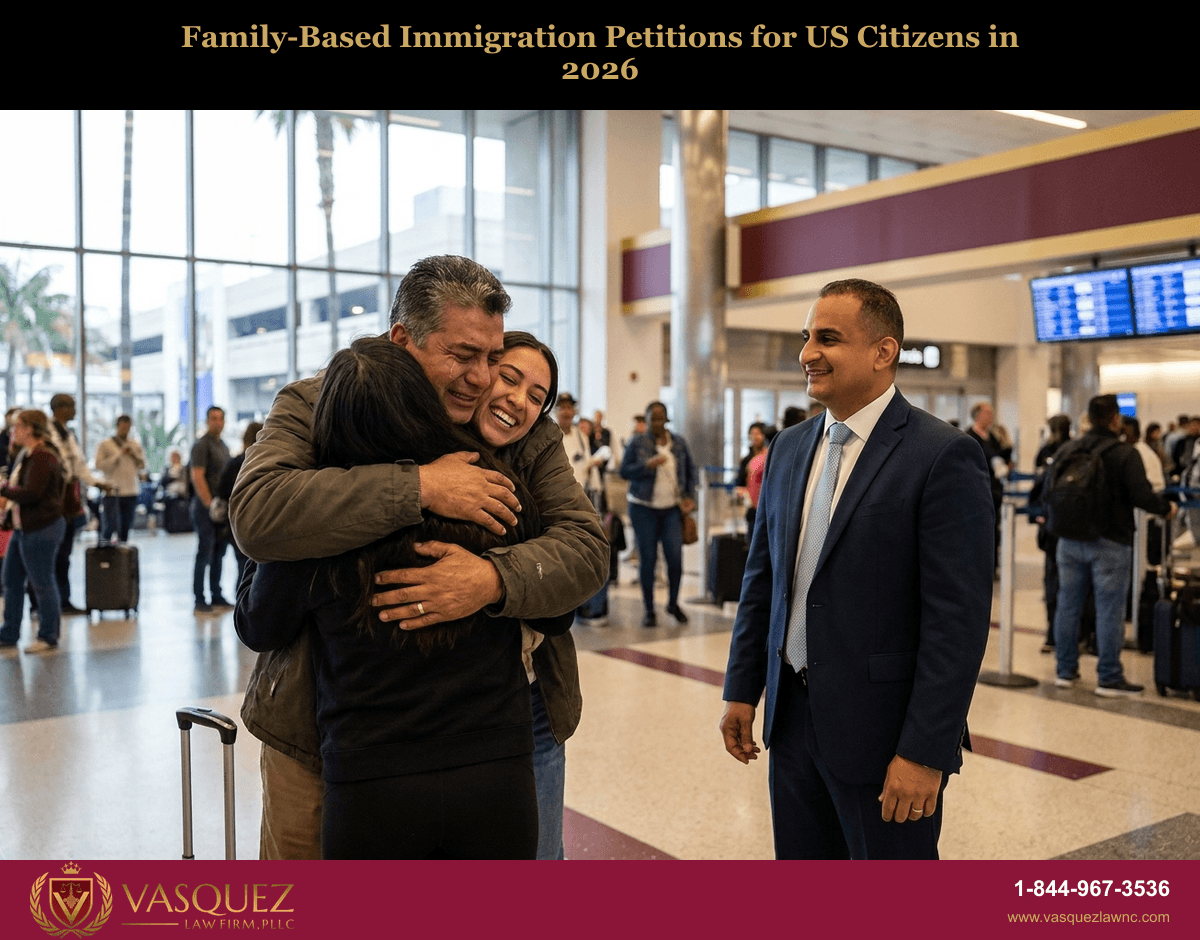
Family-based immigration petitions for US citizens in 2026 start with Form I-130 to establish family relationships. Immediate relatives like spouses and minor children have visas available without wait. Others face longer timelines based on preference categories. Residents of Raleigh, NC and Orlando, FL should understand the process, eligibility, and next steps to navigate petitions efficiently.
Published on June 23, 2026
Talk to an immigration attorney
Free call. A clear plan for your case.
Free & confidential · Se habla espanol · 24/7
Have questions? Talk to an attorney - free evaluation.
Call 1-844-967-3536Worried how the latest immigration news affects you?
Schedule a confidential case review with an immigration attorney - know exactly where you stand.
USCIS Case Status
Check your USCIS case status
Enter your receipt number and get the official status. Free, no registration.
This article provides general legal information, not individualized legal advice. Reading does not create an attorney-client relationship. For advice specific to your situation, contact Vasquez Law Firm.
What is the process for US citizens to petition for family-based immigration in 2026?
Ready to Become a US Citizen?
The naturalization process has strict requirements. Let us help you get it right the first time.
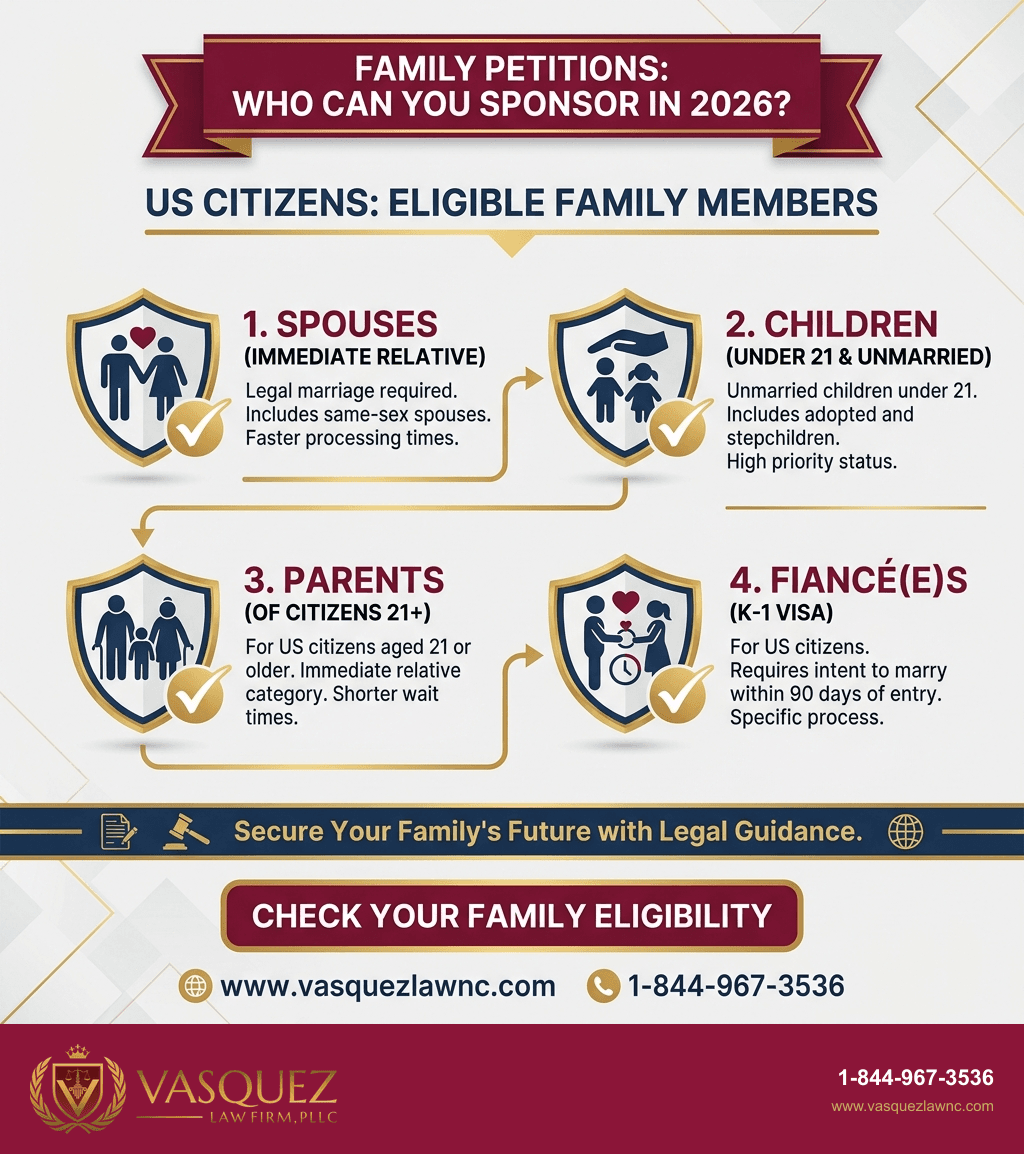
US citizens petitioning for family-based immigration in 2026 begin by filing Form I-130, Petition for Alien Relative, to establish the qualifying family relationship. Immediate relatives such as spouses, unmarried children under 21, and parents (if the petitioner is 21 or older) have visas always available. Other family members fall under preference categories subject to annual visa limits and wait times.
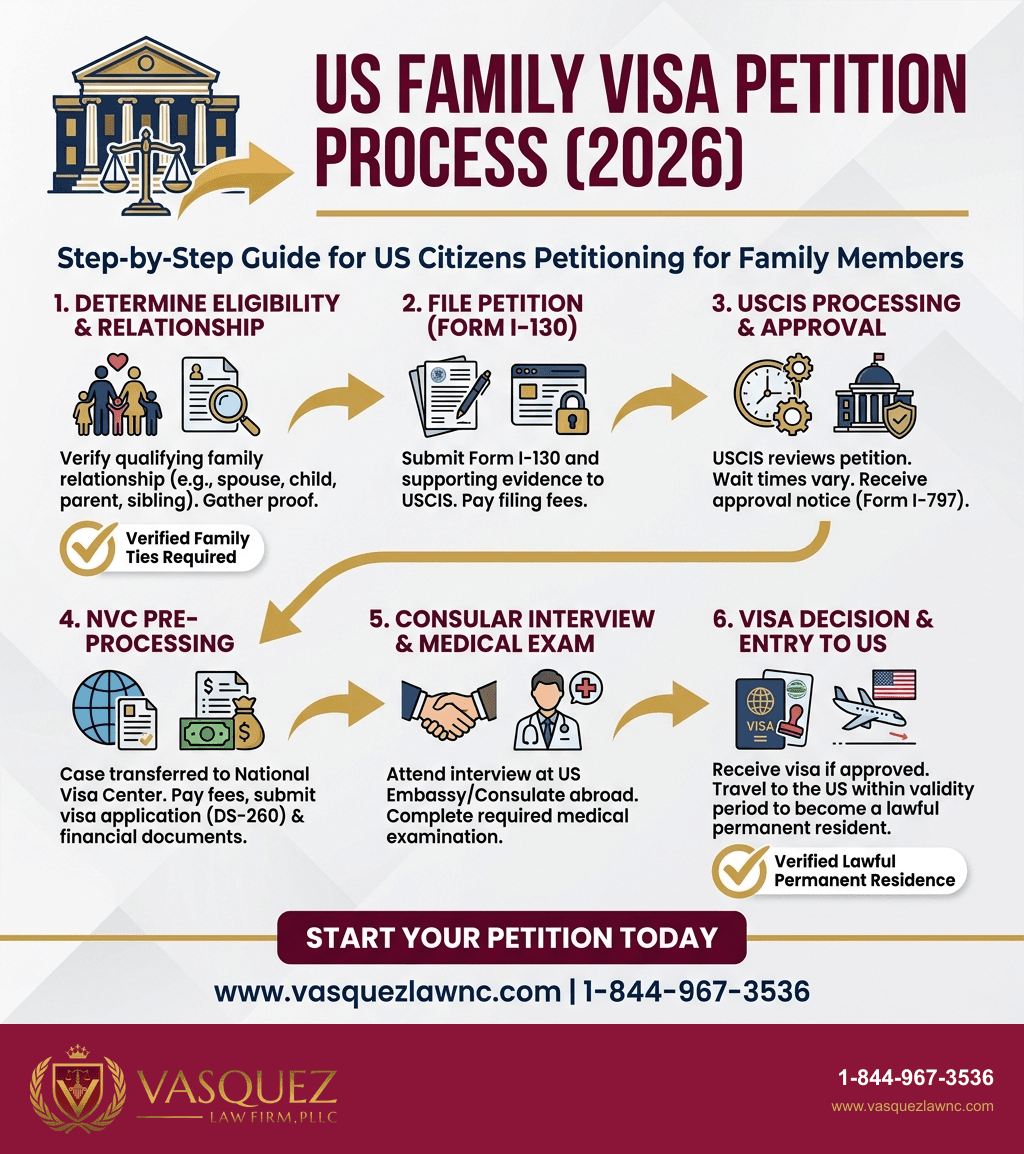
The petition process starts with submitting Form I-130 to USCIS, which serves to prove the familial relationship. Once approved, the petition either allows the relative to apply for adjustment of status if they are in the United States or initiates consular processing abroad. Immediate relatives can often file Form I-485, Application to Register Permanent Residence or Adjust Status, concurrently with the I-130 if they are in the US.
For family members outside the US, the approved petition is forwarded to the National Visa Center, which schedules consular interviews once a visa number becomes available. The timeline depends on the family member’s category, with immediate relatives having no visa wait and preference categories subject to priority dates and visa bulletin schedules.
Fiancé(e) visas (K-1) and K-3/K-4 visas for spouses and their children also require filing Form I-129F. These visa types facilitate entry to the US for marriage or reunification purposes but do not grant permanent resident status directly.
The process is governed by USCIS and Department of State regulations, with forms and instructions available on the USCIS website. Petitioners should carefully follow filing requirements to avoid delays.
Who is affected by family-based immigration petition timelines in 2026, especially in Raleigh, NC and Orlando, FL?
Family members of US citizens residing in Raleigh, NC and Orlando, FL are directly impacted by the 2026 family-based immigration petition process and timelines. Immediate relatives have the shortest wait times, while other family members face longer waits due to visa caps and priority date backlogs.
In Raleigh, NC and Orlando, FL (where our Florida office is located), many US citizens petition for spouses and children, as these categories have visas immediately available. Parents of US citizens over 21 also fall under immediate relatives and benefit from shorter processing times. However, siblings and married adult children face longer waits under preference categories.
According to USCIS data, the majority of family-based petitions filed in these regions involve spouses and minor children, reflecting the immediate relative category. The visa bulletin and USCIS processing times indicate that preference category petitions, such as for siblings or married children, can have wait times extending several years.
Local immigrant communities in Raleigh, NC and Orlando, FL often rely on family reunification through these petitions. The timelines affect family planning, employment authorization eligibility, and adjustment of status opportunities.
Understanding the priority dates and visa availability is crucial for petitioners and beneficiaries in these areas to anticipate processing durations and plan accordingly.
What does the law say about family-based immigration petitions for US citizens?
The legal framework for family-based immigration petitions by US citizens is primarily established under the Immigration and Nationality Act (INA) and implemented by USCIS regulations. The key statutory provision governing adjustment of status is 8 U.S.C. § 1255, which allows certain aliens to apply for lawful permanent residence while in the United States.
US citizens may petition for immediate relatives and certain preference categories as defined by the INA. Immediate relatives include spouses, unmarried children under 21, and parents if the petitioner is 21 or older. Other family members fall into preference categories with numerical limits on visas issued annually.
"To petition for a family member to receive a Green Card (permanent residence), begin by filing Form I-130, Petition for Alien Relative. This form establishes the family relationship that exists between you and your relative." (Source: USCIS, https://www.uscis.gov/family/family-of-us-citizens)
The law distinguishes between immediate relatives, who have visas immediately available, and preference categories, which require waiting for a visa number based on priority dates. The visa bulletin published monthly by the Department of State provides current availability.
Additionally, USCIS regulations at 8 CFR § 245.1 outline eligibility for adjustment of status, including requirements for family-based applicants. Employment authorization during the adjustment process is governed by 8 CFR § 274a.12.
Fiancé(e) visas and K-3/K-4 visas are authorized under separate provisions and require filing Form I-129F. These visas facilitate entry but do not confer permanent residence without further processing.
What should you do if you want to petition for a family member in 2026?
If you are a US citizen seeking to petition for a family member in 2026, begin by determining your relative’s eligibility category and gathering the necessary documentation to file Form I-130, Petition for Alien Relative. Immediate relatives can often file Form I-485 concurrently if they are in the US.
At our Raleigh, NC and Orlando, FL offices, we typically see petitioners benefit from early preparation of supporting evidence such as proof of citizenship, relationship documents (marriage certificates, birth certificates), and financial support affidavits (Form I-864). The most common mistake is submitting incomplete or inconsistent documentation, which delays processing.
Here are the action steps to follow:
- Identify the family member category (immediate relative or preference category).
- File Form I-130 with USCIS, including all required evidence and fees.
- If the relative is in the US and eligible, file Form I-485 concurrently or after I-130 approval.
- If the relative is abroad, wait for the National Visa Center to process the petition and schedule consular processing.
- Prepare for the interview and submit additional forms such as Form I-864 Affidavit of Support.
- Monitor case status online and respond promptly to any Requests for Evidence (RFEs).
| Step | Form | Purpose | Notes |
|---|---|---|---|
| 1 | I-130 | Petition for Alien Relative | Establishes family relationship |
| 2 | I-485 | Adjustment of Status | Filed concurrently if relative is in the US and eligible |
| 3 | I-129F | Fiancé(e) Visa Petition | For fiancé(e)s and K-3/K-4 visa applicants |
| 4 | I-864 | Affidavit of Support | Demonstrates financial ability to support relative |
Petitioners should keep copies of all filings and track processing times via the USCIS My Case Status tool. Consulting an immigration attorney can help avoid common pitfalls and navigate complex situations such as prior immigration violations or criminal records.
What happens next after filing a family-based immigration petition?
After filing Form I-130, USCIS reviews the petition to verify the family relationship and eligibility. If the relative is in the US and an immediate relative, they may file Form I-485 to adjust status to lawful permanent resident. Otherwise, the petition is forwarded to the National Visa Center for consular processing abroad.
Visa availability depends on the category of the relative. Immediate relatives have visas immediately available, while preference categories must wait for their priority date to become current according to the Visa Bulletin.
Once a visa number is available, the National Visa Center schedules an interview at the US consulate or embassy. The applicant must complete medical exams and submit supporting documents. Successful applicants receive an immigrant visa to enter the US as a permanent resident.
"If your relative is already in the United States, they may apply to adjust status to become a Green Card holder (lawful permanent resident) after a visa number becomes available using Form I-485. If your relative is outside the United States, your petition will be sent to the National Visa Center (NVC)." (Source: USCIS, https://www.uscis.gov/family/family-of-us-citizens)
Petitioners and beneficiaries should monitor the visa bulletin and USCIS processing times regularly. Delays can occur due to security checks or requests for additional evidence. Staying informed and prepared facilitates smoother processing.
What's Your Immigration Situation?
Answer 3 questions - we'll tell you your options
Question 1 / 3
What best describes your situation?
Keep Reading
For residents of Raleigh, NC and Orlando, FL, local USCIS offices and consulates provide resources and support. Legal counsel can assist with interview preparation and responding to USCIS or consular inquiries.
Frequently Asked Questions
What family members can a US citizen petition for?
A US citizen can petition for spouses, unmarried children under 21, parents (if the petitioner is 21 or older), married and unmarried adult children, and siblings (if the petitioner is 21 or older). Immediate relatives (spouses, minor children, parents) have visas immediately available.
How long does it take to get a Green Card through family petition?
Processing times vary by category. Immediate relatives often receive Green Cards within 12 months, while preference categories can take several years depending on visa availability and priority dates.
Can a family member apply for adjustment of status while in the US?
Yes, immediate relatives in the US can file Form I-485 concurrently with Form I-130 or after approval. Preference category relatives generally must wait for a visa number before applying.
What forms are required to petition for a fiancé(e) visa?
Form I-129F, Petition for Alien Fiancé(e), is required to petition for a fiancé(e) visa. This form also covers K-3/K-4 visas for spouses and their children.
Does an approved petition guarantee a visa or Green Card?
No, an approved petition only establishes the qualifying relationship and places the relative in line for visa processing. Approval does not guarantee a visa or permanent residence.
This article provides general legal information, not individualized legal advice. Reading does not create an attorney-client relationship. For advice specific to your situation, contact Vasquez Law Firm.
Reviewed by William Vasquez, Founder & CEO, Vasquez Law Firm, PLLC.
If you need legal assistance, learn more about how our immigration attorneys can help, or call us at 1-844-967-3536 for a free evaluation.
Related Topics

William Vasquez
Founder & CEO, Vasquez Law Firm, PLLC
William Vasquez is the founder and CEO of Vasquez Law Firm, PLLC, a results-driven firm specializing in immigration, criminal defense, personal injury, and workers' compensation. A U.S. Air Force veteran and recipient of the Joint Service Achievement Medal, William is dedicated to fiercely fighting for his clients' rights.
Related Legal Services
Need legal help? Learn more about speak with an immigration lawyer, or contact us for a free evaluation.
You can also visit our NC immigration team for more information.