What Is Mandamus and How It Works in Immigration in 2026
Facing delays in immigration? Learn how mandamus petitions can compel USCIS action in 2026. Contact Vasquez Law for a free evaluation today.
Published on June 23, 2026
Talk to an immigration attorney
Free call. A clear plan for your case.
Free & confidential · Se habla espanol · 24/7

Have questions? Talk to an attorney - free evaluation.
Call 1-844-967-3536Worried how the latest immigration news affects you?
Schedule a confidential case review with an immigration attorney - know exactly where you stand.
USCIS Case Status
Check your USCIS case status
Enter your receipt number and get the official status. Free, no registration.
What Is Mandamus and How It Works in Immigration in 2026
Mandamus is a legal tool immigrants can use when USCIS unreasonably delays processing their cases. In 2026, understanding how mandamus works is crucial for applicants in Raleigh, NC and Orlando, FL. This article explains the writ of mandamus in immigration law, including the process, requirements, timeline, and common mistakes to avoid. If your immigration case is stalled, mandamus relief could help accelerate USCIS action and protect your legal rights.
Need help with your case? Our experienced attorneys are ready to fight for you. Se Habla Español.
Or call us now: 1-844-967-3536
Quick Answer
A mandamus writ is a court order that compels USCIS or another immigration agency to act on delayed cases. It is used when normal processing times have passed without action, and no other legal remedy is available.
- Mandamus forces USCIS to move on stalled petitions
- Requires proving unreasonable delay
- It is filed in federal court
- Common for green card and visa delays
- Can help applicants in Raleigh, NC and Orlando, FL
Understanding Mandamus in Immigration Law
Imagine waiting over a year for USCIS to process your adjustment of status application, with no updates. This frustrating delay is why mandamus exists as a legal remedy. Mandamus is a Latin term meaning "we command." It is a writ issued by a federal court compelling a government official or agency to perform a duty they are legally required to do but have neglected.
In immigration, mandamus petitions often challenge unreasonable delays by USCIS or immigration courts refusing to schedule hearings or issue decisions. For example, if a green card application or naturalization petition remains pending beyond published USCIS processing times, mandamus can push the agency to act. However, before filing, petitioners must show they have waited long enough and exhausted all other administrative remedies.
Under 28 U.S.C. § 1361, federal courts have jurisdiction to hear mandamus actions that seek to compel officers or agencies of the United States to perform their duties. The Legal Information Institute clarifies mandamus is not used to correct errors in decisions but to force the government to fulfill its legal obligations.
Our immigration legal services specializing in Raleigh, NC and Orlando, FL understand these federal writs and help clients apply this tool effectively. Attorney Jessica Vasquez has extensive experience representing immigrants facing delays, working to obtain mandamus relief and move cases forward.
Mandamus vs Other Legal Remedies
Mandamus differs from administrative appeals or motions within USCIS because it usually requires filing a separate lawsuit in federal district court. It is reserved for situations where the agency has delayed beyond reasonable processing times. It is not a shortcut to speed up processing but rather a check to ensure timely agency action.
Common Situations Calling for Mandamus
- Adjustment of status application pending over actual USCIS processing times
- Delays in Naturalization interview scheduling or decision
- Long delays in visa petition approvals
- Immigration court hearings postponed indefinitely
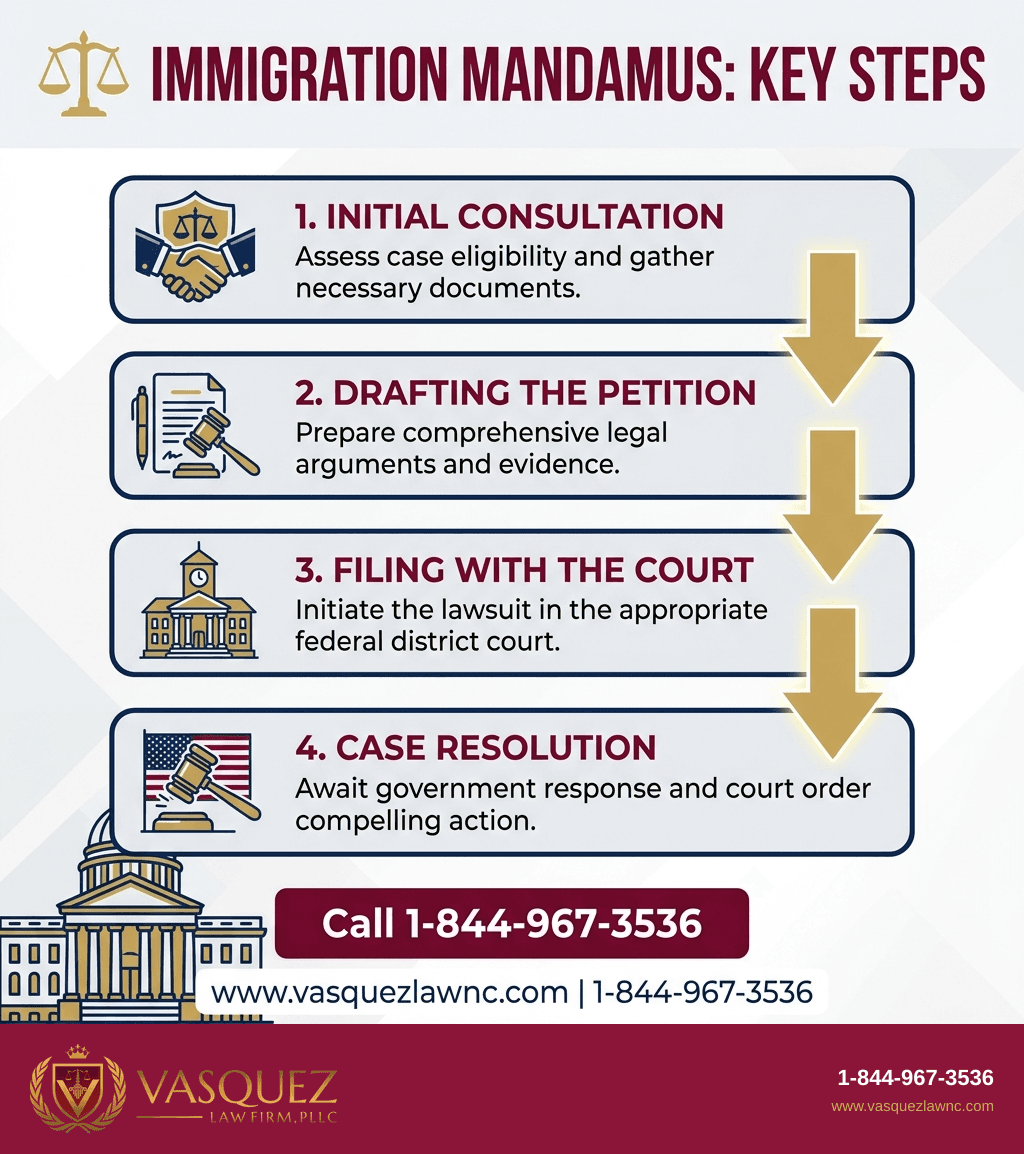
Key Steps to File a Mandamus Petition
- Confirm USCIS Delay: Check USCIS posted processing times at USCIS Processing Times to verify your case is delayed beyond normal ranges.
- Wait Reasonable Time: Depending on the type of application, waiting six months to a year is common before mandamus is viable.
- Complete Administrative Remedies: Use all available USCIS inquiries, Ombudsman requests, or InfoPass appointments to prompt agency action.
- Consult an Immigration Attorney: A qualified lawyer in Raleigh or Orlando can assess mandamus suitability and prepare necessary filings.
- File Federal Lawsuit: Draft and file complaint in federal court requesting the writ of mandamus compelling USCIS to act.
- Serve USCIS and Respond: Notify USCIS and respond to any motions or government defenses.
- Follow Court Procedures: Attend hearings, submit evidence, and comply with court orders until case resolution.
Role of Evidence
Strong evidence that demonstrates your case has been pending beyond published USCIS processing times is crucial. Keep detailed records of receipts, inquiry responses, and notices that show the delay’s length and impact.
Common Mistakes to Avoid in Mandamus Petitions
- Filing Too Early: Starting mandamus before USCIS has had a reasonable time can lead to dismissal.
- Ignoring Administrative Remedies: Not exhausting USCIS tools like case inquiries can weaken your petition.
- Lack of Documentation: Insufficient proof of delay harms case credibility.
- Failing to Hire an Experienced Lawyer: Mandamus involves federal litigation requiring specialized knowledge.
- Confusing Mandamus with Appeals: Mandamus compels action but does not challenge agency decisions.
- Overlooking Local Jurisdiction Rules: Filing in the wrong district court delays process.
- Underestimating Time and Costs: Litigation can be lengthy and costly without guarantees.
If you only remember one thing: Mandamus is a tool to demand action, not a guaranteed shortcut or appeal of your immigration case’s result.
Don't wait to get the help you deserve. Call us now for immediate assistance. Se Habla Español.
Timeline and What to Expect with Mandamus Relief
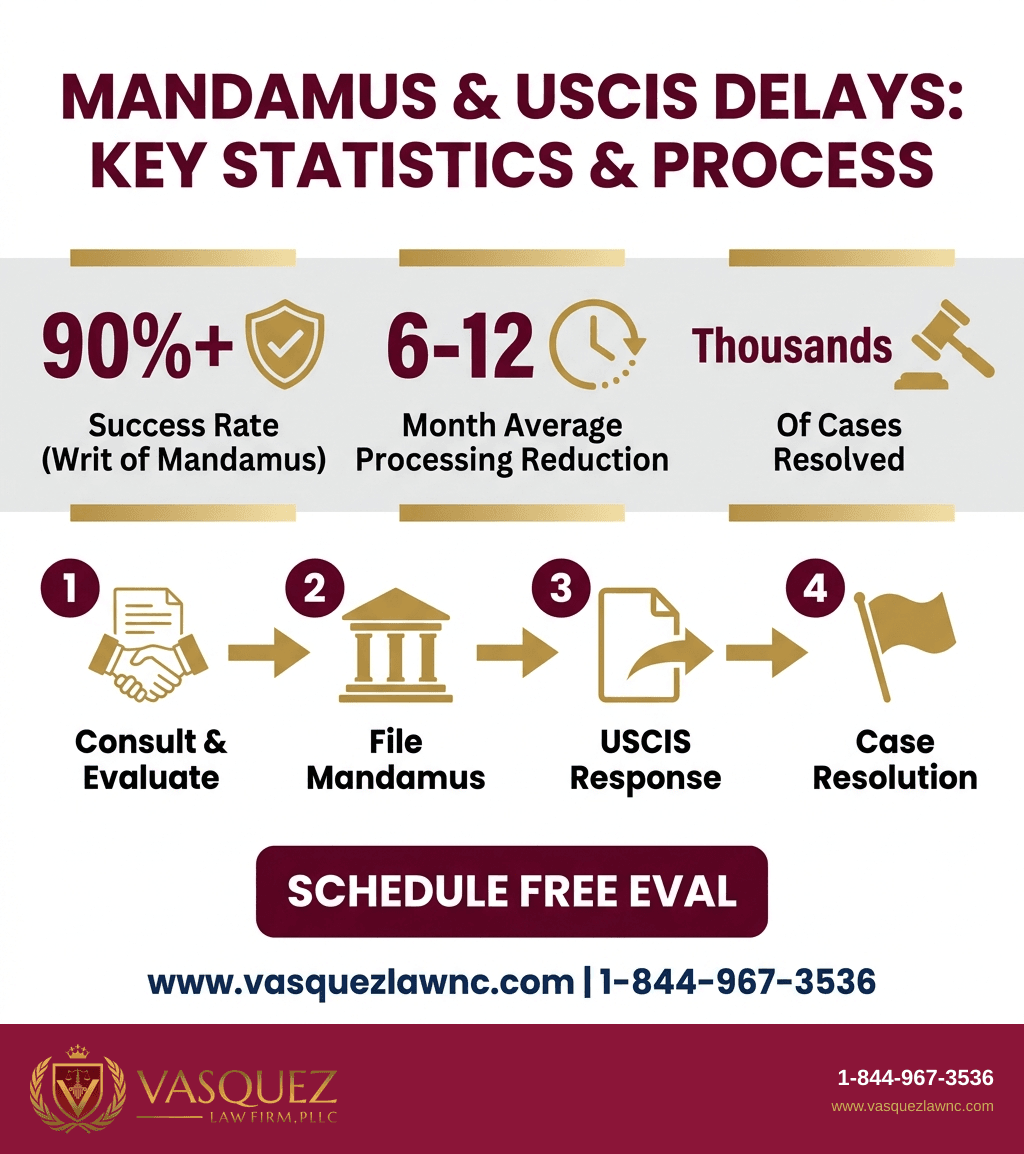
Mandamus cases are federal lawsuits and their timeline is influenced by multiple factors such as court schedules, government responsiveness, and case complexity. Here is a general expectation for mandamus petitions filed in districts covering Raleigh, NC and Orlando, FL:
- 0-6 Months: Initial filing, service of process on USCIS, and government responses.
- 6-12 Months: Discovery phase, evidence gathering, and possible settlement discussions.
- 12-18 Months: Court hearings or motions on mandamus; potential court order requiring USCIS action.
- Post-Judgment: USCIS processes the case, but this timeline can vary depending on agency workload.
USCIS consistently updates processing times, but delays beyond these can justify mandamus. Checking USCIS processing times regularly helps estimate wait periods.
Frequently Asked Questions
What does mandamus mean in legal terms?
Mandamus is a court order requiring a government agency to perform its legal duties, often used when immigration agencies unreasonably delay cases. It forces action but does not decide the merits.
What are the 5 writs of mandamus?
There is only one writ of mandamus in U.S. law. Other writs like habeas corpus or certiorari serve different purposes and are not interchangeable with mandamus.
What is a writ of mandamus example?
Filing in federal court to compel USCIS to process a delayed green card application after waiting beyond published processing times is a typical example of mandamus.
How successful is a writ of mandamus?
Success depends on proving unreasonable delay and lack of alternatives. Courts expect proof that USCIS has failed to act within reasonable time frames.
How does a writ of mandamus work?
Petitioners file a federal lawsuit requesting the court order USCIS to act. The court reviews evidence of delay and issues an order demanding agency action if justified.
Can I file a mandamus petition for any immigration case?
Mandamus is generally for cases stuck beyond normal processing. It may not apply if the agency still has time or other options are available.
How long does a mandamus case take in Raleigh or Orlando?
Typically, mandamus cases last 6 to 18 months depending on court load, USCIS responsiveness, and case facts in these jurisdictions.
Does filing a mandamus petition speed up my immigration case?
A mandamus petition compels USCIS to act but does not guarantee approval. It is a tool to reduce delays, not an expedited process.
NC, FL, and Nationwide Notes
North Carolina Notes
In Raleigh, mandamus petitions generally file in the Eastern District of North Carolina. Local attorneys familiar with the federal court’s procedures can ensure correct filing. USCIS service centers processing NC cases often reference Charlotte or Raleigh.
Florida Notes
In Orlando, mandamus lawsuits also proceed in federal court. The federal Middle District of Florida governs the region. USCIS regional offices in Florida handle many immigration benefits, but delays may warrant mandamus. Local process knowledge is critical.
Nationwide Concepts
Mandamus is a federal tool available nationwide but subject to jurisdictional venue rules. The federal courts have nationwide authority, but the local district where the USCIS office or applicant resides determines where to file.
When to Call a Lawyer Now
- Your USCIS application has exceeded normal processing times from the official USCIS website.
- USCIS has not responded to inquiries or case status requests for months.
- You have received no interview notice or decision after a year or more.
- You want to understand if mandamus could help your immigration case.
- You have lost confidence in USCIS or immigration court to process your case timely.
- You face a complicated situation involving multiple agencies or motions.
- You want to avoid costly litigation mistakes when filing mandamus.
About Vasquez Law Firm
At Vasquez Law Firm, we combine compassion with aggressive representation. Our motto "Yo Peleo®" (I Fight) reflects our commitment to standing up for your rights.
- Bilingual Support: Se Habla Español — Spanish-speaking attorneys and staff available
- Service Areas: North Carolina, Florida, and nationwide immigration services
- Experience: Over 30 years helping clients navigate complex legal matters
- Results: Thousands of successful cases across multiple practice areas
Attorney Trust and Experience
William J. Vásquez is admitted to the North Carolina State Bar (2011) and to the U.S. Courts of Appeals for the 4th, 5th, 6th, and 11th Circuits. Florida-jurisdiction matters at the firm are handled by Florida Bar attorney Alekssandra Lopez. The firm has provided dedicated legal representation since 2011, with personalized attention to each client's case.
Take the first step toward justice today. Our team is standing by to help. Se Habla Español.
Start Your Free Evaluation Now
Call us: 1-844-967-3536
Se Habla Español - Estamos aquí para ayudarle.
Sources and References


William Vasquez
Founder & CEO, Vasquez Law Firm, PLLC
William Vasquez is the founder and CEO of Vasquez Law Firm, PLLC, a results-driven firm specializing in immigration, criminal defense, personal injury, and workers' compensation. A U.S. Air Force veteran and recipient of the Joint Service Achievement Medal, William is dedicated to fiercely fighting for his clients' rights.
Related Legal Services
Need legal help? Learn more about our immigration legal services, or contact us for a free evaluation.
You can also visit our North Carolina immigration practice for more information.