How Citizenship Policy Affects Immigrants in 2026
Learn how citizenship policy impacts U.S. citizenship requirements and your rights in 2026. Contact Vasquez Law Firm for a free consultation today.
Published on August 17, 2026
Talk to an immigration attorney
Free call. A clear plan for your case.
Free & confidential · Se habla espanol · 24/7
Have questions? Talk to an attorney - free evaluation.
Call 1-844-967-3536Free Tool
Check Your USCIS Case Status Now
Enter your receipt number - get the official USCIS status in English or Spanish. No registration.
How Citizenship Policy Affects Immigrants in 2026
In 2026, citizenship policy continues to shape the experiences of immigrants seeking U.S. citizenship. Understanding current citizenship requirements and constitutional rights is essential for hopeful applicants, especially in Orlando and Raleigh. This guide explains how updated policies influence naturalization, derivative citizenship, and protection from deportation. Vasquez Law Firm provides bilingual, compassionate legal support for immigrants navigating these complex laws in North Carolina, Florida, and nationwide.
Need help with your case? Our experienced attorneys are ready to fight for you. Se Habla Español.
Or call us now: 1-844-967-3536
Quick Answer
Citizenship policy in 2026 dictates eligibility criteria for naturalization, derivative citizenship, and addresses constitutional protections. Key rules include the five main requirements to become a U.S. citizen, protections for naturalized citizens, and recent policy adaptations affecting immigrants in Orlando and Raleigh.
- Five requirements to naturalize under current law
- Changes in derivative citizenship rules
- Impact of constitutional safeguards on citizenship policy
- How policy affects deportation risk
- Available resources like USCIS citizenship book PDF
Understanding Citizenship Policy in 2026
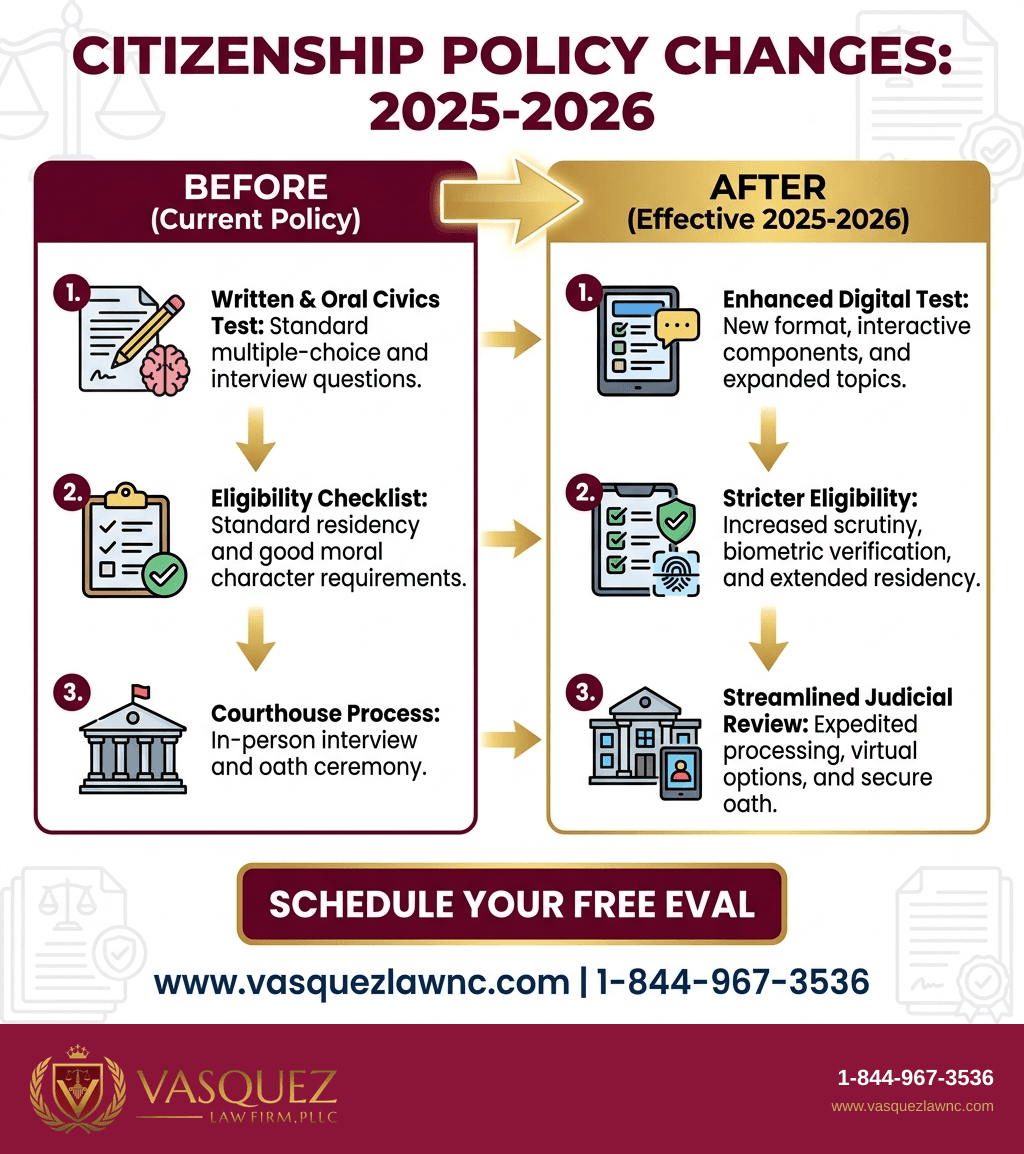
In 2026, U.S. citizenship policy is fundamentally shaped by federal statutes, constitutional law, and regulatory guidelines. The Immigration and Nationality Act (INA) governs most naturalization procedures, including eligibility and grounds for denial under 8 U.S.C. § 1427. Updated policies clarify who qualifies as a "naturalized" citizen and how derivative citizenship applies to children of citizens, as detailed by the USCIS derivative citizenship chart.
A new challenge remains at the intersection of constitutional rights and legislative changes. Courts continue to uphold that only Congress can change citizenship rules, constrained notably by the 14th Amendment, which guarantees birthright citizenship. For immigrants in Orlando and Raleigh, navigating these policies means understanding both legal protections and bureaucratic procedures.
Five Requirements to Become a U.S. Citizen
The five key requirements under INA § 316(a) for naturalization are:
- Be at least 18 years old
- Be a lawful permanent resident (green card holder) for at least 5 years (or 3 years for spouses of U.S. citizens)
- Continuous residence and physical presence in the U.S.
- Good moral character
- Pass English and civics tests
These criteria form the backbone of U.S. citizenship eligibility and have been affirmed in recent USCIS policy updates (see USCIS Policy Manual).
Naturalized Citizens and Deportation Risk
Naturalized citizens generally have the same constitutional protections as birthright citizens. However, denaturalization and deportation are possible under certain conditions, such as citizenship obtained through fraud (8 U.S.C. § 1451). The Executive Office for Immigration Review (EOIR) adjudicates cases involving potential removal of naturalized citizens. While rare, this risk underscores the importance of legal guidance.
Step-by-step: What to Do to Pursue Citizenship
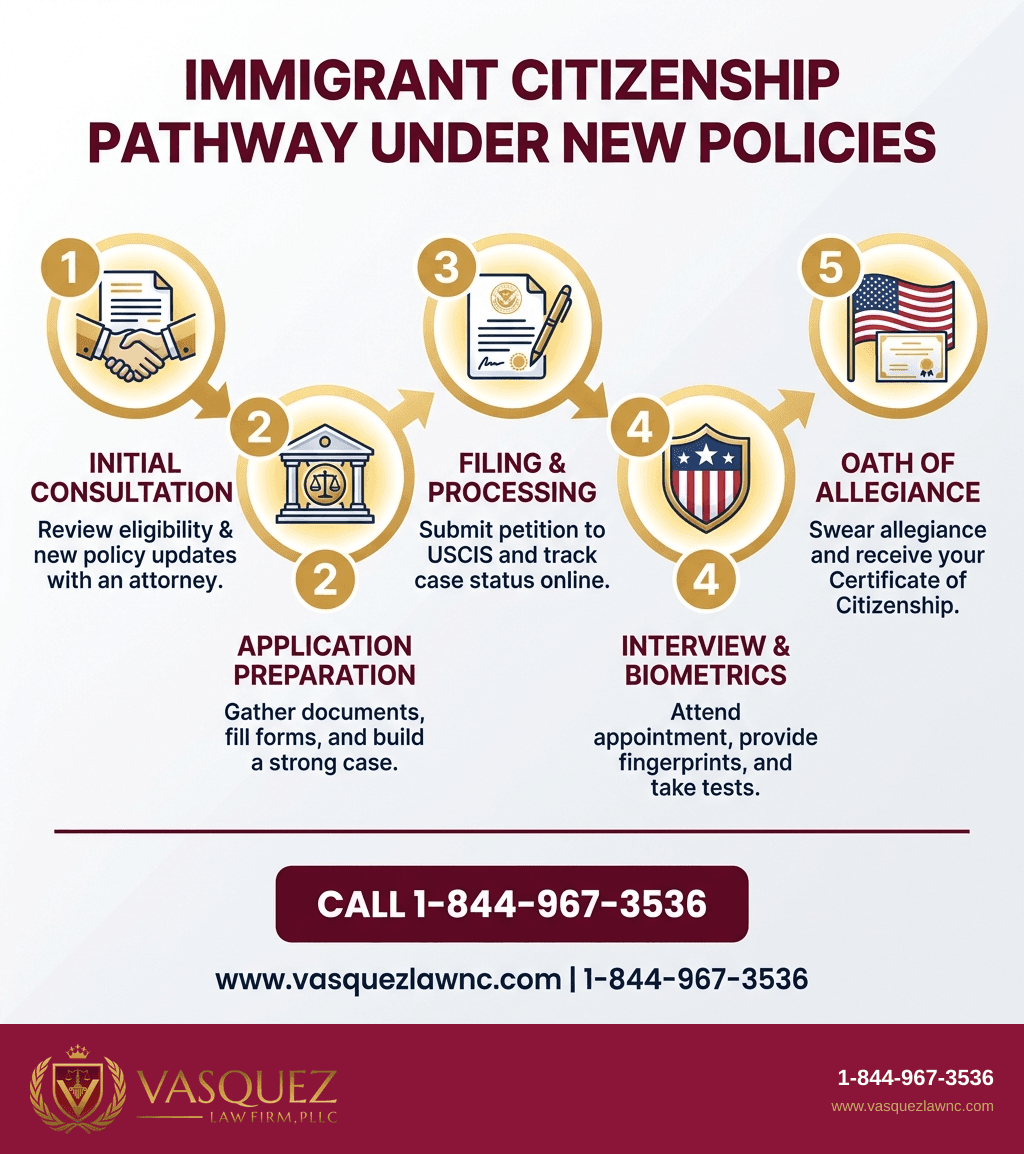
- Determine if you meet the five U.S. citizenship requirements including residence and moral character.
- Gather all necessary documents, including green card, tax returns, and evidence of residence.
- Study with available resources: download a free copy of the U.S. Citizenship book PDF to prepare for civics and English tests.
- File Form N-400 (Application for Naturalization) with USCIS.
- Attend biometrics appointment and scheduled interview.
- Take and pass the citizenship test.
- Attend the oath ceremony and officially become a U.S. citizen.
Referencing USCIS Processing Times
Processing times for Form N-400 vary by region. As of August 2026, USCIS reports typical processing times range between 8 to 14 months (USCIS Processing Times). Applicants residing in Orlando, FL and Raleigh, NC should expect timelines within this range but should plan accordingly.
Documents or Evidence Checklist for Citizenship Applications
- Permanent Resident Card (Green Card)
- Passport or travel documents
- Marriage certificate (if applying based on marriage)
- Proof of residence and employment
- Tax returns or IRS transcripts for the last 3 to 5 years
- Criminal records or police clearances
- Evidence of military service (if applicable)
Timeline: What to Expect in 2026
- Month 1-3: Submit N-400 and receive receipt notice.
- Month 3-6: Receive biometrics appointment notice and attend fingerprinting.
- Month 6-12: Interview scheduling with USCIS local office in Orlando or Raleigh.
- Month 12-14: Take citizenship test and interview.
- Month 13-14: Attend oath of allegiance ceremony.
This timeline is average and can vary based on USCIS workload and applicant-specific factors.
Costs and Fees: What Impacts the Price of Citizenship Applications
- USCIS Filing Fee: $640 for Form N-400, plus $85 biometrics fee, totaling $725 (subject to change).
- Legal Assistance: Fees vary; offering free initial consultations at Vasquez Law Firm can reduce up-front costs.
- Additional Costs: Document translations, obtaining records, test preparation materials.
- Fee Waivers: Available for qualifying low-income applicants under Form I-912.
Common Mistakes and How to Avoid Them
- Filing incomplete or inaccurate N-400 forms — double-check for errors before submitting.
- Failing to disclose past criminal history — honesty is critical, concealment risks denial or deportation.
- Not maintaining continuous residence — extended trips outside the U.S. disrupt eligibility.
- Ignoring USCIS interview notices — always respond promptly to official correspondence.
- Not preparing adequately for the civics and English tests — use official USCIS materials.
- Submitting outdated documents — ensure all evidence is current and valid.
- Failing to report address changes — keep USCIS updated to receive timely communications.
- Applying without legal counsel guidance if unsure about eligibility, especially for complex cases.
If you only remember one thing: Thorough preparation and full honesty during the application process are vital to a successful citizenship case.
Jurisdiction Notes on Citizenship Policy
Federal Framework
Citizenship policy is governed federally under the INA and overseen by USCIS nationwide, including Raleigh, NC and Orlando, FL offices. Courts also interpret constitutional limits on citizenship changes, with the 14th Amendment guaranteeing citizenship to those born on U.S. soil (8 U.S.C. § 1401 confirms derivative citizenship rules).
North Carolina and Florida Notes
While immigration and citizenship law are federal, practical steps can vary locally. Applicants in Raleigh, NC and Orlando, FL benefit from nearby USCIS offices and local legal resources. Vasquez Law Firm provides tailored assistance in both offices to reflect local procedures and community nuances.
Nationwide Provisions
Policies on citizenship tests, naturalization eligibility, and deportation protections apply nationwide. Updates published by USCIS affect all jurisdictions, but local application timelines and service availability can differ.
When to Call a Lawyer Now
- If you have a complex immigration history affecting citizenship eligibility.
- If you fear deportation despite naturalized citizenship.
- If you received a USCIS notice for interview or document request you do not understand.
- If you need help with citizenship test preparation strategies.
- If your application was denied or is delayed beyond normal processing times.
- If you want to understand how recent citizenship policy changes impact your case.
- If you are pursuing derivative citizenship for children or family members.
- If you want to explore fee waiver eligibility or cost-saving measures.
- If you want personalized representation at USCIS or immigration court.
About Vasquez Law Firm
At Vasquez Law Firm, we combine compassion with aggressive representation. Our motto "Yo Peleo®" (I Fight) reflects our commitment to standing up for your rights. We offer bilingual support to clients in Raleigh, NC, Orlando, FL, and nationwide immigration matters.
- Bilingual Support: Se Habla Español — Spanish-speaking attorneys and staff available
- Service Areas: North Carolina, plus Florida and nationwide for immigration
- Experience: Over 30 years helping clients navigate complex legal matters
- Results: Thousands of successful cases across multiple practice areas
Attorney Trust and Experience
William J. Vásquez is admitted to the North Carolina State Bar and to the U.S. Courts of Appeals for the 4th, 5th, 6th, and 11th Circuits. Since 2011, our firm has provided dedicated legal representation with personalized attention to each client's case.
Don't wait to get the help you deserve. Call us now for immediate assistance.
Or schedule a free case evaluation. Se Habla Español.
Frequently Asked Questions
What are the five requirements to become a U.S. citizen?
The five requirements include being at least 18 years old, a green card holder for 5 years (or 3 if married to a U.S. citizen), residing continuously in the U.S., demonstrating good moral character, and passing English and civics tests.
Can a naturalized citizen still be deported?
Yes, but only under limited circumstances such as fraud during the naturalization process or certain criminal convictions. Denaturalization proceedings are rare and require strong evidence.
What is the new rule for U.S. citizenship in 2026?
The new rules focus on clarifying derivative citizenship for children of citizens and strengthening protections against wrongful denaturalization, while maintaining existing naturalization requirements.
Do non-citizens have constitutional rights?
Non-citizens have certain constitutional protections, such as due process, but not all rights extended to citizens. For immigration matters, these rights influence deportation and detention procedures.
Where can I find free U.S. citizenship study materials?
The USCIS website offers a free downloadable U.S. Citizenship book PDF that covers civics questions, English language requirements, and application steps.
How long does the citizenship application process take?
Typically 8 to 14 months from filing Form N-400 to receiving the oath, but this varies by USCIS office and individual case specifics.
What is derivative citizenship?
Derivative citizenship refers to citizenship automatically granted to children through their parents, often during the parents' naturalization or birth abroad, as regulated by USCIS charts.
Can I lose citizenship after becoming naturalized?
Loss of citizenship after naturalization is uncommon and requires serious legal grounds such as concealment of material facts or criminal fraud in the application.
Sources and References
- U.S. Citizenship and Immigration Services
- Executive Office for Immigration Review
- Legal Information Institute
Take the first step toward justice today. Our team is standing by to help.
Start Your Free Evaluation Now
Call us: 1-844-967-3536
Se Habla Español - Estamos aquí para ayudarle.
If you need legal assistance, learn more about immigration case consultation, or call us at 1-844-967-3536 for a free evaluation.


William Vasquez
Founder & CEO, Vasquez Law Firm, PLLC
William Vasquez is the founder and CEO of Vasquez Law Firm, PLLC, a results-driven firm specializing in immigration, criminal defense, personal injury, and workers' compensation. A U.S. Air Force veteran and recipient of the Joint Service Achievement Medal, William is dedicated to fiercely fighting for his clients' rights.
Related Legal Services
Need legal help? Learn more about speak with an immigration lawyer, or contact us for a free evaluation.
You can also visit immigration attorneys across North Carolina for more information.