How Immigration Court Works and What Happens in 2026
Wondering how immigration court works? Learn how to check your case status, understand hearings, and protect your rights. Contact Vasquez Law for help today.
Published on August 16, 2026
Talk to an immigration attorney
Free call. A clear plan for your case.
Free & confidential · Se habla espanol · 24/7
Have questions? Talk to an attorney - free evaluation.
Call 1-844-967-3536Check your case status now
Look up your immigration case below, then talk to an attorney about what it means — free.
Questions about your result?
Talk to an attorney about your case — free, no obligation.
How Immigration Court Works and What Happens in 2026
If you or a family member faces removal proceedings, understanding how immigration court works is vital. Immigration court is a federal administrative tribunal where cases such as deportations and adjustment applications are heard. In 2026, the process involves hearings before an immigration judge from the Executive Office for Immigration Review (EOIR). You can check your immigration court case status online or by phone. This guide explains key steps, timelines, costs, and mistakes to avoid for individuals in Raleigh, NC and Orlando, FL.
Need help with your case? Our experienced attorneys are ready to fight for you. Se Habla Español.
Or call us now: 1-844-967-3536
Quick Answer
Immigration court is where federal judges decide if non-citizens should be removed or may stay in the U.S. Cases involve removal, asylum, or adjustment appeals. You can check your immigration court case status online or by phone using EOIR resources. Protect your rights by understanding hearings and deadlines in Raleigh and Orlando immigration courts.
- Immigration court is a federal administrative court under EOIR.
- Cases include removal proceedings, asylum, and relief applications.
- You can check your case status online or by phone.
- Hearings involve government and respondent testimony before a judge.
- Timelines vary, with some cases taking months or years.
Understanding Immigration Court and Its Role
Immigration court is a federal court system operated by the Executive Office for Immigration Review (EOIR), part of the U.S. Department of Justice. It primarily handles removal cases, where the government seeks to deport individuals who do not have lawful status. The immigration judge decides whether someone can stay in the U.S. legally or must be removed. In Raleigh, NC and Orlando, FL, local immigration courts focus on cases involving people arrested by ICE or those who receive notices to appear.
The court is distinct from federal district courts; it does not handle criminal matters but enforces immigration laws governed by statutes like INA § 240 (8 U.S.C. § 1229a). The judge hears evidence, legal arguments, and determines eligibility for relief such as asylum, cancellation of removal, or adjustment of status under federal law.
For individuals in Raleigh or Orlando, understanding the immigration court's function helps prepare for hearings and rights defense. Immigration court proceedings are administrative and must comply with strict timelines and procedures set by 8 C.F.R. § 1003.
Knowing this framework can help you better navigate your case and work with an experienced immigration lawyer in Raleigh and Orlando.
How to Check Your Immigration Court Case Status
Tracking your immigration court case status is vital to avoid missing hearings or deadlines. The EOIR maintains an Automated Case Information system online where you can enter your A-number (Alien Registration Number) to view your hearing schedule and case status. This system is updated regularly and is available nationwide.
Another way to confirm hearing dates and court information is by calling the immigration court phone number listed on your notice to appear. The phone line usually provides automated status updates and court contact information.
In Raleigh, NC and Orlando, FL, many immigration courts also publish local contact details online, making it easier to perform an immigration court date check. Regularly confirming updates is especially important given recent backlog and scheduling changes in 2026, including increased use of 'mega hearings' where multiple cases are heard simultaneously.
If you need assistance checking your status or interpreting court notices, contact our office for a consultation with an immigration attorney.
Checking Case Status Online
- Use the EOIR Automated Case Information website at https://justice.gov/eoir.
- Enter your valid A-number or receipt number.
- Review upcoming hearing dates and judge assignments.
- Print or save information to track your case.
Contacting the Court by Phone
- Call the immigration court phone number from your hearing notice.
- Use automated prompts to get case updates.
- Speak to court staff for clarifications if needed.
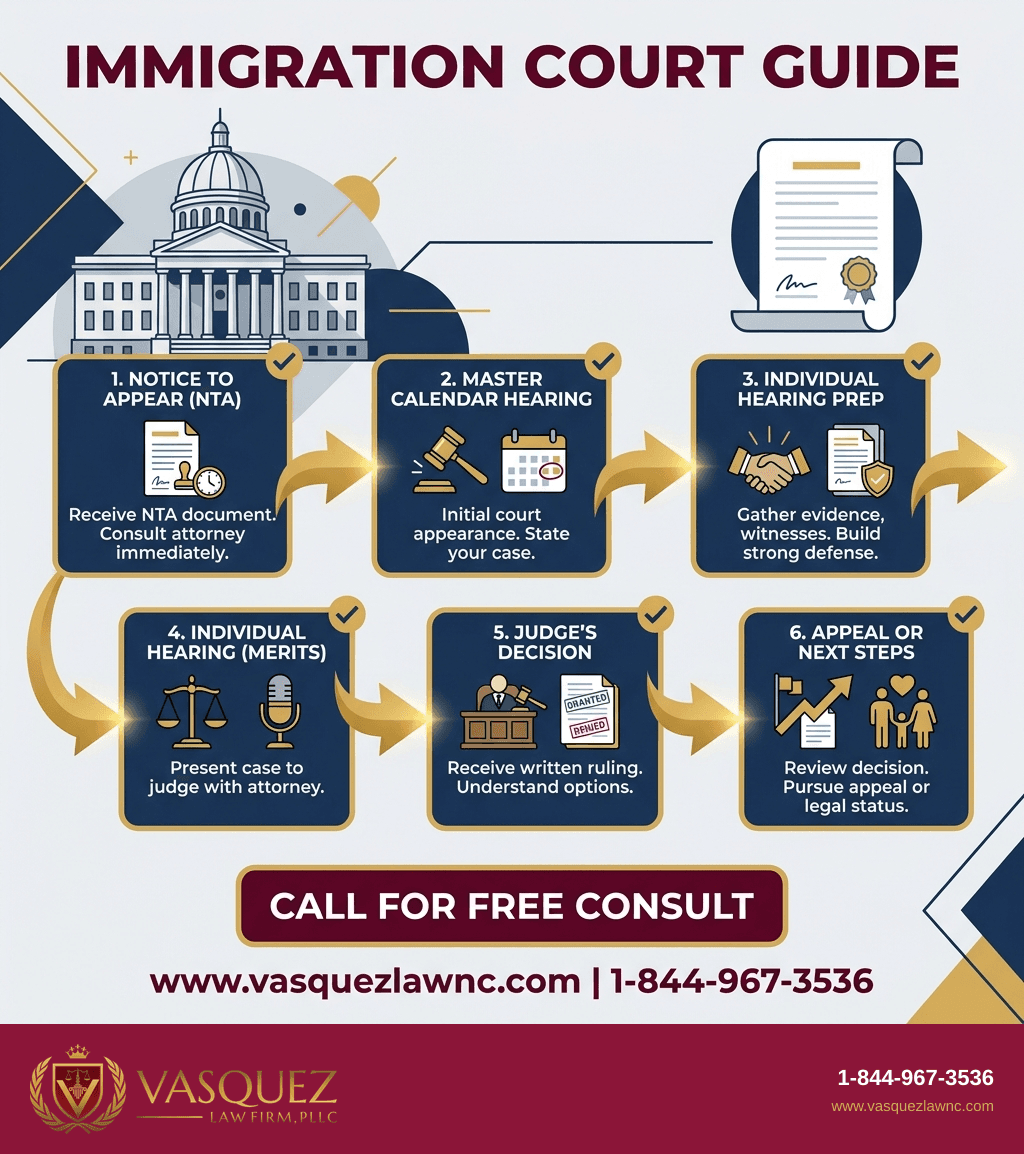
Step-by-Step: What Happens During Immigration Court Hearings
Each immigration court hearing follows a general structure but varies by case type and court. Understanding what happens at scheduled hearings helps you prepare properly.
Most cases begin with a master calendar hearing — a brief preliminary proceeding to schedule future hearings and review charges. The judge may also confirm if relief applications have been filed.
After the master hearing, an individual merits hearing is scheduled. This longer proceeding allows both sides to present evidence, call witnesses, and make legal arguments. The immigration judge then issues a decision.
Master Calendar Hearing
- Review charges listed on the Notice to Appear.
- Respondent may plead to the charges and raise preliminary defenses.
- Schedule dates for filing applications or documents.
Individual Merits Hearing
- Present evidence supporting relief or defense against removal.
- Government presents evidence to prove removability.
- Judge evaluates credibility, legal standards, and issues ruling.
Possible Outcomes
- Granted relief such as asylum, cancellation, or adjustment of status.
- Order of removal (deportation) if relief is denied.
- Appeal or reopening of the case in limited circumstances.
Missing a hearing can result in an automatic removal order, so timely attendance is crucial. If you cannot attend, notifying the court promptly and explaining valid reasons may help avoid adverse decisions.
Common Mistakes to Avoid in Immigration Court
- Missing Hearing Dates: Always verify your hearing schedule and attend each court date. Missing hearings leads to deportation orders by default.
- Not Checking Case Status: Avoid relying solely on mailed notices. Use online tools and phone check-ins regularly.
- Failing to Submit Evidence Timely: Deadlines for petitions and supporting documents must be met to preserve your case.
- Not Hiring an Attorney: Navigating immigration court alone limits understanding of legal options and risks.
- Ignoring Court Notices: Respond to all court communications timely to avoid case dismissal or default orders.
- Misunderstanding Relief Eligibility: Know which protections like asylum or cancellation you may qualify for to build a strong defense.
- Underestimating ICE Detention Risks: If detained, act fast to request bond hearings and counsel assistance.
If you only remember one thing: Attend all court hearings and keep track of dates through official EOIR resources.
Timeline and What to Expect in Your Case
Immigration court cases vary in length. Simple cases may resolve in a few months, but many take a year or more due to court backlogs and case complexity. Multi-day hearings may be scheduled especially if evidence or witness testimony is involved.
- 1-3 months: Initial Notice to Appear and master calendar hearing.
- 3-12 months: Individual merits hearing scheduled, evidence collected.
- 12+ months: Possible appeals or motions to reopen if the initial decision is unfavorable.
In 2026, federal efforts to conduct 'mega hearings' aim to consolidate many cases on limited days to accelerate processing. Though this may speed some cases, delays remain. Always check your specific court’s schedule and contact your lawyer for updated timelines.
An immigration attorney can help you understand the timeline specific to Raleigh, NC or Orlando, FL courts and advocate to move your case efficiently.
When to Call an Immigration Lawyer
- If you receive a Notice to Appear (NTA) for removal proceedings.
- Before attending your first immigration court hearing.
- If ICE detains you or a family member.
- If you want to apply for asylum or other relief.
- After receiving an unfavorable court decision.
- If you miss a hearing or receive a removal order.
- To check the status and understand complex case procedures.
- When you receive confusing court notices or affidavits.
Early legal consultation can improve your chances of a favorable outcome and prevent avoidable mistakes.
About Vasquez Law Firm
At Vasquez Law Firm, we combine compassion with aggressive representation. Our motto "Yo Peleo®" (I Fight) reflects our commitment to standing up for your rights. We provide bilingual support across immigration cases for clients in Raleigh, NC, Orlando, FL, and nationwide.
- Bilingual Support: Se Habla Español — Spanish-speaking attorneys and staff available
- Service Areas: North Carolina, plus Florida and nationwide for immigration
- Experience: Over 15 years helping clients navigate complex immigration legal matters
- Results: Thousands of successful cases across family petitions, asylum, deportations, and more
Attorney Trust and Experience
Attorney Vasquez holds a JD and has more than 15 years of experience practicing immigration law. He is admitted to the North Carolina State Bar, and works closely with clients to understand their unique circumstances. Vasquez Law Firm is dedicated to providing personalized, thorough representation in immigration court and related matters.
Don't wait to get the help you deserve. Call us now for immediate assistance.
Se Habla Español.
Frequently Asked Questions
What does an immigration court do?
Immigration court handles removal (deportation) proceedings and relief applications. Judges determine whether someone without lawful status can legally remain or be removed, applying federal immigration laws outlined in INA § 240.
How do I check my immigration court case?
You can check your case online using the EOIR Automated Case Information system or by calling your immigration court's phone number. Keeping track of your case status helps avoid missed hearings and deadlines.
What happens during an immigration court hearing?
The immigration judge reviews evidence and listens to testimony from the government and respondent. The judge then decides whether to grant relief or order removal. There are usually preliminary and merits hearings.
Is immigration court a federal court?
Yes, immigration court is a federal administrative court under the Executive Office for Immigration Review (EOIR), part of the Department of Justice. It follows federal immigration statutes.
What types of cases are heard in immigration court?
Cases include removal proceedings, asylum petitions, cancellation of removal, adjustment of status requests, bond hearings, and other immigration relief applications under U.S. law.
How long does immigration court take in North Carolina and Florida?
Times vary from months to years based on case complexity and backlog. Raleigh and Orlando courts have dealt with increasing case loads. ‘Mega hearings’ have been introduced to speed up some cases.
Can I attend my immigration court hearing virtually?
Virtual hearings are permitted for certain proceedings depending on court rules. Confirm with your Raleigh or Orlando immigration court whether your hearing qualifies for videoconference.
What is ICE’s role in immigration court?
ICE is the federal agency that initiates removal proceedings and presents evidence against the respondent. ICE detains individuals and enforces immigration laws in court cases.
Sources and References
- U.S. Citizenship and Immigration Services
- Executive Office for Immigration Review
- Legal Information Institute
Take the first step toward justice today. Our team is standing by to help. Se Habla Español.
Start Your Free Evaluation Now
Call us: 1-844-967-3536


William Vasquez
Founder & CEO, Vasquez Law Firm, PLLC
William Vasquez is the founder and CEO of Vasquez Law Firm, PLLC, a results-driven firm specializing in immigration, criminal defense, personal injury, and workers' compensation. A U.S. Air Force veteran and recipient of the Joint Service Achievement Medal, William is dedicated to fiercely fighting for his clients' rights.
Related Legal Services
Need legal help? Learn more about how our immigration attorneys can help, or contact us for a free evaluation.
You can also visit our North Carolina immigration practice for more information.