USCIS Limits Adjustment of Status to Extraordinary Cases in 2026
The latest USCIS policy announced in May 2026 restricts adjustment of status applications to extraordinary circumstances only. This means most green card applicants in Raleigh, NC must now apply through consular processing abroad. Learn how this change affects temporary visa holders and what steps to take next under the new USCIS guidance.
Published on May 27, 2026
Talk to an immigration attorney
Free call. A clear plan for your case.
Free & confidential · Se habla espanol · 24/7
Have questions? Talk to an attorney - free evaluation.
Call 1-844-967-3536Free Tool
Check Your USCIS Case Status Now
Enter your receipt number - get the official USCIS status in English or Spanish. No registration.
This article provides general legal information, not individualized legal advice. Reading does not create an attorney-client relationship. For advice specific to your situation, contact Vasquez Law Firm.
What did USCIS change about adjustment of status in May 2026?
Filing or renewing a green card?
Adjustment-of-status timing, RFEs, and travel risks all change with new policy. 15-min review of your specific case.
In May 2026, USCIS announced a new policy restricting adjustment of status (AOS) applications to only extraordinary circumstances. Normally, nonimmigrants in the U.S. must apply for green cards through consular processing abroad. This policy reinforces that rule, requiring most applicants to leave the U.S. and apply at a U.S. consulate in their home country, except in rare, exceptional cases.
This change marks a return to the original intent of immigration law, emphasizing that temporary visitors should not use their stay in the U.S. as a first step toward permanent residency. USCIS aims to reduce incentives for unauthorized stays and streamline its resources by focusing on cases that fall clearly under its jurisdiction.
The policy memo issued on May 22, 2026, directs immigration officers to evaluate adjustment of status requests on a case-by-case basis and grant relief only in extraordinary situations. USCIS spokesman Zach Kahler explained the shift as necessary to uphold the law and improve fairness and efficiency in the immigration system.
This policy affects nonimmigrant visa holders such as students, temporary workers, and tourists who previously might have sought to adjust status while in the U.S. Instead, they must now return to their home countries to apply for immigrant visas through the Department of State's consular offices.
By enforcing this approach, USCIS intends to reduce the number of individuals who remain in the U.S. unlawfully after being denied residency and to allocate USCIS resources to priorities like naturalization and visas for crime victims.
Who is affected by the new USCIS adjustment of status policy?
The new USCIS policy primarily affects nonimmigrant visa holders currently in the U.S. on temporary status who seek to adjust to lawful permanent resident status without leaving the country. This includes students, temporary workers, visitors on tourist visas, and others who have been residing temporarily in the U.S.
For residents of Raleigh, NC and Orlando, FL (where our Florida office is located), this means that individuals who had planned to file adjustment of status applications while inside the U.S. will now generally have to return to their home countries to complete consular processing. This affects thousands of applicants annually who pursue green cards through family or employment-based categories.
USCIS officers will consider extraordinary circumstances on a case-by-case basis, but the standard will be very high. Ordinary adjustment of status applications from within the U.S. will be denied unless the applicant can demonstrate exceptional reasons justifying relief.
This policy shift may increase processing times and travel costs for applicants who must leave the U.S. and attend consular interviews abroad. It may also impact employers and families in Raleigh, NC who sponsor foreign nationals, as applicants must plan for consular processing logistics.
USCIS data indicates that a significant number of adjustment of status applications come from applicants residing in North Carolina, given its growing immigrant population. The policy will therefore have a tangible impact on the immigrant community and legal service providers in the Raleigh area.
What does the law actually say about adjustment of status?
Adjustment of status is governed by 8 U.S.C. § 1255 (INA § 245(a)), which allows certain aliens physically present in the United States to apply for lawful permanent resident status without returning abroad. However, the statute does not guarantee automatic eligibility and USCIS has discretion to grant or deny applications.
The new USCIS policy memo reaffirms that the statutory framework and immigration court decisions have long emphasized that adjustment of status should be the exception, not the rule, for nonimmigrants temporarily in the U.S. The preferred process remains consular processing through the Department of State.
Specifically, the memo states:
"Consistent with long-standing immigration law and immigration court decisions, aliens seeking adjustment of status must do so through consular processing via the Department of State outside of the country. Officers are directed to consider all relevant factors and information on a case-by-case basis when determining whether an alien warrants this extraordinary form of relief." (Source: USCIS, https://www.uscis.gov/newsroom/news-releases/us-citizenship-and-immigration-services-will-grant-adjustment-of-status-only-in-extraordinary)
This language underscores that adjustment of status is an extraordinary remedy reserved for exceptional cases, not the default pathway for green card applicants.
Additionally, USCIS cites the rationale that nonimmigrants "come to the U.S. for a short time and for a specific purpose," and their visit "should not function as the first step in the Green Card process." This interpretation aligns with the statutory intent to prevent misuse of temporary visas as a backdoor to permanent residency.
Other relevant regulations include 8 CFR § 245.1, which sets eligibility criteria for adjustment of status. These criteria remain in force but will be applied more strictly under the new policy.
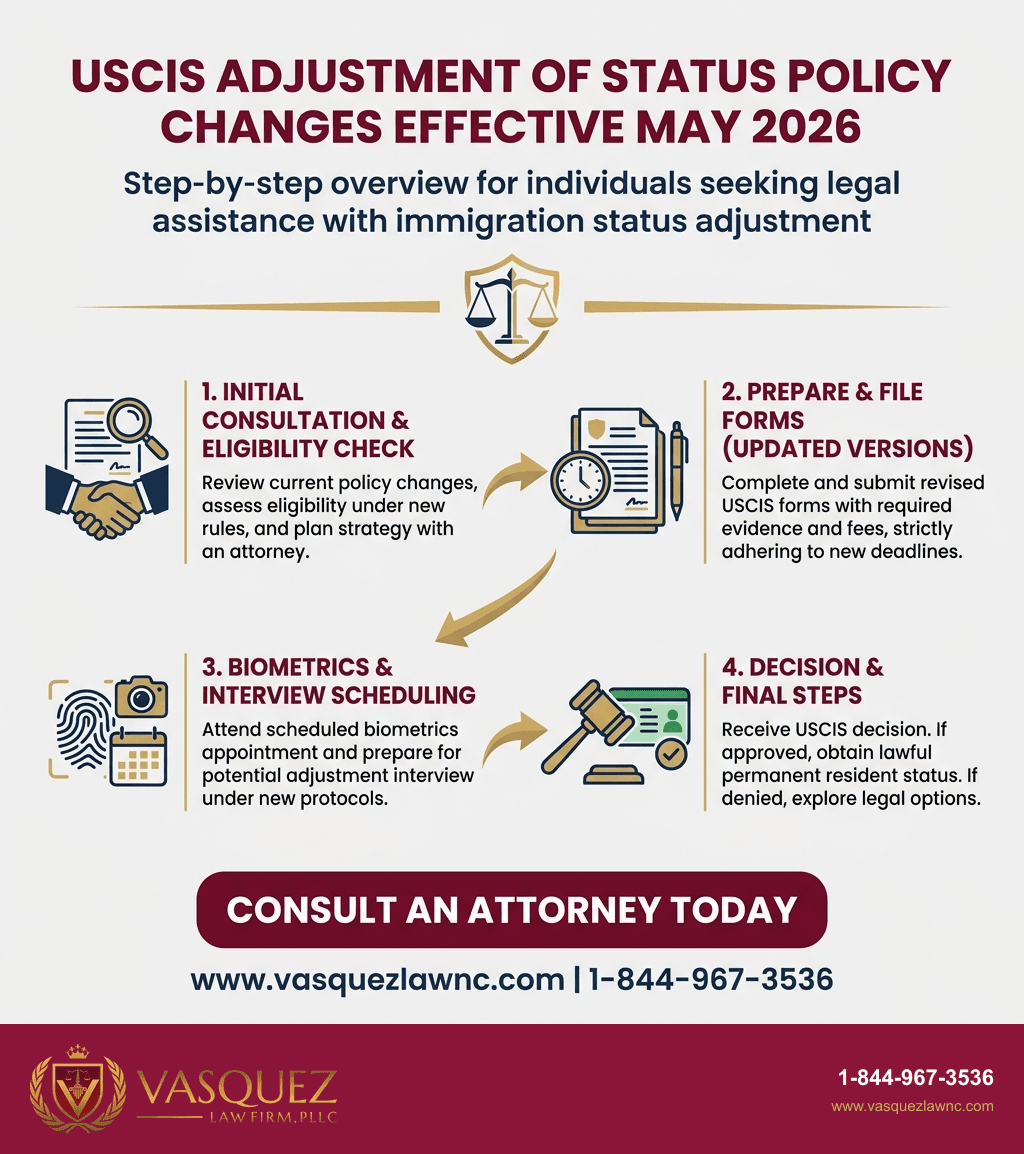
What should you do if you want to apply for adjustment of status under this new policy?
If you are currently in the U.S. on a temporary visa and considering applying for adjustment of status, it is important to understand that USCIS will now grant such applications only in extraordinary circumstances. Most applicants will be required to leave the U.S. and apply through consular processing at a U.S. embassy or consulate in their home country.
At our Raleigh, NC and Orlando, FL offices, we typically see applicants misunderstanding the new policy and attempting to file adjustment of status applications without meeting the high threshold for extraordinary relief. This often leads to denials and complications that could have been avoided with proper guidance.
Here are some concrete steps to take under the new USCIS policy:
- Consult with an experienced immigration attorney to evaluate whether your situation might qualify as an extraordinary circumstance justifying adjustment of status inside the U.S.
- If you do not meet the extraordinary circumstances standard, prepare to pursue consular processing through the Department of State, which will require you to depart the U.S. and attend an immigrant visa interview abroad.
- Gather all required documentation for consular processing, including approved petitions, medical exams, police clearances, and financial support evidence.
- Stay informed of any travel restrictions or procedural updates at the U.S. consulate where you will apply.
- Maintain lawful status in the U.S. while preparing for your consular appointment to avoid accrual of unlawful presence that could trigger bars to reentry.
The following table summarizes the key differences between adjustment of status and consular processing under the new policy:
| Aspect | Adjustment of Status (AOS) | Consular Processing |
|---|---|---|
| Location | Inside the U.S. (only extraordinary cases) | U.S. consulate abroad (standard process) |
| Eligibility | Strict, only extraordinary circumstances | Available to most eligible applicants |
| Processing Time | Varies, potentially longer due to stricter review | Varies, but generally predictable consular schedules |
| Travel Required | No (except for extraordinary cases) | Yes, applicant must attend interview abroad |
Applicants should also be aware of the relevant statutes, including 8 U.S.C. § 1255 and 8 CFR § 245.1, which outline eligibility and procedural requirements for adjustment of status.
For residents of Raleigh, NC and Orlando, FL, local immigration attorneys can provide tailored advice and assistance navigating these changes, especially given the complex interplay of federal law and consular procedures.
Finally, applicants should monitor official USCIS announcements and consult the USCIS policy memo for updates and clarifications.
What happens next with USCIS’s adjustment of status policy?
USCIS will implement this policy immediately as of May 22, 2026, and immigration officers will apply the new standard in all adjustment of status adjudications. The agency expects this will reduce unauthorized stays and improve resource allocation.
Applicants who do not qualify for extraordinary relief will be directed to complete consular processing abroad. This may result in increased demand at U.S. consulates and longer wait times for immigrant visa interviews.
USCIS will continue to prioritize other immigration benefits such as naturalization applications and visas for victims of crimes and human trafficking, which remain under its jurisdiction.
What's Your Immigration Situation?
Answer 3 questions - we'll tell you your options
Question 1 / 3
What best describes your situation?
Keep Reading
The policy memo states:
"Following the law allows the majority of these cases to be handled by the State Department at U.S. consular offices abroad and frees up limited USCIS resources to focus on processing other cases that fall under its purview, including visas for victims of violent crime and human trafficking, naturalization applications, and other priorities." (Source: USCIS, https://www.uscis.gov/newsroom/news-releases/us-citizenship-and-immigration-services-will-grant-adjustment-of-status-only-in-extraordinary)
Stakeholders in Raleigh, NC and Orlando, FL should prepare for this shift by educating clients about consular processing and adjusting legal strategies accordingly.
It remains to be seen whether Congress or the courts will respond to this policy change. For now, USCIS is emphasizing strict adherence to the original statutory scheme governing adjustment of status and consular processing.
Frequently Asked Questions about USCIS’s new adjustment of status policy
Can I still apply for adjustment of status if I am in the U.S. on a tourist visa?
Under the new policy, tourists generally cannot apply for adjustment of status while in the U.S. They must return to their home country and apply for an immigrant visa through consular processing unless they can demonstrate extraordinary circumstances justifying adjustment inside the U.S.
What qualifies as an extraordinary circumstance for adjustment of status?
The USCIS memo does not specify exact criteria for extraordinary circumstances. Officers will review each case individually, but the standard is very high and applies only in rare, exceptional situations.
How does this policy affect employment-based green card applicants?
Employment-based applicants in the U.S. on temporary work visas will generally need to complete consular processing abroad. Adjustment of status inside the U.S. will be granted only in extraordinary cases.
Will this policy increase processing times for green card applicants?
Consular processing may involve longer wait times due to appointment availability and travel logistics. Adjustment of status applications inside the U.S. may also face stricter scrutiny, potentially delaying decisions.
Where can I find official information about this USCIS policy change?
The official USCIS announcement and policy memo are available at USCIS.gov. Applicants should rely on official sources and consult qualified attorneys for guidance.
This article provides general legal information, not individualized legal advice. Reading does not create an attorney-client relationship. For advice specific to your situation, contact Vasquez Law Firm.
Reviewed by William Vasquez, Founder & CEO, Vasquez Law Firm, PLLC.
Need immigration help? Our immigration attorneys can review your case.
Related Topics

William Vasquez
Founder & CEO, Vasquez Law Firm, PLLC
William Vasquez is the founder and CEO of Vasquez Law Firm, PLLC, a results-driven firm specializing in immigration, criminal defense, personal injury, and workers' compensation. A U.S. Air Force veteran and recipient of the Joint Service Achievement Medal, William is dedicated to fiercely fighting for his clients' rights.
Related Legal Services
Need legal help? Learn more about get immigration legal help today, or contact us for a free evaluation.
You can also visit immigration legal services throughout NC for more information.