What Happens During Deportation in 2026: Key Facts
Facing deportation in 2026? Learn about deportation process, grounds, and defense options. Contact Vasquez Law Firm for a free evaluation today.
Published on May 31, 2026
Talk to an immigration attorney
Free call. A clear plan for your case.
Free & confidential · Se habla espanol · 24/7

Have questions? Talk to an attorney - free evaluation.
Call 1-844-967-3536Check your case status now
Look up your immigration case below, then talk to an attorney about what it means — free.
Questions about your result?
Talk to an attorney about your case — free, no obligation.
What Happens During Deportation in 2026: Key Facts
Deportation can drastically change lives for immigrants in the USA. Understanding the deportation process, common grounds for removal, and your rights can help you prepare and respond effectively. In 2026, with evolving immigration policies, it’s crucial for immigrants in Orlando, FL, and Raleigh, NC, to know what to expect and how legal guidance from the Vasquez Law Firm can assist in defending against deportation. This article provides detailed information on deportation steps, timelines, costs, and common mistakes to avoid.
Need help with your case? Our experienced attorneys are ready to fight for you. Se Habla Español.
Or call us now: 1-844-967-3536
Quick Answer
Deportation is the formal removal of a noncitizen from the United States due to violations like criminal activity or visa issues. The process involves a Notice to Appear, immigration court hearings, and possible appeals before enforced removal.
- Most deportations start with an ICE arrest or deportation letter
- Grounds for removal include criminal convictions and immigration fraud
- Court hearings determine if removal is lawful under INA §§ 237 and 240
- Legal defenses can delay or stop deportation if timely applied
- Process duration ranges from months to over a year depending on case complexity
Understanding Deportation and Its Grounds
In 2026, deportation remains a serious legal process triggered by specific grounds defined in the Immigration and Nationality Act (INA). For example, John, a Raleigh resident, received a deportation letter after ICE discovered his visa had expired. His case illustrates how overstaying a visa is a common ground that can lead to removal. Other grounds include criminal convictions, fraud on immigration documents, and threats to national security.
These grounds are outlined specifically in INA § 237(a) (8 U.S.C. § 1227(a)), which lists offenses leading to deportation. For instance, certain crimes involving moral turpitude or aggravated felonies can automatically trigger removal proceedings. Immigration violations such as entering without inspection or violating visa terms also qualify.
According to the Legal Information Institute, understanding these grounds is essential for mounting a defense. In Orlando and Raleigh, noncitizens facing these grounds should promptly contact lawyers familiar with federal immigration law to assess risks and options.
Learn more about our immigration legal services to help protect your rights during removal.
Types of Grounds
- Criminal grounds: drug offenses, violent crimes, theft, or multiple convictions
- Immigration violations: visa overstays, illegal entry, or using false documents
- Security grounds: terrorism or spying activities
- Public charge grounds: reliance on public assistance can impact admissibility
Common Misunderstandings
Some assume receiving a deportation letter means immediate removal. However, removal is a legal process that involves court hearings and possible appeals. Understanding grounds helps you recognize if you have lawful defenses.
Implications for NC and FL Residents
For immigrants in Orlando, FL, and Raleigh, NC, deportation law is federal but enforcement and local ICE office policies differ slightly. Our immigration attorneys in North Carolina and Florida provide tailored advice depending on your location and specific facts.
Step-by-Step Deportation Process
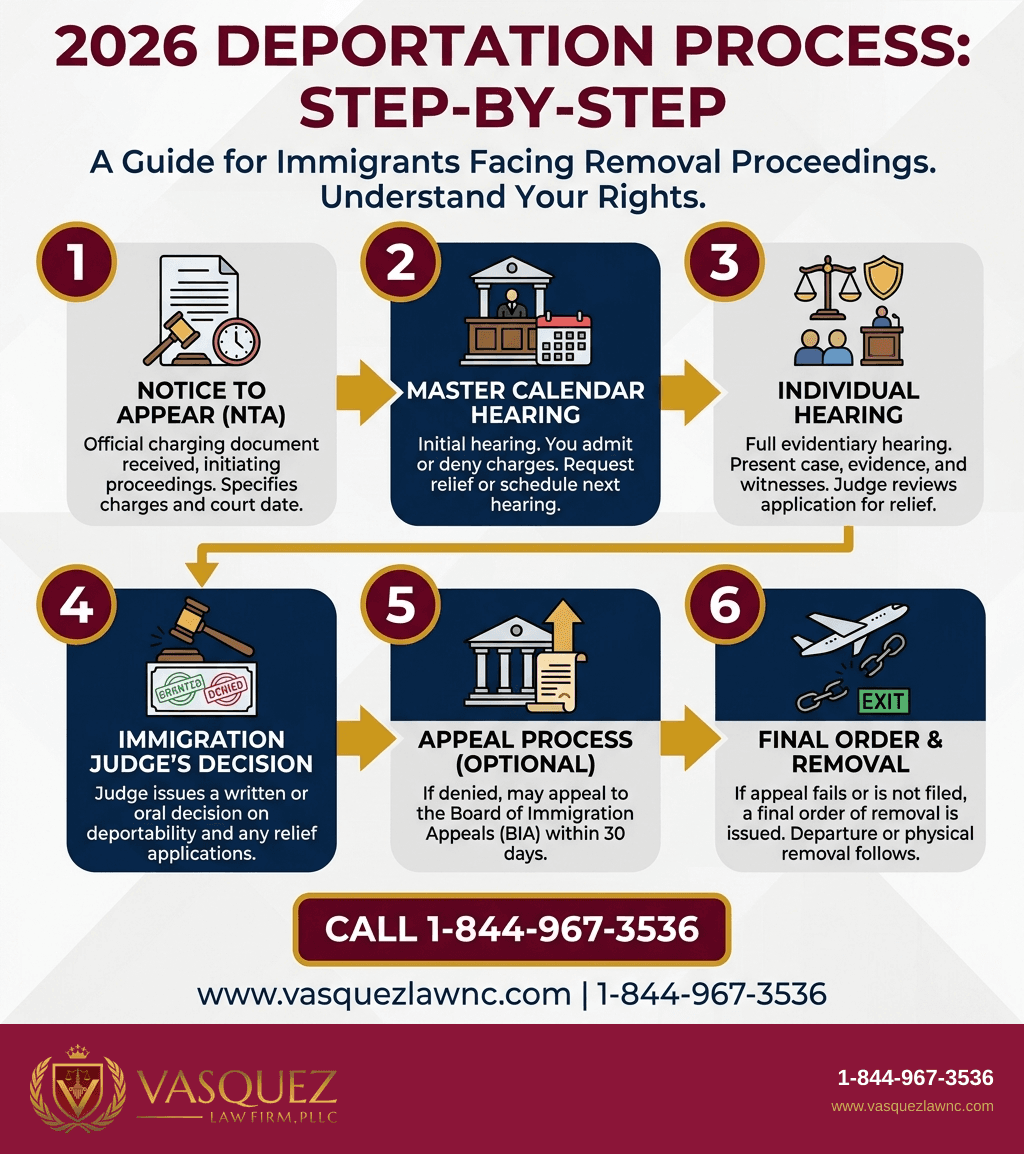
Maria, a resident in Orlando, noticed a letter from ICE indicating a Notice to Appear for immigration court. This notice starts deportation proceedings. Below is an overview of the process you can expect if facing deportation:
- ICE Arrest or Notice to Appear: Deportation usually begins with ICE issuing a deportation letter or detaining the individual. The Notice to Appear (NTA) details the charges and hearing dates.
- Master Calendar Hearing: Initial court appearance where the immigrant is informed of charges and available options.
- Individual Hearing: A substantive hearing on the merits, potential relief, or defenses to deportation.
- Appeals: If removal is ordered, appeals can be filed with the Board of Immigration Appeals (BIA) and, if necessary, federal court.
- Removal or Relief: Enforcement of removal unless relief such as asylum, cancellation of removal, or adjustment of status is granted.
Additional Steps
- Biometric appointment and background checks by DHS
- Filing motions to reopen or reconsider cases if new evidence appears
- Potential negotiations with ICE attorneys for voluntary departure
Each step has strict deadlines. Missing a hearing can result in an automatic deportation order. It is critical to respond quickly and seek legal support.
Our Attorney Vasquez specializes in representing clients throughout this process in Raleigh and Orlando.
Special Deportation Types
- Expedited removal: Recent arrivals can be removed quickly without a hearing in some cases.
- Reinstatement of removal: Occurs when someone illegally reenters after being deported.
- Removal under INA § 240: Formal court proceedings required to determine removability.
Common Mistakes to Avoid During Deportation
Facing deportation is stressful. Many immigrants make mistakes that hurt their chances. Here are common errors and how to avoid them:
- Ignoring Notices: Always read and respond promptly to any deportation letters or court notices.
- Missing Hearings: Failure to appear in immigration court results in removal orders by default.
- Not Consulting an Attorney: DIY defense reduces chances of success. Legal representation is vital.
- Providing False Information: Lying or withholding facts can lead to additional charges and barred relief.
- Delaying Action: Waiting too long to file motions or appeals reduces options.
- Ignoring ICE Presence: Avoid confrontations but do not ignore ICE requests for information or detainment.
- Not Collecting Evidence: Gather all immigration documents, records, and proof of eligibility for relief ahead of hearings.
If you only remember one thing: Prompt legal counsel can guide you through avoiding these pitfalls and building the strongest case possible.
Timeline: What to Expect During Deportation
The deportation process timeline varies widely. For Maria’s case in Orlando, the timeline from Notice to Appear to final hearing lasted about 10 months. However, others experience ranges from 3 months to over 18 months depending on factors like court backlog and case complexity.
- Initial ICE action: Immediate upon arrest or letter issuance
- First hearing (Master Calendar): Within 30 to 90 days of NTA issuance
- Individual hearing dates: Scheduled several months after initial hearing
- Appeals process: Can add 6-12 months or longer
- Total process: 6 months to 2 years in many cases
Real cases in federal immigration courts show that delays are common due to backlogs. Immigration courts in Orlando and Raleigh handle thousands of cases annually.
Stay updated by checking USCIS processing times at USCIS Processing Times and EOIR court statistics.
Costs and Fees: What Impacts the Price
Legal fees for deportation cases vary depending on the case details and defense complexity. Some key cost factors are:
- Type of relief sought (e.g., asylum, cancellation of removal, adjustment of status)
- Number of court hearings and motions needed
- Whether the client is detained or released on bond during proceedings
- Attorney experience and location (Raleigh, NC, or Orlando, FL)
- Need for expert witnesses or translations
Typical private attorney fees for deportation defense start from several thousand dollars but can vary widely. Some nonprofits offer limited free services.
Contact our immigration attorneys in Orlando and Raleigh to discuss fee structures and possible payment plans.
NC, FL, and Nationwide Notes
NC Notes
North Carolina residents facing deportation can expect proceedings governed by federal law but local ICE offices in Raleigh provide most in-person enforcement. Vasquez Law Firm’s Raleigh office supports clients with personalized advice and representation throughout.
FL Notes
In Orlando, FL, ICE enforcement may be aggressive in some neighborhoods. Local immigration courts operate on federal schedules. Legal help is vital to navigate these local conditions and delays.
Nationwide Concepts
Federal deportation procedures, governed by INA § 240 and 8 C.F.R. Part 1240, broadly apply nationwide. Differences exist mainly in local court schedules and ICE policies. Seeking legal guidance is important everywhere.
When to Call a Lawyer Now
- If you receive any deportation letter or notice from ICE
- Upon arrest or detention by ICE
- If you have criminal convictions or charges pending
- To prepare responses to a Notice to Appear
- If you fear expedited removal or reinstatement actions
- If you want to explore relief options like asylum or cancellation
- After missed hearing or receiving a removal order
- If ICE schedules a biometric or evidence submission appointment
- To file motions to reopen or appeal removal orders
About Vasquez Law Firm
At Vasquez Law Firm, we combine compassion with aggressive representation. Our motto "Yo Peleo®" (I Fight) reflects our commitment to standing up for your rights.
- Bilingual Support: Se Habla Español — Spanish-speaking attorneys and staff available
- Service Areas: North Carolina, Florida, and nationwide immigration services
- Experience: Over 30 years helping clients navigate complex legal matters
- Results: Thousands of successful cases across multiple practice areas
Attorney Trust and Experience
William J. Vásquez is admitted to the North Carolina State Bar (2011) and to the U.S. Courts of Appeals for the 4th, 5th, and 11th Circuits. Florida-jurisdiction matters at the firm are handled by Florida Bar attorney Harold Estrada-Rodriguez (FL Bar No. 1041171). The firm has provided dedicated legal representation since 2011, with personalized attention to each client's case.
Don't wait to get the help you deserve. Call us now for immediate assistance. Se Habla Español.
Frequently Asked Questions
What are the grounds for deportation?
Grounds include criminal offenses, visa violations like overstaying, fraudulent immigration documents, and security risks. INA § 237 lists deportable offenses. Knowing your grounds early helps strategize defenses.
How does the deportation process begin?
It begins with an ICE arrest or deportation letter issuing a Notice to Appear. The individual gets a chance for hearings before an immigration judge, who decides on removal.
What types of deportation exist?
Expedited removal applies to recent arrivals, removal proceedings follow formal court process under INA § 240, and reinstatement targets illegal reentrants.
How long does the deportation process take?
Timelines range from months to over a year depending on court backlog and case type. Check USCIS Processing Times and EOIR schedules for updates.
Can a U.S. citizen be deported?
No, U.S. citizens have protection from deportation. Removal affects only noncitizens, including green card holders with serious criminal convictions.
What should I do if I receive a deportation letter?
Do not ignore it. Contact an experienced immigration attorney immediately to review your case, avoid missed deadlines, and seek possible relief.
How can an attorney help during deportation proceedings?
An attorney guides your defense, files motions, represents you at hearings, and helps access relief options like asylum or adjustment of status.
Are there ways to stop or delay deportation?
Yes, defenses like asylum, cancellation, or deferred action may stop removal. These require timely, qualified legal action to explore eligibility.
Sources and References
- U.S. Citizenship and Immigration Services
- Executive Office for Immigration Review
- Legal Information Institute
Take the first step toward justice today. Our team is standing by to help. Se Habla Español.
Start Your Free Evaluation Now
Call us: 1-844-967-3536
Se Habla Español - Estamos aquí para ayudarle.


William Vasquez
Founder & CEO, Vasquez Law Firm, PLLC
William Vasquez is the founder and CEO of Vasquez Law Firm, PLLC, a results-driven firm specializing in immigration, criminal defense, personal injury, and workers' compensation. A U.S. Air Force veteran and recipient of the Joint Service Achievement Medal, William is dedicated to fiercely fighting for his clients' rights.
Related Legal Services
Need legal help? Learn more about our immigration legal services, or contact us for a free evaluation.
You can also visit our North Carolina immigration practice for more information.