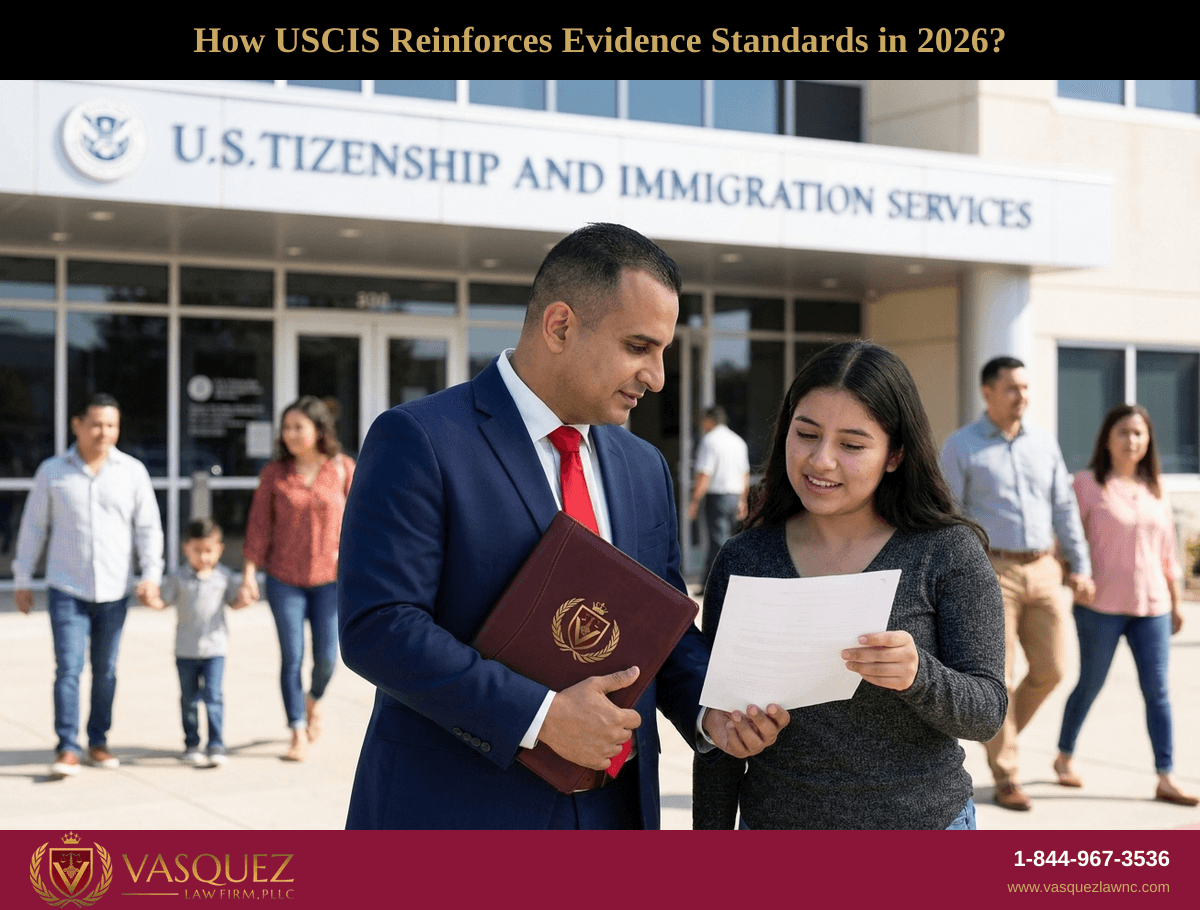
How USCIS Reinforces Evidence Standards in 2026?
The latest USCIS policy update on August 5, 2026, requires immigration benefit applicants to submit all required evidence at filing or face denial without an RFE. This change affects applicants in Raleigh, NC and Orlando, FL, aiming to reduce frivolous filings and improve processing efficiency.
Published on August 5, 2026· Updated September 9, 2026
Talk to an immigration attorney
Free call. A clear plan for your case.
Free & confidential · Se habla espanol · 24/7
Have questions? Talk to an attorney - free evaluation.
Call 1-844-967-3536Free Tool
Check Your USCIS Case Status Now
Enter your receipt number - get the official USCIS status in English or Spanish. No registration.
This article gives general legal information. It is not personalized legal advice. Reading it does not create an attorney-client relationship. For advice about your own case, contact Vasquez Law Firm.
What changed in USCIS policy on evidence standards as of August 2026?
Worried About Immigration Policy Changes?
New policies can affect your case. Get current legal advice from an experienced immigration attorney.
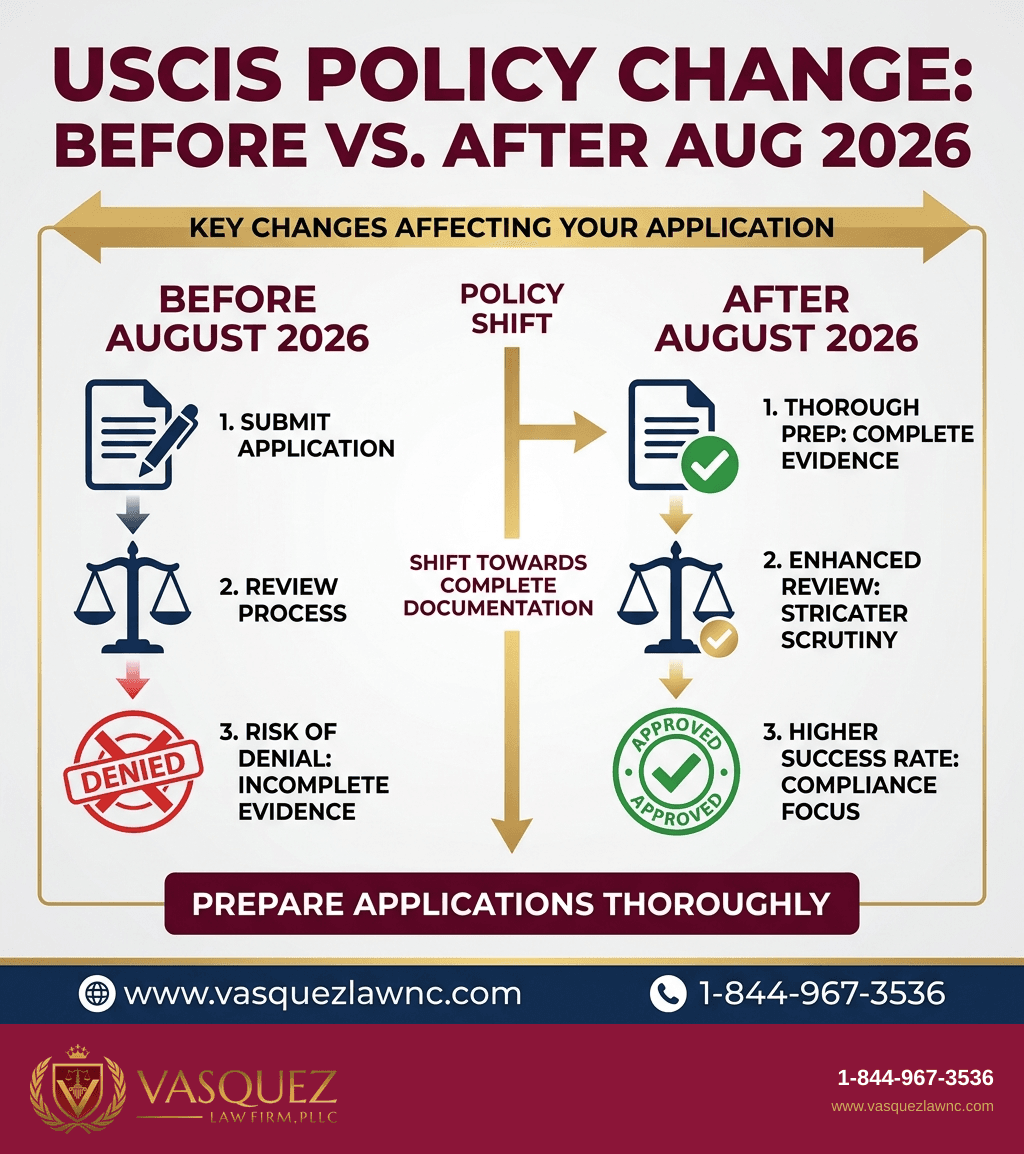
On August 5, 2026, USCIS announced a new policy. It requires people asking for immigration benefits to show they qualify and submit all needed evidence when they file their application. USCIS officers can now deny applications without sending a Request for Evidence (RFE) or Notice of Intent to Deny (NOID) if the person does not meet these rules. This reverses a previous Biden-era policy. That policy encouraged officers to ask for more evidence before denying even incomplete applications.
This update aims to stop incomplete or frivolous immigration benefit requests. These types of requests slow down processing. USCIS form instructions already list the needed evidence. So applicants have clear information. By letting officers deny applications without RFE or NOID, USCIS wants to use resources better and keep the system fair.
The old policy allowed people to file "placeholder" applications. These let them get benefits like work permission while waiting for a decision. The new policy ends this. Now, applicants must show full eligibility right away. This policy applies immediately to requests filed or still waiting on or after August 5, 2026, unless rules say otherwise.
According to the USCIS alert, "USCIS form instructions specify all required initial evidence for every benefit request, giving requestors all the information needed to comply." This means applicants must meet these standards when they file. Otherwise, USCIS can deny without more notice. The update matches USCIS procedures with Department of Homeland Security rules.
In short, the August 2026 USCIS policy change makes evidence rules stricter for immigration benefit requests. It lets USCIS deny incomplete or ineligible filings without RFE or NOID. This helps reduce frivolous requests and speeds up processing (Source: USCIS, https://www.uscis.gov/newsroom/alerts/uscis-to-reduce-frivolous-immigration-benefits-requests-by-reinforcing-evidence-standards).
Who is affected by the USCIS evidence standards update in Raleigh, NC and Orlando, FL?
This policy affects all people applying for immigration benefits or with pending requests on or after August 5, 2026. This includes those in Raleigh, NC and Orlando, FL, where our offices are located. It covers people applying for adjustment of status, work permission, asylum, and other immigration benefits.
Applicants who used to file incomplete applications or placeholder filings to get temporary benefits will now face stricter checks. For example, people applying for work permission under 8 CFR § 274a.12 must submit all required evidence when they file. If they do not, USCIS can deny their application without an RFE. Also, those applying for adjustment of status under 8 U.S.C. § 1255 must prove they qualify right away.
In Raleigh, NC, many immigrants apply based on family or work. This policy means they must prepare more before filing. In Orlando, FL, where our Florida office is, many immigrants are temporary workers or asylum seekers. They must also follow these rules.
The USCIS policy affects many benefit types, including:
- Adjustment of status applicants under INA § 245(a) / 8 U.S.C. § 1255
- Work permission applicants under 8 CFR § 274a.12
- Asylum applicants under 8 U.S.C. § 1158
- Nonimmigrant visa applicants under 8 U.S.C. § 1101(a)(15)
- Conditional permanent residents under 8 U.S.C. § 1186a
USCIS says frivolous or incomplete filings have caused big delays nationwide. The agency has not shared state-specific numbers. But the impact in North Carolina and Orlando, FL is expected to be large because many applications are processed there.
Applicants with pending cases should check their filings carefully. They must make sure all required evidence was submitted. Those planning new applications must prepare complete and eligible petitions to avoid denial.
What does the law say about USCIS's authority to deny applications without RFE or NOID?
USCIS has the legal power to deny immigration benefit requests without sending a Request for Evidence (RFE) or Notice of Intent to Deny (NOID). This power comes from Department of Homeland Security rules and the Immigration and Nationality Act (INA). The August 2026 policy explains and confirms this power.
Specifically, 8 CFR § 103.2(b)(8)(ii) says USCIS can deny an application if it is incomplete or if the applicant does not prove eligibility when filing. The INA also requires applicants to prove they qualify for benefits, like adjustment of status under 8 U.S.C. § 1255.
The USCIS alert says:
"USCIS form instructions specify all required initial evidence for every benefit request, giving requestors all the information needed to comply. This policy better aligns USCIS procedures with long-standing Department of Homeland Security regulatory authority and form instructions." (Source: USCIS, https://www.uscis.gov/newsroom/alerts/uscis-to-reduce-frivolous-immigration-benefits-requests-by-reinforcing-evidence-standards)
This means USCIS officers can deny applications if the applicant does not send the evidence required by the form instructions. The policy reverses the earlier Biden-era rule. That rule encouraged officers to send RFEs even for incomplete or ineligible applications.
For example, under 8 CFR § 245.1, people applying for adjustment of status must send evidence proving eligibility when they file. If they do not, USCIS can deny the application without more notice. This policy update lets USCIS enforce these rules strictly.
In summary, the law supports USCIS's power to deny incomplete or ineligible applications without RFE or NOID. This is true as long as applicants have clear notice of required evidence through form instructions and rules.
What should applicants do to comply with the new USCIS evidence standards?
Applicants must send complete and eligible immigration benefit requests. They must include all required initial evidence when they file. If they do not, USCIS may deny the application immediately without letting them send more evidence later.
At our Raleigh, NC and Orlando, FL offices, we often see applicants not realize how important it is to send a fully documented initial application. Common mistakes include missing key forms, not enough proof of eligibility, or relying on old policies that allowed placeholder filings. This policy change means applicants must prepare more carefully.
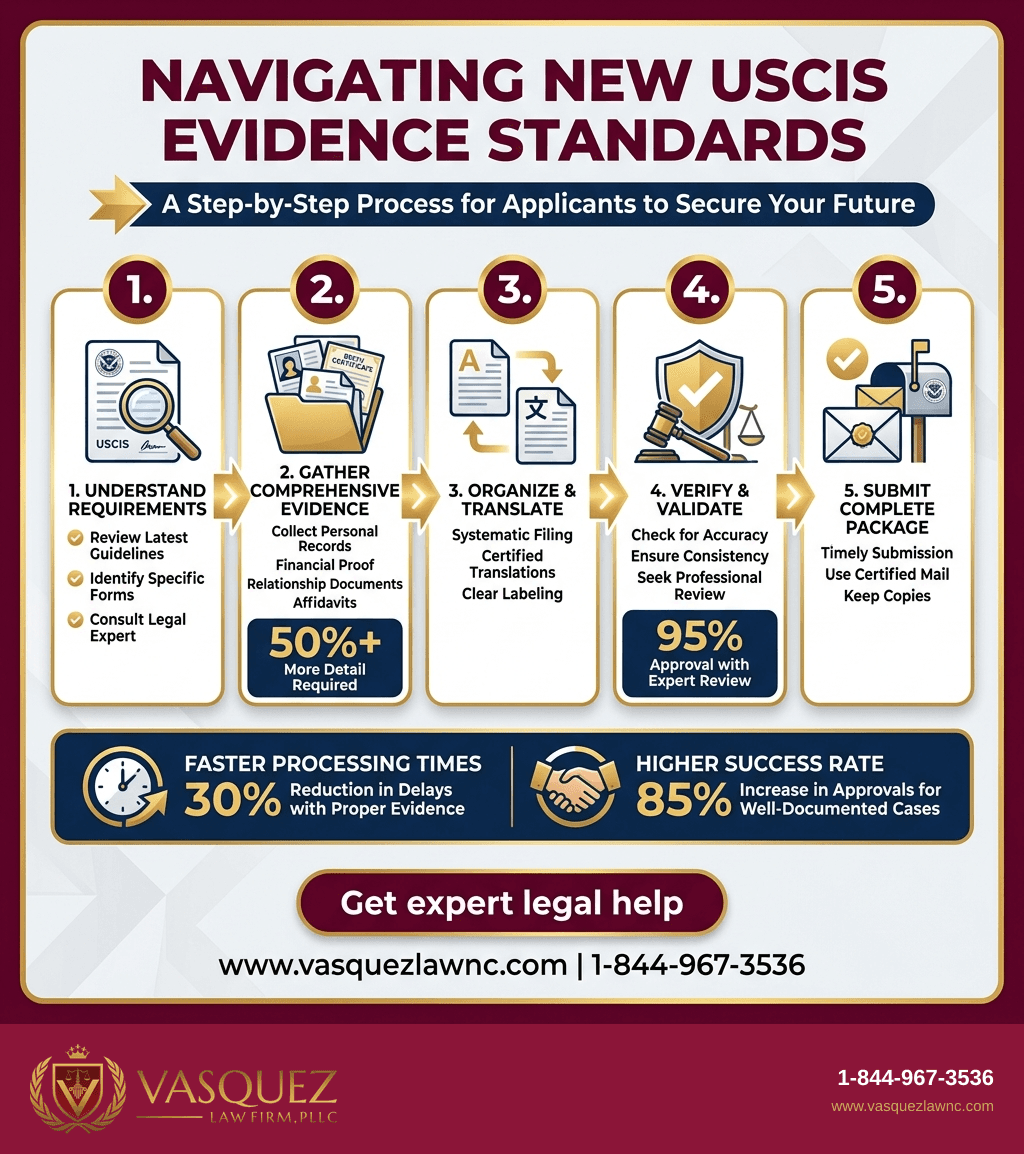
Here are practical steps applicants should take:
- Read USCIS form instructions carefully: Each form lists the evidence you must send. Read these instructions fully before filing.
- Gather all supporting documents: Collect documents that prove eligibility, identity, status, and any other evidence the instructions ask for.
- Get advice from trusted sources or an immigration lawyer: To avoid mistakes, get legal help or trusted guidance, especially for complex cases.
- Check everything is complete: Make sure all forms are signed and all evidence is included before you send your application.
- File on time and correctly: Send your application following USCIS rules and deadlines.
Below is a table that shows key differences between the old and new policies:
| Aspect | Prior Biden-Era Policy | Current August 2026 Policy |
|---|---|---|
| RFE/NOID before denial | Usually required, even for incomplete filings | Not required; denial possible without RFE/NOID if evidence missing |
| Handling incomplete applications | Allowed placeholder filings to get temporary benefits | Requires full eligibility and evidence when filing |
| Officer discretion | Limited to asking for more evidence | Full power to deny without more notice |
| Impact on processing | Slowed by frivolous or incomplete filings | Better efficiency by reducing meritless requests |
Following these steps can help applicants avoid denial and delays. Our immigration lawyers at Vasquez Law Firm can help with case review and application preparation to meet the new rules.
What happens next with USCIS policy and immigration benefit requests?
The August 2026 policy is effective right away. It applies to all immigration benefit requests filed or still waiting on or after August 5, 2026, unless rules or USCIS policy say otherwise. USCIS will keep watching how this change affects processing times and system fairness.
USCIS said:
"With this updated policy, USCIS can better allocate resources to efficiently make decisions and prevent meritless requests." (Source: USCIS, https://www.uscis.gov/newsroom/alerts/uscis-to-reduce-frivolous-immigration-benefits-requests-by-reinforcing-evidence-standards)
This shows USCIS wants to reduce backlogs and focus on good cases. Applicants should expect stricter reviews and faster denials of incomplete filings.
What's Your Immigration Situation?
Answer 3 questions - we'll tell you your options
Question 1 / 3
What best describes your situation?
Keep Reading
Applicants with pending cases should check their filings. They should think about sending more evidence if rules allow before USCIS decides. Those planning new applications must prepare complete petitions to avoid denial.
Lawyers and immigration helpers will watch for more guidance or rule updates that explain exceptions or special steps. For now, the policy shows a move toward stricter enforcement of evidence rules.
Applicants and lawyers should stay updated through official USCIS sources and get legal advice to adjust to these changes.
Frequently Asked Questions about USCIS Evidence Standards Update
Can USCIS deny my application without requesting more evidence?
Yes. Under the new policy effective August 5, 2026, USCIS can deny immigration benefit requests without issuing a Request for Evidence (RFE) or Notice of Intent to Deny (NOID) if you fail to submit all required initial evidence or demonstrate eligibility at filing.
Does this policy apply to all types of immigration benefits?
Yes. The policy applies broadly to all immigration benefit requests filed or pending on or after August 5, 2026, including adjustment of status, employment authorization, asylum, and visa applications.
What should I do if my application was incomplete under the old policy?
You should review your application immediately. If the case is still pending, consider submitting any missing evidence promptly. For new applications, ensure all required documents and proof of eligibility are included at filing to avoid denial.
How do I know what evidence is required for my application?
USCIS form instructions list all required initial evidence for each benefit request. Carefully read the instructions available on the USCIS website or consult an immigration attorney to confirm what you need to submit.
Will this policy reduce processing times for immigration benefits?
USCIS aims to improve efficiency by reducing frivolous and incomplete filings that slow processing. While stricter standards may lead to faster denials of incomplete requests, overall processing times could improve as resources focus on meritorious cases.
This article gives general legal information. It is not personalized legal advice. Reading it does not create an attorney-client relationship. For advice about your own case, contact Vasquez Law Firm.
Reviewed by William Vasquez, Founder & CEO, Vasquez Law Firm, PLLC.
If you need legal help, learn more about immigration lawyers in North Carolina, or call us at 1-844-967-3536 for a free evaluation.
Related Topics

William Vasquez
Founder & CEO, Vasquez Law Firm, PLLC
William Vasquez is the founder and CEO of Vasquez Law Firm, PLLC, a results-driven firm specializing in immigration, criminal defense, personal injury, and workers' compensation. A U.S. Air Force veteran and recipient of the Joint Service Achievement Medal, William is dedicated to fiercely fighting for his clients' rights.
Related Legal Services
Need legal help? Learn more about immigration lawyers in North Carolina, or contact us for a free evaluation.
You can also visit immigration legal services throughout NC for more information.