ICE Officers: What They Do and Your Rights in 2026
Wondering what ICE officers do and how their actions affect you? Learn about their role, powers, and how to protect your rights in 2026. Contact us for help.
Published on August 4, 2026
Talk to an immigration attorney
Free call. A clear plan for your case.
Free & confidential · Se habla espanol · 24/7

Have questions? Talk to an attorney - free evaluation.
Call 1-844-967-3536Worried how the latest immigration news affects you?
Schedule a confidential case review with an immigration attorney - know exactly where you stand.
USCIS Case Status
Check your USCIS case status
Enter your receipt number and get the official status. Free, no registration.
ICE Officers: What They Do and Your Rights in 2026
ICE officers play an important role in enforcing U.S. immigration laws. In 2026, it is very important to know what they do, their powers, and how to protect your rights. This is especially true for immigrant communities in Orlando and Raleigh.
Need help with your case? Our experienced attorneys are ready to fight for you. Se Habla Español.
Or call us now: 1-844-967-3536
Quick Answer
ICE officers are federal law enforcement agents. They enforce immigration laws. They have the power to investigate, detain, and arrest immigrants who break immigration laws. They are like police but only for immigration matters. They have different powers and limits than local police. Knowing their job, legal limits, and your rights when you meet them in Orlando or Raleigh helps you stay safe.
- ICE officers enforce immigration laws across the country.
- They can arrest people without a warrant in certain situations.
- ICE officers have different powers than local police.
- ICE officer salaries usually start around $50,000.
- You have legal rights and protections during ICE encounters.
What ICE Officers Do and Their Job Duties
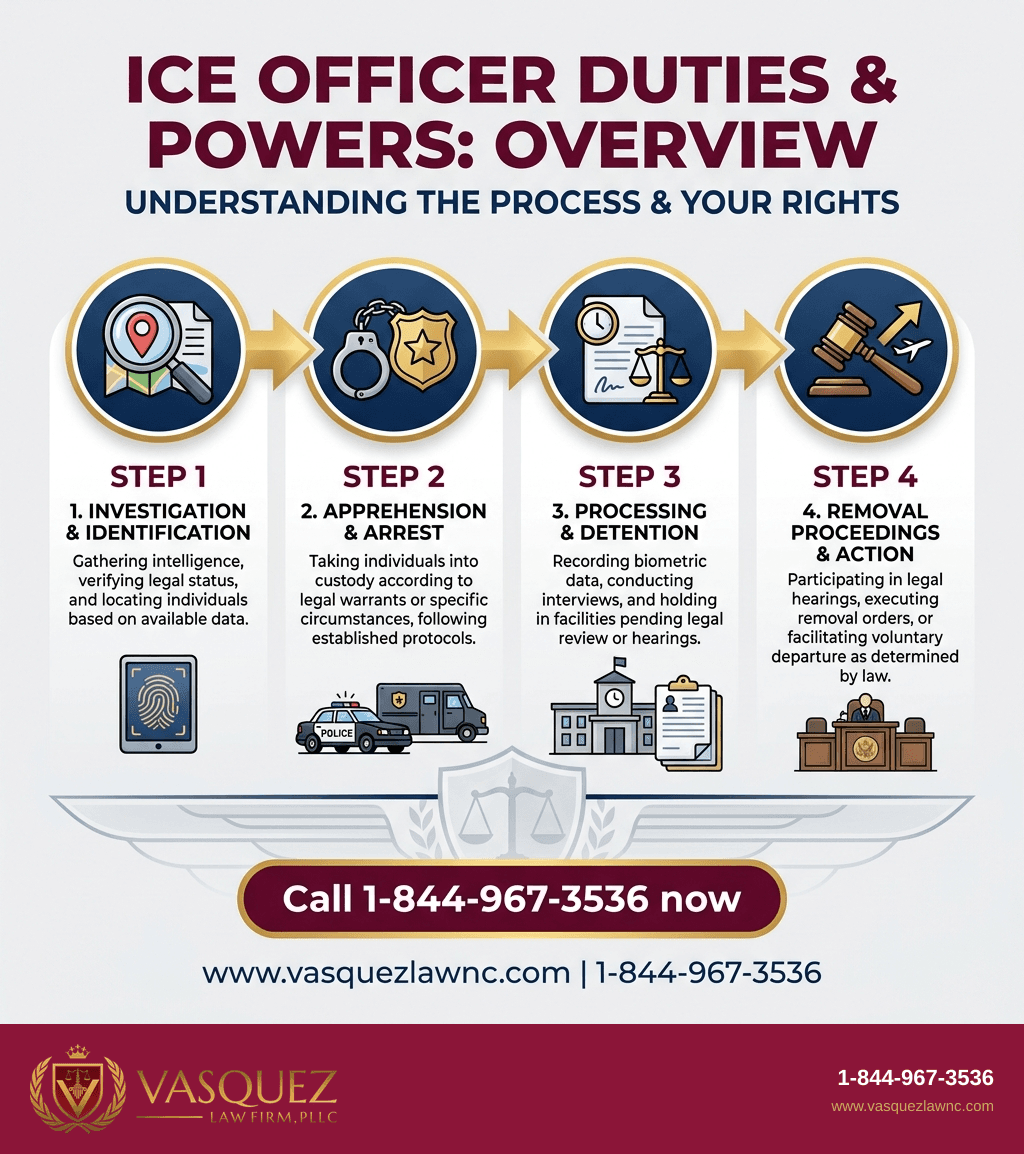
Imagine ICE officers doing an immigration raid at a workplace or neighborhood in Orlando. Their main jobs include finding undocumented immigrants. They arrest people suspected of breaking immigration laws. They hold people while waiting for removal proceedings, which is the legal process to send someone out of the country. ICE officers investigate by checking documents, watching people, and working with other law enforcement agencies. They also make sure people follow immigration laws like not staying in the U.S. illegally or working without permission.
ICE officers work under federal laws. One important law is 8 U.S.C. § 1357. This law gives immigration officers certain powers to arrest and search. Their work is important to the Department of Homeland Securitya0because it helps enforce immigration laws. But ICE officers must follow the U.S. Constitution and agency rules.
Knowing what ICE officers do is very important for immigrants in Raleigh or Orlando. It helps you know how to act and what rights to use if you meet ICE officers.
Learn more about our immigration legal services if you need help with immigration enforcement issues.
ICE officers also collaborate with other agencies such as Customs and Border Protection (CBP), the FBI, and local law enforcement to coordinate efforts and share intelligence. This cooperation enhances their ability to identify and apprehend individuals who violate immigration laws, especially those involved in serious criminal activities. For example, during multi-agency operations targeting human trafficking or gang-related activities, ICE officers play a critical role in both immigration enforcement and public safety.
In addition to enforcement, ICE officers sometimes engage in community outreach programs aimed at educating immigrant communities about the legal system and their rights. These programs can help reduce fear and misinformation and encourage cooperation with lawful authorities. However, such outreach is balanced carefully with enforcement priorities, which can sometimes lead to tension within immigrant communities.
Another key duty of ICE officers involves monitoring compliance with immigration court orders and conditions of release. For instance, they may conduct check-ins with individuals released on bond, verify addresses, and ensure that immigrants attend their scheduled hearings. Failure to comply can result in re-arrest and detention. Understanding these responsibilities helps immigrants anticipate potential encounters and maintain compliance with the law.
How to Become an ICE Officer: Application Process and Salary
If you want to join ICE as an officer, the process is strict. You must be a U.S. citizen. You must meet age limits and be physically fit. You will have background checks, drug tests, medical exams, and polygraph tests (lie detector tests). Training happens at the Federal Law Enforcement Training Center. There, you learn law enforcement skills and immigration law.
Starting salaries for ICE officers are about $50,000 to $70,000 per year. This depends on where you work and your experience. Some special agents and senior officers may earn more. Reports of $200,000 per year usually include base pay plus overtime and bonuses. For the latest salary info, check official government job websites that list ICE jobs.
For more information or personal advice, contact Attorney Vasquez. He specializes in immigration law and understands federal enforcement challenges.
Applicants must also demonstrate strong ethical character and sound judgment. The hiring process includes extensive interviews and psychological evaluations to assess suitability for the responsibilities of an ICE officer. Candidates with prior military or law enforcement experience may have an advantage but must still complete all required training and evaluations.
During training at the Federal Law Enforcement Training Center, recruits undergo rigorous instruction in firearms, defensive tactics, arrest procedures, and immigration law. They also receive cultural sensitivity training to better interact with diverse immigrant populations. After graduating, officers continue ongoing training to stay current on changing laws and enforcement techniques.
Career advancement within ICE depends on performance, experience, and specialized skills. Officers may move into roles such as criminal investigators, human trafficking specialists, or supervisory positions. Some pursue further education in law or criminal justice to enhance their qualifications. ICE also offers opportunities for detail assignments and cross-agency collaboration to broaden career experience.
Are ICE Officers Considered Police and What Powers Do They Have?
Many people ask if ICE officers are police. The short answer is: ICE officers are federal law enforcement agents. But they are not police like local or state police. Their power is only for immigration enforcement. This is mainly under 8 U.S.C. § 1357 and related rules.
Unlike local police, ICE officers cannot arrest people for crimes not related to immigration. They do not do traffic stops or general criminal investigations. Their powers include arresting people without a warrant in certain cases, checking documents, and holding people for deportation (removal) proceedings.
Knowing these differences helps immigrants in North Carolina and Florida understand ICE's role. It also helps them prepare for legal encounters with ICE.
Differences in Jurisdiction and Authority
ICE officers have jurisdiction nationwide for immigration enforcement, but their authority is limited to violations of immigration laws. In contrast, police officers enforce a broad range of state and local laws, including criminal offenses unrelated to immigration. For example, while a police officer can arrest someone for theft or assault, an ICE officer cannot unless the offense is directly tied to immigration violations.
Limitations on ICE Powers
ICE officers must adhere to constitutional protections, including respecting Fourth Amendment rights against unreasonable searches and seizures. They generally need warrants to enter private homes unless exigent circumstances exist. For instance, ICE cannot enter a home without consent or a warrant unless there is an immediate threat or emergency. Understanding these limitations helps individuals recognize when ICE may be acting outside their lawful authority.
Enforcement Priorities and Discretion
ICE officers exercise discretion in enforcement, prioritizing cases based on criminal history, public safety risks, and immigration violations. For example, individuals with recent serious criminal convictions are more likely to be targeted for arrest than those without criminal records. This prioritization aims to focus resources on removing individuals who pose threats to communities while minimizing impact on others.
Understanding ICE Officers’ Role in Orlando and Raleigh, NC
In Orlando and Raleigh, ICE officers work under federal law but adjust their enforcement to local situations. Florida and North Carolina have different levels of ICE activity because of local policies and immigrant populations. For example, ICE targets arrests based on criminal records or immigration violations.
A 2026 federal court decision overturned New York’s ban on ICE officers wearing masks during enforcement. This shows how policies can vary by state but still affect ICE actions nationwide, including Orlando and Raleigh.
Knowing local ICE enforcement rules, legal requirements, and your rights can help protect your family and community.
To learn how ICE enforcement may affect your case, contact our office for a free case evaluation.
Local Enforcement Variations
In Orlando, ICE enforcement often focuses on areas with large immigrant populations and industries employing many immigrants, such as hospitality and agriculture. ICE may conduct workplace raids or audits to identify unauthorized workers. In Raleigh, ICE activities may be influenced by cooperation levels with local law enforcement and state policies regarding immigration enforcement.
Community Impact and Response
ICE enforcement actions in these cities can have significant social and economic impacts on immigrant communities. For example, workplace raids can lead to family separations and economic hardship. In response, community organizations and legal aid groups work to provide education, legal representation, and support services to affected individuals and families.
Role of Local Governments and Policies
Local governments in Orlando and Raleigh may adopt policies that affect how ICE operates. Some localities may limit cooperation with ICE to foster trust in immigrant communities, while others may actively assist ICE in enforcement. These policies influence the frequency and nature of ICE encounters and highlight the importance of understanding local legal environments.
Common Mistakes and How to Protect Your Rights When Encountering ICE
- Giving false information: Always tell the truth but do not give extra details you do not have to.
- Not asking for identification: Ask to see ICE officers’ badges and warrants.
- Agreeing to illegal searches: Do not agree to home or car searches without a warrant.
- Not staying silent: Remember you have the right to not answer questions without a lawyer.
- Not having a lawyer ready: Keep an immigration attorney’s contact handy.
- Ignoring paperwork: Always keep copies of immigration or court papers safe and easy to find.
- Panicking during encounters: Stay calm and respectfully assert your rights.
If you remember only one thing: Know your legal rights and call an immigration lawyer right away if you are detained.
Learn more about protecting yourself by reading our latest immigration updates for 2026.
Additional Tips for Protecting Your Rights
When approached by ICE officers, it is crucial to remain polite but firm in exercising your rights. For example, if asked about your immigration status, you can respond by stating that you wish to remain silent until you have legal representation. This approach helps avoid self-incrimination while maintaining respectful communication.
Another common mistake is allowing ICE officers to enter your home without a warrant or your permission. If ICE requests entry, calmly ask to see a valid warrant signed by a judge. Without one, you can lawfully refuse entry. If officers enter without a warrant, document the interaction as best as possible and contact an attorney immediately.
Finally, avoid signing any documents or agreeing to voluntary departure without consulting a lawyer. These decisions can have serious long-term consequences for your immigration status. Having an attorney review any paperwork ensures you understand your rights and options fully.
Frequently Asked Questions
What do ICE officers do during immigration enforcement?
ICE officers enforce immigration laws by finding, arresting, and holding people suspected of immigration violations. They do raids, investigations, and process people waiting for removal (deportation). Their job is set by federal law and focuses only on immigration enforcement. For example, they may conduct workplace inspections to identify unauthorized workers or arrest individuals with outstanding deportation orders.
Are ICE officers the same as local police?
No. ICE officers are federal agents focused on immigration enforcement, whereas local police enforce state and local laws, including criminal matters unrelated to immigration. ICE officers do not conduct routine traffic stops or general criminal investigations. Understanding this distinction helps clarify what to expect during encounters with each type of law enforcement.
Does ICE have more power than local police?
ICE has wide authority within immigration enforcement but does not have greater power than local police for other criminal matters. Their authority is limited to federal immigration laws. For instance, ICE can arrest someone for being in the country without authorization but cannot arrest someone solely for a non-immigration-related crime unless working jointly with local police.
How much do ICE officers make annually?
Starting salaries for ICE officers typically range from $50,000 to $70,000 depending on location and experience. Senior agents or those in specialized roles may earn significantly more, sometimes exceeding $200,000 when including overtime and bonuses. Salary scales are subject to federal pay grades and can vary by duty station and assignment.
What is the process to apply to become an ICE officer?
Applicants must pass strict physical, medical, and background checks, including polygraph tests and drug screenings. After initial screening, candidates undergo training at the Federal Law Enforcement Training Center, where they learn law enforcement techniques and immigration law. Job openings are posted on official government websites and require U.S. citizenship and other eligibility criteria.
Can ICE officers arrest immigrants without a warrant?
Yes, ICE officers can arrest individuals without a warrant if they suspect immigration violations and have probable cause to believe the person is removable under immigration law. This typically occurs in public places or workplaces. However, warrantless arrests inside homes require exigent circumstances or consent. Knowing these rules helps you recognize lawful and unlawful arrests.
What rights do immigrants have when confronted by ICE officers?
Immigrants have the right to remain silent and refuse to answer questions without a lawyer present. They can ask ICE officers to show identification and warrants before consenting to searches. It is important to call an immigration attorney immediately if detained. These rights protect against self-incrimination and unlawful searches, ensuring due process.
How has recent legal news affected ICE officers' policies?
A 2026 federal court ruling invalidated New York’s ban on ICE officers wearing masks during enforcement, reaffirming ICE’s discretion in operational methods. This decision highlights how court rulings can shape enforcement practices nationwide. Understanding legal developments helps immigrants and advocates anticipate changes in ICE policy and enforcement strategies.
About Vasquez Law Firm
At Vasquez Law Firm, we mix care with strong representation. Our motto "Yo Peleo" (I Fight) shows our promise to stand up for your rights.
- Bilingual Support: Se Habla Español Spanish-speaking lawyers and staff available
- Service Areas: North Carolina, plus Florida and nationwide for immigration
- Experience: Over 30 years helping clients with complex legal issues
- Results: Thousands of successful cases in many practice areas
Attorney Trust and Experience
William J. Vásquez is licensed to practice law in North Carolina (2011) and in the U.S. Courts of Appeals for the 4th, 5th, 6th, and 11th Circuits. The firm has offered dedicated legal help since 2011, giving personal attention to every client’s case.
Don't wait to get the help you need. Call us now for quick assistance.
Se Habla Español
Sources and References
- U.S. Citizenship and Immigration Services
- Executive Office for Immigration Review
- Legal Information Institute
Take the first step toward justice today. Our team is ready to help.
Start Your Free Evaluation Now
Call us: 1-844-967-3536
Se Habla Español - We are here to help you.



William Vasquez
Founder & CEO, Vasquez Law Firm, PLLC
William Vasquez is the founder and CEO of Vasquez Law Firm, PLLC, a results-driven firm specializing in immigration, criminal defense, personal injury, and workers' compensation. A U.S. Air Force veteran and recipient of the Joint Service Achievement Medal, William is dedicated to fiercely fighting for his clients' rights.
Related Legal Services
Need legal help? Learn more about learn about our immigration practice, or contact us for a free evaluation.
You can also visit statewide immigration attorneys for more information.