How the USA Iran Travel Warning Affects Your Visa in 2026
Understand the USA Iran travel warning and its impact on your immigration status or visa application in 2026. Get a free consultation with Vasquez Law Firm.
Published on March 3, 2026
Talk to an immigration attorney
Free call. A clear plan for your case.
Free & confidential · Se habla espanol · 24/7
Have questions? Talk to an attorney - free evaluation.
Call 1-844-967-3536Worried how the latest immigration news affects you?
Schedule a confidential case review with an immigration attorney - know exactly where you stand.
How the USA Iran Travel Warning Affects Your Visa in 2026
The relationship between the United States and Iran has long been complex, leading to frequent updates in travel advisories and potential implications for U.S. citizens and foreign nationals alike. If you are considering travel to Iran, or if you have ties to Iran and are concerned about your immigration status, understanding the current USA Iran travel warning is crucial. This advisory can significantly affect visa applications, green card processes, and even naturalization paths for individuals with connections to the region. As of 2026, navigating these complexities requires careful attention to detail and up-to-date legal guidance to protect your rights and ensure compliance with U.S. immigration law.
Need help understanding the USA Iran travel warning and its impact on your immigration case? Our experienced attorneys are ready to fight for you. Se Habla Español.
Schedule Your Free Case Evaluation
Or call us now: 1-844-967-3536
Quick Answer
A USA Iran travel warning indicates significant risks for travelers, including U.S. citizens, and often poses challenges for immigration processes. It can lead to enhanced scrutiny, delays, or denials for visa and green card applicants with ties to Iran. Understanding these advisories is vital for anyone navigating U.S. immigration laws in 2026.
- Travel warnings often reflect heightened security risks.
- They can impact visa eligibility and processing times.
- U.S. citizens may face arrest or detention risks in Iran.
- Consult an immigration attorney before any travel or application.
- The U.S. government strongly advises against all travel to Iran.
Understanding the USA Iran Travel Warning
The U.S. Department of State regularly issues travel advisories to inform American citizens about potential risks when traveling abroad. For Iran, these advisories have consistently been at Level 4: "Do Not Travel." This is the highest level of warning and is typically reserved for countries where there is a very high risk to personal safety due to war, civil unrest, terrorism, or arbitrary detention of U.S. citizens.
In 2026, the USA Iran travel warning remains critical. It highlights risks such as kidnapping, arbitrary arrest, and detention of U.S. citizens, particularly those of Iranian descent. These warnings are not merely suggestions; they reflect serious threats to safety and freedom. For individuals with existing immigration cases or those planning to apply for U.S. visas or green cards, this warning carries significant weight and can influence their eligibility and the outcome of their applications.
The implications extend beyond just physical travel. Any past or future association with a country under such a severe travel warning can trigger additional review by U.S. immigration authorities, including USCIS and consular officers. This heightened scrutiny is part of national security protocols and can result in prolonged processing times or requests for additional evidence. It is essential to be fully transparent about any past travel or ties to Iran when dealing with U.S. immigration agencies.
Impact on U.S. Citizens and Permanent Residents
Even U.S. citizens and lawful permanent residents (green card holders) are not immune to the risks associated with the USA Iran travel warning. The State Department explicitly warns that U.S. citizens traveling to Iran are at risk of being detained or arrested without due process. Dual nationals, those holding both U.S. and Iranian citizenship, are particularly vulnerable, as Iran does not recognize dual nationality and may treat them solely as Iranian citizens.
For U.S. citizens, this means exercising extreme caution and reconsidering any non-essential travel. For permanent residents, travel to Iran can raise questions upon their return to the U.S., potentially impacting their admissibility or future naturalization applications. While a green card allows travel, extended stays in countries with high travel warnings, especially those deemed state sponsors of terrorism, can lead to inquiries about intent and allegiance.
Furthermore, the warning can affect family members of U.S. citizens or permanent residents who reside in Iran. Sponsoring relatives for immigration to the U.S. becomes more complicated, as consular processing in Iran is not available, and applicants must travel to a third country for their visa interviews. This adds layers of logistical and security challenges to an already complex process, emphasizing the need for expert legal guidance for immigration cases involving Iran.
How the Warning Affects Visa and Green Card Applications
The USA Iran travel warning significantly impacts individuals applying for U.S. visas or green cards who have current or past connections to Iran. Consular officers at U.S. Embassies and Consulates worldwide are instructed to apply rigorous scrutiny to applicants from countries designated as state sponsors of terrorism or those with high travel advisories. This means an Iranian national, or someone who has traveled to Iran, can expect a more intensive review process.
Applicants may face administrative processing delays, often referred to as a "221(g) refusal," which requires additional background checks and security clearances. These delays can last for months or even years, creating immense uncertainty and hardship. The Department of State's visa processing guidelines often include specific instructions for high-risk nationalities, affecting everything from student visas to employment-based green cards.
Moreover, the travel warning can influence the perception of an applicant's intent. For example, if an applicant has recently traveled to Iran, they may need to provide extensive documentation to prove their reasons for travel were legitimate and did not involve activities that could pose a national security risk. Vasquez Law Firm in Raleigh and across North Carolina and Florida specializes in helping clients navigate these challenges, ensuring all necessary documentation is prepared and presented accurately.
Don't face your legal challenges alone. Our team is here to help you every step of the way.
Call today: 1-844-967-3536 | Se Habla Español
Steps to Take If Affected by the Travel Warning
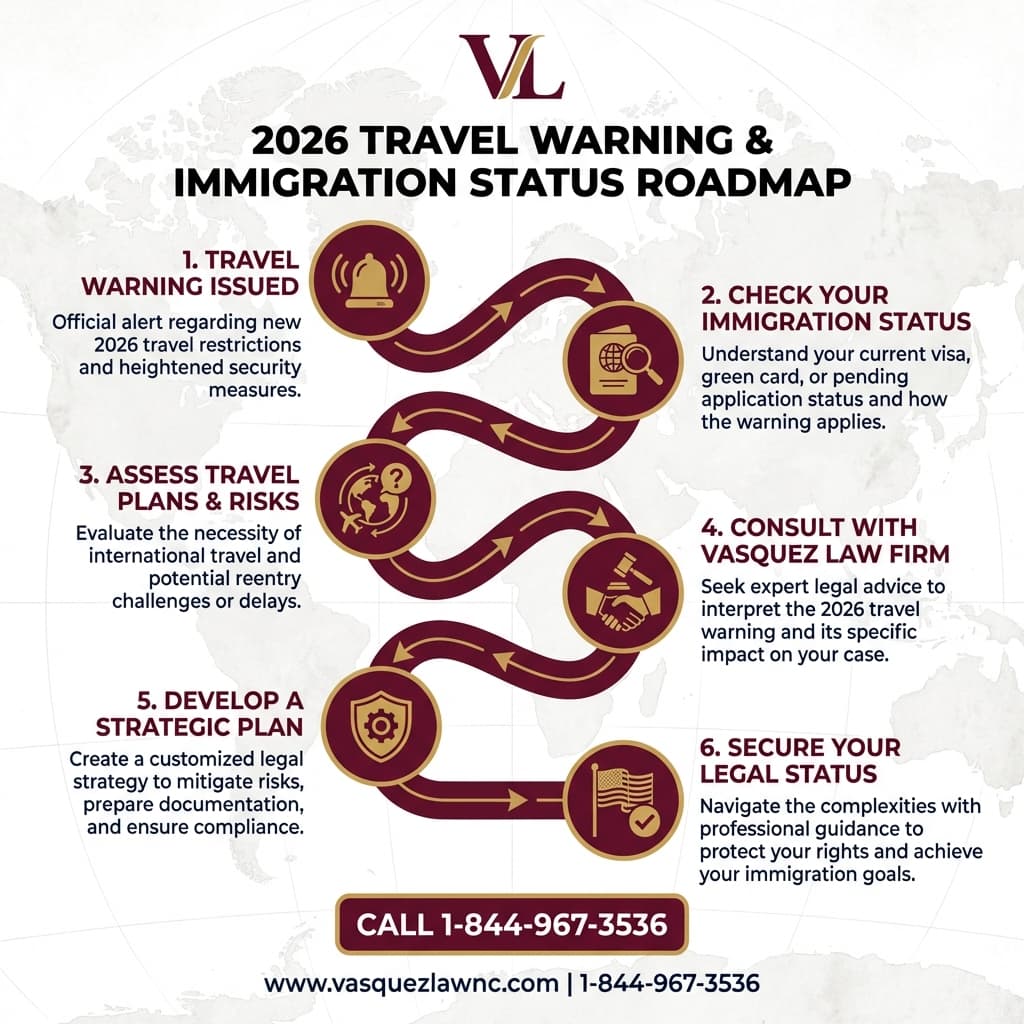
If you are a U.S. citizen, permanent resident, or visa applicant with ties to Iran, taking proactive steps is essential to protect your legal status. The first and most critical step is to consult with an experienced immigration attorney. An attorney can assess your specific situation, explain how the USA Iran travel warning might affect you, and help you develop a strategy to mitigate risks.
Before Traveling to Iran
For U.S. citizens and green card holders, the U.S. government strongly advises against all travel to Iran. If travel is absolutely unavoidable, ensure you are enrolled in the Smart Traveler Enrollment Program (STEP) to receive alerts and locate you in an emergency. Draft a will, designate appropriate power of attorney, and discuss care for minor children or dependents. Understand that emergency services from the U.S. government are extremely limited in Iran.
During Visa or Green Card Application
Be prepared for enhanced scrutiny and potential delays. Provide complete and truthful information on all forms and during interviews. Gather extensive supporting documentation for any past travel to Iran, including itineraries, purpose of travel, and contacts. If you receive a Request for Evidence (RFE) or notice of administrative processing, respond promptly and thoroughly with legal guidance. Do not attempt to conceal any information, as this could lead to serious immigration consequences, including a finding of misrepresentation.
Common Mistakes and How to Avoid Them
Navigating U.S. immigration law, especially with a USA Iran travel warning in effect, is fraught with potential pitfalls. Avoiding common mistakes can significantly improve your chances of a successful outcome.
- Underestimating the Warning: Many believe a travel warning only applies to tourists. It impacts all individuals with ties to the country, including those seeking immigration benefits. Always take the State Department's advisories seriously.
- Providing Inconsistent Information: Any discrepancies between your current application and past records, or between what you say and what your documents show, can lead to suspicion and denial. Ensure all information is consistent and verifiable.
- Traveling to Iran Without Legal Consultation: For U.S. citizens and green card holders, traveling to Iran, even for family emergencies, can have unforeseen consequences upon return. Always consult an immigration attorney before making such a decision.
- Failing to Disclose All Ties to Iran: Attempting to hide past travel, family connections, or financial interests in Iran is a severe mistake. U.S. immigration agencies have sophisticated methods for detecting omissions, which can result in accusations of fraud or misrepresentation.
- Not Preparing for Extended Administrative Processing: Assume your case will take longer than average. Have contingency plans for work, housing, and family if your visa or green card application is delayed due to the travel warning.
- Ignoring Requests for Additional Evidence: RFEs or other requests from USCIS or consular offices are critical. Failing to respond adequately or on time can lead to denial. Seek legal help to craft a comprehensive response.
- Relying on Outdated Information: Immigration laws and travel advisories can change rapidly. What was true last year may not be true in 2026. Always verify information with current official sources or an attorney.
- Assuming Consular Officers Understand Your Situation: While officers are trained, they process many cases. Clearly and concisely present your situation, supported by strong evidence, rather than assuming they will grasp complex family or political dynamics.
If you only remember one thing: Never underestimate the impact of a USA Iran travel warning on your immigration case, and always seek legal counsel before making decisions related to travel or applications.
NC, FL, and Nationwide Immigration Notes
Immigration law in the United States is primarily federal, meaning the core laws and regulations are the same across all states, including North Carolina and Florida. However, the practical application and impact of federal policies, like the USA Iran travel warning, can have specific local implications.
North Carolina Notes
For individuals residing in North Carolina, including Raleigh, who have ties to Iran, access to experienced immigration legal services is crucial. While the federal government issues travel warnings and visa policies, local attorneys can assist with navigating USCIS field offices, preparing applications, and representing clients in immigration court if necessary. Vasquez Law Firm serves clients throughout North Carolina, providing diligent representation for complex immigration matters.
Florida Notes
Similarly, Florida, with its diverse population, has many residents who may be affected by the USA Iran travel warning. Immigration procedures, while federal, require local legal support for residents dealing with USCIS offices or seeking assistance with consular processing issues. Our firm also extends its immigration services to clients across Florida, ensuring they receive the expert guidance needed for their cases.
Nationwide Concepts (General Only, Rules Vary)
The USA Iran travel warning is a nationwide advisory from the U.S. Department of State. Its implications for visa processing, green card applications, and U.S. citizen travel are uniform across the country. However, the availability of legal resources, community support, and specific foreign policy interpretations can vary regionally. Regardless of your location, the fundamental principles of U.S. immigration law as it pertains to countries with high travel advisories remain consistent. Always remember, individual state laws do not supersede federal immigration regulations, but local legal representation can be invaluable for navigating the federal system.
When to Call a Lawyer Now
The complexities surrounding a USA Iran travel warning and its immigration implications mean that prompt legal advice is often critical. Do not hesitate to contact an experienced immigration attorney if any of the following situations apply to you:
- You are a U.S. citizen or green card holder considering travel to Iran.
- You have an upcoming visa or green card interview and have past ties or travel to Iran.
- Your visa or green card application has been denied or is experiencing significant administrative processing delays.
- You have received a Request for Evidence (RFE) from USCIS related to your ties to Iran.
- You are concerned about potential issues returning to the U.S. after travel to Iran.
- You are a dual national with U.S. and Iranian citizenship and have questions about your rights.
- Your family members in Iran are seeking to immigrate to the U.S., and you need assistance with the process.
- You fear arbitrary arrest or detention if you travel to Iran.
- You need clarification on how current U.S. sanctions against Iran might affect your immigration case.
- You are facing any immigration challenge that involves a country with a Level 4 travel advisory.
About Vasquez Law Firm
At Vasquez Law Firm, we combine compassion with aggressive representation. Our motto "Yo Peleo" (I Fight) reflects our commitment to standing up for your rights. We understand the unique challenges faced by individuals navigating complex immigration issues, especially those involving sensitive international relations like the USA Iran travel warning. Our dedicated team is here to provide the robust legal support you need.
- Bilingual Support: Se Habla Español - our team is fully bilingual, ensuring clear communication and understanding.
- Service Areas: We proudly serve clients in North Carolina, Florida, and offer nationwide immigration services.
- Experience: With over 15 years of dedicated experience, Attorney Vasquez has a proven track record of helping clients achieve favorable outcomes.
- Results: We are committed to achieving the best possible results for our clients across various practice areas.
Attorney Trust and Experience
Attorney Vasquez holds a Juris Doctor degree and is admitted to practice in both the North Carolina State Bar and Florida Bar. With over 15 years of dedicated legal experience, he has built a reputation for providing personalized attention and achieving favorable outcomes for his clients. His deep understanding of immigration law, coupled with a compassionate approach, makes Vasquez Law Firm a trusted advocate for your legal needs.
Don't face your legal challenges alone. Our team is here to help you every step of the way.
Call today: 1-844-967-3536 | Se Habla Español
Frequently Asked Questions
What does a Level 4 "Do Not Travel" warning for Iran mean?
A Level 4 "Do Not Travel" warning signifies the highest advisory level issued by the U.S. Department of State. It means there is a high likelihood of life-threatening risks, including arbitrary arrest, detention, and kidnapping of U.S. citizens. The U.S. government urges citizens not to travel to Iran and advises those already there to depart as soon as it is safe to do so.
Can a USA Iran travel warning affect my green card application?
Yes, a USA Iran travel warning can significantly affect your green card application. Past travel to Iran, or current ties to the country, may trigger enhanced security checks and administrative processing, leading to delays or even denials. Transparency and thorough documentation are crucial, and legal counsel is highly recommended to navigate these complexities effectively.
Are U.S. citizens of Iranian descent more affected by the warning?
Yes, U.S. citizens of Iranian descent, especially dual nationals, are particularly vulnerable. Iran does not recognize dual nationality and may treat them solely as Iranian citizens, denying them consular access and potentially subjecting them to arbitrary arrest and detention. The State Department explicitly highlights this heightened risk.
What if I need to travel to Iran for an emergency?
The U.S. government strongly advises against all travel to Iran, even for emergencies. If travel is absolutely unavoidable, individuals should enroll in the Smart Traveler Enrollment Program (STEP), inform family, and prepare a will. U.S. consular services in Iran are extremely limited, so be aware that assistance may not be available in a crisis. Consult an attorney beforehand.
How long do visa delays typically last due to the Iran travel warning?
Visa delays due to the USA Iran travel warning can vary greatly, often lasting several months to over a year, depending on the specifics of the case and the intensity of administrative processing. These delays are unpredictable, making it essential to apply well in advance and prepare for potential extended waiting periods. Legal guidance can help manage expectations and processes.
Does the travel warning impact all types of U.S. visas?
Yes, the USA Iran travel warning can impact all types of U.S. visas, including non-immigrant visas (like student or tourist visas) and immigrant visas (for green cards). The heightened scrutiny applies across the board, as the U.S. government assesses potential national security risks associated with travel to or ties with Iran for any applicant.
Can I lose my green card if I travel to Iran?
While traveling to Iran does not automatically revoke your green card, it can raise serious questions upon your return to the U.S. Extended stays, or activities perceived as contrary to U.S. interests, could lead to inquiries about your intent to abandon permanent residency or even national security concerns. Consulting an immigration attorney before travel is highly advisable.
What is administrative processing in the context of the Iran travel warning?
Administrative processing refers to additional background checks and security clearances conducted by the U.S. government beyond the initial interview. For applicants with ties to Iran, this process is common due to the USA Iran travel warning and national security protocols. It can cause significant delays in visa issuance and requires patience, often with legal assistance to track progress.
Are there any exceptions to the travel warning for humanitarian reasons?
The U.S. Department of State's Level 4 "Do Not Travel" warning for Iran does not typically have formal exceptions for humanitarian reasons. The advisory is a strong recommendation based on inherent risks. While individuals may choose to travel for humanitarian purposes, they do so at their own risk, with very limited U.S. government support available in Iran. Legal consultation is vital.
How can Vasquez Law Firm help with my immigration case related to Iran?
Vasquez Law Firm provides comprehensive legal assistance for immigration cases impacted by the USA Iran travel warning. Our attorneys can help you prepare thorough applications, respond to RFEs, navigate administrative processing, and represent you in dealings with USCIS or consular offices. We aim to protect your rights and guide you through the complexities of U.S. immigration law with ties to Iran.
Sources and References
- U.S. Citizenship and Immigration Services (USCIS)
- U.S. Department of State - U.S. Visas
- Executive Office for Immigration Review (EOIR)
- 8 U.S.C. § 1255 - Adjustment of Status
Need immigration help? Our immigration attorneys can review your case.
Ready to take the next step? Contact Vasquez Law Firm today for a free, confidential consultation. We're committed to fighting for your rights and achieving the best possible outcome for your case.
Start Your Free Case Evaluation Now
Call us: 1-844-967-3536
Se Habla Español - Estamos aquí para ayudarle.

William Vasquez
Founder & CEO, Vasquez Law Firm, PLLC
William Vasquez is the founder and CEO of Vasquez Law Firm, PLLC, a results-driven firm specializing in immigration, criminal defense, personal injury, and workers' compensation. A U.S. Air Force veteran and recipient of the Joint Service Achievement Medal, William is dedicated to fiercely fighting for his clients' rights.
Related Legal Services
Need legal help? Learn more about our immigration legal services, or contact us for a free evaluation.
You can also visit North Carolina immigration lawyers for more information.